

Can a medical institution truly claim clinical excellence when the foundational integrity of its sterile processing department remains compromised by high staff turnover and inconsistent sterilization outcomes? You likely recognize that the mounting pressure from regulatory bodies such as the Joint Commission, coupled with the systemic instability caused by surgical delays, necessitates a more robust approach to workforce development than generic onboarding can provide. The implementation of custom sterile processing training programs for hospitals serves as the definitive mechanism for aligning departmental performance with the stringent mandates of the revised ANSI/AAMI ST79:2026 standards. This specialized educational approach ensures that institutional protocols aren't merely suggestions but are instead the core of a disciplined, technical culture.
This comprehensive guide illustrates how specialized pedagogical frameworks transform the sterile processing department from a source of operational risk into a cornerstone of institutional excellence. By prioritizing a curriculum that addresses the specific technical nuances of your facility, leadership can secure a fully certified workforce and achieve a measurable reduction in bioburden incidents. We will examine the critical pathways for streamlining department workflows and ensuring that every technician possesses the advanced technical mastery required to uphold the highest standards of patient safety in this high-stakes environment.
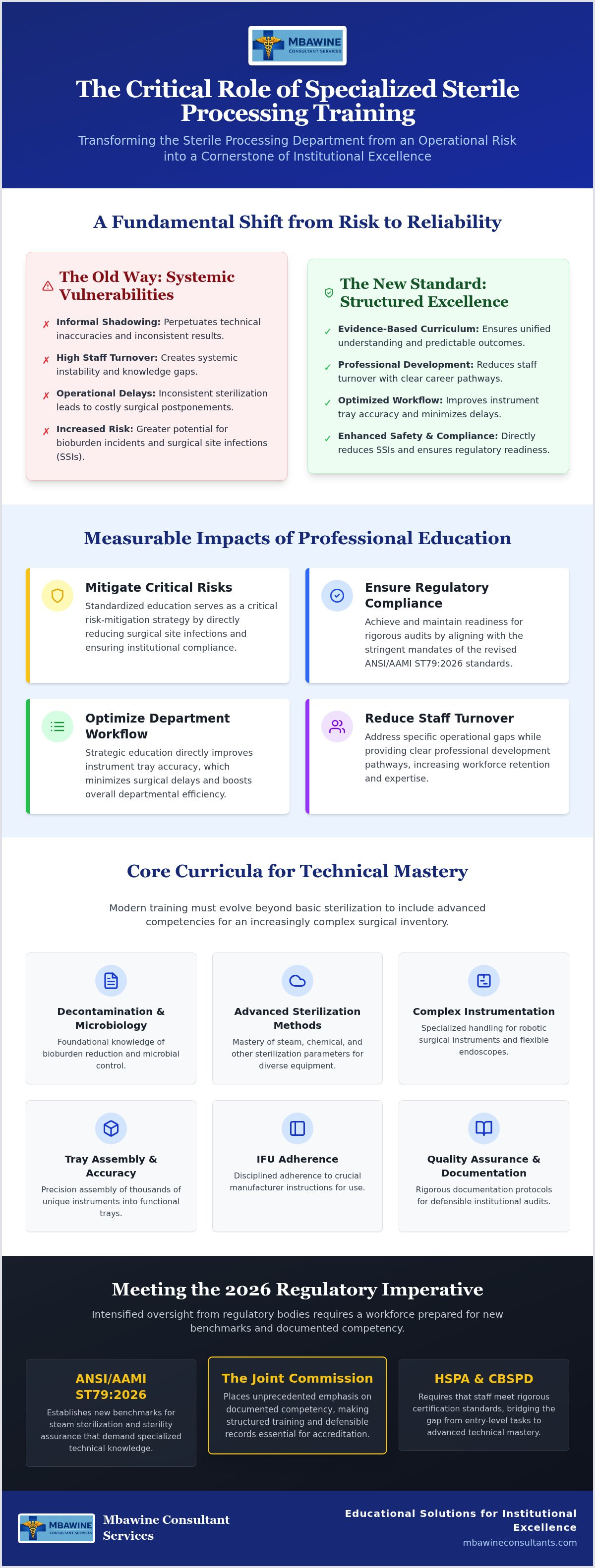
The professionalization of the Central Sterile Services Department (CSSD) represents more than an operational adjustment; it's a fundamental pillar of institutional risk mitigation. Historically, many facilities relied on informal peer-to-peer shadowing, a method that often perpetuates technical inaccuracies and inconsistent results. In 2026, the complexity of modern surgical instrumentation demands a transition toward evidence-based, structured curricula. Implementing custom sterile processing training programs for hospitals provides a systematic framework that ensures every technician operates with a unified understanding of microbiology, decontamination physics, and sterilization parameters. This shift from anecdotal learning to rigorous, standardized education is the only viable pathway to achieving predictable clinical outcomes. Precision is mandatory. Without it, the entire surgical pipeline remains vulnerable to human error.
The clinical implications of sterilization failure extend far beyond operational delays. Surgical site infections (SSIs) remain a primary driver of hospital liability and patient morbidity, often tracing back to residual bioburden or improper chemical exposure times. Expertly designed training programs diminish these bioburden risks by instilling a disciplined adherence to manufacturer instructions for use (IFUs) within high-volume surgical centers. Education prevents the cross-contamination of complex surgical instruments, ensuring that every tray delivered to the operating room meets the highest safety benchmarks. It's the difference between a successful procedure and a catastrophic post-operative complication.
Regulatory oversight has intensified as of September 2026, with the Joint Commission and AAMI placing unprecedented emphasis on documented competency. The release of the revised AAMI ST79:2026 guidelines has established new benchmarks for steam sterilization and sterility assurance that require specialized technical knowledge. Adherence to these Healthcare Sterilization: 2026 Professional Standards is no longer optional for facilities seeking to maintain national accreditation. Custom sterile processing training programs for hospitals ensure that the workforce is prepared for the rigorous certification requirements mandated by HSPA and CBSPD. These programs effectively bridge the gap between entry-level tasks and advanced technical mastery, providing the defensible documentation necessary for successful institutional audits. Compliance saves lives and protects the institution's reputation.
Modern healthcare environments require a sophisticated curriculum that transcends basic manual labor. Custom sterile processing training programs for hospitals must integrate high-level technical competencies to address the increasing complexity of surgical inventory. This involves a multi-layered approach to education, encompassing decontamination, high-level disinfection, and varied sterilization methods. Success in the sterile processing department (SPD) hinges on the staff's ability to identify thousands of unique instruments and assemble them into precise, functional trays. Accuracy is non-negotiable. Institutional excellence is built upon the technician's capacity to verify that every instrument is not only clean but also fully functional and correctly placed. Quality assurance protocols and rigorous documentation requirements serve as the final safeguards in this complex process.
A rigorous educational framework must provide a deep dive into various sterilization modalities, including steam, ethylene oxide, and hydrogen peroxide gas plasma. Technicians require specific training on the mechanics of autoclave systems and the ability to troubleshoot common cycle failures. Adhering to the CDC Sterilization and Training Guidelines ensures that institutional practices align with federal benchmarks for efficacy and operator safety. This mastery extends to the meticulous application of manufacturer Instructions for Use (IFUs). Every device has unique requirements for cleaning, packaging, and sterilization. Failure to follow these specific steps compromises patient safety and institutional integrity. Furthermore, custom sterile processing training programs for hospitals must include specific modules for the processing of robotic surgical instruments and flexible endoscopes, as these high-risk assets require specialized handling to prevent cross-contamination.
The role of the technician is shifting from manual processing to data-driven department management. Modern facilities utilize sophisticated tracking software to monitor instrument flow and sterilization cycles, requiring staff to be proficient in digital documentation and real-time data analysis. Preparing the workforce for CRCST certification establishes a baseline of professional mastery that elevates the entire department's credibility. Beyond technical skills, developing soft skills is essential for effective communication between the SPD and the Operating Room (OR). This synergy reduces tension and ensures that surgical teams have the tools they need exactly when they need them. For institutions seeking to solidify these professional standards, it's often beneficial to enroll in professional classes that provide structured, expert-led guidance tailored to the 2026 regulatory landscape.
Institutional excellence is fundamentally tied to the efficiency of the Sterile Processing Department (SPD), where the velocity and precision of instrument turnaround directly dictate the productivity of the surgical suite. Implementing custom sterile processing training programs for hospitals serves as a catalyst for these operational improvements by eliminating the systemic inefficiencies that lead to surgical delays. When technicians possess a high degree of tray assembly accuracy, the incidence of missing or dysfunctional instruments in the operating room decreases, thereby preserving the surgical schedule and maximizing theater utilization. Beyond the immediate temporal gains, standardized education ensures that instruments are handled according to rigorous technical specifications. This adherence to protocol significantly extends the functional lifespan of expensive surgical assets and reduces the institutional capital expenditure required for frequent replacements.
The financial implications of an undertrained workforce often manifest as hidden costs, specifically through the frequent necessity of re-cleaning contaminated items or the high-risk practice of immediate-use steam sterilization. These reactive measures not only compromise patient safety but also disrupt the methodical flow of the department. By utilizing comprehensive resources such as The 2026 Guide to Sterile Processing Consultant Services, leadership can identify specific competency deficits and implement targeted educational interventions. Such proactive strategies reduce the hospital's reliance on costly emergency staffing by cultivating an internal talent pool capable of maintaining peak performance during high surgical volumes. Throughput is optimized when every team member understands the mechanics of the equipment and the logic of the workflow.
A mission-driven environment is sustained through the professionalization of the workforce, where technicians feel valued as critical guardians of public safety. Elevating the department through specialized sterile processing services provides employees with a clear professional development trajectory, which is essential for maintaining long-term institutional stability. The psychological impact of achieving certification cannot be overstated, as it fosters a sense of professional identity and accountability that transcends basic task completion. Industry data indicates that hospitals maintaining a high percentage of certified sterile processing staff experience significantly lower turnover rates than facilities relying on uncertified personnel. This stability ensures that institutional knowledge remains within the facility, further reinforcing the efficacy of custom sterile processing training programs for hospitals and securing a foundation for continuous operational excellence.
The deployment of custom sterile processing training programs for hospitals requires a sophisticated roadmap that balances educational rigor with operational continuity. It's insufficient to simply provide materials; leadership must engineer a transition that respects the high-volume nature of modern surgical centers. A methodical approach begins with a granular evaluation of the current workforce and culminates in a sustainable culture of mentorship. This ensures that technical mastery becomes a permanent institutional asset rather than a temporary improvement. By aligning training initiatives with the facility's specific surgical specialties, hospitals can ensure that their staff is prepared for the unique challenges of their specific inventory.
A successful implementation starts with identifying the specific knowledge gaps within the Sterile Processing Department (SPD). Utilizing professional consulting allows for an objective analysis of current practices against the 2026 AAMI standards, providing a clear picture of where the department stands. Establishing clear Key Performance Indicators (KPIs), such as a target percentage for first-time certification pass rates or a measurable reduction in tray assembly errors, allows for accountability throughout the process. A comprehensive educational audit provides the empirical foundation necessary to tailor instruction to the specific technical deficits of a department. This data-driven start ensures that resources are allocated where they'll have the most significant impact on patient safety.
Facilities must weigh the benefits of various educational formats based on their unique logistical constraints and the learning styles of their staff. On-site intensive workshops offer direct oversight for complex instrumentation, while online sterile processing classes provide the flexibility required for staff working non-traditional shifts. To prevent a decrease in surgical throughput during these training periods, institutions can utilize emergency sterile processing staffing to maintain department capacity. This strategic use of temporary personnel ensures that daily surgical volumes remain unaffected while the permanent team achieves the technical proficiency required for HSPA certification pathways. Alignment with national standards is essential for maintaining the hospital's accredited status.
Formal classroom instruction must be reinforced through a structured mentorship program where seasoned technicians provide direct guidance within the clinical environment. This peer-level oversight is essential for bridging the gap between theoretical knowledge and the practical nuances of the decontamination and sterilization phases. By developing a sustainable, phased training schedule that systematically rotates staff through educational modules, hospitals can avoid the operational bottlenecks typically associated with large-scale workforce development. This methodical approach ensures that the pursuit of institutional excellence through custom sterile processing training programs for hospitals doesn't come at the expense of current patient care. To secure your facility's operational future, enroll in our specialized sterile processing training programs today.
Mbawine Consultant Services operates as a dedicated advocate for institutional excellence, providing a sophisticated bridge between basic technical requirements and advanced operational mastery. Our custom sterile processing training programs for hospitals are meticulously designed to address the specific inventory and logistical challenges of your facility. We don't rely on generic instructional materials. Instead, our curricula are authored and delivered by expert instructors who remain active practitioners in the sterile processing field, ensuring that every lesson is grounded in the current realities of the 2026 clinical environment. This practitioner-led approach has resulted in a verified track record of high certification success rates, empowering departments to achieve a fully credentialed workforce that meets the most stringent national standards. This commitment to professional development is often rounded out with CPD and medical emergency training from First Medical Training Ltd, ensuring staff are prepared for all clinical challenges. Precision is our primary objective.
The synergy between consulting and education allows for a holistic transformation of the Sterile Processing Department (SPD). When facilities utilize our sterile processing interim leadership, they gain the high-level management expertise necessary to implement new training protocols without compromising daily surgical volumes. This interim support provides the workforce stability required for permanent staff to focus on their long-term educational goals without the distraction of management vacancies. By integrating staffing, interim management, and education, Mbawine offers a comprehensive solution that addresses both immediate operational needs and future growth. Hospital leadership also gains access to a national network of certified staff and alumni, ensuring that the department remains adequately supported during periods of transition or intensive workforce development. This holistic approach ensures that no aspect of the sterilization cycle is left vulnerable to human error or administrative oversight.
For hospital leadership, the path to a high-performing department begins with a comprehensive assessment of current capabilities. We invite you to schedule a consultation to discuss how a tailored educational framework can be integrated into your facility's operational structure. Our team works with you to develop a multi-year roadmap for department-wide certification, ensuring a steady progression toward institutional excellence. This strategic planning phase allows for the identification of specific KPIs that will measure the success of the training initiative over time. Contact Mbawine Consultant Services to receive a customized educational proposal that aligns with your facility's safety objectives and regulatory requirements. Investing in specialized education is the most effective way to secure your facility's reputation as a leader in patient safety and clinical precision.
The transition toward a high-performing Sterile Processing Department requires a deliberate commitment to standardized, evidence-based education that transcends traditional shadowing. By implementing custom sterile processing training programs for hospitals, facilities can effectively mitigate the systemic risks associated with surgical site infections while ensuring absolute compliance with the evolving 2026 AAMI and Joint Commission standards. This strategic investment not only enhances patient safety but also stabilizes the workforce by providing clear professional development pathways that reduce costly department turnover. It's a foundational step toward achieving sustainable operational excellence in an increasingly complex surgical landscape.
As an authorized provider of CRCST preparation with national coverage for hospital systems, Mbawine Consultant Services offers integrated staffing and educational solutions that address the dual challenges of workforce competency and department capacity. Our holistic approach ensures that your facility maintains peak performance during periods of transition or intensive training. Enroll your staff in Mbawine Consultant Services training programs today to optimize your department. We look forward to partnering with your leadership team to establish a new benchmark for clinical precision and institutional reliability.
Mandatory training is driven by the 2026 revisions to AAMI ST79 and ST8 standards, which establish rigorous benchmarks for sterilization assurance. Several states, including New York and Tennessee, have codified certification requirements into law to protect patient safety. Hospitals must document staff competency to satisfy the Joint Commission's accreditation criteria. Formalized custom sterile processing training programs for hospitals ensure that the workforce remains compliant with these intensifying federal and state regulatory mandates.
HSPA and CBSPD are the two primary accrediting bodies providing national certification for sterile processing professionals. HSPA offers the Certified Registered Central Service Technician (CRCST) credential, which requires 400 hours of hands-on experience and annual continuing education. CBSPD offers the Certified Sterile Processing and Distribution Technician (CSPDT) designation, which utilizes a five-year recertification cycle. Both programs validate technical mastery, though their specific eligibility requirements and renewal protocols differ slightly.
The duration of a certification program varies based on the instructional delivery model and the student's prior experience. Intensive test preparation programs can be completed in approximately 48 instructional hours, providing a concentrated review of core competencies. Comprehensive certificate programs at community colleges may extend up to one academic year. Facilities should select a timeline that balances the urgency of certification with the depth of technical knowledge required for safe clinical operations.
Digital delivery models offer a flexible alternative to traditional classroom settings, allowing employees to complete coursework without disrupting surgical schedules. Mbawine Consultant Services provides online sterile processing classes that cover the same rigorous curriculum as in-person sessions. These programs utilize interactive modules to ensure that remote learners achieve the same level of technical proficiency as those in physical classrooms. Online education is particularly effective for hospital systems managing staff across multiple shifts.
A consultant provides an objective assessment of departmental workflows and identifies specific knowledge gaps that internal audits might overlook. By implementing custom sterile processing training programs for hospitals, consultants align institutional practices with the latest industry standards. They offer a synergistic approach by integrating education with interim management and staffing solutions. This high-level expertise ensures that training protocols are not only taught but are also effectively embedded into the facility's daily operational culture.
Professional education instills a disciplined adherence to manufacturer instructions for use, which is critical for preserving the physical integrity of complex surgical assets. Technicians who understand the chemical and thermal limits of their inventory prevent the accelerated degradation caused by improper processing. This technical mastery reduces the frequency of instrument malfunctions and extends the functional lifespan of the hospital's capital investments. Proper handling directly correlates with a significant reduction in long-term equipment replacement expenditures.
The total investment required for a hospital-wide program depends on the size of the workforce and the chosen delivery model. Factors influencing the budget include the need for temporary staffing during training periods and the complexity of the facility's surgical specialties. While specific institutional costs vary, leadership should view these expenditures as a necessary investment in risk mitigation. Comprehensive training programs prevent the catastrophic financial liabilities associated with surgical site infections and regulatory non-compliance.
Mbawine Consultant Services delivers specialized in-person instruction to healthcare facilities across the nation. Our expert instructors travel to your location to provide hands-on training that is tailored to your department's specific equipment and instrumentation. This on-site approach allows for real-time troubleshooting and the immediate application of theoretical concepts within the technician's actual work environment. It's an ideal solution for large hospital systems seeking to standardize excellence across multiple departments simultaneously.

Article by
Mba Akuribila
Mba‑Akuribila is a healthcare leader, educator, and founder of Mbawine Consultants, a Bronx‑based institution recognized nationwide for advancing excellence in sterile processing and allied health workforce development. Born in Bongo in Ghana’s Upper East Region, his journey from rural beginnings to national impact reflects a lifelong commitment to service, empowerment, and community advancement.
For over two decades, he has trained sterile processing employees, mentored, and placed thousands of healthcare professionals across the United States. Through Mbawine Consultants, he established one of the country’s most trusted Sterile Processing Certification Test Prep Programs, preparing new Americans and career‑changers for successful entry into the field. The organization, as at 2026, has graduated more than 15,000 sterile processing technicians who now serve in hospitals, ambulatory centers, dental practices, and reprocessing facilities nationwide.
Under his leadership, Mbawine Consultants has expanded into a full Healthcare Staffing Agency, connecting nurses and allied health professionals to meaningful employment opportunities. His team also provides Interim Management Services, supporting hospitals and surgical centers with experienced leaders who stabilize operations, strengthen compliance, and improve workflow efficiency.
As a former surgical technician, sterile processing manager, educator, and system‑wide director, Mba‑Akuribila brings deep expertise to Sterile Processing Consulting, helping healthcare facilities elevate quality, safety, and regulatory readiness.
His work in the United States and Ghana continues to reflect his core philosophy: service above self, opportunity for all, and excellence without compromise.


