

Last Updated: October 31, 2026
Quick Summary
Ask how the SPD educator turns instructions for use into a training program, how their training changed an audit finding, and how they prove training actually stuck. Score each answer from 1 to 4, and do not hire anyone scoring 3 to 5 overall.
Hiring the wrong SPD educator costs more than a salary.
Managers often walk into interviews with twenty questions, get vague answers, and hire on gut feel. For broader guidance on evaluating sterile processing consultants before committing, see How to Choose Sterile Processing Consultants.
Three questions, asked well, tell you more than a hundred soft ones.
A candidate who fails any one of those is a technician with a good interview, not an educator.
Below, we break down each question, what a strong answer sounds like, and how to score it.
This question separates people who read IFUs from people who teach them.
Instructions for use are the manufacturer's written directions for cleaning, sterilizing, and handling a device, the legal and clinical backbone of every sterile processing task. An educator who cannot translate an IFU into a lesson plan cannot train anyone to follow one.
Listen for a sequence, not a slogan. A strong candidate will describe steps like these:
Weak answers stay abstract. "I'd make sure everyone reads the IFU" is not a program. It is a hope.
Watch out: candidates who would "summarize" the IFU into a one-page cheat sheet without citing the original are building a compliance problem.
A common mistake is accepting enthusiasm for structure. Ask the candidate to walk through one real instrument set, step by step.
Past behavior predicts future behavior better than hypotheticals. This question asks for a story, and stories are hard to fake.
You want four things: the finding, the root cause, the training response, and the result. Candidates who skip to the result usually skipped the work.
Strong answers sound like this:
Notice the pattern. The candidate names the process, the people, and the fix. They do not blame staff. They fix the system.
Listen for whether the candidate understands why the finding happened. Audit findings usually trace to a gap in training, documentation, or process design, not laziness.
Most training programs measure attendance. Good ones measure competence. Great ones measure whether the department got safer.
Ask the candidate to name their evidence. Strong answers include:
Weak answers rely on quizzes and sign-in sheets, which prove someone sat in a room, not that anyone can safely run an ultrasonic cleaner or read a sterilization cycle printout.
A useful follow-up: "How long after training do you re-check?" An educator with real experience will say something like thirty days, then quarterly. They know skills decay.
Technical knowledge is table stakes. The real test is whether the candidate can teach an adult who is tired, busy, and skeptical. Most panels never test that, which is why the wrong educator gets hired and the training program stalls.
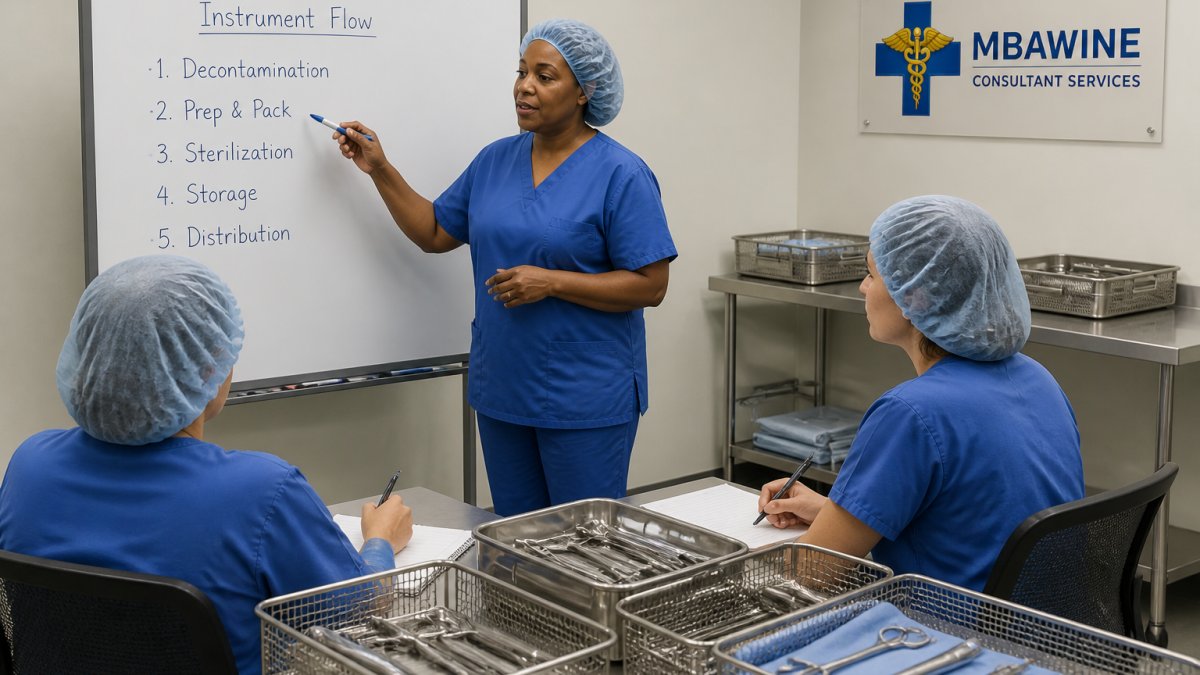
Use these questions as a shortlist, but score the answers against observable indicators rather than gut feel:
The single highest-value step most panels skip is a short teaching demonstration. Give the candidate a topic drawn from your department, for example, inspecting a instrument set for residual soil or reading a sterilization cycle printout, ten minutes to prepare, and five minutes to teach. Watch for four things:
Clarity and patience matter more than polish. A candidate who can teach a nervous new hire to perform a return demonstration beats one who gives a smooth lecture.
One question most panels miss: "Describe a training that failed." Educators who cannot name a failure are either new or not paying attention. The best answer describes what they changed afterward, a revised checklist, a shorter session, a different demonstration method, and the result. That tells you whether the candidate treats training as a system to improve or a performance to deliver.
Score each question from 1 to 4. Total the three scores, then use the bands below. This keeps the panel honest and gives you a record if the hire is challenged later.
| Question | What to Score | Score 1 (Weak) | Score 3 (Strong) | Score 4 (Excellent) |
|---|---|---|---|---|
| Q1: IFU to training | Structure and specificity | Generic, no sequence | Clear steps, cites IFU | Real example, measurable objectives |
| Q2: Audit finding | Judgment and ownership | Blames staff | Names process and fix | Fixes system, shows result |
| Q3: Proving it stuck | Evidence and follow-up | Sign-in sheets only | Return demos and files | Audit data plus re-checks |
How to read the total:
Score independently before the panel discusses the candidate; group discussion first pulls everyone toward the loudest voice in the room.
Certification is the floor, not the ceiling. Technician credentials do not by themselves show readiness for an educator role. An educator owns onboarding, ongoing education, curriculum maintenance, and collaboration with clinical stakeholders, duties a floor technician never performs.
Before the offer, confirm the candidate understands the role is not a senior technician position. An educator's responsibilities typically include:
Ask the candidate to describe how they would divide a typical week between these duties. A strong answer allocates time to observation and follow-up, not just classroom sessions. A weak answer describes teaching classes and nothing else.
Onboarding is where an educator's value shows up fastest. To see the sterile processing operational support services available to hospitals, review what is offered.
The difference comes down to design. A strong educator builds onboarding around these elements:
That structure also protects retention. For the deeper framework on SPD optimization, read the full guide. Technicians who feel competent stay.
Building a sterile processing team that trains well and audits clean starts with one good hire.
Look for current certification such as CRCST or CIS, plus hands-on experience processing instruments rather than classroom-only teaching. Ask how recently they worked on a decontamination or assembly line, and whether they hold a leadership credential like CHL if they will train supervisors. Verify certification expiration dates during the interview, since a lapsed credential signals a gap in professional development. A credible SPD educator can also explain how they keep up with updated instructions for use and changing standards.
Measure it before and after training, not just at the end. Track audit findings, documentation errors, and instrument defect rates for a set period before the program, then compare after. Pair those numbers with hands-on competency checks where technicians demonstrate each process step while being observed. Ask the educator to show a sample report from a past engagement so you can see what they actually track. Training that cannot be tied to a change in audit results or observed practice is hard to defend to administration.
Onboarding should cover the full instrument processing cycle: point-of-use treatment, transport, decontamination, ultrasonic cleaner operation and cavitation, inspection, assembly, sterilization temperature and cycle selection, and sterile storage. Add documentation, quality assurance checks, and safe work practices for each area. The educator should also walk new hires through the facility's specific instructions for use and any audit findings from the past year. A structured checklist with sign-off dates keeps onboarding consistent and gives managers a record of competency.
A skilled educator connects training to the audit findings your department already has. They review documentation gaps, observe practice on the floor, and build short sessions around the specific process steps that keep failing. That might mean retraining on decontamination handoff, tightening sterilization load records, or coaching supervisors on daily quality assurance checks. Ask candidates to describe a past compliance problem and the exact steps they took to fix it. The strongest answers include measurable follow-up, not just a training session and a sign-in sheet.


