

Last Updated: September 20, 2026
Sterile processing decontamination is the foundation of surgical safety. Without proper decontamination protocols, bioburden accumulates on instruments. Cross-contamination spreads pathogens between patients. Infections follow.
A single missed protocol can compromise an entire surgical case. The cost of failure, human and financial, is too high to ignore.
Mbawine Consultants provides specialized education for sterile processing departments. The difference between departments that pass audits and those that struggle is discipline, knowledge, and systems that work.
This guide covers the five practices that matter most, what hospitals and ambulatory-surgical facilities actually need to operate safely and maintain regulatory compliance.
Point-of-use cleaning happens immediately after a procedure ends at the surgical suite, while instruments are still warm and organic debris hasn't dried. This is your critical window.
Most failures start here: technicians skip pre-soaking, rinse with cold water, or assume the washer-disinfector will handle everything. It won't.
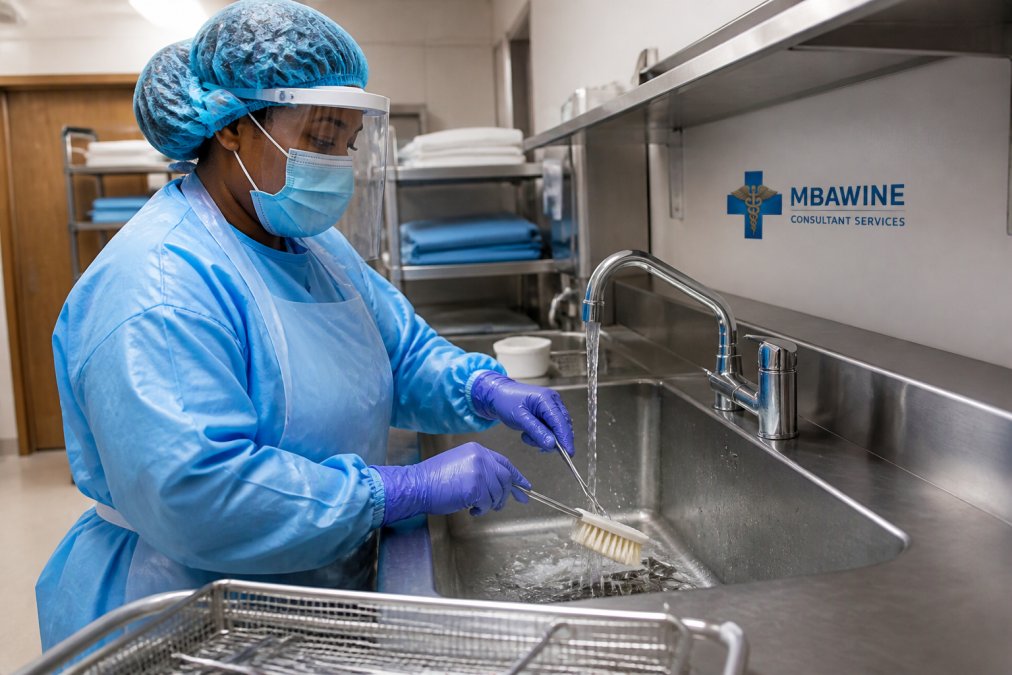
Containment begins before cleaning starts. Transport instruments in a closed, leak-proof container and use enzymatic pre-soak solutions designed for surgical instruments, soaked for the manufacturer's recommended time (usually 10-15 minutes). Enzymatic solutions break down proteins in blood and tissue, reducing bioburden significantly before manual cleaning, cold water alone cannot do this.
Key steps:
Manual cleaning removes organic debris from lumens, hinges, and serrations that machines cannot reach. Use a soft-bristled brush under warm running water, paying special attention to box locks, serrated edges, instrument lumens, and crevices. Rinse thoroughly until water runs clear. Document what you cleaned and when for traceability and compliance.
AAMI ST79 is the gold standard for sterile processing in the United States, defining decontamination, bioburden reduction, validation, and documentation requirements. Many facilities claim to follow it but haven't invested in proper validation or staff training.
Validation means proving your process works through baseline testing: swab instruments before and after decontamination and send samples to a microbiology lab to measure bioburden. AAMI ST79 requires at least a 6-log reduction (99.9999% of microorganisms). Test equipment regularly with monthly chemical indicators, quarterly biological indicators, and annual validation audits. This is required for compliance and patient safety.
Documentation is critical for compliance. Keep records for every batch including date, time, staff member, equipment used, validation test results, and any deviations. Digital tracking systems with automated audit trails eliminate manual errors and provide real-time visibility. Regulators increasingly expect electronic records with automated timestamps and user authentication.
Your washer-disinfector is only as good as its maintenance. Without active monitoring, you won't know your equipment is failing until instruments leave the decontamination zone still contaminated.
Perform daily visual inspections of water quality, spray arms, drain function, and leaks. Weekly: run a cleaning cycle with no instruments, check detergent levels, test water temperature, and inspect door seals. Monthly: clean spray arms, check filter integrity, and verify cycle times. For ultrasonic cleaners, test frequency and degassing regularly, if instruments show visible debris after cleaning, the unit likely needs transducer replacement or frequency recalibration.
Chemical indicators show whether the decontamination cycle reached the correct temperature and time. They're inexpensive insurance. Biological indicators test actual microbial kill. They're more expensive but essential for validation.
Run chemical indicators at least weekly in your washer-disinfector, in every ultrasonic cleaner cycle, when changing detergent or water sources, after equipment service, and when water temperature or cycle time changes. A chemical indicator should show color change across the entire test strip. If only part of the strip changes color, spray arm coverage is uneven or water circulation is blocked, stop using that cycle until the equipment is serviced.
Biological indicators contain spores of Geobacillus stearothermophilus to validate decontamination processes. Run them at least quarterly in each washer-disinfector, after equipment repairs, when changing suppliers or detergents, if you suspect a problem, or immediately if a chemical indicator fails. Growth indicates your process did not achieve the required log reduction.
If a biological indicator shows growth, your process has failed. Do not process instruments until the problem is identified and corrected. Common causes include water temperature too low, incorrect detergent concentration, shortened cycle time, spray arm blockage, stuck drain valve, or contaminated water supply. After fixing the problem, run another biological indicator to confirm before resuming processing. Document the failure, corrective action, and confirmation test result.
Many modern washer-disinfectors include built-in data logging that records cycle temperature, time, and detergent concentration automatically. Review the data weekly for trends, drifting temperature or extending cycle time are early warning signs of equipment degradation. Keep all results in a centralized file and show them during audits to prove you're monitoring equipment and catching problems before they affect patient care.
Equipment manufacturers recommend annual preventive maintenance including seal replacement, internal cleaning, temperature sensor calibration, and pump inspection. A service call and complete replacement can be costly. Preventive maintenance is far cheaper. Keep all service records as proof you followed the manufacturer's maintenance schedule.
Your decontamination zone is a biohazard area that must be physically separated from clean areas to prevent cross-contamination and manage ergonomic and safety risks.
Design your decontamination area with clear physical boundaries and airflow moving from clean areas toward decontamination. Remove PPE before leaving the zone, use separate hand-washing stations, never move instruments backward, and designate separate carts for contaminated items. Use color-coding: red for contaminated instruments, blue or green for cleaned instruments, with clear labeling and visual reminders at zone boundaries.
Environmental controls matter more than most people realize. High humidity promotes microbial growth. Extreme temperature swings can affect equipment calibration.
Maintain temperature at 68-72°F, relative humidity at 30-50%, and at least 6-12 air changes per hour with positive airflow from clean toward contaminated areas. Monitor conditions daily with automated systems or manual thermometer and hygrometer checks. Document readings to show regulators you're managing these factors actively.
Decontamination work is physically demanding. Common ergonomic hazards include repetitive strain injuries (carpal tunnel, tendinitis, shoulder strain), back and knee strain from improper work heights and hard floors, chemical exposure from splashing, and lifting injuries from heavy instrument trays (20-30 pounds).
Set manual cleaning sinks at 36-38 inches to reduce shoulder and back strain. Install high-quality anti-fatigue mats to reduce leg and lower back fatigue. Use tray carts with wheels and mechanical lifts to reduce lifting strain.
Your equipment is only as good as the people operating it. A technician who doesn't understand why they're following a protocol won't maintain it when pressure builds.
New technicians need structured training covering why sterile processing decontamination matters, facility-specific protocols, equipment operation, PPE requirements, documentation procedures, and problem recognition. Validate competency by observing key tasks and administering a written assessment on AAMI ST79 basics. Provide annual refresher training, quarterly competency checks, and certification prep courses for technicians pursuing CRCST or CIS credentials.
Audits reveal problems before regulators find them. Conduct internal audits quarterly at minimum.
Audit checklist:
Maintain a centralized compliance file:
Problems happen. The question is whether you catch them quickly and fix them.
Surgical instrument management is a chain. Decontamination is the first critical link.
Facilities that excel at decontamination have:
The five core steps are: (1) point-of-use cleaning at the surgical site, (2) transport and containment to the decontamination zone, (3) manual and mechanical cleaning to remove organic debris and bioburden, (4) disinfection via washer-disinfector or ultrasonic cleaner, and (5) rinsing and quality assurance inspection before sterilization. Each step follows AAMI ST79 standards and requires documented validation to ensure microbial levels are reduced to safe thresholds for subsequent sterilization.
Point-of-use cleaning prevents organic debris and blood from drying on instruments, which makes later decontamination far more difficult and less effective. When performed immediately after use, it reduces bioburden significantly, shortens overall processing time, and protects instrument integrity. Delaying cleaning allows contaminants to bond to surfaces, requiring more aggressive chemical and mechanical action that can damage delicate surgical instruments and compromise their function.
AAMI ST79 is the primary standard for reprocessing of reusable surgical instruments in healthcare settings. It establishes requirements for cleaning efficacy, disinfection, sterilization validation, and documentation. OSHA regulations also apply, mandating personal protective equipment, safe handling of chemical disinfectants, and workplace safety protocols in the decontamination zone. State regulations and Joint Commission standards may impose additional requirements depending on facility type and location.
Effective decontamination directly extends instrument lifespan, maintains functionality, and prevents cross-contamination that could lead to healthcare-associated infections. Instruments processed through rigorous decontamination protocols maintain their integrity, fit, and sharpness, reducing the need for premature replacement and lowering costs. Proper management also ensures traceability and audit trails, supporting compliance audits and demonstrating due diligence in infection control and patient safety.


