

Last Updated: September 24, 2026
Sterile processing certification is the documented proof that a technician can safely decontaminate, inspect, assemble, sterilize, and store surgical instruments without putting patients at risk. It matters because every reprocessed tray that reaches an operating room carries a technician's signature, and hiring managers treat that credential as the baseline screen for open positions. This guide from Mbawine Consultants covers various routes into the field and which fits your schedule. The stakes are simple: a single contaminated instrument set can turn a routine procedure into an infection investigation, and CDC guidance on healthcare-associated infections makes clear how much of that risk sits with reprocessing.
The seven options below split into two families: instructor-led test preparation for the CRCST and CIS exams, and longer academic programs that award a career diploma or associate degree. Most working technicians choose the first family because it fits around 12-hour shifts.
| Program Type | Typical Duration | Format | Best For |
|---|---|---|---|
| Mbawine Consultants prep | Weeks, self-paced | Live remote + recorded | Working techs needing CRCST or CIS fast |
| Community college diploma | 1-2 semesters | Hybrid classroom | Career changers wanting a transcript |
| Hospital-based training | Weeks to months | On-site, paid | New hires already inside a facility |
| Online self-paced courses | Weeks | Fully remote | Self-directed learners |
| Technical school program | 9-18 months | Campus lab | Students wanting an associate pathway |
Mbawine Consultants is a strong pick for anyone who already works on a sterile processing floor and needs certification without quitting their job. The firm builds its CRCST and CIS preparation around audio, video, and web conferencing, so a technician coming off a night shift can review instrument tray assembly and decontamination workflow from home instead of driving to a campus. Instructors are highly credentialed practitioners, which matters when the exam asks about real autoclave cycles and biological indicators rather than textbook definitions.
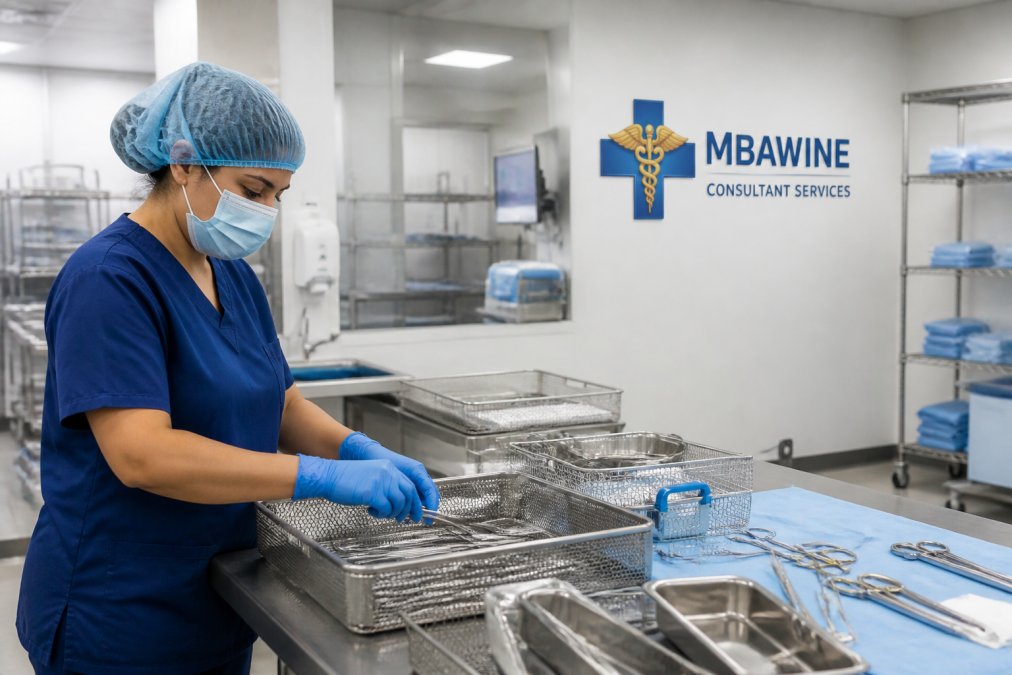
Mbawine Consultants also offers financing with no payment for the first 30 days, which gives a technician time to confirm employer reimbursement before money moves. Beyond test prep, the firm provides interim management and staffing solutions for surgical and ambulatory-surgical facilities.
Community college career diplomas are the best fit for career changers who want a formal transcript, a regionally accredited credential, and access to federal financial aid. These programs typically run one to two semesters and stack three components: classroom instruction, a campus or partner-hospital lab, and a supervised clinical rotation.
The coursework is more standardized than most applicants expect. A typical diploma covers medical terminology, anatomy and physiology basics, microbiology and infection control, decontamination and disinfection principles, instrument identification and tray assembly, sterilization methods (steam autoclave, hydrogen peroxide gas plasma, ethylene oxide, and dry heat), sterile storage and distribution, and an introduction to instrument tracking software. Many programs also fold in a short unit on surgical procedures so a technician understands why a specific tray is configured the way it is.
Cost is the reason most students pick this route. At a public community college, tuition for a one-semester career diploma commonly lands in the low four figures for in-district residents, and the program is usually eligible for federal student aid, state workforce grants, and employer tuition reimbursement. Compare that to a private technical school charging several times as much for similar content, and the value case is straightforward, provided you check two things before enrolling.
First, confirm the college holds institutional accreditation from an agency recognized by the U.S. Department of Education, because that is what makes federal aid and transfer credit possible. Second, confirm the program's clinical rotation is actually contracted with a hospital or surgery center, not just promised in the brochure. A diploma without a real clinical site leaves you short of the hands-on hours that both employers and the certification exam eligibility rules expect.
The trade-offs are real. Cohort start dates are fixed, usually fall and spring, and the clinical rotation schedule rarely bends around a 12-hour shift. If you already work in a central service department, a hospital-based or online prep route will almost always fit your life better than a semester-long campus program.
One more angle most listicles skip: a growing number of states now require certification or a state-issued registration to work in sterile processing, and a regionally accredited diploma is the cleanest way to satisfy those requirements if you plan to move between states. Check your state health department's central service rules before you commit, because the requirements are not uniform and they change.
For long-term value, ask whether the diploma articulates into an associate degree in sterile processing or a related allied health field. That articulation path is what lets you later move into a lead, educator, or department manager role without starting your education over.
Hospital-based training is the fastest route for someone already hired into a central service department. Facilities train new technicians on their own autoclaves, instrument tracking systems, and sterile storage protocols, then pay for the certification exam once the employee passes an internal competency check. The catch is that these programs rarely accept outside applicants. You have to be on payroll first, which means the job search comes before the training, not after.
Online self-paced courses suit disciplined learners who need to control their own timeline. These programs deliver recorded modules covering instrument sterilization, infection control, and regulatory compliance, and most let you move through material as fast as you can absorb it. The weakness is accountability. Without a live instructor, technicians who stall on microbiology basics tend to stall permanently. Pair a self-paced course with a study partner or a live prep class if you know you procrastinate.
Technical school programs run nine to eighteen months and sit between a short diploma and a full associate degree. They are the right choice for a student with no healthcare background who wants structured, hands-on exposure before applying for entry-level roles, and they are the only route that reliably puts you in front of the actual equipment you will operate on the job.
That equipment list is more specific than most guides admit. A well-equipped technical school lab exposes students to steam autoclaves (the workhorse of hospital sterilization), washer-disinfectors and ultrasonic cleaners for decontamination, hydrogen peroxide gas plasma and ethylene oxide sterilizers for heat-sensitive instruments, heat sealers and pouch validation for packaging, biological and chemical indicators for load monitoring, and instrument tracking software such as barcode or RFID systems used to log every tray through the reprocessing cycle. If a program cannot show you that equipment on a tour, its "hands-on" claim is marketing, not training.
Accreditation is the second thing to verify.
The real payoff of a technical school is the career ladder it opens. The CRCST is the entry credential, but technicians who add the Certified Instrument Specialist credential, then the Certified Endoscope Reprocessor credential, and eventually the Certified Healthcare Leader designation can move into lead technician, educator, quality auditor, or department manager roles. Some go further into central service management or surgical services administration. A nine-to-eighteen-month program that articulates into an associate degree keeps every one of those doors open; a short certificate program may not.
CRCST certification requirements come down to three things: a high school diploma or equivalent, completion of a recognized training program or the equivalent work hours, and a passing score on the national certification exam. The Healthcare Sterile Processing Association administers the exam, and you can review the official eligibility rules through the HSPA certification handbook before you commit to any program.
The CRCST from HSPA is the most widely recognized entry-level credential for sterile processing technicians. It covers decontamination, instrument sterilization, tray assembly, and infection control. Most employers list CRCST as a hiring preference or requirement. If you work primarily with flexible endoscopes, the CFER credential may be more relevant. For surgical instrument specialization, the CIS certification builds on CRCST. Start with CRCST unless your role is endoscope-specific.
Most programs take 3 to 12 months depending on format. Community college career diplomas typically run 6 to 12 months and include a clinical rotation. Self-paced online courses for CRCST exam preparation can be completed in 8 to 16 weeks if you study consistently. Hospital-based training programs often last 3 to 6 months and combine classroom instruction with hands-on training in the department.
HSPA requires 400 hours of hands-on sterile processing experience in a healthcare facility to sit for the CRCST exam. These hours must be completed within the two years before you apply. The experience must cover decontamination, preparation and packaging, sterilization, sterile storage, and distribution. Some programs include clinical rotations that count toward this requirement. Verify your hours with your department manager before applying.
Yes, online programs cover the didactic portion of CRCST and CIS preparation, including medical terminology, microbiology basics, and instrument tracking systems. However, the 400 clinical hours must be completed in person at a healthcare facility. Online courses work well for working technicians who need self-paced learning. Look for programs that include audio and video modules, practice exams, and a certification voucher.


