

The integrity of modern surgical outcomes rests not merely upon the surgeon's skill, but upon the meticulous precision and unwavering standards of the sterile processing department. For those pursuing sterile processing training in 2026, the path to professional mastery often appears obscured by the complexities of competing certification bodies and the high-stakes nature of clinical decontamination. You likely recognize that obtaining a credential is only the first step in a career that demands absolute technical proficiency and a deep commitment to public safety. It's understandable to feel a sense of trepidation regarding the rigorous HSPA exam requirements or the potential lack of hands-on application in traditional educational formats.
This article serves as an authoritative guide to navigating these professional hurdles, offering a comprehensive analysis of the pathways that lead to national certification and beyond. By examining the nuances of CRCST preparation and the systematic mastery of sterilization protocols, we provide the clarity needed to transform entry-level knowledge into specialized expertise. We'll explore how a structured pedagogical approach allows you to transcend basic requirements, facilitating a deliberate progression into high-level management or healthcare consulting roles where your technical leadership becomes an institutional asset.
The healthcare infrastructure of 2026 recognizes the Central Sterile Services Department (CSSD) as the definitive nexus of clinical safety, where the implementation of comprehensive sterile processing training serves as an essential institutional safeguard against the proliferation of healthcare-associated infections. Historically perceived as a secondary support function, the field has undergone a radical transformation into a rigorous, science-based discipline that demands high-level technical proficiency and an acute understanding of microbiology. This evolution is driven by the increasing complexity of robotic surgical instrumentation and the stringent requirements of modern infection control protocols. As healthcare facilities face heightened scrutiny regarding patient outcomes, the demand for credentialed professionals who can demonstrate a mastery of decontamination and sterilization science has never been more acute.
Formal education programs do more than just impart technical skills; they establish an institutional barrier against surgical site infections (SSIs) and the subsequent legal liabilities that follow. When technicians are equipped with a thorough understanding of biofilm disruption and thermal disinfection parameters, the likelihood of cross-contamination decreases significantly. This professionalization of the workforce ensures that every instrument processed meets a validated standard of safety, protecting both the patient and the healthcare institution's reputation. It's a shift from simple task-orientation to a specialized methodology that prioritizes patient life above all else.
The sterile processing professional functions as a silent advocate for the patient, operating in a high-pressure environment where there's no room for error. Excellence in this field requires a mission-driven mindset that prioritizes ethical responsibility over mere task completion. During the initial phases of professional development, technicians learn that their adherence to a specific temperature range or a timed enzymatic soak is a moral imperative. This dedication to precision ensures that every surgical patient receives care that is uncompromised by preventable microbial threats. It's a role that demands technical integrity and a deep sense of professional advocacy.
Adherence to national standards, specifically those outlined in ANSI/AAMI ST79 and current CDC guidelines, remains the benchmark for departmental success. In the 2026 fiscal year, regulatory bodies like The Joint Commission (TJC) have intensified their focus on documented competency and evidence-based practice. Effective sterile processing training must align with these evolving standards to ensure that facilities remain compliant during unannounced surveys. By anticipating these regulatory shifts, professionals can position themselves as leaders who don't just follow rules but actively uphold the highest echelons of public health safety. You can learn more about how these standards integrate into professional practice through our specialized healthcare consulting services.
A robust curriculum for sterile processing training in 2026 transcends basic procedural knowledge, demanding a deep immersion into the microbiological principles that underpin patient safety. Students must master the identification of complex surgical instrumentation, ranging from standard stainless steel retractors to intricate robotic end effectors, while simultaneously evaluating their functional integrity. This academic foundation ensures that technicians can recognize subtle signs of wear or residual bioburden that might compromise the sterilization process. Mastery in this field requires understanding the specific life cycles of pathogens and the chemical reactions necessary to neutralize them effectively before any instrument reaches the sterile field.
The decontamination phase represents the most critical step in the reprocessing cycle, as sterilization cannot be achieved on a surface that remains soiled. Professional training emphasizes the chemistry of enzymatic detergents, which are formulated to break down specific proteins and lipids found in surgical bioburden. Technicians must differentiate between manual cleaning techniques and the mechanical action of ultrasonic cleaners and washer-disinfectors. For semi-critical medical devices that cannot withstand terminal sterilization, the curriculum covers rigorous high-level disinfection (HLD) protocols, ensuring that the appropriate contact times and chemical concentrations are strictly maintained to meet institutional safety standards.
Sterilization is a precise science governed by the laws of physics and chemistry. Training programs provide detailed instruction on the parameters of saturated steam, including the critical relationship between time, temperature, and pressure. Beyond steam, technicians must achieve technical mastery over low-temperature modalities such as Ethylene Oxide (EtO) and vaporized hydrogen peroxide. A significant portion of the coursework is dedicated to implementing a robust quality control program through the use of biological and chemical indicators. These tools provide the empirical evidence required to validate each cycle, ensuring that every load meets the Sterile Processing Technician Certification Requirements established by national governing bodies.
The final stage of a comprehensive curriculum focuses on workflow optimization and the systematic progression of items through the department. This includes the transition from the decontamination area to the clean assembly room, and finally to sterile storage. Documentation remains a cornerstone of this process, providing the audit readiness necessary for institutional transparency and regulatory compliance. For those seeking to master these technical competencies under the guidance of industry experts, you may enroll in our professional development programs to begin your journey toward certification.
Selecting a pedagogical model for sterile processing training requires a strategic assessment of how technical theory translates into clinical practice. Digital learning environments in 2026 have achieved a high level of efficacy for delivering the complex scientific data required for certification, particularly in areas of regulatory compliance and microbiology. However, the sterile processing department (SPD) remains a high-stakes physical environment that demands tactile precision and manual dexterity. Hybrid models have emerged as the gold standard, allowing students to digest theoretical coursework at their own pace while participating in rigorous, hands-on laboratory sessions that simulate real-world surgical scenarios. This dual approach ensures that institutional accreditation is backed by documented competency rather than just academic completion. Major healthcare systems increasingly prioritize candidates from programs that demonstrate a balanced integration of digital flexibility and physical laboratory requirements.
Generic vocational programs often fail to address the systemic challenges found within modern healthcare facilities. Education designed by active sterile processing consultants provides a distinct advantage by integrating current hospital sterilization case studies directly into the curriculum. This allows students to view decontamination through the lens of departmental leadership and regulatory oversight. You can explore these perspectives through our specialized sterile processing education programs, which are structured to bridge the gap between basic technical knowledge and high-level consulting expertise. This methodology ensures that graduates aren't just prepared for an exam, but for the complex operational realities of a functioning surgical center.
The attainment of the Certified Registered Central Service Technician (CRCST) designation remains contingent upon the successful completion of 400 hours of hands-on clinical experience. This component of sterile processing training isn't merely a formality; it's the environment where theoretical concepts regarding bioburden and sterilization parameters are tested against the realities of high-volume surgical schedules. Securing a clinical site requires professional networking and a proactive approach to career development. Mentorship from seasoned industry leaders during this phase is invaluable. It accelerates technical proficiency by providing nuanced insights that aren't found in standard textbooks, such as the subtle variations in instrument assembly or the rapid troubleshooting of sterilization equipment. This guided experience ensures that a technician enters the workforce as a prepared professional ready to uphold institutional standards.
The transition from academic sterile processing training to professional credentialing is a structured progression that demands meticulous attention to regulatory detail. The first phase involves selecting the most appropriate credentialing body, typically between the Healthcare Sterile Processing Association (HSPA) and the Certification Board for Sterile Processing and Distribution (CBSPD). While both organizations maintain high standards, the HSPA's Certified Registered Central Service Technician (CRCST) designation is frequently cited as the preferred credential by major health systems for its rigorous focus on technical mastery. Once a body is selected, candidates must fulfill specific educational prerequisites and document 400 hours of hands-on clinical experience, ensuring their theoretical knowledge is anchored in departmental reality. This experience must be verified by a supervisor; it serves as a formal testament to the technician's competency in decontamination, assembly, and sterilization protocols.
Managing the application and examination scheduling process requires foresight, as candidates must coordinate their testing windows with Prometric or authorized testing centers. Upon successful completion of the exam, the professional journey continues through the mandatory maintenance of credentials earned during your sterile processing training. In 2026, the HSPA requires 12 continuing education units (CEUs) annually to ensure that technicians remain current with evolving industry standards and technological advancements in surgical instrumentation. This commitment to lifelong learning is what separates a technician from a true professional leader in the field.
Success on the CRCST exam is predicated on a systematic analysis of the HSPA exam content outline, which covers seven critical knowledge domains. Strategic study techniques involve more than rote memorization; they require a conceptual understanding of sterilization terminology and the physics of microbial destruction. To facilitate this level of preparation, we provide comprehensive CRCST certification preparation resources designed to mirror the complexity of the actual examination environment. Mastering these domains ensures that you don't just pass the test, but possess the technical confidence required for high-stakes clinical decision-making.
Professional advancement often necessitates moving beyond the foundational CRCST credential to pursue specialized designations such as the Certified Instrument Specialist (CIS) or the Certified Healthcare Leader (CHL). For those operating in specialized surgical centers, the Certified Endoscope Reprocessor (CER) designation has become an essential credential for managing complex flexible scopes. Leveraging these multiple certifications allows professionals to transition into lucrative roles in interim management or healthcare consulting. To begin your path toward these advanced professional milestones, you should enroll in our professional certification track to ensure your training meets the highest institutional standards.
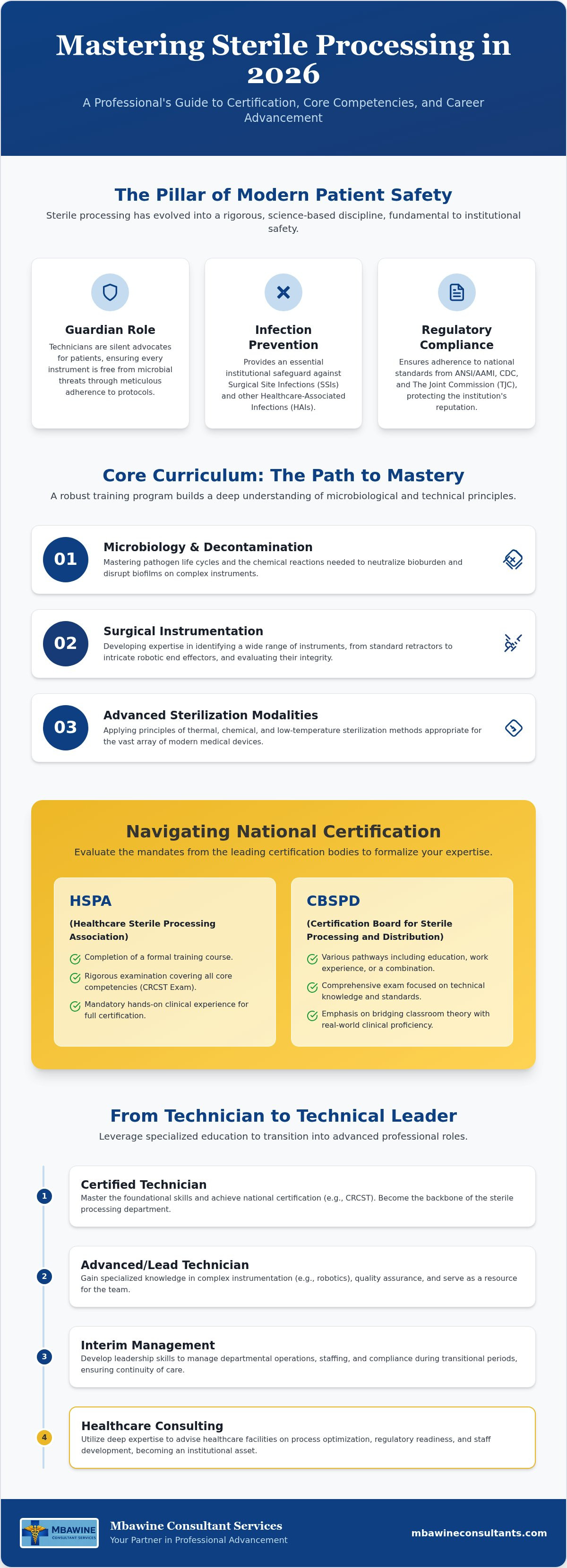
Professional development in 2026 requires a shift from viewing sterile processing training as a finite course toward embracing it as a continuous pathway to technical leadership. While entry-level roles provide the necessary clinical exposure, the transition into management or consulting demands a more sophisticated understanding of departmental operations and regulatory oversight. By positioning yourself as a subject matter expert, you don't just secure a position; you become an essential asset capable of guiding healthcare institutions through complex sterilization audits and process optimizations. This level of expertise yields significant professional benefits, allowing technicians to transcend traditional roles and enter the specialized fields of interim management and healthcare consulting where their insights directly influence institutional excellence.
The demand for specialized knowledge is particularly evident in high-stakes environments that require high-level staffing assignments to maintain operational continuity. Mbawine Consultant Services bridges the gap between credentialed proficiency and professional placement, ensuring that trained specialists are ready for the rigors of 24/7 emergency staffing scenarios. This synergy between education and employment allows professionals to gain exposure to diverse healthcare environments, rapidly expanding their clinical repertoire and technical adaptability. For a deeper analysis of these advanced roles, we invite you to examine The Strategic Role of Sterile Processing Interim Leadership, which details how technical mastery translates into administrative authority.
Formalizing your commitment to this field is a strategic investment in your professional future. By choosing a mentor-led institution, you align your career with the highest standards of public safety and institutional integrity. Taking the first step involves more than just an interest in the medical field; it requires a deliberate choice to uphold the rigorous protocols that define modern surgical care. We encourage you to begin this journey through enrollment in Mbawine classes, where our consultancy-backed sterile processing training ensures you're prepared for the complexities of the 2026 healthcare landscape. This professional commitment is the foundation upon which institutional excellence is built, ensuring that every instrument processed is a testament to your technical proficiency and ethical dedication to patient safety.
The pursuit of excellence in the surgical environment is a foundational requirement for patient safety and institutional integrity in 2026. This comprehensive analysis has detailed how a structured approach to sterile processing training serves as the definitive nexus between entry-level technical skills and high-level professional leadership. By mastering the rigorous standards set by national credentialing bodies and understanding the complex science of decontamination, you position yourself as a vital guardian of public health. Mbawine Consultant Services provides the pedagogical foundation necessary to navigate this high-stakes field, offering a consultancy-led curriculum designed by industry experts that prepares you for national certification while providing integrated pathways into interim management and staffing roles.
Your transition from a technician to a recognized subject matter expert begins with a deliberate commitment to specialized education and professional development. We invite you to Enroll in Professional Sterile Processing Classes Today to formalize your career path and join a network of elite professionals dedicated to surgical excellence. Your expertise is the silent safeguard of modern medicine; it's time to elevate your technical proficiency into a legacy of clinical leadership.
The primary distinction lies in the organizational focus and institutional recognition of the credentials. The Healthcare Sterile Processing Association (HSPA) offers the Certified Registered Central Service Technician (CRCST) designation, which is often the preferred benchmark for major healthcare systems. The Certification Board for Sterile Processing and Distribution (CBSPD) provides a more generalized certification. While both bodies validate technical competency, HSPA requires a more rigorous documentation of 400 hours of clinical experience to achieve full certification status.
The duration required to achieve certification depends on the intensity of your sterile processing training and the speed at which you complete clinical hours. Most formal classroom or online programs span between eight and sixteen weeks. However, the mandatory 400-hour clinical practicum typically adds another three to four months of full-time engagement. Most professionals successfully navigate the entire process from initial enrollment to passing the national examination within six months.
Online sterile processing training has proven highly effective for mastering the theoretical and scientific foundations of the field, such as microbiology and regulatory standards. These digital programs offer the flexibility required by working professionals while maintaining academic rigor. However, technical mastery also requires physical exposure to surgical instrumentation. The most successful candidates often utilize a hybrid approach, combining the comprehensive digital curriculum provided by Mbawine Consultant Services with hands-on laboratory or clinical experience.
The 400-hour requirement for CRCST certification must encompass specific knowledge domains within the department. Candidates must document hands-on proficiency in decontamination, assembly and packaging, sterilization, and sterile storage. This experience isn't merely observational; it requires active participation in the reprocessing cycle under the direct supervision of a certified professional. Each hour must be verified by a supervisor to ensure the technician has met the institutional standards for technical safety and precision.
It's possible to secure employment within a sterile processing department while you're still completing your educational requirements. Many healthcare facilities hire "provisional" technicians who are given a specific window, often six to twelve months, to achieve national certification. This arrangement allows you to accrue your 400 clinical hours while earning a salary. This practical experience is invaluable for reinforcing the technical concepts learned during your formal classes and significantly improves exam pass rates.
The total investment for certification in 2026 involves several distinct components, including examination fees, study materials, and formal education programs. While specific exam costs are set by the certifying bodies like HSPA or CBSPD, candidates should also account for the cost of textbooks and specialized preparatory courses. It's advisable to consult the official websites of these credentialing organizations for the most current fee schedules, as these institutional costs are subject to periodic regulatory adjustments.
Maintaining your professional credentials requires a commitment to lifelong learning through continuing education units (CEUs). For the CRCST designation, technicians must complete 12 approved credits annually to remain current with evolving sterilization modalities and infection prevention protocols. These units can be earned through technical seminars, professional workshops, or specialized training modules. This requirement ensures that every certified professional remains an authoritative guardian of industry standards and public safety within their respective healthcare facilities.
Mbawine Consultant Services provides a direct bridge to professional opportunities through our specialized healthcare staffing and interim management solutions. While we focus on delivering high-level education, our integration with temporary and emergency staffing services allows our alumni to access diverse clinical environments. We position our students to be competitive candidates for high-stakes assignments, leveraging our consultancy-backed reputation to help professionals secure roles that match their technical mastery and career aspirations.

Article by
Mba Akuribila
Mba‑Akuribila is a healthcare leader, educator, and founder of Mbawine Consultants, a Bronx‑based institution recognized nationwide for advancing excellence in sterile processing and allied health workforce development. Born in Bongo in Ghana’s Upper East Region, his journey from rural beginnings to national impact reflects a lifelong commitment to service, empowerment, and community advancement.
For over two decades, he has trained sterile processing employees, mentored, and placed thousands of healthcare professionals across the United States. Through Mbawine Consultants, he established one of the country’s most trusted Sterile Processing Certification Test Prep Programs, preparing new Americans and career‑changers for successful entry into the field. The organization, as at 2026, has graduated more than 15,000 sterile processing technicians who now serve in hospitals, ambulatory centers, dental practices, and reprocessing facilities nationwide.
Under his leadership, Mbawine Consultants has expanded into a full Healthcare Staffing Agency, connecting nurses and allied health professionals to meaningful employment opportunities. His team also provides Interim Management Services, supporting hospitals and surgical centers with experienced leaders who stabilize operations, strengthen compliance, and improve workflow efficiency.
As a former surgical technician, sterile processing manager, educator, and system‑wide director, Mba‑Akuribila brings deep expertise to Sterile Processing Consulting, helping healthcare facilities elevate quality, safety, and regulatory readiness.
His work in the United States and Ghana continues to reflect his core philosophy: service above self, opportunity for all, and excellence without compromise.


