

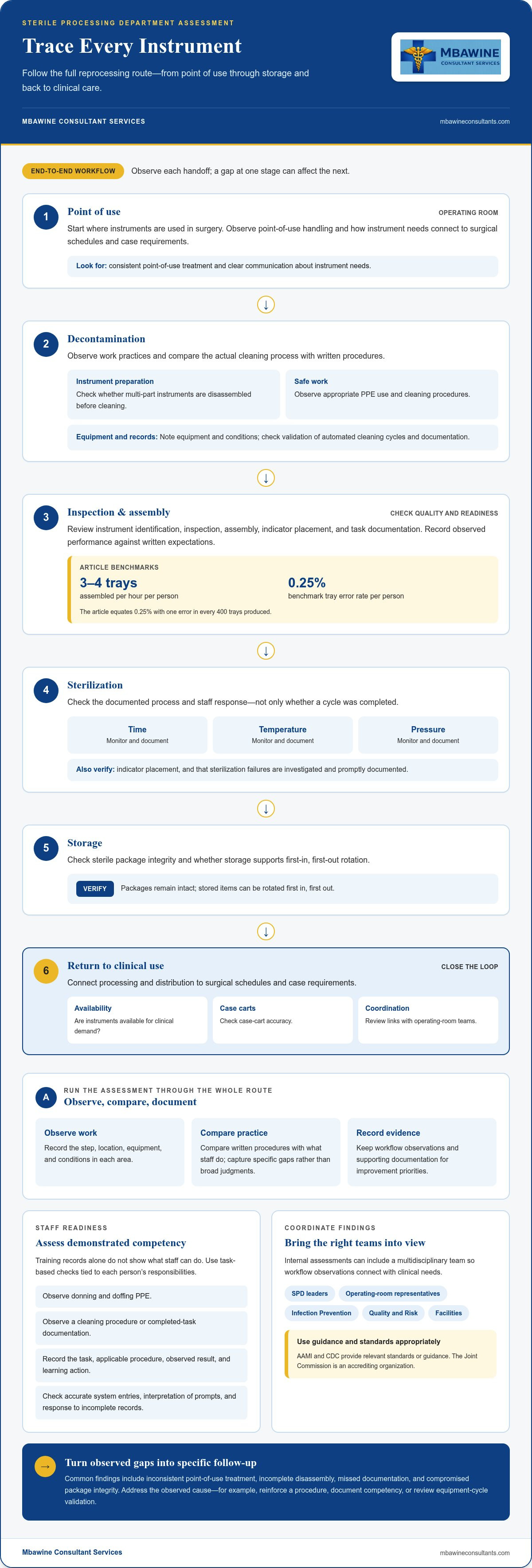
An SPD department assessment should trace instruments from the point of use in surgery through decontamination, inspection and assembly, sterilization, and storage, then back to the operating room. It should also examine staff competency, coordination with clinical teams, and whether workflows and resources support safe, reliable reprocessing. Reviewing these areas together gives leaders a practical picture of how the department performs as a whole.
Because a gap at one stage can affect the next, an assessment should go beyond written procedures and equipment. This article explains how to review workflow, staff readiness, and coordination with operating rooms and clinics, then build an assessment agenda and turn findings into implementation priorities. The result is a structured way to identify what works, where risks or bottlenecks may arise, and which improvements to address first.
An SPD department assessment should trace instruments through every reprocessing stage rather than review isolated tasks. Follow a representative set from the operating room’s point of use through decontamination, inspection and assembly, sterilization, storage, and return to clinical use. This end-to-end review can reveal breakdowns in handling, documentation, or communication.
In the United States, assessments should consider applicable AAMI and CDC guidance, along with The Joint Commission’s standards. These organizations provide standards or guidance relevant to sterile processing and infection prevention. Leaders should review current materials when setting assessment criteria.
Observe work in each area and record the step, location, equipment, and conditions. For example, note whether staff disassemble multi-part instruments before cleaning, validate automated cleaning cycles, use appropriate PPE, and document sterilization parameters. Compare written procedures with observed practice, recording specific gaps instead of broad judgments.
Key sterilization and infection-prevention criteria include effective cleaning, inspection, correct indicator placement, and monitoring time, temperature, and pressure. Check whether staff investigate and promptly document sterilization failures, verify sterile package integrity, and store items to support first-in, first-out rotation.
Readiness depends on more than completed cycles. A hospital SPD prepares reusable devices to be sterile, functional, and ready for patient care, so the assessment must also examine surgical schedules, instrument availability, and case-cart accuracy. A benchmark assembly rate is 3-4 trays per hour per person. The benchmark tray error rate is 0.25% per person, equivalent to one error in every 400 trays produced.
Common findings include inconsistent point-of-use treatment, incomplete disassembly, missed documentation, and compromised package integrity. These gaps can increase infection risk, affect patient safety, or delay procedures. Corrective actions should address the observed cause, such as reinforcing a procedure, documenting competency, or reviewing equipment-cycle validation.
Hospitals can organize internal assessments through SPD leaders and multidisciplinary teams that include Infection Prevention, Quality and Risk, Facilities, and operating-room representatives. The Joint Commission is an accrediting organization; AAMI and CDC provide relevant standards or guidance, not hospital accreditation.
Record findings as they arise, including workflow observations and supporting documentation. These details provide a practical basis for prioritizing improvements and aligning processing practices with surgical readiness.
Keep the department’s service role in view throughout the assessment. A hospital sterile processing department cleans, disinfects, sterilizes, assembles, and distributes surgical instruments and reusable medical devices. Sterile Processing professionals handle these tasks for healthcare facilities. Use these responsibilities to frame observations across the workflow, noting where each activity fits rather than treating it as an isolated result.
Consider distribution in relation to clinical demand. Sterile processing departments should coordinate instrument distribution with surgical schedules and case requirements. Examine how schedules and requirements inform the preparation and availability of instruments. Recording this connection keeps distribution within the end-to-end review and links observed processing activities to readiness for clinical use. Follow-up can then focus on coordination points identified during observation.
A sterile processing assessment should examine what staff can do, not just what training records show. Continuing education matters because procedures, best practices, and technology change. Review how employees apply current department procedures during routine work, including instrument identification, inspection, and documentation. Compare observed performance with written expectations and record specific competency gaps for follow-up.
Explain the assessment’s purpose before observation begins. Tell staff which workflows will be reviewed, how findings will be used, and how they can raise operational concerns. For example, let decontamination employees know the review will examine safe work practices and training needs, not simply individual speed. Clear expectations help staff understand the process and add context to observed variations.
Use task-based competency checks that reflect each employee’s responsibilities. An assessor might observe an employee donning and doffing personal protective equipment, following a cleaning procedure, or documenting a completed task. Record the procedure observed, the steps performed, and any coaching or retraining needed. Sterile processing departments should document both training completion and competency assessment outcomes.
Automation brings specific competency needs. Instrument tracking software and integrated SPD systems can document reprocessing from decontamination through delivery, while alerts and real-time updates improve workflow visibility. Assess whether staff can enter accurate information, interpret system prompts, and respond appropriately to incomplete records. A tracking system supports the work but does not replace staff judgment or procedural knowledge.
Base staff-readiness reviews on observable evidence, not assumptions about experience or role. A practical record can identify the task, applicable procedure, observed result, and next learning action. If a staff member misses a step, determine whether the cause is training, unclear instructions, equipment access, or a system workflow. Addressing the cause makes the next competency review more meaningful.
Use findings to shape a focused learning plan, then reassess the relevant task after instruction. For structured professional development, Sterile Processing classes can support staff seeking to strengthen their knowledge alongside department-based competency review.
Continuing education keeps professional development active as rules, best practices, and technology change. It is an essential part of professional development for Sterile Processing technicians. Departments should also train staff in proper PPE donning and doffing procedures. Revisit these topics through instruction and practice, then confirm employees can follow the applicable procedure in their assigned work. If a review identifies uncertainty, connect the learning action to the specific task and provide an opportunity to practice before reassessment. Emphasize safe, consistent performance and clear expectations, while giving employees room to ask questions about procedures or tools. An ongoing approach helps staff maintain knowledge as departmental practices and technology evolve, rather than treating training as a one-time event.
A sterile processing department supports operating rooms, procedural suites, and patient care areas. Its schedule needs to reflect the instruments and case carts each area requires. During an assessment, compare surgical schedules with requests, cart preparation, dispatch records, and reported shortages. This reveals where coordination supports efficient service and where information arrives too late.
Include operating-room representatives, Infection Prevention, Quality and Risk, Facilities, and relevant clinical teams in the review. Each group can explain a different part of the instrument pathway. For example, an OR team can identify recurring tray substitutions, while SPD staff can explain how case changes affect assembly priorities. Record both perspectives against the same workflow.
Trace a scheduled case from request to instrument delivery. Check whether case requirements reach SPD in time, requested items match the planned procedure, and substitutions or missing items are communicated promptly. Review how urgent changes are handled, including who receives the update and how revised priorities reach decontamination, assembly, and dispatch.
Assess case-cart preparation against the surgical schedule and the items each case requires. Observe how staff identify an emergent case cart, gather its contents, and prepare it for delivery. The benchmark time to identify an emergent case cart and have it picked and ready is seven minutes. Use this as a reference for reviewing the process, not as a substitute for examining local conditions.
Distribution also depends on coordination with vendor partners and medical teams. Review how the department communicates instrument availability, tracks vendor-related items, and responds when a required instrument is delayed or unavailable. Clarify the communication path: who reports the issue, which team makes the decision, and which clinical area receives the update.
Use records and observations to pinpoint coordination gaps. Compare schedule changes with case-cart documentation, delivery records, and reports of missing or incorrect items. When a mismatch appears, trace it to its source: a late request, unclear case details, inaccurate picking, or a delayed handoff. This helps distinguish communication problems from processing constraints.
Conclude the review by assigning each coordination issue to the relevant teams for follow-up. A shared action record should describe the observed problem, its effect on case readiness, and the workflow step requiring attention. This keeps operating-room, clinic, and sterile processing priorities visible during improvement planning.
Prepare for a facility review by agreeing with administrators on its purpose, process, and deliverables, then sharing a practical agenda. Gather relevant records, identify areas and participants, and notify affected departments before the assessment begins.
Start with the decisions the review needs to support. For example, an agenda focused on instrument flow should cover decontamination, assembly, sterilization, storage, and distribution. If infection prevention or staffing is a priority, include relevant records and personnel. A defined scope helps participants understand why each area is included.
Build the agenda around the sequence of work, not department titles alone. Identify where assessors will observe each step, which staff can explain local procedures, and which documents relate to the activity. For instrumentation, a practical review may follow a tray from intake through processing and delivery, noting handoffs and documentation points.
Set a clear schedule without overloading each session. Allow time for opening discussions, workflow observation, record review, staff interviews, and a closing discussion of preliminary themes. Allocate time according to the facility’s scope, operating schedule, and the number of areas involved.
Gather records before the assessment to make observations more specific. Department leaders can prepare productivity reports, immediate-use steam sterilization tracking, employee competencies, and preventive maintenance records. Organize materials by topic and identify someone who can explain their context. This helps assessors connect documents with observed healthcare practices.
Share the agenda with department leaders and affected teams before assessors enter their work areas. Include the purpose, scope, participating groups, expected records, and sequence of activities. Notify operating-room and clinic representatives if their schedules, requests, or handoffs are part of the review.
Use the agenda as a working document during the assessment. If an observation reveals a handoff issue between the operating room and sterile processing, record the related workflow and identify who can clarify it. Keep deviations visible so the final report can distinguish planned activities from additional areas that need review.
End the agenda with a defined discussion of observations and next steps. Identify which leaders will receive the findings and how questions will be captured. A structured close connects assessment evidence with implementation planning without presenting preliminary observations as final conclusions.
A facility review should connect physical conditions, equipment capacity, staffing, and surgery scheduling to the department’s workload. An internal SPD department assessment may be a half-day project or a larger multisite, multiday review. Set the scope according to facility size, case mix, instrument volume, and operational questions.
Before observations begin, department leaders should secure administrative support and agree on the project’s purpose, process, and deliverables. Identify who will receive findings and who can authorize workflow changes, staffing realignments, or capital requests. Include Infection Prevention throughout the assessment, except when reviewing matters such as human resources files.
Review the work environment alongside the processing sequence. Inspect equipment used for cleaning and sterilization, including automated cleaning systems and steam sterilizers, and examine maintenance records. Observe workplace hazards and PPE access, and check whether temperature and humidity are maintained and documented. These conditions can affect staff performance and equipment operation.
Documentation connects observed conditions with department performance. Gather productivity reports, immediate-use steam sterilization tracking, employee competency records, and preventive maintenance records. Compare them with current practices, instrument volumes, and case-cart movement. Where relevant, review instrument tracking systems and their integration with other hospital platforms.
Assess capacity in context instead of applying the same production rate to every facility. For example, a standalone ambulatory surgery center with three operating rooms may have lower case and instrument volumes than a university health system’s central sterile processing department. Scheduling patterns, staffing, equipment availability, and case requirements all influence implementation priorities.
Use findings to build an improvement plan that identifies the gap, its operational effect, the responsible team, and the resources needed. For example, a report may recommend validating peel-pack double-packing against the manufacturer’s instructions for use. The final report should combine observations and notes with explanatory photos, industry guidelines, and context for each improvement opportunity.
A sample survey described a facility that had been without a manager and one of three supervisors for more than a year. Leadership vacancies can shape assessment findings, but the implementation plan should address the facility’s documented needs. Hospital administrators and affected departments should review the report together, especially when changes involve capital funds, workflow adjustments, or staffing realignments.
Turn prioritized training gaps into a defined staff-development action alongside facility changes. Enroll in Sterile Processing classes to support professional learning as the department implements its improvement plan.
Mbawine Consultant Services offers Sterile Processing classes for professionals looking to strengthen their knowledge when an assessment identifies learning needs. For workflow or operational challenges, Healthcare Sterile Processing Consulting can help facilities address improvement priorities. Healthcare Temp staffing and Interim Management can support staffing capacity and department leadership.
The appropriate next step depends on the assessment findings. A competency gap may call for education, while broader workflow concerns may benefit from consulting. Staffing or management needs may require another form of support. Match the follow-up to the identified need to keep improvement work focused on the department’s actual priorities.
For information about support options, contact Mbawine Consultant Services.
An SPD department assessment delivers the most value when its findings guide practical decisions beyond the review. Use the identified priorities to shape staff development, determine where operational support is needed, and assign clear ownership for follow-through. This keeps improvement work connected to the department’s changing needs.
Mbawine Consultant Services offers Sterile Processing classes, Healthcare Temp staffing, and Interim Management. These services can address different needs, from professional learning to staffing capacity and department leadership. Choose the next step that aligns with the findings and the work your team is prepared to undertake.
For staff development, explore Sterile Processing classes as a way to continue building professional knowledge. A deliberate next step can help your team carry assessment priorities into ongoing department work.
An SPD department assessment is a structured review of how a hospital’s sterile processing service performs and supports patient care. It examines whether the department’s people, procedures, equipment, and records work together effectively. For example, leaders can use findings to distinguish a training need from a scheduling or equipment-capacity issue, then address the underlying cause rather than treating every problem as an individual performance concern.
During an SPD department assessment, reviewers combine direct observation, interviews, and record reviews against facility procedures and applicable guidance. They can sample completed instrument records, compare entries with corresponding work steps, and discuss discrepancies with staff and supervisors. Document findings with supporting evidence and prioritize them by operational impact. This helps leaders assign owners and define follow-up actions without treating isolated exceptions as recurring patterns.
Assess staff readiness by comparing documented preparation and demonstrated competency with assigned duties. Reviewers may examine training records, competency outcomes, continuing education, and role-specific task performance. For example, an employee responsible for tracking documentation should demonstrate accurate record entry, while staff using protective equipment should demonstrate appropriate donning and doffing. Findings can identify needs for instruction, supervised practice, or updated competency documentation.

Article by
Mba Akuribila
Mba‑Akuribila is a healthcare leader, educator, and founder of Mbawine Consultants, a Bronx‑based institution recognized nationwide for advancing excellence in sterile processing and allied health workforce development. Born in Bongo in Ghana’s Upper East Region, his journey from rural beginnings to national impact reflects a lifelong commitment to service, empowerment, and community advancement.
For over two decades, he has trained sterile processing employees, mentored, and placed thousands of healthcare professionals across the United States. Through Mbawine Consultants, he established one of the country’s most trusted Sterile Processing Certification Test Prep Programs, preparing new Americans and career‑changers for successful entry into the field. The organization, as at 2026, has graduated more than 15,000 sterile processing technicians who now serve in hospitals, ambulatory centers, dental practices, and reprocessing facilities nationwide.
Under his leadership, Mbawine Consultants has expanded into a full Healthcare Staffing Agency, connecting nurses and allied health professionals to meaningful employment opportunities. His team also provides Interim Management Services, supporting hospitals and surgical centers with experienced leaders who stabilize operations, strengthen compliance, and improve workflow efficiency.
As a former surgical technician, sterile processing manager, educator, and system‑wide director, Mba‑Akuribila brings deep expertise to Sterile Processing Consulting, helping healthcare facilities elevate quality, safety, and regulatory readiness.
His work in the United States and Ghana continues to reflect his core philosophy: service above self, opportunity for all, and excellence without compromise.


