Why Online CRCST Prep Courses Fit Full-Time Schedules
If you are searching for the best online CRCST certification prep courses for someone working full-time, the short answer is this: self-paced programs with recorded audio and video modules are the only realistic option for technicians pulling 12-hour shifts. The Certified Registered Central Service Technician credential, administered through the Healthcare Sterile Processing Association, requires classroom hours plus hands-on clinical training, and online prep courses let you complete the book work on your own clock.
How to Compare Online CRCST Certification Prep Courses
Compare online CRCST certification prep courses on four things: schedule flexibility, pass-rate transparency, instructor credentials, and whether clinical hours are included or arranged separately. Everything else is marketing.
Self-Paced vs. Scheduled Classes
Self-paced wins for full-time workers, with one condition. You need a completion deadline to avoid drifting. A common mistake is enrolling in a self-paced program with no target test date, then stretching eight weeks of material across eight months.
Pass Rate Transparency and Instructor Credentials
Ask two questions before you pay: what percentage of your students pass the certification exam on the first attempt, and are your instructors currently certified and working in the field? A provider that will not answer the first question is telling you something.
What to Look for in a CRCST Exam Study Guide
A useful CRCST exam study guide mirrors the actual exam blueprint rather than the textbook's table of contents. The certification exam is proctored, multiple-choice, and weighted across several domains, so your study guide should tell you how many questions come from each area.
Check these before you buy:
Domain-by-domain breakdown matching the current exam blueprint
Practice questions with rationales, not just answer keys
Coverage of instrument decontamination, sterilization methods, and sterile storage
A section on regulatory compliance and industry standards
Audio or video format for reviewing during commutes
At least two full-length practice exams
Pro TipRecord yourself reading your weakest domain aloud and play it back during your commute. Technicians who study in stolen ten-minute blocks between trays consistently outperform those who wait for a perfect two-hour window that never arrives.
Meeting the Sterile Processing Clinical Hours Requirement While Working
The sterile processing clinical hours requirement is the single biggest obstacle for employed candidates, and it is the part of the process most prep courses gloss over. The CRCST exam is administered through the Healthcare Sterile Processing Association, and eligibility depends on documented hands-on experience in a working central service or sterile processing department, not on classroom time alone. You cannot substitute book study for those hours, and you cannot backdate them after the fact.
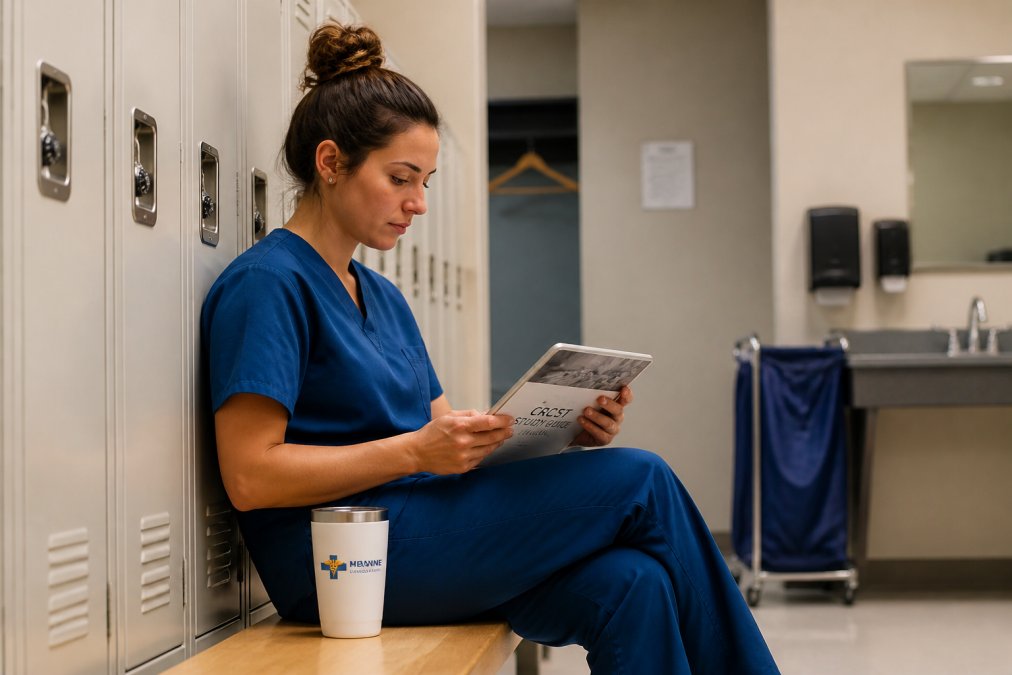
Sterile processing technician studying for CRCST prep courses on a tablet during a break in a hospital locker room
The Three-Part Problem Full-Time Workers Face
Most guides treat clinical hours as a single checkbox. In practice, employed candidates hit three separate walls:
Coverage. Hours spent only in decontamination do not demonstrate competency in assembly, sterilization, or sterile storage. You need rotation through each area, and your manager controls that rotation.
Verification. Someone with authority over your department has to sign off on the hours. Many employers will verify, but few track them proactively.
Timing. Hours must be complete before you sit for the exam. If you finish coursework first and only then start chasing signatures, you slip your target test date.
How to Arrange Rotations Without Burning Your Shift
Do not try to study on shift. You will make errors, and in a department handling surgical instrumentation, errors matter. Instead, separate the two goals: earn hours on the clock, study off it.
Ask your manager for a written rotation plan that touches decontamination, assembly and packaging, sterilization, and sterile storage. Frame it as cross-training, which most departments already want for coverage.
Volunteer for the areas you are weakest in. A technician who normally works assembly can often pick up decontamination shifts when someone calls out, and those hours count.
Track hours weekly in a spreadsheet your supervisor can sign off on, with columns for date, area, hours, and initials. A running log is far easier to verify than a reconstructed one.
Confirm the exact hour total and competency list with your program before you start counting. Requirements and documentation formats can change, and a program that arranges clinical placements for you removes most of this work.
Watch OutVerifying clinical hours after the fact is far harder than logging them as you go. Candidates who finish their coursework and only then ask their manager to reconstruct months of hours frequently miss their target test date by a full quarter.
What to Ask a Prep Provider About Clinical Hours
Before you pay for any course, ask three questions in writing:
Does the program arrange clinical placements, or do you find your own site?
Does it provide a documentation template that matches what the certifying body expects?
What happens if your hours are rejected or your rotation is interrupted by a schedule change?
Employer Reimbursement and Funding Options for CRCST Training
Employer reimbursement is the most underused funding route in sterile processing. Many hospital systems already have tuition assistance or professional development budgets that managers never advertise, because nobody asks.
The Policy Vocabulary That Gets You Paid
Managers approve requests that fit an existing budget line. Learn the terms your facility uses so your ask lands in the right bucket:
Tuition assistance or tuition reimbursement, usually a formal HR policy with a dollar cap per year and a grade or completion requirement.
Professional development or continuing education, often a smaller departmental budget the manager controls directly, with less paperwork.
Certification reimbursement, some systems cover exam fees and prep separately from tuition, so ask about both.
Career ladder or clinical ladder, if your facility has one, certification may trigger an automatic differential rather than a discretionary raise.
A One-Page Request You Can Adapt
Bring a single page, not a verbal request. Include:
The program and total cost, including exam fee and any materials.
The business case. Frame it as retention, survey readiness, and reduced reprocessing errors, not personal benefit. A certified technician supports accreditation surveys and can precept new hires.
The commitment. Offer to stay 12 months after certification, or to precept one new technician. A commitment converts a cost into an investment.
The timing. State whether you need upfront payment or can be reimbursed on completion, and ask which the facility prefers.
The fallback. If the full amount is not available, ask for partial funding, exam fee coverage, or paid study time.
Pro TipSubmit the request during budget planning season if you can. Departments often have more discretion over next year's professional development line than over money already committed this quarter.
If the Answer Is No
A refusal is not always final. Common alternatives:
Shift flexibility instead of cash. Getting your clinical hours signed off is often worth more than the tuition, and a manager who cannot fund a course can usually approve a rotation.
Exam fee only. Many facilities will cover the certification exam even when they will not cover prep.
Payment plans and deferred billing. Some providers offer financing with no payment for the first 30 days, which gives you time to file reimbursement paperwork before the first bill arrives. Pricing depends on the program and format, so request a quote directly rather than budgeting from a guess.
Tax treatment. Some education expenses related to your current job may be deductible or eligible for an employer education assistance exclusion. Rules and limits change, so confirm with a tax professional rather than relying on a coworker's experience.
Document every conversation in writing, even a short follow-up email summarizing what was agreed. If funding is approved, get the approval in writing before you enroll, and confirm whether the facility pays the provider directly or reimburses you after completion.
How to Negotiate a Higher Salary After CRCST Certification
Certification gives you use, but only if you use it at the right moment. The strongest position is a written offer or a scheduled review, not a casual conversation in the hallway.
Key TakeawayThe raise usually comes from the role you move into, not the certificate itself. Pair your CRCST with a leadership track such as CHL preparation and you are negotiating for a different job, not a bump in the same one.
Common Mistakes When Choosing Online CRCST Prep Courses
The most expensive mistake is buying on price alone and never finishing. The second is choosing a program that covers the exam but ignores the clinical hours requirement, leaving you certified on paper and stuck in practice.
Watch for these:
No stated pass rate. A provider that avoids the question usually has a number it does not want to publish.
No clinical hour support. Ask explicitly how the program helps you arrange and document hands-on training.
Textbook-only instructors. Current certifications and current field experience are not the same thing.
No practice exams. Reading material without timed testing is not exam prep.
Fixed schedules with no recordings. If you miss a session on a 12-hour shift day, you need a replay.
What to Check
Weak Program
Strong Program
Schedule
Fixed live sessions only
Self-paced with recordings
Pass rate
Not disclosed
Published or shared on request
Instructors
Textbook-based
Currently certified, field-active
Clinical hours
Not addressed
Guidance and documentation support
Exam practice
Chapter quizzes
Full-length proctored practice exams
Funding help
None
Employer reimbursement guidance
Conclusion
The hardest part of earning your CRCST while working full-time is not the exam. It is protecting the study time and logging your clinical hours.
Frequently Asked Questions
Can I work full-time while studying for my CRCST?
Yes. Many online CRCST prep courses are designed for working professionals. Look for self-paced modules, recorded lectures, and audio options that fit around 12-hour shifts. The key is choosing a program with flexible scheduling and no fixed class times. Set aside 5-7 hours per week for study, and use downtime on breaks to review flashcards or listen to audio lessons. Most students complete the coursework in 8-16 weeks while working full-time.
How long does it take to get a CRCST certification online?
Most online CRCST prep courses take 8-16 weeks to complete, depending on your pace and prior experience. The certification exam itself is separate. You must also complete the required sterile processing clinical hours requirement, which typically involves 400 hours of hands-on experience. If you are already working in a sterile processing department, those hours may count toward the requirement. Check with your employer and the certification body for specific documentation.
What should I look for in a CRCST exam study guide?
A good CRCST exam study guide covers all exam domains: decontamination, preparation and packaging, sterilization, sterile storage, and distribution. It should include practice questions with detailed answer explanations, not just answers. Look for guides updated for the current exam version and aligned with industry standards. Many online prep courses include a study guide as part of their package. If you buy separately, verify the publisher is recognized by healthcare facilities.
How difficult is the CRCST exam?
The CRCST exam is challenging but passable with proper preparation. It covers 150 multiple-choice questions across several areas, including instrument decontamination, surgical instrumentation, and infection control. The passing score is typically 70%. Many candidates find the exam difficult if they rely only on on-the-job training. A structured online prep course with practice tests and a solid study guide significantly improves your chances. Focus on weak areas and take multiple practice exams before scheduling.
Central Sterile Processing Instructors — New York &
New Jersey
Our instructors are credentialed sterile processing professionals who teach CRCST,
CIS and CHL preparation classes and place graduates in hospitals, surgical centres
and third party reprocessing units across the tri-state area.