

Last Updated: September 11, 2026
Choosing among online sterile processing programs comes down to three things: accreditation, externship support, and certification alignment. Get those wrong and you'll finish without the clinical hours or credentials employers require.
Most programs advertise flexibility but don't explain how you'll complete the hands-on requirement for a national certification exam.
Accreditation determines whether your certificate carries weight with hospital hiring managers. It's formal recognition that a program meets standards set by a recognized accrediting body.
Look for programs tied to industry-recognized credentials, particularly the Certified Registered Central Service Technician (CRCST) credential administered through the Healthcare Sterile Processing Association (HSPA). Coursework should map to exam domains: instrument decontamination, sterilization methods, and quality assurance.
A common mistake is enrolling in a program with no stated accreditation and no exam alignment, leaving you with a certificate employers don't recognize.
Clinical externship placement is the biggest differentiator between programs. CRCST certification requires documented hands-on hours in a real central sterile supply department, and not every online program helps you find that placement.
Ask directly: does the program have partner facilities, or do you source your own site? Programs with placement coordinators save weeks of cold-calling.
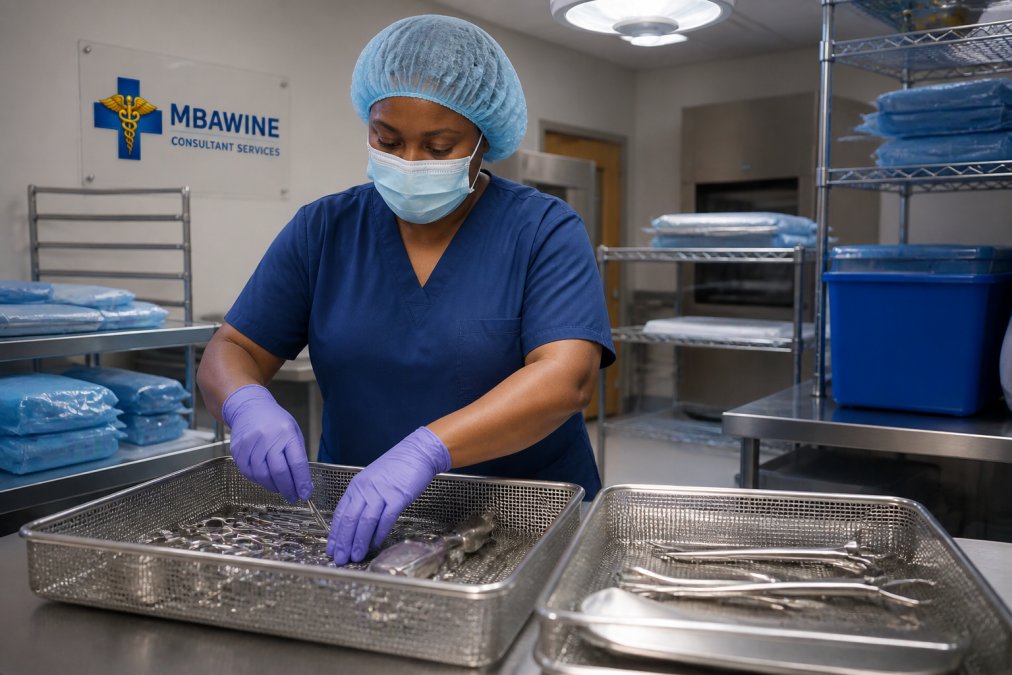
The five options below represent the main program types available in 2026: comprehensive test prep with placement support, community college career diplomas, self-paced online certificates, employer-sponsored training, and hybrid university programs.
| Program Type | Format | Best For | Clinical Placement Help | Certification Prep |
|---|---|---|---|---|
| Mbawine Consultants | Live and recorded audio/video, web conferencing | Working technicians needing fast CRCST prep | Guidance from credentialed instructors | CRCST, CIS, CHL |
| Community college career diploma | Semester-based, hybrid | Students wanting a full academic credential | Varies by school | CRCST aligned |
| Self-paced online certificate | Fully online, self-paced | Self-motivated learners on tight schedules | Student-sourced | Exam review only |
| Employer-sponsored training | On-site plus online modules | Current hospital employees | Built into employment | Employer-funded |
| Hybrid university program | Online coursework plus campus labs | Career changers wanting structured pacing | Campus lab hours | CRCST aligned |
1. Mbawine Consultants
Mbawine Consultants leads this list because it's built for people already working on the floor. The CRCST and CIS test preparation uses live and recorded audio and video modules plus web conferencing, so you can review instrument decontamination and autoclave operation between shifts. Instructors are highly credentialed practitioners, not textbook lecturers, and financing includes no payment for the first 30 days. The limitation: this is exam preparation, not a full academic degree.
2. Community College Career Diploma
Regional community colleges offer career diplomas in sterile processing that bundle general education with technical coursework. The advantage is a recognized academic credential and access to financial aid. The drawback: semester start dates and fixed lab times clash with 12-hour hospital shifts.
3. Self-Paced Online Certificate
These programs let you move through online coursework at your own speed, often completing in a few months. They work well for disciplined learners. The catch is clinical externship: most require you to find your own placement site, which is harder than it sounds in competitive markets.
4. Employer-Sponsored Training
Many hospital systems run in-house training with online modules and on-site clinical hours. If your employer offers tuition reimbursement, this is often the cheapest path. Coverage and eligibility vary, so confirm details with HR.
5. Hybrid University Program
Hybrid programs combine online lectures with periodic campus lab sessions, suiting career changers who want structure and face-to-face instruction. Cost and travel time are the trade-offs.
CRCST certification requirements center on a high school diploma or equivalent, completion of a recognized training program, and documented hands-on experience before you sit for the exam. HSPA sets the eligibility standards, so verify current requirements with the certifying body before enrolling.
Eligibility typically includes:
The exam covers instrument decontamination, medical device sterilization, aseptic technique, and infection control. Recertification requires continuing education credits, so plan for ongoing professional development.
Getting sterile processing clinical hours is the step most online learners underestimate. Certification bodies require documented hands-on experience in a real central sterile supply department, and online coursework alone does not satisfy it, yet most program guides tell you hours are required, then leave you to figure out placement alone.
Here's how externship coordination actually works, and how to tell whether a program is genuinely helping you.
Programs use the phrase loosely. Placement support falls into three tiers:
When you evaluate a program, ask which tier it operates in. "We help you find placement" is not the same as "we have a coordinator who places you." Ask for the coordinator's name, how many partner facilities they work with, and what happens if no site is available in your area during your enrollment window.
Before you can set foot in a hospital SPD as a student, the school and facility usually need a signed affiliation agreement (sometimes called a clinical placement agreement), a contract covering liability, supervision, scheduling, and student conduct. It can take weeks to negotiate and is the most common reason clinical hours get delayed.
If you source your own site, you cannot sign this agreement yourself, your program has to. Even a "student-sourced" placement depends on your program's willingness to paper the arrangement with the facility you found, and some programs will not enter into new affiliation agreements at all.
If your program does not place you, treat the search like a job hunt:
Documentation matters as much as the hours themselves, and certification bodies are strict about format. Facilities often sign off weeks after you finish, so start logging the day you begin.
Track, at minimum:
Getting clear answers to those five questions separates programs that actually place students from programs that simply require placement. The difference is usually measured in months.
Sterile processing technician salary expectations vary by region, facility type, shift, and credential stack, but the biggest lever is certification. Most employers post a pay differential for certified technicians, and hospital systems typically pay above standalone ambulatory surgery centers because they run higher surgical volumes and more complex instrument sets.
According to the U.S. Bureau of Labor Statistics occupational outlook for medical equipment preparers, demand for these roles continues to grow as surgical volumes increase. For current wage data in your area, check the BLS Occupational Employment and Wage Statistics database and local hospital job postings rather than relying on national averages, metro-level pay in high-cost regions can run well above the national median, and rural facilities often pay below it.
Four levers matter more than years of service:
Most program guides stop at entry-level pay. The longer view: sterile processing is a ladder, not a single job:
Each rung compounds. A technician who earns CRCST, then CIS, then CHL over several years sees a materially different earnings trajectory than one who stops at the first credential, and each credential opens doors at other facilities, where real wage growth happens.
Entry-level pay is modest, but certification, shift differentials, specialty credentials, and the supervisory path change the picture quickly. Plan the ladder from day one rather than treating the first certification as the finish line.
State-specific licensing requirements are the detail most online program guides skip. Some states mandate certification for sterile processing technicians; others leave it to employer policy. Check your state health department's facility regulations before assuming a national credential is enough.
This is where employer-sponsored tuition reimbursement becomes valuable. Many hospital systems cover certification prep, exam fees, or continuing education for current employees. Ask HR three questions:
If you're weighing a leadership path, the Certified Healthcare Leader (CHL) credential builds on CRCST experience. Mbawine Consultants offers CHL preparation alongside its CRCST and CIS tracks, letting technicians plan a career ladder rather than a single exam.
The hardest part of becoming a sterile processing technician isn't the coursework. It's finding a program that prepares you for the national certification exam while fitting around 12-hour shifts and securing your clinical hours. Mbawine Consultants was built for exactly that, with fast-track CRCST and CIS test preparation, live and recorded audio and video modules you can access from home, instruction from highly credentialed experts, and financing with no payment for the first 30 days. If you're ready to move from the floor into a certified role, enroll with Mbawine Consultants and start preparing on your own schedule.
The best online sterile processing programs combine accredited coursework with clinical externship placement support. Look for programs that prepare you for the CRCST certification exam, offer self-paced learning, and include hands-on training in instrument decontamination and autoclave operation. Programs from community colleges, technical schools, and specialized providers vary in cost and duration, so compare clinical hour requirements and job placement rates before enrolling.
Most online CRCST certification programs take between 3 and 9 months to complete, depending on whether you study full-time or part-time. The certification itself requires passing the national certification exam and completing a minimum number of hands-on clinical hours. Self-paced learning options let you fit coursework around 12-hour hospital shifts, but you will still need to arrange in-person clinical externship hours at a hospital surgery center or central sterile supply department.
The CRCST credential from the Healthcare Sterile Processing Association (HSPA) is the most widely recognized entry-level certification for sterile processing technicians. Many employers also value the CIS certification for instrument specialists and the CHL for leadership roles. Accreditation matters too: programs aligned with industry-recognized credentials and regulatory standards for medical device sterilization give you the strongest footing when applying to hospital surgery centers and ambulatory-surgical facilities.
Accreditation varies by provider. Some online sterile processing programs hold accreditation from recognized bodies, while others offer career diplomas without institutional accreditation. Before enrolling, confirm that the program prepares you for the national certification exam and includes clinical externship placement support. Ask whether the coursework covers infection control, aseptic technique, and quality assurance, since these topics appear on certification exams and matter for patient safety on the job.


