

The integrity of modern surgical intervention depends entirely upon the invisible rigor of the decontamination cycle. While many view medical device reprocessing as a technical formality, it's actually the cornerstone of institutional safety and public health. Selecting a comprehensive sterile processing class is the most critical step for those seeking to transition into this high-growth field, yet the path is often obscured by conflicting information regarding HSPA and CBSPD standards. You understand that the weight of patient safety rests on your mastery of these protocols, and the anxiety surrounding national certification exams is a natural response to such significant professional responsibility.
This article serves as an authoritative prospectus to help you master the technical and regulatory foundations of medical device sterilization through expert-led education. We'll clarify the distinctions between primary certification bodies, analyze the curriculum requirements for the 9th Edition Technical Manual, and outline the pathway to achieving the 400 hours of clinical experience necessary for full licensure. By the end of this guide, you'll possess a structured roadmap to navigate the complexities of professional training and secure your place as a guardian of clinical excellence.
The Central Sterile Services Department (CSSD) functions as the primary engine of any acute care facility, facilitating the complex cycle of decontamination, assembly, and sterilization that allows surgical services to proceed without interruption. This department isn't merely a support unit; it's the vital hub where the intersection of patient safety and technical precision occurs. Enrolling in a professional sterile processing class is no longer a peripheral choice for those entering the field but a fundamental requirement for understanding the high-stakes nature of modern medical device reprocessing. As healthcare systems evolve, the reliance on informal, on-the-job training is rapidly diminishing in favor of structured academic foundations that ensure every technician operates with a comprehensive understanding of pathogenic transmission and sterilization kinetics.
The operational flow of medical instrumentation through a facility requires a meticulous, unidirectional path from the contaminated zone to the sterile storage environment. This process directly impacts surgical outcomes; any failure in the cleaning or sterilization phase can lead to catastrophic healthcare-associated infections that compromise patient recovery. The relationship between the SPD and the Operating Room is one of absolute interdependence. The technician acts as a silent partner to the surgical team, ensuring that every instrument set meets the rigorous standards established by AAMI ST79. This role demands a level of focus that transcends basic labor, requiring a deep commitment to the meticulous standards that define modern surgical success.
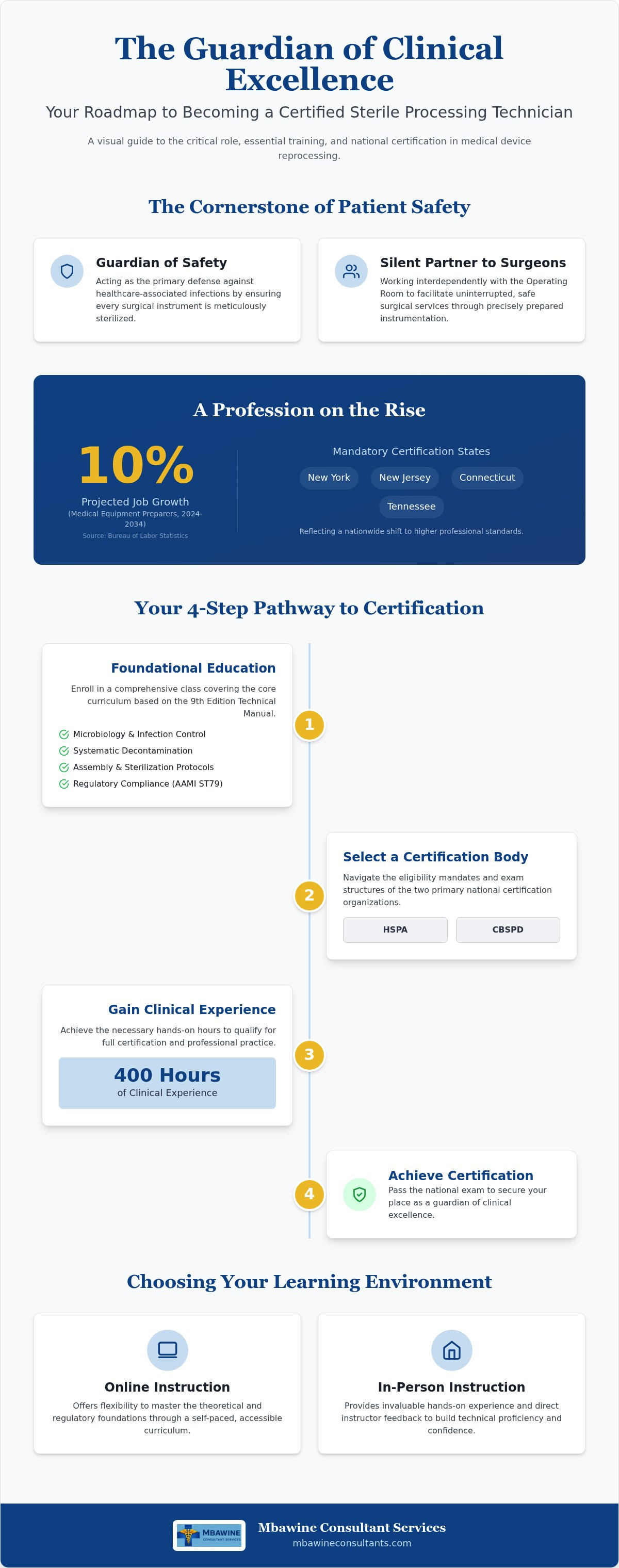
The profession has undergone a significant transformation, moving away from repetitive, task-oriented labor toward a specialized discipline that requires expertise in microbiology and regulatory compliance. This shift is reflected in the growing number of jurisdictions, including New York, New Jersey, Connecticut, and Tennessee, that now mandate professional certification for all practitioners. By choosing a reputable sterile processing class, individuals commit to a culture of accountability that prioritizes institutional standards over convenience. This educational rigor prepares candidates for the Sterile Processing Classes: Certification Guide pathways, fostering a sense of professional advocacy that positions the technician as a guardian of public health. With the Bureau of Labor Statistics projecting a 10% job growth for medical equipment preparers between 2024 and 2034, the transition toward mandatory certification ensures that this growth is supported by a workforce of highly trained, competent professionals.
A rigorous sterile processing class provides the scientific framework required to manage the lifecycle of surgical instrumentation with absolute fidelity. The curriculum begins with a deep exploration of microbiology, specifically focusing on the pathogens most prevalent in clinical settings and the biological mechanisms that allow them to persist on medical surfaces. Understanding the technical foundations of infection control ensures that technicians don't just follow rote steps but actually mitigate risks through informed decision-making. This academic depth is essential for transitioning from a basic laborer to a specialized professional who can navigate the complexities of modern hospital environments.
Decontamination represents the first and most critical line of defense in the sterilization cycle. Students learn the systematic approach to removing bioburden, which involves understanding the specific chemical concentrations of enzymatic cleaners and their interaction with organic matter. This technical mastery extends to the physical handling of biohazardous materials, where the correct application of personal protective equipment (PPE) is treated as a non-negotiable safety standard. Mastery of these protocols is a prerequisite for advancing within the CBSPD certification frameworks, which prioritize the safety of both the technician and the patient through standardized decontamination practices.
Once decontamination is complete, the focus shifts to the inspection and assembly of complex instrument sets. This phase requires an expert eye to identify hundreds of distinct surgical tools and verify their functional integrity. The training covers the selection of appropriate packaging materials, such as non-woven wraps or rigid containers, which must be chosen based on the specific sterilization modality used. Precision in assembly ensures that instruments are not only sterile but also fully operational when they reach the surgical suite.
The science of sterilization itself involves a comprehensive study of various modalities, including saturated steam, Ethylene Oxide (ETO), and vaporized Hydrogen Peroxide. Each method has unique parameters for temperature, pressure, and concentration that must be strictly monitored. Students are trained to interpret mechanical, chemical, and biological indicators to validate that every load meets the necessary sterility assurance levels. Developing these specialized skills is essential for those who wish to enroll in a professional certification program that bridges the gap between theoretical knowledge and clinical application.
Achieving national certification represents the definitive benchmark of professional competency in medical device reprocessing. The choice between the Healthcare Sterile Processing Association (HSPA) and the Certification Board for Sterile Processing and Distribution (CBSPD) often depends on specific institutional preferences and long-term career objectives. While both organizations maintain rigorous standards, their frameworks for eligibility and maintenance differ significantly. A professional sterile processing class provides the academic foundation necessary to navigate these differing requirements, ensuring that candidates are prepared for the technical depth of either examination. It's not merely about passing a test; it's about validating one's ability to protect patient safety through standardized practice.
The Certified Registered Central Service Technician (CRCST) credential, offered by HSPA, is widely regarded as the industry standard. Candidates must demonstrate mastery of the 9th Edition Technical Manual and complete 400 hours of hands-on clinical experience. This clinical component is vital because it translates theoretical concepts into tactile proficiency within a live healthcare environment. HSPA allows candidates to sit for the exam before completing their clinical hours, though they're granted only a six-month provisional window to finalize the requirement. Maintenance of this credential requires an annual renewal fee and the submission of 12 continuing education points to stay current with evolving AAMI standards. For those seeking structured guidance through this complex process, Mbawine CRCST Preparation offers a comprehensive pathway to meeting these rigorous institutional demands.
The CBSPD offers the Certified Sterile Processing and Distribution Technician (CSPDT) designation as a robust alternative. This path is often favored by those working in outpatient facilities or ambulatory surgery centers where facility requirements might prioritize different operational nuances. The recertification cycle for the CBSPD occurs every five years, requiring 100 contact hours to maintain active status. This longer cycle demands a consistent commitment to professional development rather than an annual check-in. Mbawine classes are architected to support both certification frameworks, providing a versatile education that remains relevant regardless of which board a technician chooses. Success on the first attempt requires a methodical study strategy that synthesizes theoretical knowledge with the practical realities of the decontamination room, ensuring that every sterile processing class participant feels equipped for the high-stakes environment of the national exam.
The pedagogical landscape for sterile processing education has diversified significantly, presenting candidates with several distinct pathways to professional mastery. When selecting a sterile processing class, prospective technicians must conduct a rigorous assessment of their own learning styles and professional constraints. The choice between digital platforms and traditional classroom environments isn't merely a matter of convenience; it's a strategic decision that influences one's ability to synthesize complex regulatory standards and technical protocols. While theoretical knowledge can be acquired through various mediums, the high-stakes nature of medical device reprocessing often necessitates a learning environment that mirrors the precision of a clinical setting.
Digital platforms have matured into sophisticated hubs for theoretical instruction, offering the flexibility required by individuals transitioning from other careers. These online modules facilitate a deep dive into microbiology and sterilization science, allowing students to engage with the curriculum at a pace that ensures total comprehension. However, this modality demands a high degree of self-discipline and a structured study schedule to overcome the inherent challenges of remote learning. It's essential to evaluate the quality of virtual instructional materials, ensuring they include interactive assessments and comprehensive support systems that address the technical nuances of the HSPA 9th Edition Technical Manual. A reputable online program should provide a bridge between abstract concepts and the practical realities of the decontamination room, ensuring that the absence of physical presence doesn't result in a deficit of technical understanding.
In-person instruction remains the gold standard for tactile learners who benefit from immediate, expert-led feedback. This environment provides direct access to seasoned mentors and industry consultants who serve as guardians of public safety, offering insights that extend beyond the standard curriculum. Classroom settings facilitate peer-to-peer learning and the development of professional networks, which are invaluable as students prepare to enter a high-demand healthcare workforce. Physical laboratory experiences allow for the simulated handling of complex surgical instrumentation, ensuring that students develop the manual dexterity and inspection skills required for clinical excellence. This direct mentorship is particularly effective in reducing anxiety regarding exam difficulty, as instructors can provide targeted guidance on the most challenging aspects of national certification. You can review the Mbawine Enrollment and Schedules to identify a session that provides the structured, authoritative environment necessary for your career launch. To ensure you receive the most comprehensive training available, secure your seat in an upcoming professional course today.
Mbawine Consultant Services approaches the sterile processing class not as a standalone educational product but as the foundational entry point into a specialized professional ecosystem. By integrating pedagogical excellence with high-level institutional consulting, the organization ensures that students aren't merely absorbing theoretical data; they're mastering the operational standards required by modern healthcare facilities. This dual perspective allows the curriculum to remain agile, reflecting the latest shifts in AAMI standards and regulatory mandates that govern the field. It's this commitment to the professionalization of the industry that distinguishes a graduate of this program as a true guardian of public safety.
The transition from a certified candidate to a practicing professional is facilitated through a robust network of staffing and alumni connections. Mbawine serves as a vital bridge, connecting highly trained technicians with facilities that face critical personnel shortages or require specialized expertise for complex surgical programs. The organization provides both temporary and permanent staffing solutions, ensuring that every placement meets the rigorous technical requirements of the host institution. You can explore these career pathways through the Mbawine Staff and Alumni portal, which functions as a central nexus for professional advancement. This direct connection ensures that the investment in your education translates into a stable career within a high-demand healthcare sector.
Beyond individual education, Mbawine provides essential support to healthcare systems through interim management and departmental optimization. The same rigorous standards taught in every sterile processing class are applied to consulting engagements, ensuring that departments operate at peak efficiency while maintaining total regulatory compliance. This holistic approach addresses the "guardian" role of the technician at an institutional level, bridging the gap between individual certification and departmental excellence. For a comprehensive analysis of how these services enhance departmental performance, refer to The 2026 Guide to Sterile Processing Consultant Services. By offering interim leadership, the firm stabilizes departments during administrative transitions, ensuring that patient safety remains the primary priority throughout any operational change. This commitment to lifelong professional development ensures that both the technician and the institution remain at the forefront of the industry.
The transition into medical device reprocessing requires more than just a passing familiarity with surgical tools; it demands a rigorous commitment to the scientific principles of microbiology and the regulatory standards established by national certifying bodies. By completing a professional sterile processing class, you position yourself at the intersection of technical precision and public health advocacy. You've learned that the path to CRCST or CSPDT certification is a multifaceted journey involving both theoretical mastery and the 400 hours of critical clinical experience required for institutional excellence. Mbawine Consultant Services stands ready to support this transition through expert-led instruction by industry consultants and comprehensive preparation for national examinations. As a trusted partner for healthcare staffing and interim management, we provide the institutional bridge necessary to move from the classroom into a high-demand healthcare career. Your dedication to excellence ensures that every surgical outcome begins with a foundation of absolute sterility. We invite you to Enroll in Mbawine Sterile Processing Classes Today and begin your journey toward professional mastery. Your future as a vital member of the healthcare team starts with the right educational foundation.
The primary distinction lies in the recertification cycle and clinical requirements. HSPA requires annual renewal accompanied by 12 continuing education points and 400 hours of hands-on experience for full CRCST status. The CBSPD utilizes a five-year recertification cycle that requires 100 contact hours. While both are nationally recognized, HSPA is often the preferred standard for acute care hospitals, whereas CBSPD is frequently utilized in ambulatory surgery centers.
The academic portion of a sterile processing class generally spans between 4 and 16 weeks depending on the program's intensity. This timeframe focuses on mastering the theoretical foundations of microbiology and sterilization science. It's important to understand that achieving full national certification requires an additional commitment to fulfill 400 hours of clinical experience, which most students complete within three to six months of full-time work.
Most professional programs require a high school diploma or an equivalent secondary education credential as a baseline prerequisite. While prior medical experience isn't mandatory, candidates must possess the physical stamina to stand for long periods and the manual dexterity to handle complex surgical instrumentation. A foundational understanding of medical terminology is helpful, but most technical competencies are developed through the structured curriculum of the training program itself.
You can complete the academic requirements and prepare for the national exam through an online sterile processing class, but full certification is not granted without clinical hours. The HSPA allows you to take the certification exam after finishing your coursework, but your status remains provisional. You must then complete and document 400 hours of hands-on experience in a healthcare facility within six months to finalize your professional credentials.
The job outlook is exceptionally positive, with the Bureau of Labor Statistics projecting a 10% growth rate for medical equipment preparers through 2034. This rate is significantly faster than the average for all occupations, resulting in approximately 10,900 job openings annually across the country. This demand is driven by an aging population and the increasing volume of surgical procedures performed in both traditional hospitals and specialized outpatient centers.
Fulfilling this requirement involves working or volunteering in a Central Sterile Services Department under the direct supervision of a certified manager. You must document specific hours across various areas, including decontamination, assembly, and sterilization. Mbawine Consultant Services utilizes its extensive staffing and consulting networks to help students identify reputable facilities where they can gain this essential hands-on experience while adhering to the highest institutional standards.
The national exams prioritize core technical competencies that directly impact patient safety. The most heavily weighted sections typically include:
Certification is becoming mandatory because it provides an objective verification of a technician's competency in following AAMI and ANSI standards. Healthcare facilities face increasing pressure from regulatory bodies like The Joint Commission to ensure all staff are properly trained to prevent healthcare-associated infections. By requiring certification, institutions mitigate liability and ensure that every technician functions as a qualified guardian of the sterile field and overall surgical excellence.

Article by
Mba Akuribila
Mba‑Akuribila is a healthcare leader, educator, and founder of Mbawine Consultants, a Bronx‑based institution recognized nationwide for advancing excellence in sterile processing and allied health workforce development. Born in Bongo in Ghana’s Upper East Region, his journey from rural beginnings to national impact reflects a lifelong commitment to service, empowerment, and community advancement.
For over two decades, he has trained sterile processing employees, mentored, and placed thousands of healthcare professionals across the United States. Through Mbawine Consultants, he established one of the country’s most trusted Sterile Processing Certification Test Prep Programs, preparing new Americans and career‑changers for successful entry into the field. The organization, as at 2026, has graduated more than 15,000 sterile processing technicians who now serve in hospitals, ambulatory centers, dental practices, and reprocessing facilities nationwide.
Under his leadership, Mbawine Consultants has expanded into a full Healthcare Staffing Agency, connecting nurses and allied health professionals to meaningful employment opportunities. His team also provides Interim Management Services, supporting hospitals and surgical centers with experienced leaders who stabilize operations, strengthen compliance, and improve workflow efficiency.
As a former surgical technician, sterile processing manager, educator, and system‑wide director, Mba‑Akuribila brings deep expertise to Sterile Processing Consulting, helping healthcare facilities elevate quality, safety, and regulatory readiness.
His work in the United States and Ghana continues to reflect his core philosophy: service above self, opportunity for all, and excellence without compromise.


