

Surgical patient safety is fundamentally forged through rigorous biochemical and mechanical discipline long before a surgeon makes the first incision. For dedicated healthcare professionals seeking to master cental stelie processing operations, however, establishing a career in sterile services can quickly feel overwhelming. It's entirely normal to feel intimidated by dense ANSI/AAMI standards, complex microbiological principles, and the persistent confusion surrounding the distinct credentials offered by HSPA versus CBSPD, areas where Mbawine Consultant Services provides expert guidance.
You don't have to navigate mandatory clinical hours, facility compliance audits, or high-stakes certification requirements through frustrating trial and error. This definitive guide provides the structured framework you need to master the core operational principles, sterilization standards, and professional pathways governing modern healthcare environments. Across the following sections, we'll examine the complete instrument reprocessing cycle from decontamination to sterile storage, outline actionable strategies to pass the CRCST exam on your first attempt, and chart an authoritative roadmap for your long-term career advancement nationwide.
Central sterile processing is the specialized clinical discipline dedicated to eradicating pathogenic microorganisms from reusable medical devices, thereby preventing catastrophic hospital-acquired infections. Operating as the operational heart of acute surgical services, modern perioperative suites depend entirely on continuous, flawless instrument throughput managed by the central sterile services department. Without this rigorous reprocessing engine, invasive clinical procedures immediately grind to an unscheduled halt.
Every year, millions of surgeries rely on the meticulous execution of cental stelie processing protocols. Rather than simply washing instruments, technicians orchestrate a strict chain of custody: receiving soiled assemblies, conducting micro-level chemical decontamination, inspecting delicate mechanical joints, packaging assemblies under aseptic technique, and executing validated terminal sterilization cycles. This systematic workflow eliminates the biological reservoirs that trigger deep surgical site infections.
Patient advocacy within sterile processing begins with unyielding compliance to manufacturer Instructions for Use (IFU). Because modern surgical instrumentation incorporates intricate lumens, robotic articulation, and heat-sensitive optical polymers, standard cleaning approaches no longer suffice. Technicians function as the definitive frontline defense against cross-contamination vectors, intercepting bioburden, bloodborne pathogens, and transmissible endospores before trays ever return to sterile fields.
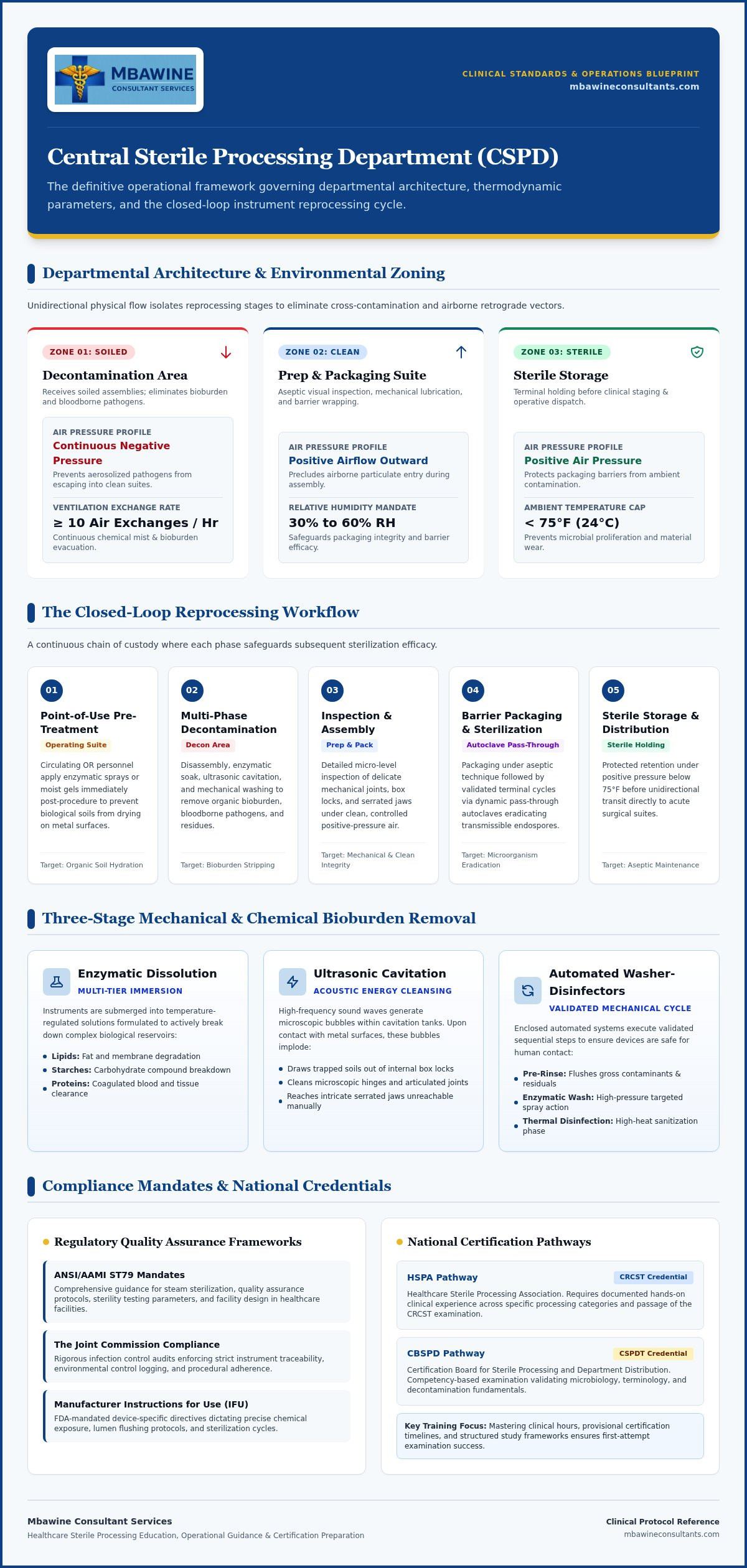
Modern departmental engineering relies on unidirectional physical flow to prevent airborne and contact-mediated retrograde contamination. Facility architecture isolates reprocessing activities into segregated zones governed by precise thermodynamic parameters:
By enforcing physical structural walls, pass-through visual windows, and interlocking dynamic pass-through autoclaves between dirty and clean environments, facilities eliminate cross-traffic contamination risks. Mastering these architectural fundamentals ensures that foundational decontamination translates into unquestioned clinical sterility throughout healthcare networks nationwide.
Instrument reprocessing represents a closed-loop quality continuum where a lapse at any stage compromises terminal sterility. Point-of-use pre-treatment initiates this systematic cycle. Circulating operating room personnel apply enzymatic sprays or moist gels immediately after surgical intervention, preventing biological soils and synthetic polymers from desiccating on metallic surfaces prior to transport. Adhering strictly to FDA guidance on reprocessing medical devices, departmental staff systematically advance contaminated surgical instruments through distinct decontamination and assembly protocols.
Decontamination strips resilient organic debris and bioburden through coordinated chemical and mechanical actions. Technicians first immerse disassembled instruments into temperature-controlled, multi-tier enzymatic solutions that actively break down lipids, starches, and blood proteins. Next, ultrasonic cavitation tanks produce high-frequency sound waves that form microscopic imploding bubbles, pulling trapped bioburden from intricate box locks, hinges, and serrated jaws. Automated washer-disinfectors then execute multi-phase cycles of pre-rinsing, enzymatic washing, and thermal disinfection, rendering instruments safe for handling.
Cleaning alone doesn't guarantee sterility. Once dry, instruments undergo meticulous examination under high-power lighted magnification to verify the complete absence of bone debris, bioburden, and structural flaws like pitting or burrs. Technicians subsequently assemble validated instruments into standardized procedural sets using rigid sterilization containers, multi-ply non-woven wraps, or specialized peel pouches. Internal chemical indicators are positioned inside every assembly to confirm that sterilizing agents achieve adequate penetration during subsequent cycle exposure.
Terminal sterilization eliminates lingering microbial life, including resilient bacterial endospores. High-temperature dynamic air-removal steam autoclaves remain the primary modality for durable, heat-tolerant stainless steel sets. Conversely, moisture- and heat-sensitive devices, such as robotic arms and diagnostic scopes, require low-temperature vaporized hydrogen peroxide gas plasma systems. Biological indicators containing viable Geobacillus stearothermophilus spores serve as the definitive benchmark for confirming true cycle lethality.
Mastering these critical, multi-phase cycles requires systematic didactic training and precise manual discipline. Developing rigorous competence in cental stelie processing workflows equips candidates to protect patient welfare and excel in perioperative environments nationwide. Aspiring technicians can formalize their procedural capabilities through specialized sterile processing certification classes designed to translate technical standards into daily clinical excellence.
Quality assurance within sterile reprocessing is governed by an unyielding framework of legal, federal, and consensus standards. Regulatory bodies do not treat instrument decontamination as routine custodial work; instead, clinical surveyors evaluate reprocessing suites through the lens of strict liability and infection prevention. Healthcare facilities must demonstrate unassailable adherence to evidence-based benchmarks, where incomplete records expose hospital systems to severe accreditation penalties and catastrophic malpractice vulnerabilities.
The Food and Drug Administration (FDA) regulates medical device manufacturers by requiring validated Instructions for Use (IFU) under federal law. Sterile processing departments bear the legal responsibility of executing these parameters without deviation. Facilities seeking operational stability increasingly rely on specialized sterile processing consulting and leadership solutions to ensure their workflows fully satisfy evolving hospital accreditation surveys.
ANSI/AAMI ST79:2017/(R)2022 represents the core benchmark for hospital steam sterilization. This comprehensive standard establishes precise technical criteria across daily operations:
Surveyors from The Joint Commission scrutinize chemical and biological cycle records during unannounced clinical audits. Because undocumented work equates to unperformed work under regulatory scrutiny, electronic asset tracking systems catalog individual instrument trays across their entire lifespan. Barcode scanning links each load to specific patient encounters, sterilizer mechanical printouts, and physical technician signatures.
A resilient tracking system relies on unique lot control numbers detailing the specific sterilizer unit, daily cycle number, and exposure date. When a biological indicator registers a positive failure, technicians immediately identify and quarantine every device processed in that load. Maintaining this unbroken evidentiary audit trail protects patient safety and elevates cental stelie processing into an exact administrative science.
This rigorous compliance environment reflects the broader economic value placed on sterile processing personnel. As documented in the Bureau of Labor Statistics occupational profile for medical equipment preparers, the demand for highly skilled technicians continues to grow alongside increasingly technical sterilization mandates nationwide.
Mandatory certification policies increasingly govern acute care health systems nationwide. Hospital networks no longer view sterile processing as an entry-level stepping stone; instead, executive leadership treats professional credentialing as a vital pillar of clinical risk reduction. Technicians holding recognized credentials demonstrate verified competence across microbiology, medical terminology, and surgical device mechanics, distinguishing themselves as trusted patient advocates.
Currently, seven states mandate professional credentials by statute, with legislative initiatives advancing across additional jurisdictions. In response, acute care facilities nationwide enforce departmental hiring policies that prioritize certified candidates over uncertified applicants. Earning a credential validates theoretical acumen, safeguards surgical suites, and creates reliable avenues for departmental promotion.
Prospective technicians often struggle to differentiate between the primary credentialing entities: the Healthcare Sterile Processing Association (HSPA) and the Certification Board for Sterile Processing and Distribution (CBSPD). Both certifications validate rigorous competency, yet they follow distinct structural requirements:
For candidates pursuing the HSPA track, securing verified hands-on experience represents the most demanding prerequisite. HSPA permits candidates to take the exam first to earn Provisional CRCST status. However, provisional holders face a strict deadline: they must complete and document their 400 clinical hours within exactly six months of passing the exam, or their credential and exam results are completely forfeited.
These clinical hours require balanced exposure across five departmental zones:
Meeting these rigorous milestones demands structured preparation that links textbook theory with live clinical workflows. Candidates seeking to accelerate their preparation and secure first-time success on their credentialing exam can enroll in comprehensive sterile processing classes designed to master the full scope of cental stelie processing operations nationwide.
Mastering surgical instrument reprocessing requires far more than passive memorization. Because credentialing examinations assess both theoretical concepts and real-world clinical troubleshooting, self-directed study through dense technical manuals often leaves candidates unprepared for complex scenario-based questions. Structured didactic training bridges this gap by transforming abstract microbiological principles, chemical properties, and medical device mechanics into practical, retrievable expertise.
Targeted instruction systematically demystifies complex topics that often trigger test anxiety. Candidates must swiftly distinguish between gram-positive and gram-negative bacteria, interpret anatomical terminology to anticipate surgical tray configurations, and master thermodynamic sterilization variables. Investing in expert-led instruction establishes the operational foundation required to excel in cental stelie processing departments across the country.
Not all training programs offer the same depth of operational knowledge. When evaluating educational pathways, prospective technicians should prioritize curricula developed by veteran sterile processing leaders who maintain active departmental consulting and interim hospital leadership experience. Quality programs offer distinct advantages:
Achieving a passing score on the CRCST examination requires disciplined, strategic preparation. Top-tier curricula utilize timed test simulations that accurately mirror the structure, pacing, and cognitive difficulty of national credentialing exams. These adaptive mock assessments pinpoint individual knowledge gaps across chemical monitoring, low-temperature sterilization, and mechanical cleaning, allowing students to refine their focus well before testing day.
Certification serves as the definitive bridge between basic technical literacy and verified clinical excellence. By mastering standard operating procedures and regulatory frameworks in a structured classroom setting, candidates approach their examinations with genuine confidence. Take decisive control of your healthcare career by choosing to enroll in our specialized sterile processing classes today.
Modern surgical excellence depends upon the uncompromising discipline of sterile services personnel. As regulatory oversight expands and healthcare systems increasingly mandate verified competency, mastering cental stelie processing workflows becomes both a patient safety imperative and a transformative career milestone. Precision in decontamination, packaging, and terminal sterilization directly shields vulnerable patients from preventable harm while establishing operational reliability across operating suites.
Achieving national credentialing requires dedicated guidance grounded in current clinical realities. With curricula developed by experienced sterile processing leaders and industry consultants, our specialized instruction provides comprehensive coverage of national standards and core certification competencies. You don't have to face technical examinations or evolving compliance mandates alone. Take the definitive step toward professional distinction today and enroll in professional sterile processing classes to lead the future of healthcare safety.
Sterile processing focuses on the decontamination, inspection, and terminal sterilization of invasive surgical instrumentation, whereas central supply traditionally manages consumable bulk medical materiel, clean linen supply, and non-sterile ward distribution. Although historical facilities combined both roles under one department, modern clinical infection standards mandate that cental stelie processing operates as a dedicated technical discipline physically separated from general hospital logistics.
State law and acute care health systems increasingly mandate national credentials for sterile processing personnel. While seven states enforce statutory certification requirements by law, hospital networks across the remaining jurisdictions routinely establish mandatory internal hiring standards. Facilities prioritize certified technicians to minimize clinical liability, uphold Joint Commission accreditation compliance, and guarantee verified competency across surgical instrument processing lines.
The CRCST examination evaluates comprehensive technical competencies spanning seven primary operational domains. Candidates face computerized multiple-choice questions testing their grasp of medical terminology, human anatomy, microbial eradication, decontamination chemistry, assembly and barrier packaging, sterilization modalities, and inventory distribution. A significant portion of the test challenges examinees with clinical scenarios requiring rapid problem-solving grounded in manufacturer instructions for use and ANSI/AAMI standards.
Didactic coursework and theoretical exam preparation can be completed through structured online classes, but achieving full certification ultimately requires documented hospital experience. High-quality educational programs deliver comprehensive digital lectures, terminology drills, and practice simulations that prepare students for national testing. However, practical proficiency in cental stelie processing demands direct clinical exposure, requiring candidates to translate their virtual curriculum into physical decontamination and assembly skills inside operating hospital suites.
Students fulfill the 400-hour clinical requirement through practical departmental rotations in an acute care hospital or accredited surgical center. Technicians must document specific minimum hours across five areas: decontamination, preparation and packaging, sterilization, storage, and quality assurance. Candidates testing under Provisional CRCST status secure departmental employment or formal volunteer externships, obtaining direct supervisory sign-offs on their documentation within the mandatory six-month post-examination deadline.
Complex lumened devices, robotic articulation instruments, and flexible diagnostic endoscopes present the most severe decontamination hurdles. Narrow internal channels readily harbor blood, tissue fragments, and resilient biofilm that resist standard immersion washing. Cleaning these intricate devices requires specialized mechanical flushing adapters, dedicated ultrasonic cavitation baths, and microscopic borescope inspections to confirm complete bioburden removal before thermal or chemical sterilization can safely take place.
ANSI/AAMI ST79 dictates standard operating procedures across every phase of steam sterilization in healthcare facilities. The standard governs atmospheric airflow parameters, mechanical chamber loading spacing, and dry-time duration. It also establishes mandatory protocols for biological indicator testing and dictates quarantine procedures for implantable medical devices. Technicians adhere to ST79 daily to guarantee that chemical and physical sterilizer variables produce unequivocal microbial lethality.

Article by
Mba Akuribila
Mba‑Akuribila is a healthcare leader, educator, and founder of Mbawine Consultants, a Bronx‑based institution recognized nationwide for advancing excellence in sterile processing and allied health workforce development. Born in Bongo in Ghana’s Upper East Region, his journey from rural beginnings to national impact reflects a lifelong commitment to service, empowerment, and community advancement.
For over two decades, he has trained sterile processing employees, mentored, and placed thousands of healthcare professionals across the United States. Through Mbawine Consultants, he established one of the country’s most trusted Sterile Processing Certification Test Prep Programs, preparing new Americans and career‑changers for successful entry into the field. The organization, as at 2026, has graduated more than 15,000 sterile processing technicians who now serve in hospitals, ambulatory centers, dental practices, and reprocessing facilities nationwide.
Under his leadership, Mbawine Consultants has expanded into a full Healthcare Staffing Agency, connecting nurses and allied health professionals to meaningful employment opportunities. His team also provides Interim Management Services, supporting hospitals and surgical centers with experienced leaders who stabilize operations, strengthen compliance, and improve workflow efficiency.
As a former surgical technician, sterile processing manager, educator, and system‑wide director, Mba‑Akuribila brings deep expertise to Sterile Processing Consulting, helping healthcare facilities elevate quality, safety, and regulatory readiness.
His work in the United States and Ghana continues to reflect his core philosophy: service above self, opportunity for all, and excellence without compromise.


