

Technical mastery at the decontamination sink will make you an exceptional technician, but it won't prepare you to direct sterile processing operations through an unannounced Joint Commission survey. Securing the certified healthcare leader (chl) credential marks the vital transition from frontline instrument reprocessing to strategic healthcare administration, establishing your executive authority across the entire surgical services continuum.
You already know that bridging the divide between bench operations and executive leadership presents significant institutional friction. Interpreting rigorous AAMI and OSHA standards, navigating ambiguous recertification cycles, and justifying departmental capital budgets require far more than mechanical expertise; they demand proven administrative acumen and regulatory discipline.
This definitive guide breaks down the updated prerequisite pathways, the examination blueprint, and the core competencies necessary to validate your management expertise and step into leadership. Ahead, we examine the four testing domains in detail, providing the practical framework you need to build audit-proof quality assurance systems and advance your sterile processing career with complete confidence.
The Certified Healthcare Leader designation represents the standard of managerial excellence within complex medical instrument reprocessing environments. The certified healthcare leader (chl) stands as the premier management credential recognized by healthcare accreditation bodies for sterile processing oversight. Contemporary healthcare networks increasingly mandate specialized leadership credentials for management appointments, recognizing that modern operational scale has outpaced informal departmental training. This certification bridges critical logistical gaps between central processing suites and surgical theaters, translating high-level administrative mandates into disciplined frontline execution. Department heads with this credential carry institutional accountability for sterilization efficacy, infection prevention benchmarks, and regulatory compliance that directly safeguards surgical patients.
Baseline technical credentials validate essential procedural skills, concentrating on decontamination chemistries, complex tray assembly, micro-inspection, and rigid sterilization parameters. In contrast, managerial certification demands verified expertise in fiscal governance, capital budgeting, human resource management, and workforce scheduling. The transition into administrative management requires shifting focus from individual instrument throughput to facility-wide quality assurance systems across the Central Sterile Services Department (CSSD). Professionals establishing their underlying operational competencies often prepare through structured sterile processing classes to ensure their technical foundation supports advanced leadership responsibilities.
Accrediting organizations, including The Joint Commission and state public health authorities, place sterile reprocessing management under intense scrutiny during clinical surveys. Department heads who earn the certified healthcare leader (chl) credential mitigate surgical site infection risks through rigorous standard operating procedures that systematically eliminate reprocessing errors. Beyond clinical safety, administrative competence directly governs fiscal health. Facilities guided by certified leaders achieve higher instrument availability, shorter operating room turnaround intervals, and lower technician turnover through structured departmental accountability.
To qualify for the certified healthcare leader (chl) credential, candidates must hold an active baseline technical credential and satisfy verified operational experience standards. The examination blueprint evaluates critical knowledge domains essential for central service operational oversight through a rigorous computer-based testing format. Rather than assessing basic mechanical repetition, the testing framework demands both theoretical comprehension and situational critical-thinking execution under strict exam conditions, measuring an applicant's ability to orchestrate sterile workflows, oversee fiscal budgets, and enforce statutory mandates.
Candidates pursuing the designation must hold an active CRCST certification through an accredited governing body. Under the updated 2026 qualification framework, applicants must substantiate their technical foundation alongside demonstrated managerial readiness. Examination qualification requires an active technical credential combined with at least 12 months of sterile processing experience, 12 months of documented leadership experience, or a post-secondary Associate degree or higher. Technicians planning their administrative transition must document verified supervisory hours, which include coordinating shift assignments, managing instrument tray optimization projects, or conducting internal audit reviews. Professionals preparing for this career milestone can enroll in specialized leadership classes offered by Mbawine Consultant Services to methodically verify and master these prerequisite competencies.
The computer-based assessment consists of 150 multiple-choice questions administered over a three-hour testing window. The test measures practical problem-solving capability across four systematically weighted functional domains:
Mastering these weighted areas ensures candidates understand how daily administrative decisions directly influence patient outcomes and departmental compliance across the entire surgical continuum.
Translating theoretical examination metrics into daily departmental competence is the definitive challenge of modern central service leadership. The certified healthcare leader (chl) designation serves as a framework for standardizing complex biological barrier operations across acute care settings. While regulatory bodies delineate mandatory parameters, the practicing department leader must integrate these directives into high-volume workflows without causing surgical scheduling bottlenecks. Sustained excellence requires establishing closed-loop quality assurance programs that systematically eliminate contamination risks, control operational overhead, and foster transparent alignment with perioperative clinical teams.
Continuous survey readiness demands methodical oversight rather than reactive preparation before an accreditation audit. Operating procedures must align with current sterile processing classes and published industry consensus standards, encompassing ANSI/AAMI ST79, CDC disinfection guidelines, and FDA reprocessing instructions for use. Leaders direct continuous documentation tracking for physical parameters, chemical indicators, and daily biological monitoring lots. When sterilization aborts or bioburden residuals occur, the departmental head leads comprehensive root-cause analyses using fishbone diagrams and failure mode effects analyses, isolating mechanical failures or human error to prevent clinical breaches.
Central service directors govern complex asset portfolios requiring rigorous financial stewardship. Professional oversight balances inventory availability against high holding costs, as detailed below:
Departmental isolation undermines patient safety and degrades perioperative efficiency. Bridging organizational divides requires structured, objective communication between sterile processing personnel and operating room leadership. Utilizing computerized instrument tracking software, a certified healthcare leader (chl) provides verifiable cycle histories and tray scan records, defusing emotional conflicts over instrument availability. Certified managers represent central service interests on surgical governance committees, presenting empirical throughput data, justifying staffing adjustments, and championing frontline technical education directly to hospital executive leadership.
Preparing for the certified healthcare leader (chl) examination requires an instructional strategy distinctly different from baseline technical testing. Passive memorization tactics and basic definition flashcards fail to cultivate the contextual critical thinking demanded by advanced leadership assessments. Candidates must implement a disciplined, phased preparation curriculum that systematically synthesizes regulatory mandates, labor law statutes, and interdepartmental risk mitigation. Administering an initial diagnostic assessment establishes a clear baseline, identifying individual deficiencies across unfamiliar administrative responsibilities such as asset depreciation, grievance protocols, and capital expenditure forecasting before formal review commences.
A rigorous candidate establishes a structured 12-to-16-week study schedule, allocating dedicated weekly blocks across every core blueprint domain. Allocate preparation time strictly proportional to domain weightings rather than lingering on familiar operational tasks. Primary source materials must anchor this schedule, centering review on the current edition of the Sterile Processing Leadership Manual and core ANSI/AAMI ST79 standards. Incorporating bi-weekly diagnostic milestone tests under timed simulation conditions provides empirical tracking data, allowing candidates to refine their focus and reinforce weaker conceptual areas.
Independent textbook study rarely prepares technicians for the situational complexities found on administrative examinations. Structured educational cohorts provide direct interaction with veteran sterile processing directors who translate abstract management theory into actionable operational strategies. In these interactive environments, instructors deconstruct multifaceted scenarios involving human resource disputes, case-cart delivery failures, and joint accreditation survey conflicts. Prospective managers can build the necessary strategic confidence and accelerate their advancement when they enroll in sterile processing leadership training led by experienced industry practitioners.
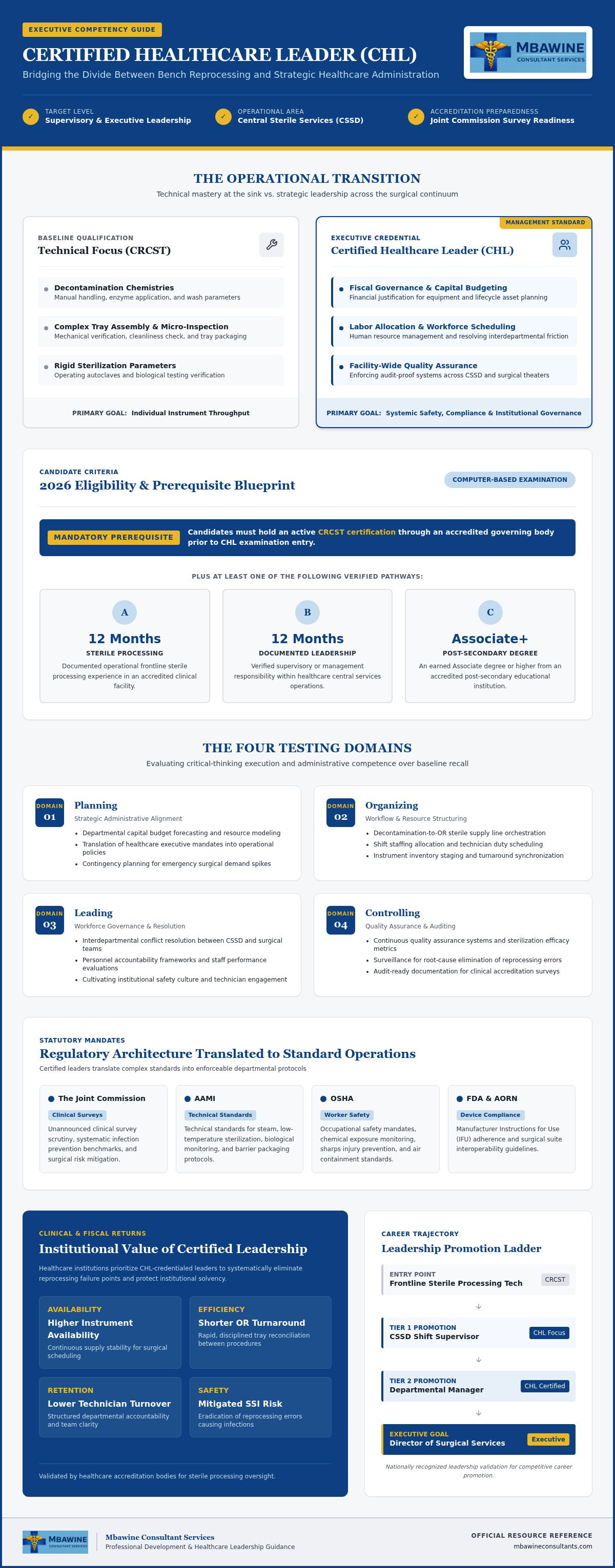
Attaining credentialed status as a certified healthcare leader (chl) reshapes an individual's career path from task-oriented shift execution toward executive clinical governance. Advanced credentialing signals to hospital administrators that a leader possesses both the regulatory fluency and operational maturity required to direct high-risk sterile processing departments. Healthcare networks don't simply seek supervisory oversight; they require leaders who can align sterile processing operations with wider perioperative goals, infection prevention mandates, and fiscal sustainability. Earning this designation confirms administrative readiness, positioning certified professionals at the forefront of modern surgical services leadership.
Healthcare facilities increasingly stipulate the credential as a mandatory qualification or primary hiring preference for central service manager and director vacancies. Certified department heads carry the organizational credibility needed to steer sterile processing divisions through institutional mergers, capital expansions, and automated equipment conversions. Their verified competence commands respect across multidisciplinary surgical committees, allowing them to advocate effectively for staffing models and capital investments alongside chief nursing officers and surgical chairs. When acute care facilities experience unexpected administrative vacancies, experienced managers often transition into strategic roles, such as sterile processing interim leadership, maintaining operational stability and survey readiness during institutional transitions.
Beyond conventional hospital management positions, the certified healthcare leader (chl) designation unlocks diverse, high-impact career pathways in advisory and departmental transformation roles. Seasoned leaders frequently deploy their regulatory expertise through independent sterile processing consultant services, conducting comprehensive gap analyses, evaluating workflow ergonomics, and resolving chronic survey citations for healthcare systems nationwide. In parallel, interim directors leverage systematic management protocols to stabilize distressed departments, standardizing standard operating procedures and rebuilding staffing structures to restore accreditation compliance. Those ready to expand their executive influence and secure administrative roles can take the definitive step to enroll in advanced professional courses designed for emerging sterile processing executives.
Navigating the operational realities of modern surgical instrument processing requires far more than mechanical proficiency. Achieving the certified healthcare leader (chl) credential establishes your strategic vision, proving that you possess the administrative rigor to govern departmental budgets, enforce complex infection prevention mandates, and unite central processing workflows with perioperative demands. This credential validates your transition from frontline task execution to institutional governance, opening expansive pathways into directorships, consulting, and interim executive management.
True operational leadership begins with deliberate, comprehensive preparation. You don't have to face the evolving examination blueprint alone; targeted education aligned with industry benchmarks provides the tactical bridge between foundational knowledge and administrative mastery. Take control of your career trajectory today when you enroll in professional sterile processing certification courses. With rigorous preparation and dedication to continuous quality improvement, you'll establish an audit-proof department and lead surgical services toward standard-setting clinical outcomes.
The Certified Healthcare Leader (CHL) credential is an advanced professional certification administered by the Healthcare Sterile Processing Association (HSPA) that validates comprehensive management and administrative expertise within central service departments. While baseline technical designations verify frontline reprocessing competence, this credential confirms an individual's capability to direct departmental operations, manage fiscal budgets, oversee regulatory compliance, and orchestrate high-level quality assurance systems across multidisciplinary surgical service environments.
Candidates must maintain an active Certified Registered Central Service Technician (CRCST) designation as an absolute baseline. In addition to technical certification, applicants must fulfill at least one administrative qualification pathway: twelve months of verified full-time central sterile processing experience, twelve months of documented supervisory or leadership experience, or an Associate degree or higher from an accredited post-secondary institution. These requirements verify that candidates possess practical exposure to operational workflows before attempting administrative certification.
The examination consists of 150 computer-based, multiple-choice questions administered through proctored testing facilities during a scheduled three-hour testing window. The assessment blueprint evaluates operational leadership across four core domains: Planning and Decision Making (30%), Organizing (25%), Leading (30%), and Controlling (15%). Candidates must analyze complex situational scenarios reflecting real-world clinical governance, inventory logistics, and infection control compliance rather than simple rote procedural recall.
The baseline CRCST credential focuses on technical, task-oriented execution, such as decontamination parameters, surgical instrumentation assembly, packaging, and high-temperature sterilization cycles. Conversely, the certified healthcare leader (chl) credential addresses macro-level departmental stewardship. CHL holders govern resource allocation, lead root-cause analyses following biological indicator failures, interpret AAMI and OSHA regulatory standards, coordinate perioperative supply chains, and direct human resources functions across complex healthcare networks.
Maintaining active certification requires annual recertification aligned with the credential holder's renewal cycle. Certified individuals must submit documentation verifying annual continuing education units that focus heavily on management, leadership, infection control, and sterile processing technologies, alongside paying the annual renewal fee. Additionally, certificants must keep their underlying CRCST credential active, as lapses in baseline technical credentials automatically compromise the validity of the secondary leadership designation.
Credentialed leaders qualify for competitive executive and administrative appointments across acute healthcare systems. Typical positions include central sterile processing supervisor, departmental operations manager, sterile processing director, and surgical supply chain coordinator. Beyond hospital employment, experienced certificants frequently transition into high-impact advisory roles, including healthcare sterile processing consulting or interim departmental management, guiding hospital networks through regulatory surveys, modernization initiatives, and operational restructuring nationwide.
Technicians without formal managerial titles can sit for the examination provided they satisfy the baseline CRCST prerequisite and fulfill the educational or experience criteria. Holding an Associate degree or higher qualifies an active technician, as does accumulating twelve months of verified full-time sterile processing experience. Technicians can also document leadership responsibilities by verifying time spent coordinating shift logistics, mentoring incoming staff, or leading internal departmental quality assurance projects.

Article by
Mba Akuribila
Mba‑Akuribila is a healthcare leader, educator, and founder of Mbawine Consultants, a Bronx‑based institution recognized nationwide for advancing excellence in sterile processing and allied health workforce development. Born in Bongo in Ghana’s Upper East Region, his journey from rural beginnings to national impact reflects a lifelong commitment to service, empowerment, and community advancement.
For over two decades, he has trained sterile processing employees, mentored, and placed thousands of healthcare professionals across the United States. Through Mbawine Consultants, he established one of the country’s most trusted Sterile Processing Certification Test Prep Programs, preparing new Americans and career‑changers for successful entry into the field. The organization, as at 2026, has graduated more than 15,000 sterile processing technicians who now serve in hospitals, ambulatory centers, dental practices, and reprocessing facilities nationwide.
Under his leadership, Mbawine Consultants has expanded into a full Healthcare Staffing Agency, connecting nurses and allied health professionals to meaningful employment opportunities. His team also provides Interim Management Services, supporting hospitals and surgical centers with experienced leaders who stabilize operations, strengthen compliance, and improve workflow efficiency.
As a former surgical technician, sterile processing manager, educator, and system‑wide director, Mba‑Akuribila brings deep expertise to Sterile Processing Consulting, helping healthcare facilities elevate quality, safety, and regulatory readiness.
His work in the United States and Ghana continues to reflect his core philosophy: service above self, opportunity for all, and excellence without compromise.


