

The integrity of a surgical suite doesn't begin with the surgeon's first incision; it starts within the meticulous, high-stakes environment of the Sterile Processing Department. You likely recognize that obtaining a professional credential through sterile processing certification training is more than a career milestone; it's a fundamental obligation to public safety and institutional excellence. However, the path to achieving this status often feels fragmented by the conflicting standards of various governing bodies. Evaluating the choice between HSPA and CBSPD while simultaneously securing the requisite 400 hours of clinical experience can create significant professional anxiety for those entering the field.
This comprehensive guide is designed to demystify the certification process through a structured curriculum that prioritizes academic reliability and technical precision. By following this professional prospectus, you'll gain the clarity needed to master the CRCST exam and secure a stable, high-impact role in a modern healthcare facility. We'll provide an exhaustive assessment of certification pathways, clinical hour requirements, and the strategic milestones necessary to advance from entry-level technician to specialized leadership or department management roles.
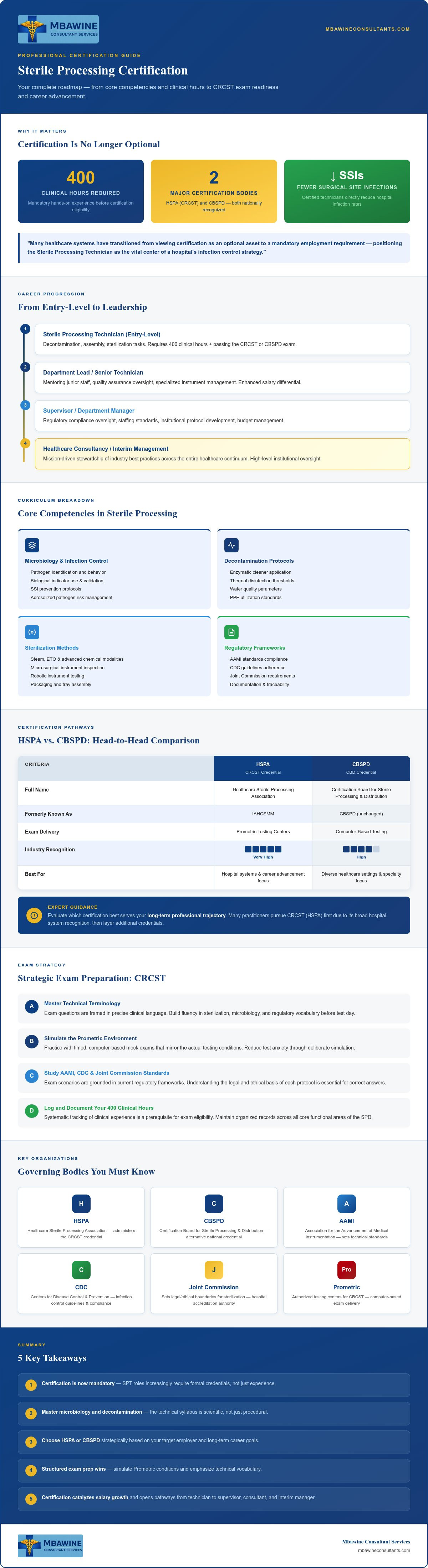
The integrity of a surgical intervention relies entirely on the invisible work performed within the decontamination and sterilization suites. Within this framework, sterile processing certification training serves as the foundational pillar upon which patient safety is constructed. It's no longer a supplementary credential; it's a rigorous professional standard that ensures every instrument reaching the operating room meets exacting biological and mechanical criteria. Many healthcare systems have transitioned from viewing certification as an optional asset to a mandatory requirement for employment. This systemic shift reflects a broader understanding of the Sterile Processing Technician (SPT) as the vital center of a hospital's infection control strategy. The professional gravity of reprocessing complex, high-stakes surgical instrumentation demands a level of technical mastery that can only be validated through a formal assessment of competency.
The historical trajectory of the field, marked by the transition of the International Association of Healthcare Central Service Materiel Management (IAHCSMM) to the Healthcare Sterile Processing Association (HSPA), illustrates a rising bar for technical proficiency. As we approach 2026, industry standards increasingly prioritize the sophisticated use of biological indicators and advanced chemical sterilization modalities to combat evolving pathogens. This professionalization isn't merely academic. It's directly linked to a measurable reduction in Surgical Site Infections (SSIs), positioning the certified technician as a guardian of institutional standards. Mastery of these evolving protocols is essential for anyone seeking to maintain compliance with modern regulatory requirements.
Beyond institutional safety, obtaining a nationally recognized credential functions as a significant economic and professional catalyst. Industry data consistently indicates a substantial salary differential between uncertified staff and those who've completed formal sterile processing certification training. This certification provides the necessary framework for advancement into leadership roles such as department leads, supervisors, or specialized roles in interim management. For many, this path evolves into a mission-driven career in healthcare consultancy. Practitioners in this space act as stewards of industry best practices. They bridge the gap between entry-level technical work and high-level institutional oversight, ensuring that excellence is maintained across the entire healthcare continuum.
The curriculum of a professional sterile processing certification training program is engineered to facilitate a profound transition from a generalist understanding to a specialized mastery of clinical safety protocols. It isn't merely a series of vocational tasks; it's a rigorous academic syllabus that demands mastery of complex biological and mechanical systems. Students must analyze the intricate relationship between microbiology and the decontamination process, ensuring that every protocol is grounded in scientific efficacy. This education also requires a deep understanding of the regulatory frameworks established by the Association for the Advancement of Medical Instrumentation (AAMI), the Centers for Disease Control and Prevention (CDC), and the Joint Commission. These standards provide the legal and ethical boundaries within which a technician operates.
Technical proficiency starts in the decontamination zone, where the application of enzymatic cleaners and specialized detergents is calculated based on soil load and water quality parameters. Understanding the science of thermal disinfection is paramount. Technicians must verify specific temperature and time thresholds required for total biological inactivation. This zone also mandates the strict utilization of Personal Protective Equipment (PPE) to mitigate the risks associated with aerosolized pathogens and chemical exposure.
As surgical technology evolves, the complexity of inspecting and testing micro-surgical and robotic instruments has increased significantly. Training focuses on the functional assessment of these delicate tools to ensure they're free from bioburden and mechanical failure. Technicians must also distinguish between various sterilization modalities, such as saturated steam, ethylene oxide (EtO), and hydrogen peroxide gas plasma. Each method has specific material compatibility and aeration requirements. Accurate documentation for load tracking and sterility assurance is not just an administrative task; it's a professional obligation that ensures every patient receives care with validated sterile instruments. Prospective students can review the comprehensive technical syllabus to begin their journey toward this specialized level of mastery.
The landscape of professional validation in this field is primarily governed by two organizations: the Healthcare Sterile Processing Association (HSPA) and the Certification Board for Sterile Processing and Distribution (CBSPD). Selecting the appropriate sterile processing certification training program requires a deliberate analysis of these accrediting bodies, as each offers a distinct framework for technical assessment and professional mobility. While both certifications are nationally recognized and accredited by the National Commission for Certifying Agencies (NCCA), they differ significantly in their prerequisites and specialized offerings. Understanding these nuances is essential for practitioners seeking to align their credentials with the specific expectations of high-volume surgical departments and institutional standards.
HSPA's Certified Registered Central Service Technician (CRCST) designation is often regarded as the industry benchmark due to its rigorous emphasis on practical application. A defining characteristic of this pathway is the mandatory completion of 400 hours of hands-on clinical experience within a Sterile Processing Department. This requirement ensures that theoretical knowledge is tempered by the physical realities of instrument reprocessing. For those who demonstrate theoretical proficiency before fulfilling this requirement, HSPA offers a provisional certification status. This allows candidates to pass the examination first, provided they complete their clinical hours within six months. You can prepare for your CRCST exam with our specialized curriculum, which is architected to bridge the gap between academic theory and the complexities of the modern SPD environment.
The CBSPD provides an alternative pathway that often appeals to those seeking immediate full certification or specialized technical tracks. Their foundational Certified Sterile Processing and Distribution Technician (CSPDT) credential maintains high standards for technical knowledge across the entire sterilization cycle. Beyond the foundational level, CBSPD offers specialized credentials such as the Certified Instrument Specialist (CIS) and Certified Endoscope Reprocessor (CER). These certifications address the increasing complexity of flexible scopes and robotic instrumentation. When choosing between these paths, students should consider a decision framework based on three primary factors: the specific hiring preferences of local healthcare systems, the desire for international reciprocity, and the individual's long term aspirations for technical specialization or interim management roles.
The debate between online and in-person training models must be viewed through the lens of academic reliability. While online platforms offer logistical flexibility, the most effective sterile processing certification training integrates rigorous digital instruction with a deep understanding of the clinical setting. This comprehensive approach ensures that the gravity of infection control is never minimized by a purely theoretical environment, maintaining the high-stakes nature of the profession while providing a bridge to advanced technical mastery.
Success in the final assessment phase of your professional journey requires more than rote memorization. It necessitates a strategic alignment with the psychometric standards of the testing environment. High-level sterile processing certification training provides the essential framework, but the candidate's personal study methodology often determines the final outcome. One must adopt a systematic approach to technical terminology, focusing on the linguistic roots of surgical instrumentation and microbiological processes. This foundation allows for the intuitive navigation of complex exam questions. Utilizing practice assessments that replicate the Prometric testing interface is critical for mitigating test-day anxiety and mastering time management. Many candidates fail not because of a lack of knowledge, but because they're unprepared for the rigorous tempo of the digital examination. Common pitfalls often include over-focusing on instrumentation names while neglecting the weighted importance of decontamination and sterilization protocols.
The HSPA Certification Handbook serves as the authoritative blueprint for the CRCST exam, detailing the specific weight assigned to various technical domains. Candidates must prioritize their study efforts toward high-weight areas such as decontamination and sterilization, which typically constitute nearly half of the examination content. Within the context of the HSPA Exam Content Outline, Sterile Processing is defined as the comprehensive system of decontamination, inspection, assembly, and sterilization of medical devices to ensure they're safe for patient use according to established regulatory standards. A disciplined study cadence of ten to twelve weeks is recommended, balancing theoretical reading with the practical application of concepts observed during clinical hours.
Securing the mandatory 400-hour hands-on requirement is often the most significant hurdle for prospective technicians. You should approach healthcare facilities with a professional prospectus, inquiring about volunteer or internship opportunities within their Sterile Processing Department. To satisfy HSPA requirements, these hours must be documented across specific competencies, including decontamination, assembly, sterilization, storage, and distribution. Each task must be verified by a department manager or supervisor to ensure the integrity of the professional record. For a deeper understanding of the institutional requirements you'll encounter, you can read our guide on professional sterilization standards. Mastery of these standards is essential for passing the exam and excelling in a clinical setting. To ensure you're fully prepared for these high-stakes requirements, you may enroll in our professional training program to receive expert mentorship through every phase of the certification process.
Mbawine Consultant Services functions as a critical nexus between academic preparation and institutional operational excellence. Unlike generic educational platforms, our sterile processing certification training is deeply rooted in the practical realities of the modern healthcare environment. Because we operate simultaneously as a consulting and staffing firm, our curriculum is continuously refined to reflect the current workforce needs and regulatory challenges faced by Sterile Processing Departments nationwide. This dual-purpose model ensures that students aren't merely learning to pass an examination; they're training under the guidance of industry guardians who understand the high-stakes nature of surgical safety and the meticulous demands of the operating room. Our commitment to the field extends beyond the classroom, positioning our brand as a dedicated advocate for the professionalization of the entire sterilization workforce.
Our pedagogical approach prioritizes technical mastery through a mentor-driven framework that accommodates both entry-level candidates and advancing professionals seeking to refine their expertise. Whether attending our intensive in-person sessions or engaging through our structured online platforms, students encounter a syllabus that mirrors the complexity of a professional prospectus. This isn't a passive learning experience. It's a rigorous immersion into the systematic processes required for CRCST excellence, informed by our ongoing consulting work with facilities to optimize their sterilization workflows. You can enroll in our upcoming sterile processing classes today to begin a journey characterized by academic reliability and professional mentorship that prepares you for the realities of the clinical environment.
The value of our program extends far beyond the issuance of a certificate; we act as a lifelong professional bridge for our graduates. Through our specialized healthcare staffing solutions, we connect qualified technicians with facilities that demand the highest standards of infection control, ensuring a seamless transition from the classroom to the Sterile Processing Department. For those seeking to advance their career trajectory, we provide a clear pathway into interim management and specialized healthcare consulting roles. Our alumni benefit from a robust professional network that provides ongoing support and access to leadership opportunities throughout the healthcare industry. By integrating education with operational support and staffing, we ensure our graduates are positioned as leaders who can navigate the complexities of modern surgical services. You may explore our comprehensive healthcare staffing and consulting services to understand how we support the professional lifecycle of the modern sterile processing expert.
Achieving a nationally recognized credential is the definitive step toward a career characterized by technical mastery and professional reliability. By understanding the rigorous standards of HSPA and CBSPD and implementing a methodical study cadence, you position yourself as a vital asset to any surgical team. Mbawine Consultant Services offers a unique advantage by grounding your sterile processing certification training in the real-world demands of current institutional staffing and management. Our expert-led curriculum ensures you're prepared for the complexities of the CRCST or CSPDT examinations while providing direct access to our extensive alumni and staffing networks. This structured pathway transforms a daunting certification process into a manageable professional milestone. We invite you to Enroll in Mbawine's Professional Sterile Processing Classes to secure your role in this critical healthcare field. Your commitment to patient safety begins with the right educational foundation. We're here to mentor you toward lasting success in the Sterile Processing Department.
Completion of sterile processing certification training typically requires three to six months for the academic component, though the total timeline depends on your clinical hour progression. Most formal programs are structured to cover the technical syllabus in twelve to sixteen weeks. Following the coursework, candidates pursuing HSPA certification must document 400 hours of hands-on experience. This requirement can add several months to the overall professional timeline depending on your weekly shift availability.
You can complete sterile processing classes online and still achieve full national certification through accrediting bodies like HSPA or CBSPD. Professional training firms provide rigorous digital curricula that meet the academic requirements for exam eligibility. However, candidates must still complete the physical clinical requirements in a hospital setting. The credentialing process requires a combination of theoretical mastery and documented hands-on proficiency in an actual department to ensure the highest standards of patient safety.
The primary distinction between HSPA and CBSPD lies in their clinical experience requirements and certification structure. HSPA requires 400 hours of hands-on experience for its CRCST credential, which can be completed before or after the examination. CBSPD offers a more direct pathway for its foundational technician credential while providing specialized tracks for instrument specialists and endoscope reprocessors. Both organizations are nationally recognized, and the choice often depends on the specific hiring standards of your target healthcare institution.
Fulfilling the 400-hour clinical requirement for the CRCST credential involves performing specific tasks within a Sterile Processing Department under professional supervision. Candidates typically secure these hours through internships, volunteer positions, or entry-level employment in a hospital setting. To ensure the hours are valid, they must be documented across specific domains like decontamination and sterilization. A department manager must verify the record to confirm you've met the rigorous standards for sterile processing certification training.
The pass rate for the technician certification exam varies annually, but industry professionals report that a significant number of candidates don't pass on their first attempt without structured preparation. Achieving a passing score requires a deep understanding of complex microbiology and technical standards. Utilizing a specialized curriculum that mirrors the Prometric testing environment is the most effective way to ensure a first-time pass and avoid the professional delays associated with the mandatory re-examination waiting period.
Sterile processing remains an exceptional career choice for 2026 and beyond due to the increasing volume of complex surgeries and the heightened focus on infection prevention. The transition toward mandatory certification across many states ensures that qualified technicians are in high demand. As healthcare facilities expand their surgical suites, the need for certified professionals who can manage sophisticated robotic instrumentation continues to grow. This trend offers stable employment and clear pathways into interim management and consulting.
A college degree isn't a requirement to become a certified sterile processing technician. The foundational prerequisite for entering a professional training program is typically a high school diploma or an equivalent GED. The field prioritizes specialized technical knowledge and hands-on competency over a traditional four-year academic degree. This makes it an accessible yet high-stakes professional path for individuals who are committed to public safety and are willing to master complex, systematic sterilization protocols.
The cost of the certification exam in 2026 is determined by the specific accrediting body, such as HSPA or CBSPD, and is subject to periodic adjustment. Candidates should consult the official handbooks of these organizations for current fee schedules, which typically include the initial examination fee and any subsequent renewal costs. It's important to account for these administrative expenses as part of your overall professional development budget when planning your certification trajectory and technical training.

Article by
Mba Akuribila
Mba‑Akuribila is a healthcare leader, educator, and founder of Mbawine Consultants, a Bronx‑based institution recognized nationwide for advancing excellence in sterile processing and allied health workforce development. Born in Bongo in Ghana’s Upper East Region, his journey from rural beginnings to national impact reflects a lifelong commitment to service, empowerment, and community advancement.
For over two decades, he has trained sterile processing employees, mentored, and placed thousands of healthcare professionals across the United States. Through Mbawine Consultants, he established one of the country’s most trusted Sterile Processing Certification Test Prep Programs, preparing new Americans and career‑changers for successful entry into the field. The organization, as at 2026, has graduated more than 15,000 sterile processing technicians who now serve in hospitals, ambulatory centers, dental practices, and reprocessing facilities nationwide.
Under his leadership, Mbawine Consultants has expanded into a full Healthcare Staffing Agency, connecting nurses and allied health professionals to meaningful employment opportunities. His team also provides Interim Management Services, supporting hospitals and surgical centers with experienced leaders who stabilize operations, strengthen compliance, and improve workflow efficiency.
As a former surgical technician, sterile processing manager, educator, and system‑wide director, Mba‑Akuribila brings deep expertise to Sterile Processing Consulting, helping healthcare facilities elevate quality, safety, and regulatory readiness.
His work in the United States and Ghana continues to reflect his core philosophy: service above self, opportunity for all, and excellence without compromise.


