

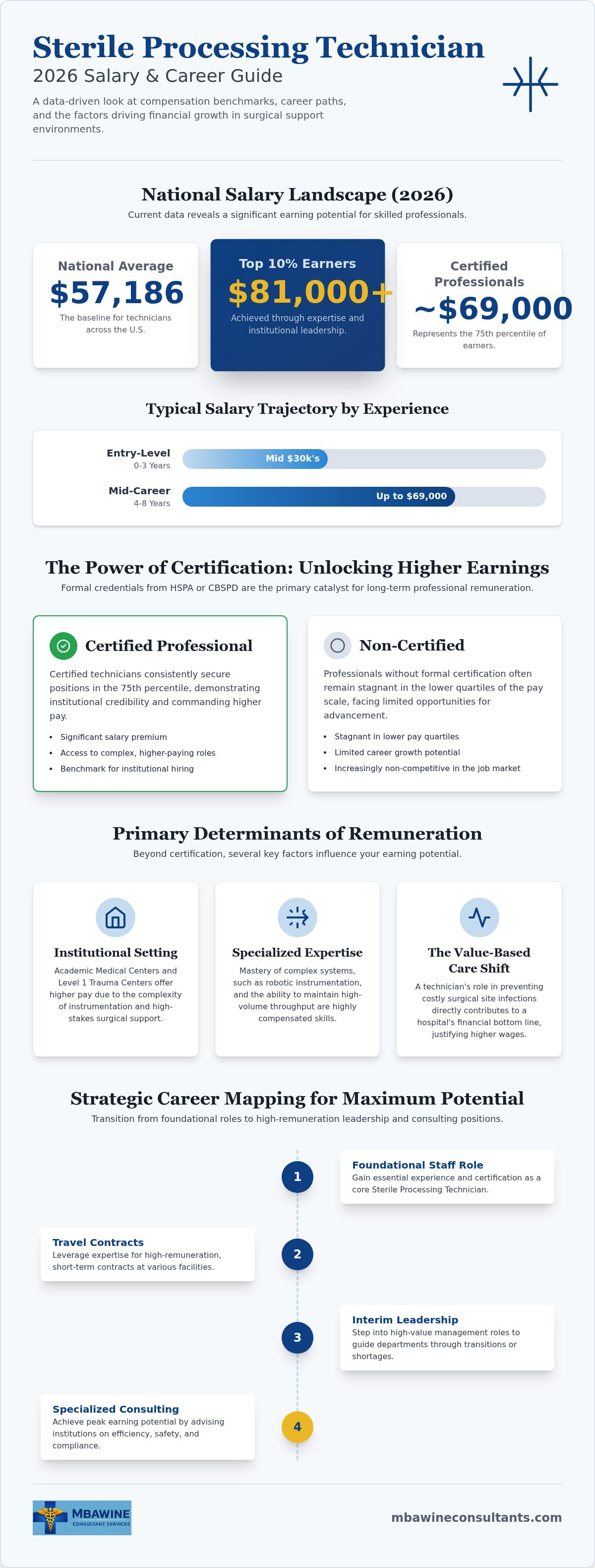
While the national average sterile processing technician salary currently rests at $57,186, the top decile of professionals has successfully breached the $81,000 threshold by leveraging technical expertise and institutional leadership. You've likely encountered a disparate landscape of compensation data that fails to account for the rigorous standards of modern surgical support environments, leaving you uncertain about the tangible return on investment associated with formal certification. This comprehensive report serves as an authoritative examination of current national compensation benchmarks and the specific variables that drive fiscal advancement within the sterile processing department. We'll provide a data-driven justification for pursuing advanced credentials and outline a strategic roadmap for transitioning from foundational roles to high-value interim management and consulting positions. By the conclusion of this analysis, you'll possess a clear understanding of the 2026 economic landscape and the professional levers required to maximize your career's financial and technical potential. This guide bridges the gap between entry-level expectations and the mastery required to command leadership-level remuneration in an increasingly specialized healthcare field.
The modern healthcare facility relies on the Central Sterile Services Department (CSSD) as its operational nucleus. As we progress through 2026, the sterile processing technician salary has become a primary indicator of how institutions value risk mitigation and surgical throughput. Current data confirms a national average salary of $57,186, with top performers in the 90th percentile earning $81,000. This upward trend reflects a systemic transition where technicians aren't viewed as peripheral support but as essential guardians of patient safety. The industry's reliance on these professionals has never been more pronounced, especially as surgical volumes escalate to meet the needs of an aging population.
The adoption of Value-Based Care models has fundamentally altered the financial importance of the department. Hospitals now face significant fiscal penalties for healthcare-associated infections, making the sterile processing professional's role in preventing surgical site infections a direct contributor to the institution's bottom line. This shift has created an environment where mandatory certification is becoming the baseline standard. It's this requirement that's placing consistent upward pressure on base wages across the industry, as facilities compete for a limited pool of credentialed experts who can navigate complex regulatory environments.
Terminology within the industry is evolving from "Central Service" to "Sterile Processing Professional," a change that signals a higher level of technical expectation and corresponding remuneration. A Sterile Processing Technician is a high-stakes technical professional whose mastery of decontamination and sterilization protocols requires specialized credentials to ensure the integrity of surgical outcomes. As surgical volumes continue to rise, the demand for these specialists has intensified. Facilities are increasingly willing to offer higher compensation to those who can manage complex robotic instrumentation and maintain high-volume throughput without compromising safety standards.
Inflationary trends throughout the mid-2020s have necessitated a recalibration of entry-level and mid-career salary expectations. Entry-level technicians now typically start in the mid-$30,000s, while those with four to eight years of experience see significant growth toward the $69,000 mark. National workforce shortages act as a catalyst for these competitive remuneration packages. Because hospitals must maintain specific staffing ratios to keep operating rooms functional, budget allocations for the department have seen a marked increase. Professionals who have completed professional sterile processing classes are best positioned to capitalize on these budget shifts. They enter the workforce with the validated skills that facilities are desperate to secure, allowing them to bypass lower-tier wage brackets more quickly than their non-certified peers.
Remuneration within the sterile processing field is governed by a complex interplay of professional credentials, institutional complexity, and tenure. While the baseline sterile processing technician salary data provides a national overview, the "Certification Premium" remains the most significant variable for individual earning potential. Statistical analysis of 2026 trends indicates that certified technicians often secure positions in the 75th percentile, earning approximately $69,000, whereas their non-certified counterparts frequently remain stagnant in the lower quartiles. This pay gap is enforced by the Healthcare Sterile Processing Association (HSPA) and the Certification Board for Sterile Processing and Distribution (CBSPD), whose standards have become the benchmark for institutional hiring practices across the United States.
Institutional setting further dictates compensation levels. Academic Medical Centers and Level 1 Trauma Centers typically offer higher remuneration packages to account for the heightened complexity of surgical instrumentation and the high-stakes nature of emergency trauma support. In contrast, outpatient surgery centers may offer more predictable schedules but often lack the intensive shift differentials found in large-scale hospitals. Tenure also provides a structured path to advancement. Professionals with over eight years of experience can expect to see their base wages rise significantly as they transition into senior technician or lead roles, especially when these years of service are backed by a consistent record of continuing education and technical mastery.
The financial return on investment for formal education is realized almost immediately upon securing a credential. Technicians who utilize comprehensive CRCST Certification Preparation resources significantly increase their probability of passing the examination on their initial attempt, thereby avoiding the career delays and lost wages associated with retesting. The first year of post-certification employment typically yields a substantial salary increase, as facilities recognize the validated expertise of the individual. To maximize this professional trajectory, many ambitious professionals choose to enroll in specialized classes that align with current HSPA standards and institutional requirements.
Facility tiering remains a critical determinant of total annual earnings. Specialized centers focusing on orthopedics or cardiac surgery often provide higher compensation because of the intricate nature of the instrument sets involved. Beyond base pay, shift differentials for evening and overnight rotations can add between $2 and $6 per hour to the standard sterile processing technician salary, while on-call requirements further augment the total compensation package. For those seeking the highest earning potential, a combination of Level 1 Trauma experience and a willingness to work specialized shifts provides the most direct path to the $81,000 annual threshold currently seen among top earners.
The career trajectory for sterile processing professionals in 2026 is no longer a linear path restricted to permanent hospital employment. While permanent staff positions provide essential institutional stability and comprehensive benefit packages, many professionals now evaluate the high-remuneration potential of travel contracts and leadership tiers. A permanent sterile processing technician salary remains the foundation of the industry, but those seeking to maximize their fiscal outcomes often transition into specialized roles that command significant premiums. This diversification of the workforce allows technicians to align their career goals with their financial requirements, whether they prioritize long-term pension benefits or immediate liquid income.
Travel contracts represent a high-liquidity compensation model that decouples base pay from traditional institutional benefits. In 2026, these contracts typically include several key financial components:
While the short-term financial gains are substantial, professionals must weigh these against the lack of long-term seniority and the complexities of managing individual healthcare and retirement accounts. This model requires a high degree of professional adaptability and typically mandates a minimum of two years of clinical experience alongside active HSPA or CBSPD certification. For many, the travel market acts as a catalyst for rapid savings, though it lacks the institutional influence found in permanent leadership roles.
Advancement into Lead Technician or SPD Supervisor roles serves as the primary bridge to institutional management. These positions offer a structured increase in remuneration, often placing professionals in the upper deciles of the national pay scale. For those aiming for the pinnacle of the field, Sterile Processing Managers and Directors oversee complex departmental budgets and regulatory compliance, where compensation packages significantly exceed the standard sterile processing technician salary benchmarks. A significant 2026 trend is the rise of 'Interim Leadership', where seasoned experts provide high-level management during institutional transitions. This specialized path is supported by Sterile Processing Leadership and Management Services, which help facilities bridge leadership gaps with certified experts. Understanding the strategic role of sterile processing interim leadership in institutional excellence is crucial for technicians who wish to transition from technical tasks to high-value consulting and department-wide oversight.
Achieving a top-tier sterile processing technician salary requires a deliberate shift from passive employment to active career management. This progression is defined by five critical milestones that build technical authority and institutional value. The initial phase involves securing a rigorous educational foundation through professional sterile processing classes, which provide the theoretical knowledge necessary for professional practice. Upon completion, obtaining HSPA or CBSPD certification is essential to establish clinical credibility and fulfill the mandatory requirements of high-performing healthcare systems. Subsequent growth depends on gaining experience within high-acuity environments, such as Level 1 Trauma centers, where the complexity of instrumentation demands technical mastery. Professionals should then pursue specialized training in robotic instrumentation or endoscopy, as these niches command significant pay premiums. Finally, transitioning into leadership, interim management, or consulting roles allows for the maximization of long-term equity and professional influence.
Maintaining certification through Continuing Education Units (CEUs) isn't merely a regulatory requirement; it's a strategic tool for preserving salary standing. As surgical technology evolves, technicians must identify high-demand specialties like Orthopedics or Neurology, where specialized knowledge of complex instrument sets creates institutional leverage. Leveraging professional networks and alumni associations can also reveal higher-paying opportunities that aren't advertised on public job boards. For those ready to accelerate this journey, the most effective first step is to enroll in a comprehensive certification program that aligns with current industry standards.
Successful negotiation within a clinical environment relies on the presentation of objective performance data. Certified professionals should use their credentialing status and departmental efficiency metrics to justify merit-based raises during annual reviews. It's equally important to evaluate the total compensation package, which includes health benefits, 401k matching, and tuition reimbursement, as these factors significantly impact net financial outcomes. Many hospitals utilize structured 'Career Ladders' that provide predictable pay increases based on skill acquisition and tenure. By understanding these institutional frameworks, technicians can ensure their sterile processing technician salary reflects their increasing expertise and contribution to surgical safety.
Mbawine Consultant Services stands as the premier institutional partner for those seeking to navigate the complex 2026 compensation landscape with precision and authority. While the baseline sterile processing technician salary is influenced by broader market demand, the speed at which a professional ascends to the highest deciles of remuneration is determined by the depth of their educational foundation. Our professional sterile processing classes do more than just impart technical knowledge; they systematically reduce the time required to achieve certification, thereby accelerating a professional's entry into elite institutional tiers. By aligning technical instruction with the rigorous standards required by high-volume surgical centers, we ensure that our graduates are recognized as high-value assets capable of driving departmental excellence from their first day of service.
The traditional reliance on informal "on-the-job training" carries inherent systemic risks that modern, risk-averse healthcare facilities can no longer afford to tolerate. Learning by doing without a comprehensive theoretical foundation in sterilization standards often leads to critical gaps in technical proficiency, which can compromise patient safety and stall long-term career progression. Mbawine's pedagogical approach prepares students for the rigors of contemporary SPD environments by emphasizing the clinical science behind decontamination and sterilization processes. For a detailed breakdown of the path to professional validation, individuals should consult our Sterile Processing Classes: Certification Guide. This structured preparation ensures that technicians possess the validated expertise required to command premium wages and bypass the lower pay brackets associated with uncertified roles.
The intersection of specialized education, staffing solutions, and high-level consulting provides Mbawine with a unique vantage point on current market rates and institutional hiring priorities. Our staffing solutions bridge the gap between certified professionals and facilities that require elite talent, ensuring that technical mastery is met with appropriate and competitive remuneration. Professionals who wish to secure their financial future must first invest in their own career equity through formal validation and continuous skill acquisition. To join the ranks of the nation's most respected sterile processing experts, we invite you to access the Mbawine enrollment portal and begin your journey toward technical and fiscal mastery. Professionalism is the only sustainable path to financial excellence in the high-stakes healthcare environment of 2026.
The evolution of the sterile processing field has transformed the role from a technical support function into a critical pillar of surgical safety and institutional risk management. It's clear that the sterile processing technician salary remains fundamentally linked to the acquisition of formal credentials and the mastery of complex instrumentation. The data presented underscores that a strategic career path is built upon the dual pillars of specialized education and proactive leadership development. By transitioning from foundational technical roles into high-value consulting or interim management, you position yourself at the forefront of healthcare's operational nucleus.
To secure your place within these elite professional tiers, you must align your skills with the rigorous demands of the modern medical environment. Mbawine Consultant Services provides specialized training programs designed by industry experts and offers a proven track record in certification preparation along with access to national staffing and consulting networks. We invite you to Enroll in Mbawine's Professional Sterile Processing Classes Today to solidify your career equity. Your commitment to technical excellence is the most reliable catalyst for long-term fiscal and professional success.
The average starting sterile processing technician salary in 2026 typically ranges from the low to mid $30,000s, with institutional data suggesting a mean entry-level figure of approximately $39,953. This baseline is often influenced by the candidate's initial educational background and whether they enter the field with a provisional certification. Facilities prioritize individuals who demonstrate a foundational understanding of sterilization standards, often offering higher starting rates to those who've completed formal training programs before their first clinical appointment.
Certified professionals command a significant premium, often earning between 10% and 20% more than their uncertified counterparts. While uncertified technicians frequently remain in the lower wage quartiles, those holding HSPA or CBSPD credentials often reach the 75th percentile of the sterile processing technician salary scale, currently benchmarked at $69,000. This disparity reflects the institutional shift toward mandatory certification as a prerequisite for risk mitigation and the management of complex surgical instrumentation in high-acuity environments.
Transitioning to an ambulatory surgery center doesn't always result in a base salary increase, as these facilities often lack the intensive shift differentials and on-call premiums found in large-scale hospitals. Level 1 Trauma Centers and academic medical institutions typically offer higher total remuneration because of the technical complexity and high-volume throughput required. However, specialized orthopedic or cardiac surgery centers may offer competitive rates for technicians with niche expertise in specific instrument sets, balancing lower overtime opportunities with higher base pay.
The salary outlook remains exceptionally positive, with demand projected to grow by 17% through the early 2030s, far outstripping the average for most healthcare occupations. This sustained growth is driven by an aging population and a corresponding increase in surgical interventions, which necessitates approximately 10,000 new positions annually. As facilities compete for a limited pool of certified experts, inflationary pressures and workforce shortages are expected to continue driving base wages upward across all institutional tiers through 2031.
Travel technicians can indeed earn significantly more than permanent staff, though the claim of "double" the pay often includes non-taxable stipends and housing allowances rather than just the hourly base rate. In 2026, travel contracts leverage urgent staffing needs to offer high-liquidity compensation models that bypass traditional institutional benefits. While the immediate financial gains are substantial, these roles require high adaptability and usually mandate at least two years of experience and active professional certification to secure the most lucrative assignments.
Mastery of robotic instrumentation, endoscopy, and complex orthopedic sets allows a technician to command a higher hourly rate. Facilities increasingly require specialized knowledge to manage the high-stakes reprocessing of sophisticated surgical technology. Technicians who pursue advanced training in these areas provide greater institutional value by reducing instrument downtime and ensuring compliance with manufacturer instructions for use. Developing expertise in neurology or cardiovascular instrumentation serves as a primary lever for moving into the 90th percentile of earners.
Becoming a Lead Sterile Processing Technician typically results in a move toward the upper deciles of the national pay scale, with top earners reaching approximately $81,000. This role involves a shift from purely technical tasks to departmental oversight, quality assurance, and the mentorship of junior staff. The increase in compensation reflects the added responsibility of managing surgical throughput and ensuring regulatory compliance. It also serves as a critical stepping stone for those pursuing high-value interim management or consulting roles.
Investing in professional sterile processing classes offers a high return on investment by accelerating the transition from entry-level wages to certified salary tiers. Formal education reduces the risk of exam failure and provides the theoretical foundation necessary to handle complex instrumentation with confidence. When compared to the potential salary increase of several thousand dollars annually upon certification, the initial cost of a structured training program is recovered quickly through higher base pay and expanded access to elite staffing networks.

Article by
Mba Akuribila
Mba‑Akuribila is a healthcare leader, educator, and founder of Mbawine Consultants, a Bronx‑based institution recognized nationwide for advancing excellence in sterile processing and allied health workforce development. Born in Bongo in Ghana’s Upper East Region, his journey from rural beginnings to national impact reflects a lifelong commitment to service, empowerment, and community advancement.
For over two decades, he has trained sterile processing employees, mentored, and placed thousands of healthcare professionals across the United States. Through Mbawine Consultants, he established one of the country’s most trusted Sterile Processing Certification Test Prep Programs, preparing new Americans and career‑changers for successful entry into the field. The organization, as at 2026, has graduated more than 15,000 sterile processing technicians who now serve in hospitals, ambulatory centers, dental practices, and reprocessing facilities nationwide.
Under his leadership, Mbawine Consultants has expanded into a full Healthcare Staffing Agency, connecting nurses and allied health professionals to meaningful employment opportunities. His team also provides Interim Management Services, supporting hospitals and surgical centers with experienced leaders who stabilize operations, strengthen compliance, and improve workflow efficiency.
As a former surgical technician, sterile processing manager, educator, and system‑wide director, Mba‑Akuribila brings deep expertise to Sterile Processing Consulting, helping healthcare facilities elevate quality, safety, and regulatory readiness.
His work in the United States and Ghana continues to reflect his core philosophy: service above self, opportunity for all, and excellence without compromise.


