

What if a failed sterilization cycle signals a serious process deviation, but not proof that a patient has been infected? The consequences of a failed sterilization cycle can include potential exposure to inadequately processed instruments, disrupted procedures, and follow-up. The event itself, however, doesn’t confirm patient infection. That distinction matters when teams need to act quickly and document what they know.
It’s understandable to be uncertain about whether instruments from a suspect load can be released or used, particularly when patient safety and workflow are both at stake. A controlled response starts with containing affected items, escalating through the facility’s established process, and preserving records for traceability and review. Specific actions should follow current authoritative guidance and facility policy.
This article explains how to distinguish a failed cycle from confirmed harm, what immediate containment and escalation involve, and how documentation supports investigation and follow-up. It also covers potential operational and patient-safety consequences, along with how consistent procedures and continuing education can help staff understand monitoring responsibilities and reduce repeat failures.
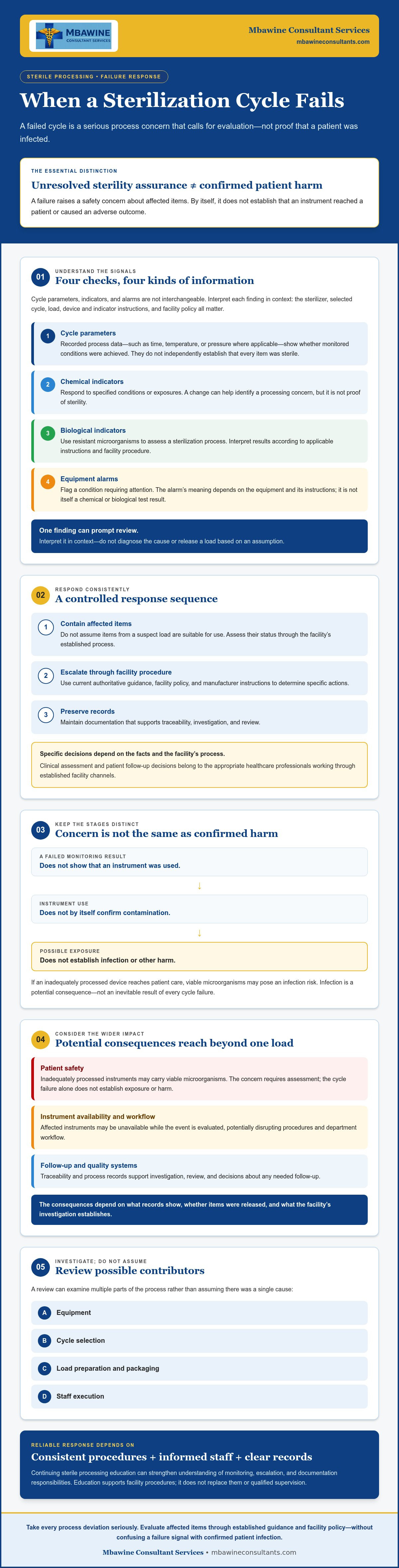
A failed sterilization cycle is a process or monitoring result that requires evaluation before affected instruments can be considered suitable for use. It signals unresolved sterility assurance, not confirmed patient infection. This distinction helps teams respond seriously without assuming that exposure or harm has occurred.
Sterilization uses physical or chemical methods to eliminate viable microorganisms, but the process must suit the device and follow its instructions. A foundational overview of sterilization processes describes the principles behind these methods. In practice, device instructions and facility procedures guide how each load is processed and assessed.
A cycle may require investigation if recorded parameters don’t meet specified requirements, a monitoring result is unacceptable, or the sterilizer generates an alarm indicating a problem. The meaning of each finding depends on the sterilizer, selected cycle, load configuration, device instructions, indicator instructions, and facility policy. There isn’t one pass-or-fail rule for every sterilization method and device.
These signals provide different information and shouldn’t be treated as interchangeable:
A single signal may prompt review. Staff should interpret it in context rather than diagnose the cause or release a load based on an assumption.
If instruments haven’t been adequately processed, viable microorganisms may remain and could be introduced into patient care if those instruments are used. Infection is a potential consequence, not an inevitable result of every cycle failure. A failure raises a safety concern about the affected items and requires assessment of their status. It doesn’t, by itself, establish that an instrument reached a patient or caused an adverse outcome.
Reliable sterility assurance supports safe instrument availability by giving staff evidence to assess processing before devices are used. The consequences of a failed sterilization cycle depend on what monitoring and process records show, whether affected items were released, and what the facility’s investigation determines.
A cycle concern can affect more than the load under review. Its consequences depend on whether instruments were released, what traceability records show, and what the facility’s investigation establishes. A measured response protects patients while helping staff avoid treating a process deviation as proof of harm.
If an inadequately processed device reaches patient care, viable microorganisms may pose an infection risk. However, the stages of concern are distinct: a failed monitoring result isn’t evidence that an instrument was used; use doesn’t by itself confirm contamination; and possible exposure doesn’t establish infection or other harm. Keeping these distinctions clear supports an appropriate investigation without minimizing the safety concern.
Clinical assessment and decisions about patient follow-up belong to the appropriate healthcare professionals, working through the facility’s established process. Whether review, reporting, or communication is indicated depends on the facts identified, applicable requirements, and facility policy. A sterilization concern alone doesn’t establish that a patient was exposed or that the facility is automatically liable.
While affected items are assessed, keeping them unavailable may reduce the instruments ready for a planned case. If suitable alternatives aren’t available, teams may need to adjust case readiness or scheduling and coordinate with clinical and sterile processing personnel. Reprocessing or replacement should occur only as authorized under applicable instructions and facility procedures.
Containment also depends on reliable traceability. Staff may need to identify the affected load and items, determine their status, and review records showing whether devices were distributed or used. Accurate documentation helps designated personnel reconstruct events, assess the scope of the concern, and decide whether further action is appropriate.
The consequences of a failed sterilization cycle can extend across patient-safety review, instrument availability, department workflow, and quality-system oversight. Clear escalation helps the appropriate personnel assess each area, while consistent records support trend review and corrective action if an investigation identifies a recurring issue. Any reporting or compliance response should be determined against current requirements and facility policy, not assumed to apply universally.
For sterile processing professionals, understanding monitoring and process fundamentals can support more consistent recognition and escalation of concerns. Sterile processing classes can help reinforce that foundational knowledge alongside facility procedures, manufacturer instructions, and qualified supervision.
The immediate priority is to prevent potentially affected instruments from entering use. A failed indicator, unmet cycle parameter, or equipment alarm should prompt a controlled response, not an improvised decision about whether a load is safe. Follow current standards, manufacturer instructions, and facility policy, since required actions and thresholds vary by sterilization process and device.
First, stop release of the load and identify the affected items. Keep them separate from items cleared for use, and preserve the labels and records needed to trace the load. If any items may already have moved beyond the processing area, don’t make assumptions about their status or attempt an informal retrieval. Escalate the concern promptly through the facility’s established process.
Notify the supervisor or other designated personnel identified in facility policy. They can determine who else must be involved, such as staff responsible for infection prevention, quality, or clinical operations. Individual staff shouldn’t independently authorize release, recall, or reuse beyond their assigned responsibilities. Escalation helps ensure decisions are coordinated and consistent with institutional procedures.
Once the items are contained and the appropriate personnel have been notified, preserve and review relevant information. Depending on the event, this may include:
Document the initial finding, containment steps, notifications, investigation, decisions, and corrective actions according to facility requirements. A clear, timely record supports review and helps the team distinguish confirmed facts from unresolved questions. If the investigation identifies a possible patient exposure, route that information to designated personnel for assessment under established procedures.
The authorized next step may involve further evaluation, reprocessing, equipment follow-up, or another action, depending on the process and investigation. Don’t apply a universal recall rule or return items or equipment to use based on an assumption. Verify applicable criteria against current authoritative guidance, manufacturer instructions, and facility policy. The consequences of a failed sterilization cycle can be better controlled when staff follow a defined escalation pathway and document how the concern was resolved.
A failed cycle is a finding to investigate, not a diagnosis of its cause. Equipment issues, unsuitable cycle selection, load preparation, packaging, or a missed step during staff execution may be relevant, but one alarm or indicator result can’t establish which factor contributed. A careful review compares the event with sterilizer and device instructions, load details, records, and facility procedures.
Start by checking whether the selected cycle and load configuration were appropriate for the devices being processed. Review packaging and loading practices, along with applicable equipment maintenance records and staff competency, as relevant to the event. If an alert suggests an equipment concern, qualified personnel should assess it and determine whether technical service is needed. These are areas to investigate, not assumptions about fault.
Physical records, chemical indicators, and biological indicators provide different evidence. Physical or mechanical records show the cycle conditions recorded by the sterilizer; chemical indicators respond to specified exposure conditions; and biological indicators assess the process using resistant microorganisms. Each has limits, and results must be interpreted according to applicable instructions and facility policy. CDC recommendations include biological monitoring at least weekly and for every load containing an implantable device, as well as a chemical indicator inside every package. Facilities should verify current guidance and local requirements before applying monitoring schedules or response thresholds.
These prompts can help organize a review. They point to questions, not universal diagnoses:
Monitoring is most useful when integrated with accurate records and a consistent investigation process. Together, these help teams identify patterns without overinterpreting one result. Check current AAMI, AORN, CDC, manufacturer, and facility guidance for the applicable process. For broader context, see the 2026 healthcare sterilization standards guide.
Ongoing education can reinforce how staff interpret monitoring results and follow escalation and documentation procedures. Explore sterile processing classes to strengthen foundational process knowledge alongside facility-specific training and supervision.
Consistent responses depend on more than recognizing a failed indicator or alarm. Sterile processing professionals need a working understanding of process fundamentals, monitoring terminology, load traceability, and the limits of their role. That knowledge helps them follow the correct escalation path rather than make an unauthorized release or reuse decision. These skills support reliable use of facility procedures when time and workflow pressures are present.
Staff should understand what physical records, chemical indicators, and biological indicators can show, and why each result must be interpreted according to relevant instructions and facility policy. Familiarity with traceability also helps personnel identify which items and records may need review. Employees should know whom to notify, what information to document, and which decisions belong to designated personnel or qualified supervisors.
Education can establish and reinforce this foundation, but it doesn’t replace current work instructions, manufacturer directions, facility-specific training, or qualified supervision. Professionals exploring foundational learning can review this CRCST preparation information as part of understanding a certification pathway.
After an event, facilities can use approved quality processes to review what happened and determine whether additional education is appropriate. The review may identify a need to reinforce a task, clarify an escalation responsibility, or update work instructions. Those actions should be based on the investigation rather than assumed to be the solution to every failure. Competency reinforcement should align with the employee’s role and the facility’s established procedures.
Training supports consistent practice, but it can’t guarantee that every failure will be prevented. Equipment, process design, instructions, workload, and other factors may also warrant review. Addressing the consequences of a failed sterilization cycle therefore requires coordination, with education complementing rather than substituting for sound procedures and follow-up.
Mbawine Consultant Services offers sterile processing classes to support professional learning. Readers considering further study can review sterile processing class enrollment information.
A failed cycle calls for a disciplined review, not an assumption that a patient has been harmed. The consequences of a failed sterilization cycle can range from reduced instrument availability to patient-safety follow-up. Staff should secure affected items, escalate through facility procedures, and maintain clear traceability while authorized personnel investigate.
Reliable response also depends on understanding monitoring results, documenting decisions, and following current instructions and policy. Education can reinforce these practices, but it complements rather than replaces facility procedures and qualified supervision.
Mbawine Consultant Services offers in-person and online sterile processing classes, certification preparation, and employee education to support foundational knowledge and consistent professional practice. Review sterile processing class enrollment to explore learning options. Build your knowledge through a class and apply it alongside your facility’s procedures and supervision.
The affected load shouldn’t be treated as ready for use until authorized personnel evaluate the result. The consequences of a failed sterilization cycle depend on the failure signal, equipment, load, and applicable requirements. Staff should follow facility procedures to secure affected items, notify designated leaders, review cycle records and monitoring results, and document the event. The appropriate next step must also reflect manufacturer instructions and current facility policy.
Don’t assume instruments from a failed or unresolved cycle are safe to use. Follow the facility’s hold, evaluation, and release procedures, including relevant instructions for the devices and sterilizer. Only personnel with appropriate authority should determine what happens to the items. A failed indicator requires investigation, but it doesn’t by itself establish that an instrument reached patient care or that a patient was exposed or harmed.
No. A failed cycle or monitoring result means the process requires evaluation; it doesn’t prove an instrument was used or that a patient developed an infection. If potentially affected devices may have reached patient care, the facility’s clinical and quality leadership should assess the circumstances and determine appropriate follow-up. Patient-related decisions or communication should be handled by the responsible professionals under applicable requirements and established facility procedures.
First, prevent the affected load from being released or used, following the department’s established procedure. Identify and secure relevant items, preserve traceability, and notify the designated supervisor or other personnel named in facility policy. Document the event as required. Staff shouldn’t independently decide that a load is acceptable or initiate a recall unless that action falls within their authorized responsibilities and established procedures.
Possible investigation areas include cycle selection, loading, packaging, equipment performance, maintenance, and staff execution. An indicator result or equipment alarm alone may not identify the cause. Qualified personnel should review cycle records, monitoring results, applicable instructions, and load circumstances to assess what occurred. The facility’s documented investigation should guide corrective actions rather than assumptions about a single cause.
A failed cycle is a broad description of an unacceptable process result, which may involve cycle parameters, an equipment alarm, or monitoring. A positive biological indicator is one specific monitoring finding that requires evaluation and response under current guidance and facility policy. Its interpretation depends on the sterilization process and circumstances. Staff should follow established procedures and avoid applying a generic response rule across different equipment or processes.
Record the details required by facility policy, which may include cycle and load identifiers, monitoring results, equipment information, notifications, investigation, and authorized disposition. Documentation should support traceability and quality review while distinguishing confirmed facts from unresolved questions. Avoid speculation about patient harm. Required details and record-retention practices can vary, so follow applicable standards and institutional requirements when documenting and maintaining the event record.

Article by
Mba Akuribila
Mba‑Akuribila is a healthcare leader, educator, and founder of Mbawine Consultants, a Bronx‑based institution recognized nationwide for advancing excellence in sterile processing and allied health workforce development. Born in Bongo in Ghana’s Upper East Region, his journey from rural beginnings to national impact reflects a lifelong commitment to service, empowerment, and community advancement.
For over two decades, he has trained sterile processing employees, mentored, and placed thousands of healthcare professionals across the United States. Through Mbawine Consultants, he established one of the country’s most trusted Sterile Processing Certification Test Prep Programs, preparing new Americans and career‑changers for successful entry into the field. The organization, as at 2026, has graduated more than 15,000 sterile processing technicians who now serve in hospitals, ambulatory centers, dental practices, and reprocessing facilities nationwide.
Under his leadership, Mbawine Consultants has expanded into a full Healthcare Staffing Agency, connecting nurses and allied health professionals to meaningful employment opportunities. His team also provides Interim Management Services, supporting hospitals and surgical centers with experienced leaders who stabilize operations, strengthen compliance, and improve workflow efficiency.
As a former surgical technician, sterile processing manager, educator, and system‑wide director, Mba‑Akuribila brings deep expertise to Sterile Processing Consulting, helping healthcare facilities elevate quality, safety, and regulatory readiness.
His work in the United States and Ghana continues to reflect his core philosophy: service above self, opportunity for all, and excellence without compromise.


