

With nearly one-third of candidates failing to achieve a passing score on their first attempt, the path to obtaining your crcst certification represents a rigorous academic and clinical challenge that demands more than mere familiarity with surgical instrumentation. You likely recognize that the transition from a dedicated technician to a certified professional is fraught with technical complexity, especially when you're attempting to reconcile the mandatory 400-hour clinical requirement with the persistent demands of a full-time professional schedule. The anxiety surrounding the HSPA examination is a logical response to the high-stakes nature of infection control and patient safety standards that govern our modern healthcare institutions.
This comprehensive guide provides the definitive roadmap required to master the Healthcare Sterile Processing Association requirements, ensuring you possess the theoretical depth and documented practical experience necessary to secure your credential on the first attempt. We'll examine the precise weighting of the 150-question examination domains, delineate systematic strategies for completing the hands-on experience hours, and explore the professional pathways that lead to increased earning potential and leadership roles within the sterile processing department. By establishing a foundation of technical excellence, you position yourself as a vital guardian of public health and a leader in surgical support services.
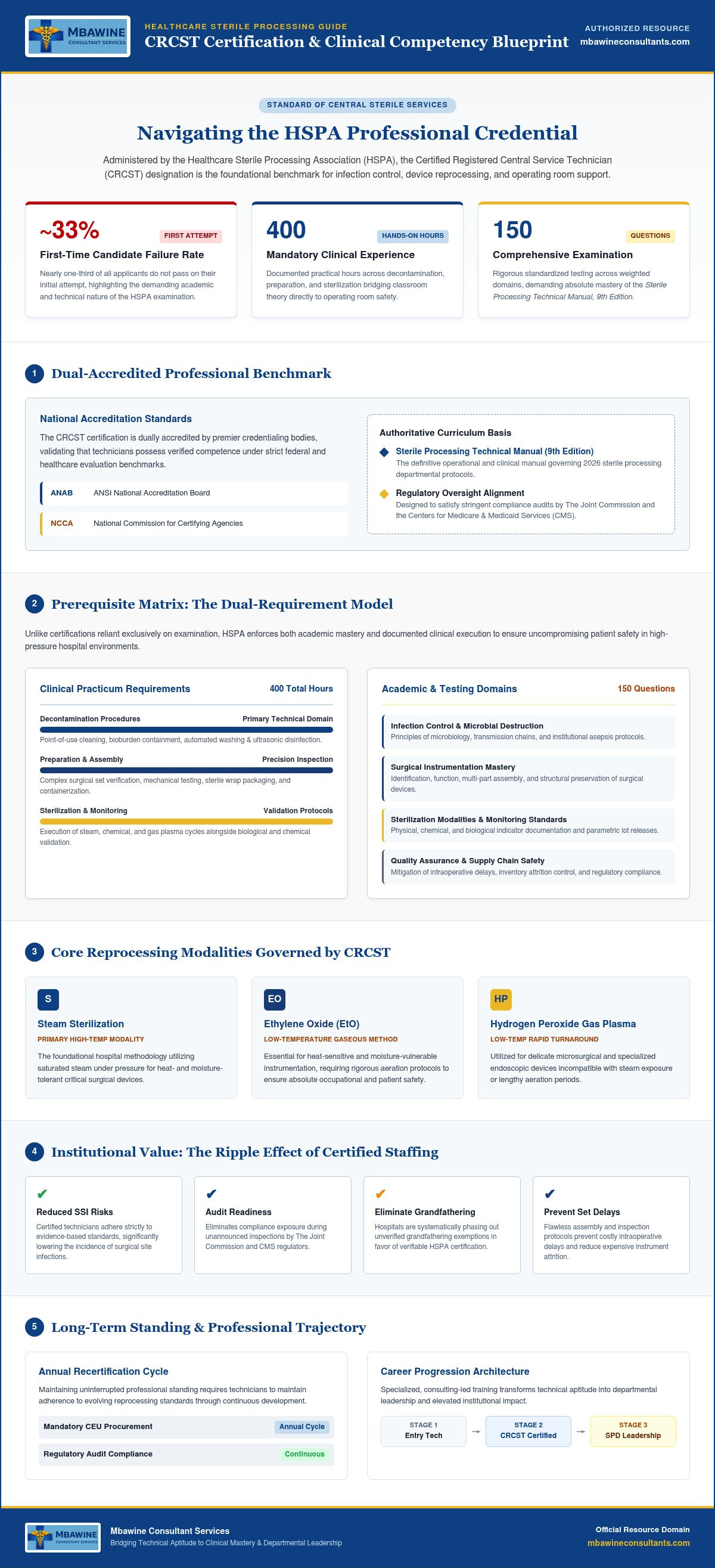
The Certified Registered Central Service Technician (CRCST) designation serves as the primary benchmark for professional competence within the field of medical device reprocessing. Administered by the Healthcare Sterile Processing Association (HSPA), this credential represents a rigorous standard of excellence that is dually accredited by the ANSI National Accreditation Board and the National Commission for Certifying Agencies. In the current regulatory environment, obtaining a crcst certification is no longer viewed as an optional professional milestone but as a fundamental requirement for practitioners operating within the central sterile services department. This shift reflects a broader institutional commitment to patient safety, as the sterile processing department functions as the critical nexus where surgical outcomes and infection prevention protocols intersect.
As healthcare systems face intensified scrutiny from The Joint Commission and the Centers for Medicare and Medicaid Services, the evolution of certification standards has become increasingly complex. The 2026 landscape demands that technicians possess a deep understanding of the Sterile Processing Technical Manual, 9th Edition, which outlines the systematic protocols necessary to mitigate the risk of healthcare-associated infections. Leading facilities prioritize HSPA-certified professionals because they provide a verifiable guarantee of technical proficiency, ensuring that every instrument set delivered to the operating room meets stringent sterilization criteria.
A certified technician must demonstrate mastery across several high-stakes domains, beginning with advanced decontamination procedures and infection control protocols. These professionals are responsible for the meticulous identification and assembly of complex surgical instrumentation, a process that requires absolute precision to prevent intraoperative delays or mechanical failures. The technical depth of the crcst certification curriculum ensures that staff members can effectively manage various sterilization modalities, including steam, ethylene oxide, and low-temperature hydrogen peroxide gas plasma, while maintaining rigorous monitoring standards to validate every cycle.
The integration of certified personnel yields measurable improvements in clinical outcomes and operational metrics. Facilities that employ HSPA-certified technicians often report a significant reduction in surgical site infections, as these professionals adhere to standardized, evidence-based practices that minimize contamination risks. Beyond clinical safety, certified staffing ensures continuous compliance with evolving regulatory bodies and accreditation standards, effectively eliminating the risks associated with grandfathering clauses that many hospitals are now phasing out. This professionalization of the workforce enhances departmental efficiency, reduces instrument attrition, and fosters a culture of accountability that is essential for maintaining the integrity of the surgical supply chain.
Achieving the crcst certification requires a balanced synthesis of theoretical academic mastery and documented clinical proficiency. Unlike many entry-level healthcare roles that rely solely on standardized testing, the Healthcare Sterile Processing Association (HSPA) mandates a dual-requirement model. This structure ensures that every technician doesn't just understand the science of microbial destruction but can also execute these protocols within the high-pressure environment of a modern hospital. Candidates must document 400 hours of hands-on experience, a requirement that serves as the definitive bridge between classroom concepts and patient safety.
The HSPA experience documentation is categorized into specific technical domains to ensure a well-rounded professional foundation. You must complete and verify the following hours within an active Sterile Processing Department (SPD):
Navigating the HSPA experience forms requires meticulous attention to detail, as every hour must be verified by an SPD manager or supervisor. It's critical to understand the distinction between provisional and full certification. If you pass the exam before completing your hours, you're granted "Provisional CRCST" status. However, this status triggers a strict six-month window. If you don't submit your verified documentation within exactly six months of your exam date, the credential is forfeited entirely, requiring a full reapplication and retake of the examination.
Selecting an appropriate educational pathway is the first critical step toward professional excellence. High-quality Sterile Processing Education programs prioritize a curriculum that integrates anatomy, physiology, and microbiology. This foundational knowledge is indispensable when applying CDC guidelines for disinfection and sterilization to real-world clinical scenarios. Understanding how bioburden interacts with different instrument materials allows a technician to transition seamlessly from theoretical study to the practical rigors of the decontamination room.
Many candidates face challenges when attempting to secure their 400 hours if they aren't currently employed in a healthcare facility. Strategic candidates often pursue volunteer or internship positions by demonstrating their commitment through prior enrollment in formal classes. It's essential to ensure your experience includes a full rotation through all departmental areas, including Prep, Pack, and Distribution. To begin your journey with a structured roadmap and expert guidance, you can register for upcoming certification preparation sessions to ensure you meet every prerequisite with confidence.
The successful acquisition of your crcst certification hinges on a candidate's ability to navigate a 150-question examination that covers seven distinct clinical and professional domains. This three-hour assessment isn't a test of rote memorization; it's a comprehensive evaluation of your ability to apply technical standards to complex reprocessing scenarios. According to current HSPA exam specifications, the core instrument reprocessing workflow, which includes decontamination, preparation, packaging, and sterilization, accounts for 63 percent of the total exam weight. Candidates must distribute their study efforts proportionally, ensuring they don't neglect the secondary domains such as departmental considerations, storage, and patient care equipment, which comprise the remaining 37 percent of the assessment.
Effective preparation requires a shift from passive reading to active study methodologies. Utilizing spaced repetition and active recall ensures that critical information, such as the specific parameters for various sterilization cycles, is moved from short-term to long-term memory. Practice examinations serve as an indispensable diagnostic tool, allowing you to identify specific knowledge gaps before you arrive at the Prometric testing center. On the day of your appointment, expect a high-security environment where you'll have 180 minutes to complete the exam following a brief tutorial. This professional rigor is why certified technicians are held in such high regard, as reflected in the Bureau of Labor Statistics occupational data for medical equipment preparers.
As surgical technology advances, the 2026 examination reflects an increased emphasis on complex surgical instrumentation and robotic specialized tools. You must be prepared to answer detailed questions regarding the specific cleaning and sterilization requirements for lumened devices and heat-sensitive equipment. Mastery of regulatory standards from AAMI, AORN, and The Joint Commission is essential, as these guidelines form the basis for institutional policy. Additionally, you should focus on quality assurance testing, including the correct interpretation of biological indicators and the documentation requirements for every sterilization load.
While self-study is possible, many candidates find that the technical complexity of the 9th Edition manual is best navigated through professional mentorship. Classroom environments provide customized feedback loops that clarify difficult concepts, such as the microbiology of moist heat sterilization or the chemistry of enzymatic cleaners. This structured approach helps manage the anxiety often associated with high-stakes testing. To refine your strategy, you should review our guide on Sterile Processing Technician Exam Tips. If you're ready to commit to a mission-driven career path, you can enroll in our upcoming certification classes to ensure you're fully prepared for the crcst certification process.
Obtaining your crcst certification represents a commitment to lifelong professional development rather than a singular academic achievement. The Healthcare Sterile Processing Association (HSPA) requires an annual recertification cycle to ensure that all credential holders remain current with evolving industry standards. This process must be completed by the end of the technician's anniversary month each year. It involves the submission of 12 Continuing Education Units (CEUs) and a renewal fee. Failing to meet these deadlines results in the immediate expiration of the credential, which can jeopardize your employment status in facilities with strict certification mandates.
Sourcing relevant clinical content for CEUs is essential for maintaining technical proficiency. Many professionals utilize accredited webinars, podcasts, and departmental inservices to satisfy these requirements. As you gain experience, the crcst certification serves as a foundational springboard for advancing the career ladder. Technicians often progress into lead roles, where they oversee shift workflows, or transition into departmental management. Pursuing specialized stackable credentials, such as the Certified Instrument Specialist (CIS), Certified Endoscope Reprocessor (CER), or Certified Healthcare Leader (CHL), distinguishes your expertise and increases your institutional value.
A certified professional carries an ethical responsibility to act as a guardian of patient safety within the surgical environment. Staying current with evolving sterilization technologies, such as robotic instrument tracking and low-temperature sterilization advancements, is a professional imperative. You don't just process tools; you manage high-stakes clinical outcomes. For those seeking ongoing mentorship, we encourage you to learn about our Staff and Alumni resources for ongoing support throughout your professional journey.
Professional credentials provide significant leverage when negotiating compensation or pursuing advanced career opportunities. Certified technicians are increasingly sought after for healthcare temp staffing and travel sterile processing roles, which offer higher earning potential and geographical flexibility. Understanding the 2026 Professional Standards is critical for long-term success in these competitive environments. By maintaining your certification, you ensure your professional trajectory remains on an upward path. If you're ready to advance your career, you can enroll in professional certification classes to secure your future in healthcare.
The pursuit of professional excellence within the sterile processing department necessitates an educational foundation that transcends basic test preparation, moving instead toward a comprehensive mastery of clinical standards. Mbawine Consultant Services provides this through a specialized synthesis of clinical expertise and academic rigor, positioning every student not merely as a candidate for the crcst certification, but as a future leader in patient safety. By integrating healthcare sterile processing consulting experience into the curriculum, these classes offer a steady, methodical transition from foundational technical knowledge to the advanced mastery required in high-stakes medical environments. This mission-driven approach ensures that the professionalization of the field is backed by a commitment to public safety and institutional reliability.
Preparing the next generation of sterilization leaders requires more than a standard syllabus; it demands an educational syllabus that mirrors the complexity of modern healthcare regulations. Professional sterile processing education through Mbawine emphasizes the gravity of the technician's role, acting as a bridge between entry-level technical requirements and the sophisticated oversight needed for interim management or consulting roles. This rigorous training environment fosters a sense of advocacy for industry standards, ensuring that every graduate carries the weight of their responsibility with academic and professional reliability.
Professional mentorship is the essential element that bridges the gap between theoretical textbook learning and the multifaceted challenges encountered in a functional Sterile Processing Department. Access to industry experts who possess deep consulting backgrounds allows students to navigate technical complexities that standardized manuals often overlook. These mentors provide declarative insights into systematic processes, helping candidates overcome the anxiety associated with the HSPA exam while preparing them for real-world decontamination and sterilization scenarios. For those seeking targeted assistance during their studies, you may view our CRCST-specific resources to enhance your technical understanding.
Beginning your journey toward professional certification involves a structured onboarding process designed to maximize your clinical aptitude and career potential. Whether you're an individual technician seeking to secure your crcst certification or a healthcare institution requiring customized training solutions for your staff, the enrollment process is streamlined to ensure immediate access to high-level knowledge. Mbawine Consultant Services offers flexible delivery through online and in-person modalities, ensuring that your education fits within the constraints of a demanding professional schedule. You don't have to navigate this technical path alone. To secure your place in our next cohort, you should Enroll in our upcoming Sterile Processing classes today and establish your foundation for long-term clinical excellence.
The journey toward obtaining your crcst certification is a deliberate commitment to patient safety and institutional reliability. By mastering the dual-requirement model of academic theory and documented clinical experience, you transition from a foundational role into a critical guardian of the surgical environment. We've explored the rigorous 400-hour hands-on requirement and the strategic preparation necessary to navigate the HSPA examination domains. This professional path demands continuous growth through annual recertification and the pursuit of specialized stackable credentials.
Mbawine Consultant Services offers an expert-led curriculum designed by sterilization consultants that ensures comprehensive preparation for current HSPA standards. Our national reach integrates specialized staffing and consulting expertise, providing you with a professional bridge to advanced career opportunities. To begin this mission-driven journey with a trusted mentor, Enroll in Mbawine's Certification Prep Classes and secure your future in healthcare.
Your dedication to technical mastery is the first step toward a rewarding and impactful career in sterile processing.
HSPA reports exam results on a strict Pass/Fail basis. They don't publish a specific numeric cut score or percentage to candidates. This policy adheres to the accreditation standards set by the ANSI National Accreditation Board and the National Commission for Certifying Agencies. Instead of focusing on a specific number, candidates should aim for technical mastery across all seven exam domains. This ensures a comprehensive understanding of the 125 scored questions within the three-hour testing window.
Candidates must document exactly 400 hours of hands-on experience in a sterile processing department to achieve full certification. This requirement is divided into specific technical areas, including 120 hours in decontamination, 120 hours in preparation and packaging, and 120 hours in sterilization and disinfection. The remaining hours are allocated to storage, distribution, and quality assurance. This structured approach ensures that every technician possesses the practical proficiency required to maintain institutional patient safety standards.
You may sit for the examination before completing your clinical requirements. Upon passing, you're granted "Provisional CRCST" status. You then have exactly six months from your exam date to submit documentation of your completed 400 hours. If you don't meet this six-month deadline, the credential is forfeited entirely. This requires the candidate to reapply and retake the exam. Planning your clinical placement early is essential to avoid this professional setback and ensure career continuity.
The primary difference lies in the administering bodies and institutional recognition. The Healthcare Sterile Processing Association (HSPA) offers the crcst certification, which is the most widely recognized credential in hospital settings. The Certification Board for Sterile Processing and Distribution (CBSPD) provides the CSPDT alternative. While state mandates often accept both, many healthcare facilities specify HSPA certification in their hiring requirements. Choosing the HSPA pathway often provides broader career mobility and access to specialized stackable credentials.
Recertification occurs annually by the end of your anniversary month. To maintain your professional standing, you must submit 12 Continuing Education Units (CEUs) along with the required renewal fee. This annual cycle ensures that certified technicians stay current with evolving infection control protocols and sterilization technologies. Failing to renew on time results in the loss of your credential. This can impact your eligibility for healthcare temp staffing or interim management roles within the industry.
The HSPA recognizes various educational modalities, provided the curriculum aligns with the technical standards outlined in the ninth edition manual. Mbawine Consultant Services offers both in-person and online sterile processing classes designed to prepare professionals for the rigorous certification process. These programs focus on bridging the gap between theoretical knowledge and the practical demands of the decontamination room. Selecting a reputable, consultant-led program ensures that your education meets the high-stakes requirements of modern healthcare facilities.
If a candidate fails the examination, there's a mandatory six-week waiting period before they're eligible to retake the test. Each attempt requires a full examination fee, which includes the application processing cost. This waiting period is intended to allow for additional study and remediation of knowledge gaps. Utilizing structured exam prep classes or practice assessments during this time can significantly improve the likelihood of passing on the second attempt and achieving your crcst certification goals.
Clinical hours must be documented on official HSPA verification forms and signed by a sterile processing department manager or supervisor. The documentation must detail the specific hours completed across the five required domains within the prior five years. Accuracy is paramount, as the HSPA conducts audits to ensure the integrity of the clinical experience requirement. Maintaining a personal log of your daily activities in the department helps ensure that your final submission is thorough and verifiable.

Article by
Mba Akuribila
Mba‑Akuribila is a healthcare leader, educator, and founder of Mbawine Consultants, a Bronx‑based institution recognized nationwide for advancing excellence in sterile processing and allied health workforce development. Born in Bongo in Ghana’s Upper East Region, his journey from rural beginnings to national impact reflects a lifelong commitment to service, empowerment, and community advancement.
For over two decades, he has trained sterile processing employees, mentored, and placed thousands of healthcare professionals across the United States. Through Mbawine Consultants, he established one of the country’s most trusted Sterile Processing Certification Test Prep Programs, preparing new Americans and career‑changers for successful entry into the field. The organization, as at 2026, has graduated more than 15,000 sterile processing technicians who now serve in hospitals, ambulatory centers, dental practices, and reprocessing facilities nationwide.
Under his leadership, Mbawine Consultants has expanded into a full Healthcare Staffing Agency, connecting nurses and allied health professionals to meaningful employment opportunities. His team also provides Interim Management Services, supporting hospitals and surgical centers with experienced leaders who stabilize operations, strengthen compliance, and improve workflow efficiency.
As a former surgical technician, sterile processing manager, educator, and system‑wide director, Mba‑Akuribila brings deep expertise to Sterile Processing Consulting, helping healthcare facilities elevate quality, safety, and regulatory readiness.
His work in the United States and Ghana continues to reflect his core philosophy: service above self, opportunity for all, and excellence without compromise.


