

Practice questions are most useful when they show why an answer is correct, not simply whether it is right. This guide provides 100 CRCST exam practice questions and explains how they can support preparation for the HSPA exam, which contains 150 questions and has a three-hour time limit. Reviewing the reasoning behind each response can help you identify concepts that need further study.
It’s understandable to compare practice tests and study materials before choosing how to prepare. With so many options, it can be hard to tell which resources offer useful explanations, how they differ, and what other learners’ experiences can tell you.
This guide compares CRCST practice tests and study materials, reviews sample questions with explanations, and shows how to consider learner experiences as part of your preparation. It also outlines the exam’s subject areas and explains how structured sterile processing classes can support learners seeking guided preparation grounded in professional practice.
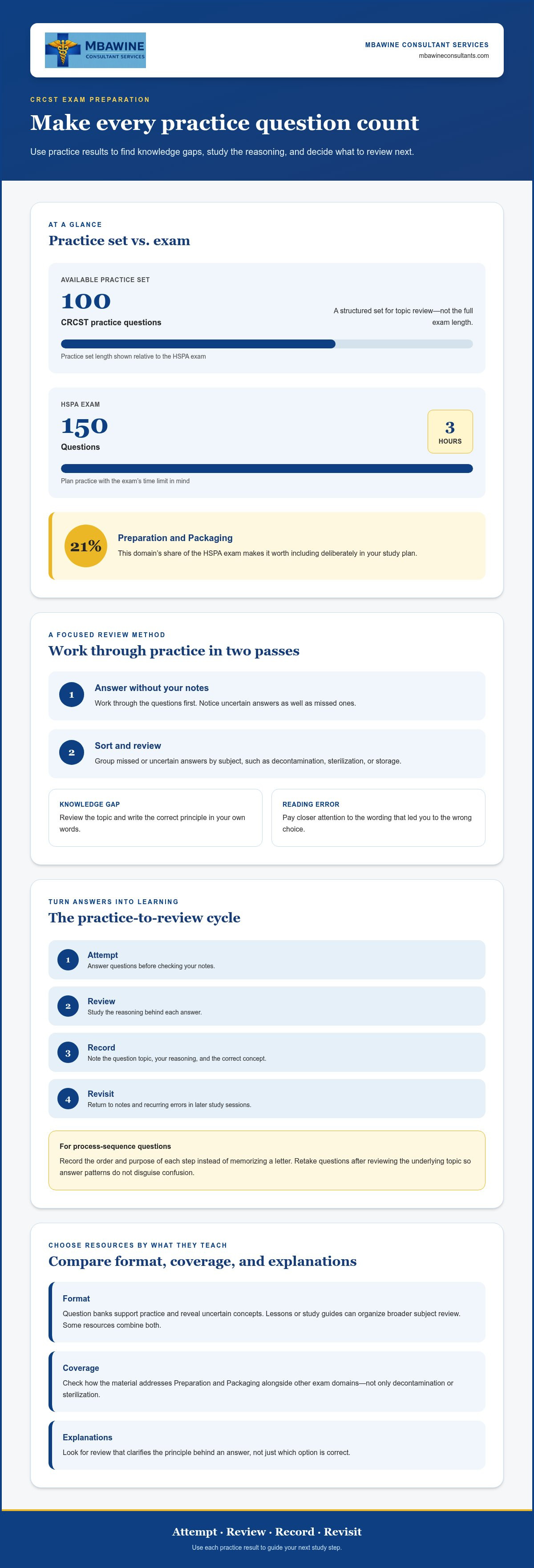
A focused preparation plan combines practice questions, content review, and analysis of incorrect answers. The available CRCST practice set contains 100 questions, while the HSPA exam contains 150 questions and allows three hours. Use each resource deliberately, rather than treating a completed test as proof of readiness.
These materials serve different purposes. Practice tests reveal knowledge gaps, while study resources explain the concepts behind the answers. CRCST exam practice questions are most useful when you review the reasoning after each attempt, rather than simply noting your score.
The available practice test provides 100 CRCST questions for structured review. Compare each question’s subject, answer choices, and explanation, not only the final score. The HSPA exam includes 150 questions, so a 100-question practice set supports topic review but does not reproduce the full exam length. Consider which subjects the items cover and where explanations clarify the answer.
Use each practice test in two passes. First, answer without consulting your notes. Then sort missed or uncertain answers by subject, such as decontamination, sterilization, or storage. This helps distinguish a knowledge gap from a misread question. Review the topic to address a gap; pay closer attention to wording to address a reading error.
Review answers soon after a practice session, while your reasoning is still clear. For each missed item, write the correct principle in your own words and explain why your chosen option was wrong. If a question tests process sequence, record the order and purpose of each step instead of memorizing a letter.
Return to your notes in later study sessions. Retake questions only after reviewing the underlying topic, since remembering answer patterns can disguise confusion. Track recurring errors by subject and prioritize topics that repeatedly leave you uncertain. This creates a practical study cycle: attempt, review, record, and revisit. CRCST exam practice questions can then guide what you study next.
Digital access can make focused review easier to fit around work or coursework. Open the materials on a suitable device, complete a group of questions, and keep a separate record of explanations and topics needing attention. The CRCST preparation page provides access to the practice questions. Organize notes by subject so you can return directly to a concept.
Plan practice sessions with the exam’s three-hour limit in mind, and pay attention to both accuracy and concentration. A longer session can show how well your attention holds across varied questions. Shorter sessions can isolate challenging subjects and leave time to review explanations. Alternate the formats: targeted practice builds knowledge in specific areas, while longer sessions test sustained application.
Use the 100-question set as one part of preparation, not as a substitute for understanding sterile processing principles. A useful review record identifies the question topic, your reasoning, the correct concept, and the next study action. Repeatedly missed concepts become priorities, while well-understood answers can receive less review time. Each practice attempt should inform your next step.
Preparation products differ by format, scope, and the type of review they support. A practice exam emphasizes applying knowledge to questions, while a course or study guide can organize broader subject review. The HSPA exam assigns 21% to Preparation and Packaging, making this area a useful point of comparison. Consider whether a resource addresses packaging decisions alongside other sterile processing topics.
Compare products by their learning features, not just their titles. Check whether a resource includes practice questions, explanations, organized lessons, or a combination. Each serves a different need: questions test recall and application, while lessons and explanations clarify the principles behind an answer. The format also affects how easily you can revisit a difficult subject.
Preparation and Packaging warrants specific attention because it represents 21% of the exam. In practice, this means including packaging-related topics in your study plan, rather than concentrating only on decontamination or sterilization. When reviewing a product, note whether it gives this domain focused coverage and whether its materials help you understand the reasons behind correct choices. That distinction supports deeper preparation than memorizing isolated responses.
A practical comparison can start with three steps:
Match the format to your current study task. If you need to identify uncertain concepts, use questions to reveal where review is needed. If you understand a subject but struggle to explain your choices, prioritize materials with clear rationales. For example, after missing a packaging question, review the relevant concept, then answer a related item and explain your reasoning before checking the answer.
Choose resources with the exam’s subject coverage in mind. A resource designed for broad review may suit an early study phase, while focused question practice can help target a specific gap. Neither replaces deliberate review: use your results to decide what to study next. Record the domains that need attention, revisit those lessons, and use practice items to check your understanding.
Learners seeking organized instruction can consider Sterile Processing classes as a structured way to study exam topics. Reviewing the Sterile Processing class enrollment information can help determine whether guided learning fits your preparation approach.
A sample question is most useful when its explanation connects the answer to a sterile processing principle. The examples below show how to review both an answer and its rationale.
Sample question: What is the first step in the sterilization process? The answer is cleaning. Review the sequence, then consider why later processing depends on this first step. Memorizing “cleaning” alone is less useful than understanding how it fits into the workflow.
Sample question: What minimum temperature is required for steam sterilization? The answer is 250°F (121°C). An explanation should connect the temperature to the specific question, rather than invite broader assumptions about every sterilization method. Treat the value as a fact to recall for this sample item.
For each question, identify the clue, choose an answer, and explain your reasoning. If your answer differs, note the principle you missed. For example, distinguish a process step from a condition associated with steam sterilization. This helps you recognize what a question is testing instead of relying on a familiar term.
Review incorrect and uncertain answers together. Even an uncertain correct answer signals a concept worth revisiting. Record the topic, your reasoning, and the corrected principle. Then try a related question without looking at your notes. This turns a single practice item into targeted review.
The CRCST exam covers technical processes, department operations, and professional skills. Its topic distribution shows how attention is allocated across domains. Use those percentages to organize your review, but study the concepts within each area rather than memorizing headings alone.
Use each domain as a study category. For example, group a cleaning-sequence question with other decontamination concepts, and review steam temperature under sterilization. Give Departmental Considerations and Professional Development attention too: technical questions are not the exam’s only subject matter.
Create a review sheet with one heading for each exam domain. File missed questions under the relevant heading, then summarize the principle in your own words. A question about storage belongs under Sterile Storage, Transport and Inventory Management. This makes patterns in your errors easier to spot and helps guide your next practice session.
Finally, revisit each note and explain the concept without looking at the answer. Use sample values and process sequences as recall checks, then connect each response to its topic. This tests your understanding across the exam’s varied content, not just your recognition of previously seen choices.
Customer accounts are most useful when they describe a study process, not just a final result. A specific account might explain how a learner used timed questions, reviewed incorrect answers, and returned to difficult topics. Those details help you decide whether the approach fits your preparation needs.
Distinguish descriptions of a resource from claims about outcomes. A learner might praise clear explanations or find the question wording challenging. These are personal observations, not evidence that a practice exam guarantees certification success. Focus on details you can apply, such as how feedback clarified a concept or how a study schedule made room for review.
Look for the practical information behind each account:
For example, “the test helped” offers little guidance. An account explaining that a missed cleaning question prompted a review of the process sequence is more informative. It identifies the question type, the learning gap, and the resulting study action. Look for this level of detail when judging whether a resource’s feedback supports your review habits.
Learners’ experiences also differ because they start with different levels of preparation. One person may need foundational review, while another needs practice distinguishing similar answer choices. Compare the learner’s starting point with your own. A comment about advanced review may offer little guidance if you are still learning basic sterile processing concepts.
Keep reported scores in context. A practice result reflects performance on that set of questions; the HSPA exam has its own content and testing conditions. Treat a score as a diagnostic signal: identify missed subjects, examine your reasoning, and plan targeted review. Don’t treat one score as a prediction of certification results.
When accounts conflict, look at what each person actually describes. One learner may value concise explanations, while another prefers detailed rationales. These preferences are not contradictory evidence about effectiveness; they point to different needs. Consider whether you learn best from a direct correction, a fuller explanation, or repeated practice with varied examples.
Turn useful feedback into a repeatable review routine. Note a reported challenge, connect it to a relevant topic, and test your understanding with another question. For instance, if a learner describes confusion about process order, review the sequence, then explain each step without looking at your notes. This turns someone’s experience into a concrete study action.
The CRCST exam spans technical processing, department operations, equipment distribution, and professional skills. Its topic percentages can help you allocate study time across these distinct areas.
Use the distribution as a planning guide, not as a reason to ignore smaller domains. The largest areas each account for 21%, while Patient Care Equipment and Distribution accounts for 5%. A balanced review should include every listed category and give additional attention to areas carrying greater weight.
The three 21% domains together represent 63% of the exam. This makes them a logical starting point for a study schedule, but not the entire plan. Departmental Considerations adds another 15%, while the remaining domains together account for 22%. Use those proportions to distribute review, then adjust your schedule according to missed questions and uncertain concepts.
Create a simple tracking table with one row per domain. Record the topic, your confidence, and your next review action. For example, file an uncertain Preparation and Packaging item under that category, not under the broader sterilization heading. This keeps errors visible and helps prevent a familiar subject from taking up all your study time.
Review related domains in pairs when a question asks you to distinguish between them. Compare Cleaning, Decontamination, and Disinfection with The Sterilization Process, then identify the category the question addresses. When sorting notes by subject, pair Sterile Storage, Transport and Inventory Management with Patient Care Equipment and Distribution. Keep the exam’s categories distinct, while noting any concepts your materials connect.
After each practice session, use this four-step review: identify the question’s domain, mark the reasoning that caused uncertainty, revisit that subject, and test yourself again. Apply the same process to all seven categories. A missed item in the 5% equipment domain still merits review; its smaller share does not make the underlying knowledge irrelevant.
For guided study organized around sterile processing topics, explore enrollment in exam preparation classes as a next step.
Mbawine Consultant Services offers Sterile Processing classes for learners seeking guided instruction alongside independent question practice. If reviewing explanations reveals recurring gaps, structured classes can help you revisit sterile processing concepts and deepen your understanding of the subject areas covered in CRCST preparation.
Classes can be a useful next step when self-directed study leaves questions about core concepts or how topics connect to professional practice. They complement practice tests with an instructional setting for continued learning. Healthcare Sterile Processing Consulting serves healthcare organizations addressing department-level needs, rather than individuals preparing for the exam.
To explore whether classes fit your preparation needs, contact Mbawine Consultant Services or visit mbawineconsultants.com.
Build a study routine you can sustain. Set a clear objective for each session, record the concepts that remain difficult, and use those notes to choose what to review next. This keeps your study purposeful and helps you track how your understanding develops across sterile processing topics.
Use CRCST exam practice questions as part of your preparation, not as the endpoint. If you want guidance connecting concepts or organizing your study, consider structured instruction as your next step. A considered plan supports steady progress and helps you approach professional preparation with focus.
For information about taking that next step, explore class enrollment options. Continue building your knowledge with care and purpose as you prepare for the responsibilities of sterile processing work.
The HSPA CRCST exam contains 150 questions and allows three hours. Of those questions, 125 are scored, while 25 are unscored pretest items. Because candidates encounter both scored and pretest questions, an individual item’s role cannot be identified from appearance alone. Treat each question with equal care, pace yourself across the full session, and avoid spending excessive time trying to identify unscored items.
A 100-question practice set is available for CRCST review. Question count alone doesn’t establish whether a resource is free, so distinguish accessible practice from no-cost access when selecting materials. To keep your preparation within a free-resource limit, use only materials whose access terms state there is no charge. Review the answer explanations alongside each question, then note concepts that need further study.
A practice prompt might ask which step comes first in the sterilization process. The answer is cleaning. Another might ask which exam domain includes cleaning, decontamination, and disinfection. Use these examples to connect process knowledge with its exam category. For infection-prevention questions, read the full scenario carefully, identify the concept being tested, and avoid assuming details the prompt doesn’t provide.
A useful practice prompt might ask what information in a scenario helps identify an instrument or determine its assembly requirements. Separate details stated explicitly from assumptions you might make, then compare your reasoning with the answer explanation. For instance, if a question names a device and asks about assembly, focus on the stated task and the relevant study material.
A sample steam sterilization question may ask for the minimum temperature identified for the process. The answer is 250°F (121°C). A monitoring prompt can ask which method or result the scenario describes; use the wording provided to identify what is being assessed. Keep method, process condition, and monitoring concept distinct during review, and explain why your selected answer fits the question.
A practice item might describe a storage, transport, or inventory scenario and ask which subject area it concerns. First identify the task in the prompt, such as organizing inventory information or handling distribution. Then explain how the details support your choice. This tests classification and reasoning without assuming procedures or requirements the question doesn’t state.
Difficulty depends partly on how well you can apply sterile processing concepts across different subjects. The reported 2025 pass rate was 65.6%, based on 10,083 passes and 5,286 failures. That rate describes candidate outcomes; it is not an individual passing-score threshold. Use practice performance to locate weak domains, revisit the underlying concepts, and assess whether you can explain answers consistently.
The most useful resource depends on what your review shows you need. A question set can reveal topics that need attention, while a study guide can help organize your review. Compare materials by topic coverage, answer explanations, and how easily you can revisit difficult concepts. For example, after missing a question, use a guide to review the relevant subject before trying another item.

Article by
Mba Akuribila
Mba‑Akuribila is a healthcare leader, educator, and founder of Mbawine Consultants, a Bronx‑based institution recognized nationwide for advancing excellence in sterile processing and allied health workforce development. Born in Bongo in Ghana’s Upper East Region, his journey from rural beginnings to national impact reflects a lifelong commitment to service, empowerment, and community advancement.
For over two decades, he has trained sterile processing employees, mentored, and placed thousands of healthcare professionals across the United States. Through Mbawine Consultants, he established one of the country’s most trusted Sterile Processing Certification Test Prep Programs, preparing new Americans and career‑changers for successful entry into the field. The organization, as at 2026, has graduated more than 15,000 sterile processing technicians who now serve in hospitals, ambulatory centers, dental practices, and reprocessing facilities nationwide.
Under his leadership, Mbawine Consultants has expanded into a full Healthcare Staffing Agency, connecting nurses and allied health professionals to meaningful employment opportunities. His team also provides Interim Management Services, supporting hospitals and surgical centers with experienced leaders who stabilize operations, strengthen compliance, and improve workflow efficiency.
As a former surgical technician, sterile processing manager, educator, and system‑wide director, Mba‑Akuribila brings deep expertise to Sterile Processing Consulting, helping healthcare facilities elevate quality, safety, and regulatory readiness.
His work in the United States and Ghana continues to reflect his core philosophy: service above self, opportunity for all, and excellence without compromise.


