

Last Updated: September 2, 2026
Preparing for the CRCST exam requires the right foundation, resources, and realistic expectations. Assess your current knowledge honestly, if you're already working in central sterile processing, you have practical experience that accelerates learning. If you're transitioning from another healthcare role, budget extra time for instrument identification and decontamination protocols.
Commit to a study schedule you can maintain. The CRCST exam covers dense material across multiple domains, and cramming doesn't work. According to healthcare certification research from the Association for the Advancement of Medical Instrumentation, professionals who study 5-8 hours per week for 8-12 weeks see significantly higher first-attempt pass rates than those who compress their preparation.
Gather your materials before starting: the official CRCST exam content outline, practice questions that mirror the actual test format, and study guides that explain the reasoning behind answers. At Mbawine Consultants, we offer multiple learning formats, audio modules, video demonstrations, and written study guides, to help professionals retain information effectively.
Understand the financial and time commitment. Study materials, exam fees, and potential retakes represent an investment. Many employers cover certification costs, and flexible remote learning options mean you can study around your work schedule.
The CRCST exam tests your mastery across seven core domains. Understanding the structure and weight of each domain helps you allocate your study time strategically.
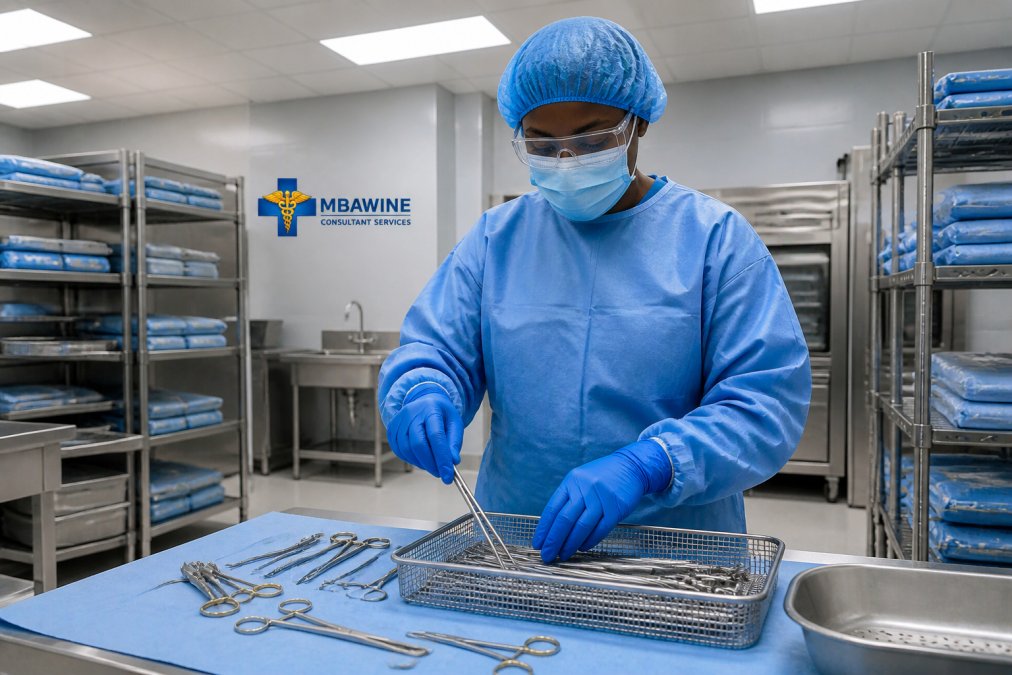
The exam content outline, established by the [Healthcare Sterile Processing Association(/blog/tags/hspa) standards | hspa.org], ensures consistency across certification programs. Each domain carries different weight on the actual exam, so don't treat them equally.
Decontamination is the removal of organic material, blood, tissue, bone, from surgical instruments before sterilization. Without proper decontamination, sterilization fails. Visible cleanliness and actual cleanliness are different things.
The process involves initial rinse, enzymatic cleaning, mechanical washing, rinsing, and drying. Enzymatic cleaners break down proteins. Mechanical action removes stubborn debris. Proper rinsing prevents residue that interferes with sterilization. Common mistakes include using water that's too hot (which sets proteins), skipping the enzymatic phase, and allowing instruments to air-dry instead of towel-drying. The exam tests whether you understand why each step matters, not just what the steps are.
Sterilization is the elimination of all microorganisms, including spores. The CRCST exam covers four primary sterilization methods: steam (autoclave), hydrogen peroxide gas plasma, ethylene oxide, and dry heat. Steam sterilization is the most common and most heavily tested.
Steam sterilization works through heat, moisture, pressure, and time. The autoclave reaches 250-275°F at 15-30 PSI. Exposure times vary by load type and density, a wrapped instrument tray takes longer to sterilize than a single unwrapped instrument because steam must penetrate the wrapping material.
Biological indicators contain spores that die only when sterilization parameters are met. Chemical indicators change color to show exposure to sterilization conditions but don't prove efficacy. The exam tests your understanding of when to use each type and how to interpret results.
You must recognize instruments by sight and understand their function. Instruments fall into categories: cutting instruments (scalpels, scissors), grasping instruments (forceps, hemostats), retracting instruments (retractors), and probing instruments (probes, elevators). Variations exist for specific surgical specialties. Focus your study on commonly used instruments first, then expand to specialty instruments.
Sterile packages must protect instruments during storage and transport while remaining easy to open without contamination. Packaging materials must allow sterilant penetration during sterilization but prevent microbial contamination during storage. Paper, non-woven materials, and rigid containers serve different purposes. You need to understand which materials work with which sterilization methods.
Storage conditions matter. Sterile packages stored in warm, humid environments degrade faster than those stored in cool, dry conditions. Shelf life depends on packaging material, storage environment, and handling frequency. The exam tests whether you understand that "sterile" is conditional on proper storage.
The Healthcare Sterile Processing Association (HSPA) establishes the standards that govern the CRCST exam. HSPA standards address infection prevention, quality assurance, regulatory compliance, and professional competency. Central sterile processing departments must operate under documented protocols, maintain records of all sterilization cycles, and conduct regular quality assurance testing.
The exam reflects these standards directly. Questions about quality assurance, documentation, and regulatory compliance aren't asking for opinion, they're asking whether you understand the requirements that govern your work.
To pass the CRCST exam, you must demonstrate competency across all seven domains of the HSPA job task analysis. The exam is criterion-referenced, meaning you're not competing against other test-takers. You either meet the standard or you don't. You're aiming for mastery, not a relative score.
The official HSPA job task analysis is your foundation. It outlines every competency the exam tests. Read it first, it's a blueprint for everything on the exam.
Comprehensive study guides that explain the reasoning behind answers are essential. Video demonstrations of sterilization equipment, decontamination processes, and instrument identification accelerate learning. Practice questions formatted exactly like the actual exam are non-negotiable. You need hundreds of practice questions to build confidence and identify weak areas.
At Mbawine Consultants, we offer study materials specifically for professionals who can't attend in-person classes. Our audio modules work during commute time or shift breaks. Our video demonstrations show real equipment and real techniques. Our practice exams use the same format and difficulty level as the actual CRCST exam.
| Study Format | Best For | Time Commitment | Retention Rate |
|---|---|---|---|
| Written study guide | Reference and deep learning | 60-80 hours | High for detail-oriented learners |
| Video demonstrations | Visual learners and procedures | 30-40 hours | High for visual/kinesthetic learners |
| Audio modules | Commute and shift time | 20-30 hours | Moderate (best combined with other formats) |
| Practice exams | Test readiness and weak areas | 15-20 hours | High (identifies gaps) |
| Live instruction | Real-time questions and interaction | 40-60 hours | Very high (but requires schedule flexibility) |
Practice questions are a diagnostic tool. Start with untimed practice questions to assess your baseline. For every incorrect answer, understand why. Don't move on until you can explain the reasoning.
Once you understand the material, move to timed practice exams. The actual CRCST exam gives you 2.5 hours for 100 questions, 1.5 minutes per question. Timed practice builds the speed and decision-making confidence you need on test day.
Track your performance by domain. If you're scoring 85% on decontamination questions but 65% on instrumentation, allocate more study time to instrumentation. Review every incorrect answer, even ones you got right by guessing. Understanding the reasoning behind correct answers prevents lucky guesses from masking knowledge gaps.
Spacing your study over weeks works better than cramming. Your brain consolidates information during rest periods. Plan for 8-12 weeks of consistent study, not four weeks of intense cramming.
Active recall beats passive review. Test yourself. Answer practice questions. Explain concepts out loud. These active strategies force your brain to retrieve information, which strengthens memory far more than passive reading.
Create a study schedule that fits your work life. If you work 12-hour shifts, studying for three hours afterward is unrealistic. Study during breaks, on days off, and during commute time. Consistency matters more than duration.

Test anxiety is real and can sabotage even well-prepared candidates. Physical preparation matters. Exercise reduces anxiety. Sleep consolidates learning. The week before your exam, prioritize sleep and exercise over extra study hours.
Practice test-taking under exam conditions. Take full-length practice exams in a quiet room with no interruptions, timed exactly like the real exam. On exam day, remember that some anxiety is normal and even helpful. Trust your preparation.
Build your study schedule around your actual life, not around an ideal schedule you'll never maintain. If you work nights, study during the day when you're alert. Use your commute, lunch breaks, and shift downtime strategically.
Aim for 5-8 hours per week over 8-12 weeks. This totals 40-96 hours of preparation, which is realistic for most professionals. Small consistent progress beats ambitious plans you can't maintain.
The CRCST certification opens doors. Many certified technicians move into supervisory roles. Departments need leaders who understand the work because they've done it. Some pursue advanced certifications like the Certified Surgical Technician (CST) or Certified Healthcare Leader (CHL). Others specialize in specific sterilization methods, surgical specialties, quality assurance, regulatory compliance, or training roles.
Career advancement in sterile processing requires continued learning and demonstrated competency. The CRCST certification is your entry point. What you do after certification determines where your career goes.
Relying on a single study format. Combine reading, watching, listening, and doing to reinforce learning across multiple pathways.
Skipping foundational material. Understand foundational concepts, microbiology, sterilization principles, regulatory requirements, before tackling complex questions.
Not reviewing incorrect practice answers. Understand why you missed each question. Was it a knowledge gap, a misreading, or a careless mistake?
Studying material not on the exam. The HSPA job task analysis is your guide. Stay focused on what's actually tested.
Waiting too long to take the exam. Once you've completed your study program, take the exam within two weeks. Waiting allows knowledge to fade.
Ignoring weak areas. If practice tests reveal weak spots, address them immediately. Spend extra time on domains where you're scoring below 80%.
Preparing for the CRCST exam is demanding, but the investment pays off. The certification validates your technical competency and opens career pathways you wouldn't otherwise access. The key is commitment to consistent, focused preparation over weeks, not days.
At Mbawine Consultants, we offer comprehensive surgical support services, needs assessment, and specialized education for sterile processing departments. Our remote learning format lets you study around your work schedule. Our instructors are highly credentialed experts with real experience in sterile processing departments. Our practice exams use the exact format and difficulty level of the actual CRCST exam. If you're serious about passing the CRCST exam and advancing your career in sterile processing, contact Mbawine Consultants to enroll in our fast-track certification preparation programs and flexible audio/video modules designed for working professionals.
The CRCST exam tests both theoretical knowledge and practical understanding of sterile processing. Success depends on how thoroughly you master decontamination procedures, sterilization methods, surgical instrumentation identification, and infection control standards. Most candidates who study systematically and use quality practice questions pass on their first attempt. The exam covers about 150 questions across multiple domains, so consistent preparation over several weeks is more effective than cramming.
The CRCST exam emphasizes decontamination and cleaning procedures, sterilization equipment and methods (including autoclave operation and biological indicators), surgical instrument identification, packaging and storage requirements, infection prevention and control standards, and quality assurance documentation. HSPA CRCST certification requirements also cover aseptic technique, safety protocols, and regulatory compliance. Focus your study on these core areas, as they represent the majority of exam questions.
Break your study into smaller, focused sessions rather than long blocks. Use audio and video modules during breaks or before shifts, and dedicate 30-45 minutes each day to practice questions. Space your studying across several weeks to avoid burnout. Best CRCST study materials include official exam outlines, practice tests, and video tutorials. Many candidates find studying on days off more productive. Consider programs that offer flexible remote learning options designed for working professionals.
The CRCST exam consists of approximately 150 multiple-choice questions. You'll have a set time limit to complete the exam, typically around 3-4 hours. Using CRCST practice test 2026 resources helps you understand the question format, pacing requirements, and content distribution so you can manage your time effectively during the actual exam.
Official CRCST study materials are available through the Healthcare Sterile Processing Association (HSPA) and include the Job Task Analysis (JTA) and exam content outline. Many credentialed programs offer downloadable study guides, practice question banks, and reference materials. Look for resources that align with current HSPA standards and include both written content and visual learning aids to reinforce key concepts.
Start by reviewing the official HSPA exam content outline to understand all domains. Master decontamination procedures, sterilization methods, and surgical instrument identification through structured study materials. Use practice questions to identify weak areas, then focus deeper study there. Consider enrolling in comprehensive prep programs that include video instruction and mentorship. Many candidates benefit from combining self-study with instructor-led guidance, especially when learning complex topics like biological indicators and chemical sterilization.
This article was written using GrandRanker


