

A PDF can organize CRCST preparation, but reading one from beginning to end is not the same as building exam readiness. If you’re searching for a CRCST exam study guide pdf, it’s reasonable to ask whether a resource is accurate, current, and comprehensive. Flashcards can reinforce individual facts, but they may not reveal gaps in your ability to explain how concepts fit together.
A disciplined approach starts with trustworthy materials and a clear framework. The HSPA CRCST exam content outline, updated in November 2023, can help you identify what to study, while the current 9th edition of the Sterile Processing Technical Manual provides a key reference for your review. Use the outline to organize your topics, then select learning materials that explain them. This guide shows how to evaluate PDFs, build a manageable study plan, and use practice questions and flashcards for active review. It also explains when structured instruction, including in-person and online sterile processing classes, can help when independent study isn’t enough.
A CRCST exam study guide pdf can make sterile processing concepts easier to review, but the label “study guide” is used for resources with different purposes and levels of detail. Some PDFs explain concepts and organize instruction; others are official outlines that identify exam coverage, or practice questions designed to test recall. Identify what kind of document you have before relying on it. A topic map or a set of questions is not necessarily a complete learning resource.
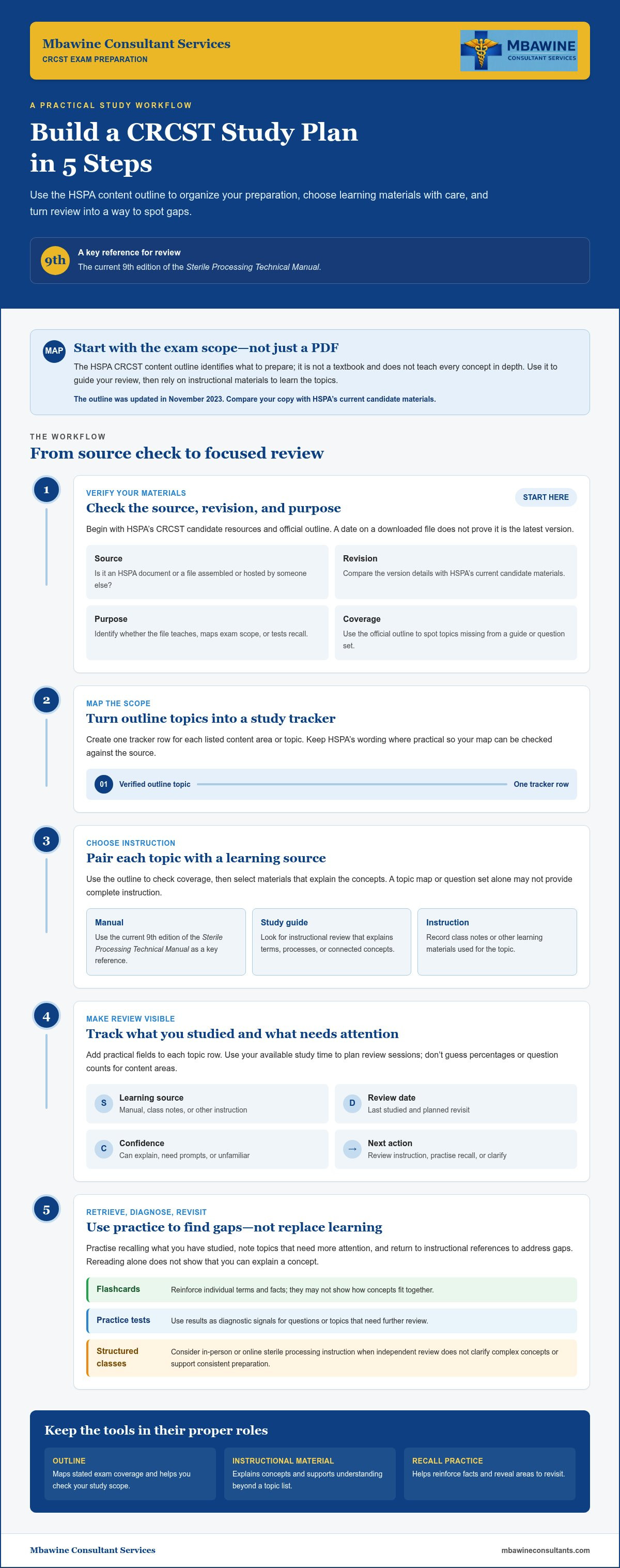
The HSPA CRCST content outline is a useful starting point for understanding exam scope. Updated in November 2023, it identifies areas candidates should prepare for, but it isn’t a textbook and does not teach every concept in depth. Use it to check your coverage, then turn to appropriate learning materials to understand the topics themselves.
A study guide is instructional review material organized around relevant topics. It may summarize processes, explain terminology, or connect related concepts, helping you revisit what you have learned. The content outline serves another purpose: it maps exam coverage so you can plan what to study and identify areas your materials may overlook.
Practice tests and flashcards support retrieval. A practice test can show which questions or topics need more review, while flashcards can reinforce individual terms and facts. Neither format alone establishes that you understand how concepts relate or can apply them consistently. Treat results as diagnostic signals, then return to instructional references to address gaps.
Begin with HSPA’s CRCST candidate resources and official content outline. Before relying on a downloaded PDF, inspect its title, source, revision date, and alignment with current HSPA guidance. The outline’s November 2023 revision is a useful reference point, but compare your copy with HSPA’s current candidate materials in case guidance has changed.
Third-party downloads and user-created flashcard sets can supplement preparation, but being available online doesn’t make them authoritative or comprehensive. Use them selectively, cross-check unfamiliar claims against reliable learning references, and don’t assume that a large question bank represents the full exam scope.
A PDF can bring order to review, but it cannot guarantee a passing score. Readiness depends on accurate materials, sound understanding, and deliberate practice. For structured support beyond independent study, explore CRCST certification preparation through in-person and online sterile processing classes.
Use the HSPA CRCST content outline to check whether your study covers the examination’s stated scope. The outline identifies what to prepare, while textbooks, classes, and other learning materials explain the underlying concepts. A well-organized CRCST exam study guide pdf can support your review, but compare its topic list with HSPA’s current materials rather than treating it as definitive on its own.
Start with HSPA’s CRCST candidate resources and locate the official content outline. The outline was updated in November 2023, but a date printed on a downloaded copy doesn’t establish that it remains the latest version. Compare your document with HSPA’s current candidate materials before building a study plan, and review any newer guidance.
If you’re using a study map from an educational source, record who produced it and compare its title, revision details, and topic coverage with the official HSPA outline. A third-party document can be useful, but it shouldn’t replace the source that defines exam scope. If its revision information is missing or its categories don’t clearly match current HSPA materials, use it cautiously and return to the official outline to resolve discrepancies.
After verifying the current outline, create one tracker row for each listed content area or topic. Preserve HSPA’s wording where practical so you can compare your tracker with the source. Add fields that show what you have studied and what still needs attention, rather than guessing percentages or question counts for each topic.
For example, if a topic feels unfamiliar, don’t mark it complete just because you reread a paragraph. Identify the concept causing difficulty, return to an instructional source, and then test whether you can explain it without looking. This makes the tracker a practical decision tool, not just a record of time spent.
Review the map regularly and update your confidence based on what you can recall and explain accurately. If you learn better with guidance, enrollment in sterile processing classes can complement independent review.
Study tools serve different purposes. A CRCST exam study guide pdf may explain concepts, organize review, or simply reproduce an outline. Flashcards prompt brief recall, practice tests help identify possible gaps, and structured instruction can help when you need an explanation or a way to clarify difficult material. Choose a resource based on what you need to learn or practise, not just its format.
Use the current HSPA content outline as a reference when assessing third-party PDFs, quizzes, and flashcards. Compare their topics with the outline before treating them as representative of exam content. A question set can be useful for practice without providing complete coverage, and a polished-looking document isn’t automatically accurate or current.
Different PDFs can play distinct roles. The official content outline helps organize topic coverage; an instructional study guide should explain relevant material. If a guide presents only short facts or prompts, treat it as a review aid rather than a substitute for deeper learning.
Keep your materials purposeful. Annotate a difficult passage, write a concise explanation in your own words, or note a question to resolve during review. Collecting multiple downloads without comparing them with the outline can create duplication and hide gaps. If a PDF conflicts with a current authoritative reference, pause before memorizing the disputed information and verify which source is reliable.
Flashcards work best for focused recall after you’ve learned the underlying concepts. They can prompt you to define a term or explain a short point, but recognizing a familiar answer doesn’t necessarily demonstrate understanding. For each card, try to explain why the answer is correct and how it connects to the broader topic.
Practice questions provide a different kind of feedback. They require you to retrieve information and can reveal where your knowledge is uncertain, but they shouldn’t become your only study method. A correct answer may reflect guessing or memorization, while a missed question can point to a concept that needs review, not simply another attempt at the same quiz.
After a practice session, trace each missed question to the relevant topic in the current outline. Return to an instructional source before testing yourself again. This turns a quiz into a feedback tool rather than a score to chase. Mbawine Consultant Services provides in-person and online sterile processing classes for learners who want structured education alongside independent review.
A useful study schedule turns the verified HSPA outline and your learning resources into repeatable actions. Adapt the five-step workflow below to the time you have available. It doesn’t prescribe a fixed preparation period or assume every candidate needs the same amount of review. Use your progress, not a calendar deadline alone, to decide what comes next.
Let the tracker guide the order and emphasis of your sessions. A familiar topic may need a shorter review and later reassessment, while an unfamiliar one may require reading, clarification, and more than one retrieval attempt. Don’t build a schedule around pages completed alone. Finishing a section of a CRCST exam study guide pdf shows exposure to the material, not necessarily that you can recall or explain it.
A simple tracker can use these headings: outline topic, learning source, session date, confidence, missed prompts, next review action. For example, a low-confidence rating could prompt you to revisit an explanation before trying new questions; a stronger rating could prompt cumulative recall later. There’s no single schedule that suits every candidate, so update the plan as your understanding changes.
If structured support would help you follow your plan, enroll in sterile processing classes designed to prepare professionals for certification. Instruction can complement independent PDF review as you work through challenging concepts.
Independent review gives candidates flexibility, but reading and recall tasks may not be enough when sterile processing concepts remain difficult to explain. A CRCST exam study guide pdf can support review, while structured education provides a framework for learning and revisiting challenging material. The approaches complement each other: classes support learning, and independent study gives you a way to review against the current HSPA content outline.
Notice what happens after you close the PDF. If you recognize a term while reading but struggle to explain it in your own words, or repeated flashcard practice leaves the same questions unresolved, revisit the underlying concept instead of repeating the prompt. A study tracker can help distinguish a temporary lapse in recall from persistent confusion.
Organized instruction can help when you need a clearer learning structure or independent review isn’t resolving uncertainty. Mbawine Consultant Services provides in-person and online sterile processing classes designed to prepare professionals for certification. These classes offer an educational option alongside self-directed study, not a promise of examination success.
Consider whether added structure could help if you:
Structured education works best as part of an ongoing preparation process, not as a reason to set aside independent review. Continue using the latest HSPA CRCST content outline to monitor topic coverage, and track concepts that need further study. After reviewing class material, return to those topics in your references and assess whether you can recall and explain the key ideas. If a concept remains unclear, note the specific question so your next review is focused.
Mbawine Consultant Services provides in-person and online classes designed for certification preparation. They can add structure to PDF-based self-study while keeping your preparation connected to the current outline and your learning needs. The right balance between classes and independent review depends on what you already understand and where you need further instruction.
If structured sterile processing education fits your preparation needs, you can enroll in a sterile processing class. Continue using accurate learning resources and the current HSPA outline as you build confidence in your knowledge.
Choose a preparation approach you can sustain and use it to strengthen your understanding over time. A CRCST exam study guide pdf can organize independent review, while structured education can provide support when you need guidance through sterile processing concepts. Combining deliberate self-study with instruction gives you a purposeful way to build your knowledge without treating any single resource as a guarantee of exam success.
Mbawine Consultant Services offers in-person and online sterile processing classes designed to prepare professionals for certification. If you’re ready to add structured learning to your preparation, enroll in a sterile processing class.
Approach your preparation with care and consistency. Each focused study session is an opportunity to build stronger professional understanding.
HSPA provides CRCST candidate resources, including an official content outline, but an outline is not the same as a comprehensive instructional study guide. It identifies the examination’s scope rather than explaining every subject in depth. Start with HSPA’s current candidate materials to establish what topics to cover, then use appropriate learning resources to understand them. Check the document’s title and revision information instead of assuming every search result is an official guide.
No PDF, whether free or paid, can establish that you’re ready or guarantee a passing result. A free guide may be useful if its material is accurate and supports your learning, but check whether it explains concepts and covers topics aligned with current HSPA guidance. If it lists terms without clarifying their meaning or application, pair it with reliable instruction and assess whether you can explain the material without relying on the page.
A CRCST study guide should address the topics identified in the current HSPA content outline and provide enough explanation to help you understand them, not merely recognize labels. Useful material defines specialized terminology, clarifies processes, and gives you a basis for explaining concepts in your own words. Note any outline topic that the guide treats only briefly; that shows where you may need a more detailed reference or additional instruction.
Yes, flashcards can help you practise recalling terms and brief facts, but a Quizlet set is not automatically complete, accurate, or current just because it is available online. Check its content against reliable study references and the current HSPA outline. If a card asks for a definition, try explaining the answer and its relevance before revealing it. Cards are most useful as recall prompts, not as the sole source for learning complex concepts.
Check who produced the PDF, its title, publication or revision date, and whether its content aligns with HSPA’s current CRCST candidate resources. Compare its topics and terminology with the latest official outline. A date on a file is helpful, but it doesn’t independently prove that the material remains current. If the source is unclear or you find conflicting information, rely on current authoritative references rather than memorizing the disputed statement.
Study a topic using instructional material first, then use practice questions to check what you can retrieve. Review each uncertain or incorrect response and identify the underlying concept instead of memorizing the answer sequence. If you guessed correctly, mark the topic for another check rather than treating it as mastered. Return to the relevant source, clarify the concept, and test yourself later with different questions.

Article by
Mba Akuribila
Mba‑Akuribila is a healthcare leader, educator, and founder of Mbawine Consultants, a Bronx‑based institution recognized nationwide for advancing excellence in sterile processing and allied health workforce development. Born in Bongo in Ghana’s Upper East Region, his journey from rural beginnings to national impact reflects a lifelong commitment to service, empowerment, and community advancement.
For over two decades, he has trained sterile processing employees, mentored, and placed thousands of healthcare professionals across the United States. Through Mbawine Consultants, he established one of the country’s most trusted Sterile Processing Certification Test Prep Programs, preparing new Americans and career‑changers for successful entry into the field. The organization, as at 2026, has graduated more than 15,000 sterile processing technicians who now serve in hospitals, ambulatory centers, dental practices, and reprocessing facilities nationwide.
Under his leadership, Mbawine Consultants has expanded into a full Healthcare Staffing Agency, connecting nurses and allied health professionals to meaningful employment opportunities. His team also provides Interim Management Services, supporting hospitals and surgical centers with experienced leaders who stabilize operations, strengthen compliance, and improve workflow efficiency.
As a former surgical technician, sterile processing manager, educator, and system‑wide director, Mba‑Akuribila brings deep expertise to Sterile Processing Consulting, helping healthcare facilities elevate quality, safety, and regulatory readiness.
His work in the United States and Ghana continues to reflect his core philosophy: service above self, opportunity for all, and excellence without compromise.


