

Last Updated: August 11, 2026
The Certified Registered Central Service Technician credential, administered through HSPA (the Healthcare Sterile Processing Association), is built around a defined exam blueprint that maps every question to a specific content domain. The exam blueprint is your single most important study document, it tells you which domains carry the most weight so you can allocate your limited study time accordingly. According to HSPA's official CRCST exam candidate handbook, reviewing the blueprint before opening any textbook is non-negotiable.
The CRCST exam blueprint organizes content into several major domains. The three that carry the most clinical weight are decontamination, sterilization, and instrument preparation and packaging. Decontamination covers standard precautions, personal protective equipment, manual and mechanical cleaning, and chemical disinfection agents. Sterilization covers steam sterilization principles, autoclave operation, biological indicators, chemical indicators, and load configuration. Packaging addresses instrument preparation, wrap selection, tray assembly, and labeling requirements.
Infection control and patient safety principles thread through all three domains. A question about biological indicators is also a question about quality assurance. Understanding those connections is what separates candidates who pass from those who score near the cutoff.
The CRCST exam uses a scaled scoring model where raw scores are converted to a scaled score, and candidates must meet a minimum passing threshold. The blueprint percentages tell you where the test emphasizes depth of knowledge. Spending time on low-weight domains at the expense of high-weight ones is a common and costly mistake.
For most working technicians, a study window of 8 to 16 weeks is realistic. Candidates with strong clinical experience often need less time; those newer to the field generally need the full 16 weeks or more. Raw hours matter more than calendar weeks, many working professionals aim for 6 to 10 hours of focused study per week.

The biggest mistake shift workers make is building a study schedule that assumes consistent energy at consistent times. A more effective approach: anchor your study sessions to your days off, not your work days. On shift days, limit yourself to passive review, listening to audio content during a commute, running through flashcards on a break, or skimming notes before sleep. Reserve active study (practice tests, workbook exercises, written review) for your off days when cognitive capacity is higher.
| Day Type | Study Mode | Time Commitment |
|---|---|---|
| Work day (12-hour shift) | Passive review only | 15-20 minutes |
| Day after long shift | Light review, flashcards | 20-30 minutes |
| Full day off | Active study, practice tests | 90-120 minutes |
| Day before exam | Light review, rest | 30 minutes max |
Protect your off-day study blocks the same way you protect a medical appointment. Put them in your calendar and treat interruptions as the exception, not the norm.
After a full shift in a sterile processing department, your working memory is depleted. Three strategies that actually help: study within the first hour after waking on your days off, use spaced repetition instead of marathon sessions, and rotate content domains across sessions rather than drilling one topic to exhaustion. Sleep is not optional, cognitive consolidation, the process by which your brain converts short-term learning into long-term memory, happens during sleep.
The best CRCST study materials combine official content with active recall tools. Passive reading alone rarely produces passing scores.
The HSPA Central Service Technical Manual is the primary reference for CRCST exam content. Every domain on the exam blueprint traces back to this text. HSPA also offers official practice questions and candidate preparation resources through their certification program, aligned directly to the exam blueprint. As noted in the CDC guidelines on sterilization and disinfection in healthcare facilities, sterile processing standards evolve regularly, so using current official materials matters.
Spaced repetition is the most evidence-backed study technique for technical certification exams. The method works by scheduling review of each concept at increasing intervals, forcing retrieval and strengthening long-term retention.
For CRCST exam study, spaced repetition works particularly well for sterilization cycle parameters, disinfection level classifications and associated agents, biological and chemical indicator types, and medical terminology related to surgical instruments. Build flashcard decks organized by exam domain and let the spaced repetition algorithm determine when cards resurface.
A sterile processing practice test simulates the cognitive demand of the actual exam in ways a textbook cannot. The most common failure mode among working candidates is under-using practice tests. Many technicians study content for weeks and then take a single mock exam the week before the real test.
Practice tests reveal knowledge gaps, build exam stamina, improve time management, and reduce test-day anxiety. Aim for at least three full-length mock exams before your test date. Review every wrong answer in detail, analyzing not just the correct response but why the incorrect options were wrong.
The CRCST exam tests applied knowledge, not just definitions. Candidates who memorize facts without understanding how they connect to patient safety and infection control consistently underperform on scenario-based questions.
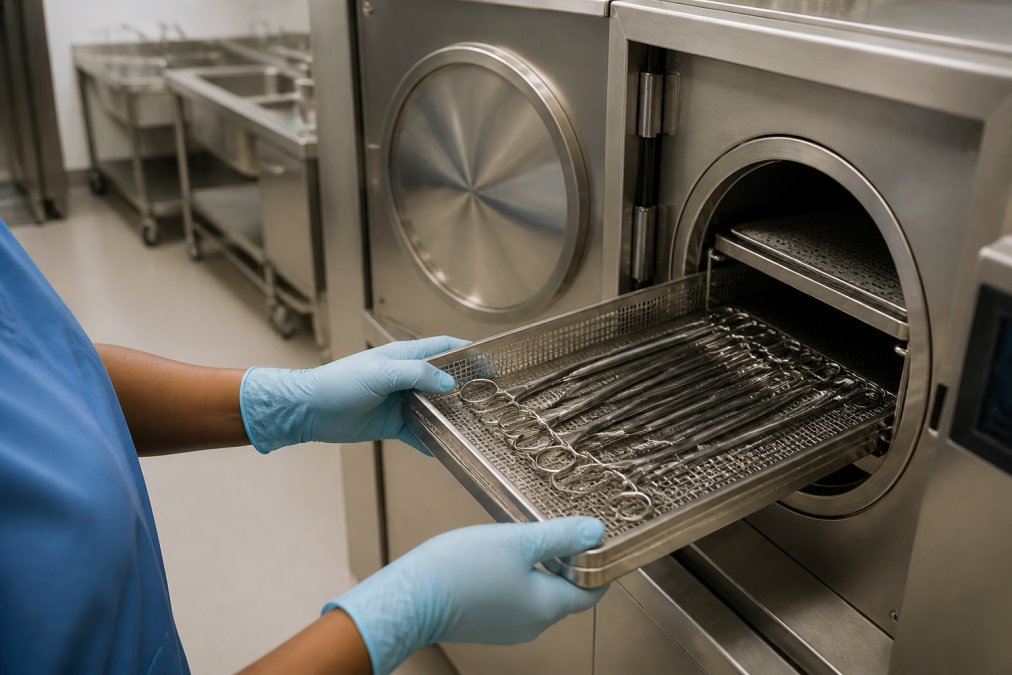
Steam sterilization is the most widely used sterilization method in surgical instrument reprocessing. The autoclave achieves sterilization through saturated steam, elevated temperature, and time. Candidates must know the parameters for gravity displacement cycles versus dynamic air removal (pre-vacuum) cycles, as well as conditions required for different load types.
Biological indicators contain highly resistant bacterial spores; if the sterilization cycle is effective, those spores are killed. Chemical indicators provide a visual process check but do not confirm sterilization. Key autoclave concepts include gravity displacement versus pre-vacuum cycle mechanics, flash sterilization indications and limitations, Bowie-Dick test purpose and interpretation, and load configuration principles that affect steam penetration.
Decontamination is the first and most critical step in the reprocessing cycle. All contaminated instruments must be decontaminated before any other step can occur. Disinfection levels matter on the exam: high-level disinfection eliminates all microorganisms except high numbers of bacterial spores; intermediate-level disinfection inactivates most organisms but not necessarily spores; low-level disinfection handles routine surface cleaning.
Regulatory compliance in decontamination is governed by standards including OSHA's bloodborne pathogens standard, which defines requirements for personal protective equipment and work practice controls in healthcare settings.
Instrument preparation covers inspection, assembly, and function testing of surgical instruments before packaging. Packaging selection depends on the sterilization method, woven and non-woven wraps, peel pouches, and rigid container systems each have specific applications. Labeling requirements include sterilizer number, cycle number, load number, and expiration date or event-related shelf life designation.
Quality assurance in sterile processing means documenting every step of the reprocessing cycle. Incomplete records create compliance gaps and patient safety risks.
Many sterile processing departments will support CRCST exam preparation if you ask directly. Some facilities offer paid study leave, reimbursement for exam fees, or access to online preparation programs as part of their professional development benefits.
Online preparation programs have made CRCST exam study significantly more accessible for working technicians. Audio and video-based learning allows candidates to review content during commutes, lunch breaks, or between tasks. Mbawine Consultants offers fast-track central sterile processing test preparation delivered through audio, video, and web conferencing, accessible from home. The program is designed specifically for working professionals who cannot restructure their schedules around fixed class times. Financing options are available, with no payment required for the first 30 days.
When evaluating any online prep program, ask whether the instructors hold current certifications and active clinical experience. Practical nuances come from people who have worked the department recently.
Read every question completely before selecting an answer. The CRCST exam frequently uses scenario-based questions where the final clause changes the correct answer entirely. Use the process of elimination aggressively, eliminating two clearly incorrect options before evaluating the remaining two improves your odds significantly. If two options seem plausible, look for the one that most directly addresses patient safety or regulatory compliance.
Manage your time by section. If a question is taking too long, mark it and move on. Arrive early enough to complete check-in without rushing, bring required identification as specified by the testing center, and trust your preparation. According to the American Psychological Association's research on test anxiety and performance, anxiety management techniques including controlled breathing and positive self-talk measurably improve performance under exam conditions.
Preparing for the CRCST exam while holding down a full-time sterile processing position is genuinely difficult. The schedule pressure, fatigue, and technical depth of the exam are real. Mbawine Consultants built its CRCST preparation program for exactly this situation: working technicians who need structured, expert-led content they can access on their own terms. With highly credentialed instructors, flexible remote learning through audio and video conferencing, and financing that removes the immediate financial barrier, the program is designed to fit around your life rather than require you to reorganize it. Enroll with Mbawine Consultants and earn your CRCST credential without sacrificing the career you're already building.
The CRCST exam is challenging but very passable with structured preparation. It covers decontamination, steam sterilization, instrument preparation, packaging, and infection control. Candidates who struggle usually underestimate the depth of the exam blueprint. Working through official HSPA study materials, completing at least two full sterile processing practice tests, and reviewing biological and chemical indicators closely will put you in a strong position to pass on your first attempt.
Yes, self-study is a valid path for CRCST exam preparation. The HSPA workbook, online practice tests, and flashcard systems using spaced repetition give you everything you need to cover the exam blueprint independently. That said, many working technicians find that a structured remote prep program helps them stay accountable and move through the material faster, especially when balancing 12-hour shifts. A guided program also ensures you do not miss low-frequency but high-stakes topics like quality assurance and regulatory compliance.
Prioritize steam sterilization principles, decontamination and disinfection procedures, surgical instrument preparation and packaging, and biological and chemical indicator interpretation. These domains make up the largest portion of the exam blueprint according to the HSPA. Medical terminology and infection control fundamentals appear throughout multiple sections, so building fluency in both early in your CRCST exam study plan pays off across the entire test rather than just one domain.
The CRCST exam contains 150 questions, of which 125 are scored and 25 are unscored pilot questions you cannot identify during the test. You have three hours to complete it. Because you cannot tell which questions count, treat every question equally. Time management matters: pace yourself to spend roughly 72 seconds per question on average, and flag difficult items to revisit rather than stalling and losing time on the questions that follow.
This article was written using GrandRanker


