

The integrity of modern surgical intervention rests not merely on the skill of the surgeon but on the rigorous, systematic decontamination processes managed by certified professionals. Obtaining your cspdt certification represents more than a career milestone; it's a formal commitment to the institutional safety standards that protect patients from healthcare-associated infections. You likely recognize that the path to this credential is often obscured by a complex landscape of competing certification bodies and varying eligibility requirements. This ambiguity frequently leads to unnecessary anxiety regarding exam difficulty and long-term professional trajectory.
We understand that distinguishing between the CBSPD and HSPA pathways requires a nuanced understanding of industry regulations and educational standards. This professional guide provides a comprehensive framework to master the specific requirements, intricate exam structure, and career advantages associated with this credential. You'll gain a clear perspective on eligibility criteria while discovering a structured methodology for technical mastery. By the conclusion of this analysis, you'll possess the requisite knowledge to secure your professional standing and leverage your expertise for enhanced salary potential in the 2026 healthcare sector.
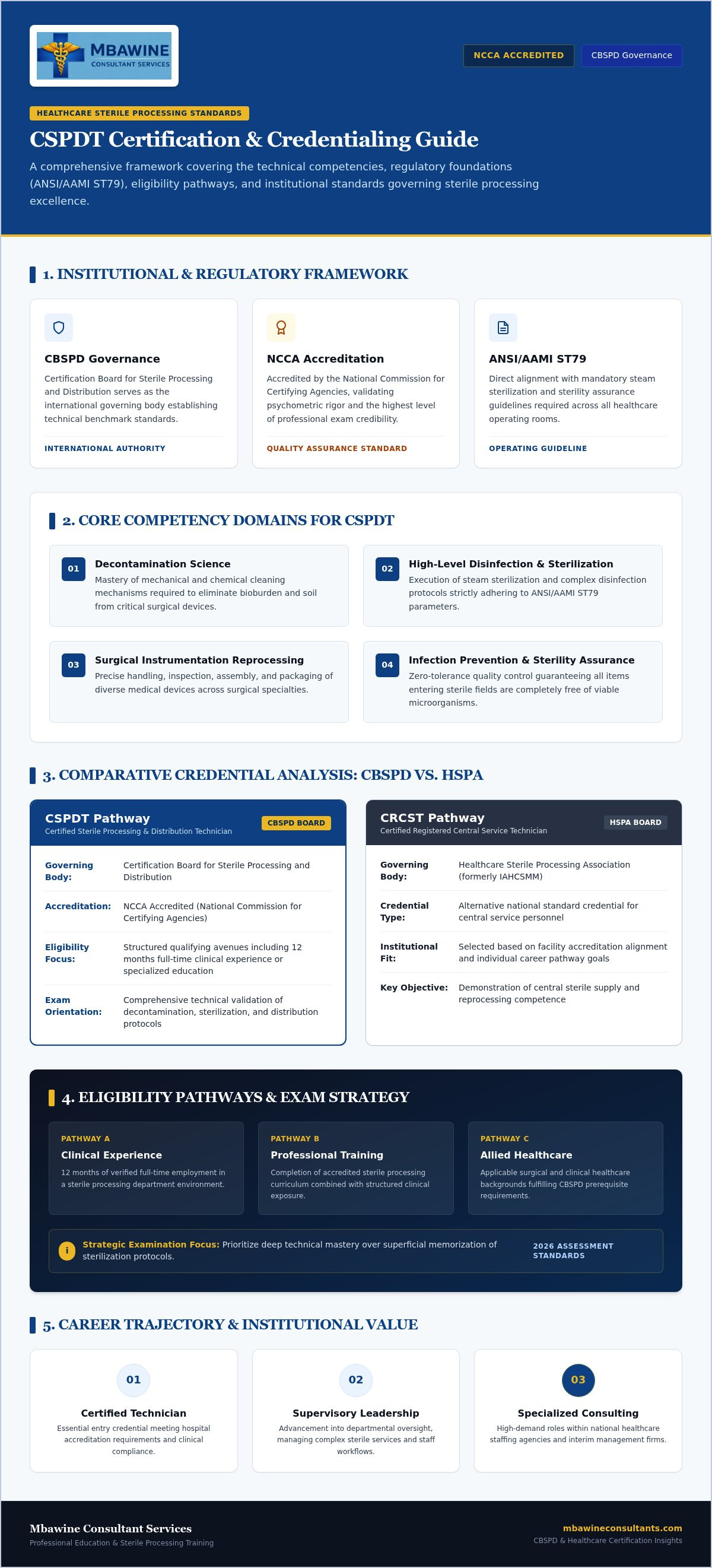
The Certified Sterile Processing and Distribution Technician (CSPDT) credential serves as the definitive technical validation for individuals operating within the central sterile services department. This certification is governed by the Certification Board for Sterile Processing and Distribution (CBSPD), an international body that maintains rigorous standards for the sterilization and distribution of medical devices. As we look toward 2026, the industry has solidified the cspdt certification as the gold standard for healthcare professionals who prioritize patient safety and institutional compliance. It's a credential whose prestige is anchored in its accreditation by the National Commission for Certifying Agencies (NCCA); this ensures that the examination and its underlying requirements meet the highest benchmarks for professional excellence and psychometric validity. The CBSPD functions as a critical guardian of these standards, ensuring that every technician possesses the specialized knowledge required to function in high-stakes clinical environments where the margin for error is non-existent.
A certified technician must exhibit a sophisticated understanding of the mechanical and chemical processes required for effective decontamination. This mastery extends beyond basic cleaning to include the intricate disinfection and sterilization protocols necessary for complex surgical instrumentation. Professionals are expected to manage the reprocessing of diverse medical devices while adhering strictly to regulatory standards, specifically the ANSI/AAMI ST79 guidelines. These guidelines provide the necessary framework for steam sterilization and sterility assurance in healthcare facilities. Such expertise ensures that every item entering the sterile field is free of viable microorganisms, thereby mitigating the risk of surgical site infections. These competencies aren't merely technical skills; they're fundamental components of a broader commitment to public health and clinical integrity that every modern hospital requires.
The acquisition of the cspdt certification creates a clear pathway for professional advancement and institutional leadership. Healthcare facilities increasingly mandate that their sterile processing staff hold national credentials to meet accreditation requirements and ensure high-quality outcomes. This trend has led to the credential being highly valued by national healthcare staffing agencies and interim management firms. Professionals who demonstrate this level of commitment often transition into specialized consulting or supervisory roles where they oversee entire departments. By enrolling in comprehensive sterile processing classes, technicians can bridge the gap between initial entry into the field and the technical mastery required for long-term career success and financial stability. This educational foundation is essential for navigating the complexities of modern healthcare infrastructure.
The path to obtaining the cspdt certification is structured to accommodate diverse professional backgrounds while maintaining a high threshold for entry. The Certification Board for Sterile Processing and Distribution provides three distinct qualifying avenues to ensure that every candidate possesses a foundational level of clinical or academic preparedness before attempting the CBSPD technician certification exam. These pathways aren't merely administrative hurdles; they serve as a safeguard for public health by verifying that technicians have been exposed to the rigorous demands of medical device reprocessing. By requiring specific milestones of experience or education, the board maintains the integrity of the credential and ensures that certified individuals can immediately contribute to the safety of the surgical environment.
Candidates must align their application with one of three established criteria to qualify for the formal assessment. The first pathway requires 12 months of full-time employment in a sterile processing environment, ensuring the technician has experienced a full cycle of institutional operational challenges. For those entering the field from an academic background, the second pathway allows for the completion of a recognized sterile processing training program, provided the candidate achieves a final grade of 70 or higher. This alternative is particularly valuable for career changers who require a theoretical foundation before entering the clinical space. The third pathway caters to part-time professionals, requiring a cumulative total of 1,600 hours of documented experience. Each of these routes emphasizes a different aspect of professional readiness, whether through sustained clinical immersion or structured theoretical education.
The examination itself is a comprehensive assessment of technical proficiency, divided into several critical domains that reflect the daily responsibilities of a technician. Decontamination and disinfection procedures carry the highest weighting, as these stages are fundamental to preventing cross-contamination in the surgical suite. Candidates must also demonstrate an exhaustive understanding of sterilization processes, equipment maintenance, and the ethical considerations surrounding patient safety. Safety, ethics, and regulatory compliance are increasingly emphasized in 2026, reflecting a global shift toward more stringent accountability in healthcare infrastructure. Success on the exam requires more than rote memorization; it demands a systematic understanding of how regulatory standards translate into clinical practice. To ensure you're fully prepared for these rigorous requirements, consider enrolling in specialized certification preparation to refine your technical expertise and professional confidence.
Choosing the right certification pathway requires a thorough evaluation of your professional background and clinical exposure. Both credentialing bodies maintain NCCA-accredited programs that establish a high level of technical competency. While the cspdt certification is the flagship offering of the CBSPD, alternative credentials exist within the broader industry. These programs are internationally recognized and serve as vital benchmarks for healthcare facilities striving to maintain rigorous sterilization standards. It's essential to recognize that these credentials cater to different professional entry points and educational preferences within the sterile processing field.
Some certification pathways are characterized by mandatory hands-on experience requirements, which must be completed prior to or shortly after the examination, focusing heavily on clinical immersion. Conversely, the CBSPD allows for a course-based eligibility pathway, making it an accessible entry point for those who prioritize academic rigor before entering the workforce. Renewal cycles also diverge significantly across different certifying boards. Some require annual membership fees and yearly continuing education credits, while the CBSPD utilizes a multi-year recertification period, emphasizing long-term continued competency through a structured volume of points collected over a broader timeframe. Understanding these logistical differences is essential when reviewing occupational data, as these credentials correlate with the professional preparation required for medical equipment preparers.
Most healthcare institutions view these credentials as functionally equivalent. They are respected standards that validate a technician's ability to protect patient safety. However, for those pursuing advanced roles in interim management or healthcare consulting, holding comprehensive qualifications can demonstrate a superior breadth of knowledge. This strategic approach often signals a commitment to mastering specific nuances of industry regulatory frameworks. Mbawine Consultant Services provides specialized training for certification pathways, ensuring candidates aren't limited by institutional preference. Whether you're exploring specific curriculum options or the CBSPD requirements, a structured educational approach is the most reliable way to ensure long-term career stability and professional recognition. We support professionals in navigating these choices to align their certification with their specific career trajectory.
Achieving the cspdt certification requires a transition from casual review to a rigorous, syllabus-driven methodology. Many candidates underestimate the depth of the CBSPD examination, assuming that clinical experience alone suffices for technical mastery. This is a misconception. The exam demands a precise understanding of the theoretical principles underlying sterilization science. Relying on self-guided study often leads to significant knowledge gaps, particularly in low-frequency but high-risk reprocessing scenarios. A structured educational framework ensures that every domain is addressed with the necessary level of clinical and regulatory detail. It's not enough to know how to perform a task. You must understand the underlying biological and chemical rationale. Don't rely solely on clinical intuition when the exam requires specific regulatory citations.
A methodical approach begins with a comprehensive self-assessment against the official CBSPD content outline. You must identify your existing strengths while isolating areas of technical weakness. Establishing a mental model of the entire sterilization cycle allows you to answer questions based on logic rather than rote memory.
Professional education serves as the bridge between basic interest and professional mastery. For working technicians, the flexibility of online sterile processing technician programs allows for the integration of high-level study into a demanding professional schedule. Expert-led instruction provides essential clarity on the nuances of ANSI/AAMI ST79 and other evolving regulatory requirements. Our instructors act as mentors who bridge the gap between textbook definitions and the practical realities of a functioning sterile processing department. Beyond the curriculum, the presence of peer interaction and mentorship significantly enhances success rates. Engaging with seasoned professionals allows you to contextualize theoretical knowledge within real-world surgical environments. This collaborative environment fosters the professional confidence necessary to excel under the pressure of a formal assessment. It's the difference between guessing and knowing. To secure your future in this high-stakes field, we recommend that you enroll in our specialized certification preparation classes to ensure you meet the rigorous benchmarks of the 2026 examination and successfully obtain your cspdt certification.
Mbawine Consultant Services operates with a profound sense of advocacy for the professionalization of the sterile processing field. We don't merely provide instruction; we act as guardians of industry standards and public safety. Our mission is to bridge the gap between initial interest and institutional mastery by providing rigorous, evidence-based education that addresses the high-stakes nature of medical device reprocessing. As a consultancy that actively engages in interim management and healthcare staffing, we possess a unique perspective on the operational challenges technicians face in 2026. This dual role allows us to refine our curriculum based on real-world requirements rather than static academic theory. We understand that a technician's expertise is the foundation of surgical success and patient health.
We offer a suite of specialized training programs designed to facilitate success for both the CRCST and the cspdt certification. Our instructional model accommodates diverse learning styles through both in-person and online class options. This flexibility is essential for working professionals who must balance career advancement with clinical responsibilities in a fast-paced healthcare environment. Every module in our curriculum is developed by industry experts with deep consulting experience, ensuring that students receive instruction that is both technically accurate and practically applicable. Our teaching methodology is detailed extensively in our guide on The Sterile Processing Technician Certification Path, which outlines the systematic steps required for professional recognition. We ensure our students aren't just prepared for an exam but are ready to lead in their respective departments.
The transition from technician to certified professional is a deliberate process that requires a reliable educational partner. Beyond initial certification preparation, Mbawine Consultant Services provides a comprehensive ecosystem for career growth and organizational development. We offer specialized support in Staffing and Interim Management, helping our alumni and partner facilities secure leadership talent within the healthcare infrastructure. Our enrollment portal is currently open for the 2026 academic cycle, providing access to schedules that align with national certification exam windows. By choosing a partner that understands the gravity of sterilization standards, you're investing in a legacy of clinical excellence. Take the definitive step toward professional mastery and Enroll in our Sterile Processing Classes today to ensure your technical skills meet the evolving demands of the modern surgical environment. We're committed to your long-term success and the safety of the patients you serve.
The acquisition of your cspdt certification represents a significant advancement in your professional trajectory, signaling a formal commitment to the rigorous safety standards required in the modern surgical environment. Success in 2026 necessitates a thorough understanding of the distinction between certification pathways and a dedicated focus on the high-weight domains of decontamination and sterilization logic. By adopting a systematic educational approach, you ensure that your technical skills meet the evolving benchmarks established by international governing bodies. This commitment to continued competency is what distinguishes a technician as a specialized professional within the healthcare infrastructure.
Mbawine Consultant Services supports this transition through a consulting-led curriculum that's grounded in national safety standards and clinical best practices. We provide flexible online and in-person education pathways that allow working professionals to achieve mastery without compromising their current clinical responsibilities. You'll receive direct mentorship from seasoned healthcare sterilization experts who bring years of interim management experience to the classroom. This comprehensive support structure is designed to build the professional confidence necessary for exam success and long-term career stability. We invite you to Enroll in Professional Sterile Processing Certification Classes and take the definitive step toward your future as a certified leader. Your dedication to excellence is the foundation of patient safety.
The passing threshold for the examination is established at a 70% benchmark. This psychometric standard ensures that every candidate possesses the requisite technical knowledge to operate safely within a high-stakes clinical environment. The CBSPD utilizes a standardized scoring methodology to maintain the integrity of the credential across different testing cycles. Achieving this score demonstrates that a technician has mastered the core competencies necessary for medical device reprocessing and patient safety.
The credential remains valid for a period of five years following the date of successful examination. This five-year cycle is designed to ensure that professionals maintain continued competency in an evolving field of healthcare sterilization standards. Technicians must document a specific number of continuing education points or successfully retake the exam before the expiration date to maintain their active status. This long-term validation reflects the board's commitment to sustained professional excellence.
Yes, candidates may qualify for the examination without prior clinical experience by completing a recognized sterile processing training program. This educational pathway requires the successful completion of a course with a grade of 70 or higher, providing a theoretical foundation before entering the workforce. This option is particularly beneficial for those transitioning from other industries who seek a structured introduction to the complexities of decontamination and sterilization protocols prior to hospital immersion.
The primary distinction lies in the governing bodies and their respective eligibility requirements. The cspdt certification is issued by the CBSPD and offers a five-year recertification cycle, while the CRCST is granted by HSPA and requires annual renewal. Additionally, HSPA mandates 400 hours of hands-on experience, whereas the CBSPD allows for eligibility through the completion of an accredited training course. Both credentials are held in high regard by healthcare institutions and staffing agencies.
Online education is highly effective when delivered through a structured, consulting-led curriculum that emphasizes technical mastery and regulatory compliance. These programs offer the flexibility required by working professionals while maintaining the same rigorous standards as traditional in-person instruction. By utilizing interactive modules and expert mentorship, online classes ensure that students develop a comprehensive understanding of sterilization science. This methodology prepares candidates to meet the high-stakes demands of modern surgical environments with professional confidence.
Candidates who don't achieve the passing threshold on their first attempt are permitted to retake the examination after a mandatory waiting period. This interval provides an opportunity to engage in a more methodical review of the specific domains where technical gaps were identified. It's advisable to utilize a structured educational syllabus during this time to ensure a more comprehensive understanding of the material. Success on subsequent attempts often depends on a systematic approach to studying high-weight domains.
Yes, the CBSPD provides a progressive certification pathway that includes specialized credentials for supervisory and management roles. These advanced certifications, such as the Certified Sterile Processing Management credential, are designed for professionals who wish to oversee department operations and institutional compliance. Obtaining these higher-level credentials often leads to opportunities in interim management and healthcare consulting. This structured professional ladder allows technicians to advance from entry-level roles into specialized leadership positions within the field.
Clinical hours must be documented through a formal verification process involving an official employer attestation. The candidate's supervisor or department manager must sign the relevant section of the application to confirm the completion of either 12 months of full-time experience or 1,600 hours of part-time work. This verification ensures that the technician has been exposed to the rigorous operational requirements of medical device reprocessing. Accurate documentation is a critical component of the cspdt certification application process.

Article by
Mba Akuribila
Mba‑Akuribila is a healthcare leader, educator, and founder of Mbawine Consultants, a Bronx‑based institution recognized nationwide for advancing excellence in sterile processing and allied health workforce development. Born in Bongo in Ghana’s Upper East Region, his journey from rural beginnings to national impact reflects a lifelong commitment to service, empowerment, and community advancement.
For over two decades, he has trained sterile processing employees, mentored, and placed thousands of healthcare professionals across the United States. Through Mbawine Consultants, he established one of the country’s most trusted Sterile Processing Certification Test Prep Programs, preparing new Americans and career‑changers for successful entry into the field. The organization, as at 2026, has graduated more than 15,000 sterile processing technicians who now serve in hospitals, ambulatory centers, dental practices, and reprocessing facilities nationwide.
Under his leadership, Mbawine Consultants has expanded into a full Healthcare Staffing Agency, connecting nurses and allied health professionals to meaningful employment opportunities. His team also provides Interim Management Services, supporting hospitals and surgical centers with experienced leaders who stabilize operations, strengthen compliance, and improve workflow efficiency.
As a former surgical technician, sterile processing manager, educator, and system‑wide director, Mba‑Akuribila brings deep expertise to Sterile Processing Consulting, helping healthcare facilities elevate quality, safety, and regulatory readiness.
His work in the United States and Ghana continues to reflect his core philosophy: service above self, opportunity for all, and excellence without compromise.


