

A checklist can document that a task was observed, but it cannot show by itself that the process is controlled or that a recurring problem has been resolved. Developing an SPD department quality assurance program means connecting applicable requirements to measurable daily controls, clear accountability, and documented follow-up. This can be difficult when audits, policies, and staff education operate separately, or when teams are unsure which measures provide meaningful evidence of performance.
Findings without assigned owners and verification can recur, while incomplete records make it harder to demonstrate how a process is managed. In 2026, The Joint Commission’s consolidated accreditation standards place greater emphasis on outcomes-based performance, reinforcing the importance of evidence beyond completed checklists. This guide explains how to establish an accountable QA framework, choose measures across the processing cycle, and turn audit findings or deviations into corrective actions that are tracked and verified. It also outlines how targeted staff education, consulting, or interim management may support teams addressing competency gaps or implementation needs.
Developing an SPD department quality assurance program means creating a documented system to monitor work, evaluate evidence, and respond to risk across the reprocessing cycle. The goal is not simply to show that a policy exists or an audit was completed. The program should help leaders determine whether required processes are followed, identify weak controls, and direct appropriate action.
Quality assurance is ongoing. A one-time audit offers a snapshot, an inspection examines a particular task, and general staff education builds knowledge or skills. Each can contribute to quality, but none alone provides a sustained way to check performance and act on results. Reliable reprocessing supports patient safety by helping ensure devices are processed according to applicable requirements. However, a QA program should not be presented as a guarantee against every error or adverse outcome.
Set the program’s reference points before measuring performance. Confirm that applicable standards, manufacturer instructions for use (IFUs), and facility policies are current, accessible, and consistent with the work being assessed. Because requirements may change, identify who checks for updates and who revises related procedures.
Map the workflow from point-of-use handling and transport through decontamination, inspection, assembly, sterilization, storage, and distribution. Include documentation and device tracking where they support facility operations. An end-to-end view can reveal handoffs where responsibility, information, or devices may be delayed or lost. For a foundational overview of department functions and terminology, see Central Sterile Services Department (CSSD).
Mark interfaces with the operating room, infection prevention, facilities, and other affected departments. A concern involving transport or a change to a processing instruction, for example, may require coordination beyond SPD. Defining these boundaries clarifies who should participate in a review and where to gather evidence.
Assign an executive sponsor to provide oversight and address resource or cross-department issues, an SPD program lead to coordinate the QA system, and process owners to monitor controls in their areas. Include staff in the process: technicians perform the work and can identify barriers that records may not reveal. Infection prevention, perioperative leaders, and quality teams should contribute through the facility’s established governance structure.
An SPD QA program is a documented system of shared accountability for monitoring reprocessing processes, reviewing results and risks, and guiding improvement through defined ownership and regular review. This definition clarifies each participant’s role and keeps the program focused on evidence and action, not paperwork alone.
A measure is useful when it helps the team make a defined decision. When developing an SPD department quality assurance program, select indicators based on process risk, applicable requirements, available evidence, and the action a result should inform. For example, a measure of assembly errors should help the team decide whether to review inspection practices, work instructions, or competency support, rather than simply generate a monthly number.
An SPD quality indicator is a defined measure of a specified process, designed to provide evidence for a particular review or operational decision. For each indicator, document its numerator and denominator where applicable, data source, accountable owner, review interval, and escalation criteria. Set thresholds and review schedules locally. Verify them against current standards, manufacturer instructions, and facility requirements instead of assuming one frequency or target applies everywhere.
Build a balanced set across the processing cycle, choosing measures that reflect department risks and workflow. Possible indicators include:
ANSI/AAMI ST79 and current manufacturer instructions can serve as verification points for relevant practices, but they do not replace a facility’s assessment of its own procedures and records. The FDA guidance on Sterilization Process Controls can also inform review of sterilization controls. Confirm how any reference applies to the facility’s equipment, processes, and governing requirements.
Use standardized audit tools and consistent sampling methods so results can be compared over time. For each review, record what was examined, the applicable procedure or instruction, the finding, and its classification. Distinguish missing documentation from a confirmed process failure. Absent evidence calls for follow-up, but does not establish by itself what occurred. Track both categories carefully and investigate recurring patterns rather than treating each entry as an isolated event.
Assign an owner to validate the data and raise exceptions according to locally defined escalation criteria. If a review identifies a competency gap, targeted staff education may help address the specific need. Sterile processing classes are one potential resource for teams planning relevant learning. Review sterile processing classes as one education option, and verify current course content before selecting training.
A completed checklist shows that someone recorded a check. It does not establish by itself that the work was performed as intended or that the process is reliable over time. A passing spot check has limits too: it reflects only the items and moments sampled, not necessarily every shift, device, or workflow condition. Developing an SPD department quality assurance program therefore calls for evidence from multiple review methods, interpreted in context.
Each method answers a different question. Policy review checks whether written procedures are current and clear. Direct observation compares actual practice with those procedures at critical workflow steps. Record review shows what was documented, such as monitoring results or release decisions. Trend analysis can reveal repeated or emerging patterns across findings. CDC guidance on a comprehensive sterilization program also underscores that effective sterilization depends on coordinated practices across the process, not documentation in isolation.
Records may show that a task was signed off, while observation can reveal whether staff follow the relevant steps, can access current instructions, or encounter workflow barriers. A brief observation, however, may not show whether a problem recurs on other shifts. Combine evidence when a finding is recurring or high risk. Before drawing conclusions, document the audit scope, selection method, time period, and other sampling limitations. A small or targeted sample can identify a concern, but should not be treated as proof of department-wide performance.
Start by recording the issue, affected process, available evidence, and any immediate containment considerations. An isolated deviation needs assessment, but does not establish the cause or full impact on its own. Examine contributing conditions such as workflow design, equipment, instructions, communication, and competency. Refer clinical, safety, or regulatory interpretation to the facility leaders responsible for those areas. A fair review maintains accountability while examining what conditions enabled the deviation, rather than defaulting to individual blame.
Audit evidence: A focused view of observed practice or reviewed records. It shows whether selected steps aligned with expectations.
Trend evidence: Findings compared over time using consistent categories. It can show recurrence or changing patterns.
Follow-up evidence: A review after action is taken. It tests whether the identified issue was addressed and whether the change is holding.
Together, these sources support a more defensible assessment than checklist completion alone. Record what each source can and cannot establish, then use the combined evidence to guide the next review or response.
A finding is useful when the department can show what happened next and whether the response addressed the problem. As part of developing an SPD department quality assurance program, establish a written sequence that moves each finding through documentation, risk assessment, ownership, action, and verification. This creates a traceable path from an identified concern to evidence-based follow-up.
Separate immediate containment from longer-term corrective and preventive action. Containment addresses an immediate concern while responsible leaders assess risk and determine next steps under facility policy. Corrective action addresses the identified cause. Preventive action considers whether related processes could be vulnerable to the same issue. Training may be appropriate when competency evidence supports it, but education alone will not resolve causes rooted in unclear instructions, equipment, workflow, or communication.
Use a consistent record that links the finding to its supporting evidence, affected process, risk assessment, accountable owner, planned action, and due date. Document decisions and approvals, including the rationale for containment or escalation. Define who approves actions and how overdue or unresolved items are brought to department or facility leadership. Keep records factual and accessible to authorized reviewers, following facility policy for documentation and retention.
Specific ownership makes an action easier to track. “The department will retrain staff” leaves important questions unanswered. A stronger record identifies the responsible role, the competency or process to address, the expected evidence of completion, and who will review it. If assessment identifies a genuine competency gap, targeted education may be part of the response. Review sterile processing classes as a potential learning resource, and confirm current course content before determining its fit.
Choose follow-up evidence that tests the changed process, not only whether an action was completed. If the change concerns an assembly step, for example, observe the relevant work or review records that directly document that step. Set the timing and sampling approach according to risk, facility policy, and applicable requirements. Record what was reviewed and what the evidence supports.
Close the action only when the planned change is implemented and the review supports its effectiveness. If the finding recurs, implementation is incomplete, or the change creates unintended workflow effects, reopen the assessment and escalate as defined locally. This closed-loop approach makes corrective action a testable control, rather than a note that work was assigned.
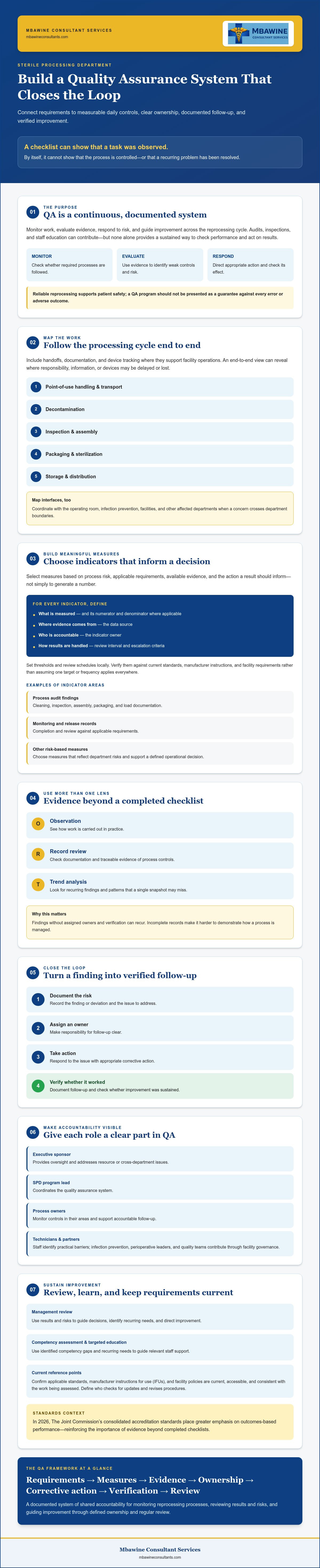
A quality assurance program remains useful only if leadership regularly checks that it still reflects how the department operates. When developing an SPD department quality assurance program, establish a management review process that considers performance trends, overdue actions, resource needs, and emerging risks. Record decisions, assigned owners, and follow-up. Review the program when standards, manufacturer instructions, equipment, workflows, or facility requirements change, and verify current obligations before revising procedures or measures.
Management review should connect data to decisions. A recurring finding may call for closer monitoring, a clearer procedure, resources to address a workflow constraint, or reassessment of how a process is controlled. Track whether assigned actions are completed and whether their results appear in subsequent reviews. This keeps oversight focused on sustained process performance, not simply the number of audits or training sessions completed.
Identify the specific knowledge or performance gap before choosing an educational response. If evidence points to a competency concern, targeted education and supervised practice may be appropriate. If the underlying issue is unclear instructions, equipment, or workflow, training alone is unlikely to resolve it. After education, reassess the relevant task using evidence that directly reflects the gap, such as observed performance or a review of applicable work records. A CRCST preparation resource may also be relevant for staff pursuing professional development. Confirm that its content fits the individual’s goals and current facility expectations.
A facility may consider sterile processing consulting when it needs an independent assessment or additional expertise to develop an implementation plan. Interim management may be useful when internal leadership capacity is limited. Before engaging a provider, clarify the scope of support, responsibilities, and availability, and ensure the proposed work aligns with facility governance. Outside expertise can inform decisions, but local leaders remain responsible for determining how recommendations apply to their operations.
Staff education can support competency needs identified through QA, while consulting or interim management may help address broader assessment or leadership capacity gaps. Mbawine Consultant Services offers sterile processing classes, healthcare sterile processing consulting, and interim management. Review current course details to determine whether the education is relevant to your development needs.
A dependable SPD quality assurance program connects documented requirements with meaningful process measures, evidence beyond checklists, and corrective actions that are assigned and verified. Developing an SPD department quality assurance program is not a one-time project. It requires regular review of trends, unresolved actions, process changes, and staff competency needs.
Start with measures that support clear decisions. Use observation, records, and trend review to understand what findings show and where more assessment is needed. When an action is taken, verify the process itself rather than relying only on proof that a task or training session was completed. This disciplined approach helps teams build accountability and focus on sustained improvement.
When QA identifies a staff learning need, relevant education can support competency development. Mbawine Consultant Services offers in-person and online sterile processing classes, as well as sterile processing consulting and interim management services that may support facilities addressing expertise or leadership capacity needs.
With clear ownership, sound evidence, and consistent follow-up, your team can strengthen its quality framework and keep improvement connected to daily work. Explore sterile processing class enrollment.
A sterile processing quality assurance program is a documented system for defining responsibilities, monitoring reprocessing processes, evaluating evidence, and responding to findings. It connects facility policies and applicable requirements with audits, records, competency review, and corrective action. Its purpose is to support processes that are consistent and reviewable, not to guarantee a particular patient outcome. The program should clarify who reviews results and how identified concerns move into follow-up.
Developing an SPD department quality assurance program begins by defining governance and scope, mapping the processing workflow, and selecting risk-informed measures. Specify each measure’s data source, owner, and review or escalation process. Pilot audit tools before broader use, communicate responsibilities, and use findings to assign corrective actions. Verify changes with follow-up evidence suited to the affected process. Review the program when equipment, workflows, standards, or facility requirements change.
Choose indicators that answer operational questions and can be measured consistently. Depending on facility processes, these may include audit findings, documentation completeness, process deviations, equipment monitoring records, device traceability, or observed staff competency. Define what counts as a finding, where the data will come from, and who reviews it. Before adopting or interpreting a measure, check applicable current standards, manufacturer instructions, and facility policies so the indicator reflects relevant requirements.
There is no single audit schedule suitable for every facility without considering applicable requirements, process risks, and local policy. Establish a documented plan that identifies what will be reviewed, the method, and the responsible roles. Reassess the schedule when findings, risks, or workflows change, and confirm current expectations with authoritative standards and facility leadership. Avoid adopting a generic interval without evaluating whether it provides appropriate oversight of the process being monitored.
Follow the facility’s approved response procedure and applicable manufacturer instructions, promptly notify designated leaders, and document the result, assessment, and decisions. Qualified facility personnel should review relevant records, loads, and process conditions to determine appropriate containment and follow-up. The correct response depends on the circumstances and governing procedures, so a general article cannot prescribe a universal disposition. Verify current standards and facility policy, and ensure decisions and assigned actions are recorded.
Define the expected process change and the evidence needed to demonstrate it before closing the action. Assign an owner, select a follow-up method that directly evaluates the affected step, and document what was reviewed and observed. For example, if an action changes an assembly practice, assess that practice rather than relying only on a completed training record. If the issue recurs or the evidence is insufficient, reassess contributing factors and revise the response.
Staff education can support a QA program when competency review identifies a knowledge or performance gap, or when procedures change. Match instruction to the task, document it according to facility policy, and assess the relevant competency using appropriate evidence. Training should complement clear procedures, suitable resources, process monitoring, and management follow-up, not substitute for them. Mbawine Consultant Services offers in-person and online sterile processing classes. Verify current course content to determine whether it fits the learning need.

Article by
Mba Akuribila
Mba‑Akuribila is a healthcare leader, educator, and founder of Mbawine Consultants, a Bronx‑based institution recognized nationwide for advancing excellence in sterile processing and allied health workforce development. Born in Bongo in Ghana’s Upper East Region, his journey from rural beginnings to national impact reflects a lifelong commitment to service, empowerment, and community advancement.
For over two decades, he has trained sterile processing employees, mentored, and placed thousands of healthcare professionals across the United States. Through Mbawine Consultants, he established one of the country’s most trusted Sterile Processing Certification Test Prep Programs, preparing new Americans and career‑changers for successful entry into the field. The organization, as at 2026, has graduated more than 15,000 sterile processing technicians who now serve in hospitals, ambulatory centers, dental practices, and reprocessing facilities nationwide.
Under his leadership, Mbawine Consultants has expanded into a full Healthcare Staffing Agency, connecting nurses and allied health professionals to meaningful employment opportunities. His team also provides Interim Management Services, supporting hospitals and surgical centers with experienced leaders who stabilize operations, strengthen compliance, and improve workflow efficiency.
As a former surgical technician, sterile processing manager, educator, and system‑wide director, Mba‑Akuribila brings deep expertise to Sterile Processing Consulting, helping healthcare facilities elevate quality, safety, and regulatory readiness.
His work in the United States and Ghana continues to reflect his core philosophy: service above self, opportunity for all, and excellence without compromise.


