

A fast response is not the same as an on-site arrival. For facilities facing an unplanned absence or vacancy, emergency SPD staffing response time expectations can be difficult to interpret because “response” may mean an initial acknowledgment, staffing coordination, or a professional’s arrival. There is no universal regulatory deadline for emergency SPD staffing, so a stated timeframe should not be treated as an arrival guarantee unless its meaning is clearly defined.
Urgent staffing support should move promptly, but speed alone does not establish whether coverage is ready to meet department needs. Qualifications, role fit, onboarding requirements, local protocols, and communication all affect how quickly a staffing response can become workable coverage. Facilities remain responsible for ensuring staffing levels and staff competency support safe, quality care.
This 2026 guide explains how to define response milestones, what can affect them, and how to assess temporary staffing or interim management support for a sterile processing department. It also gives practical questions for clarifying expectations and preparing an internal escalation process before a coverage gap becomes urgent, without assuming an unverified deployment deadline.
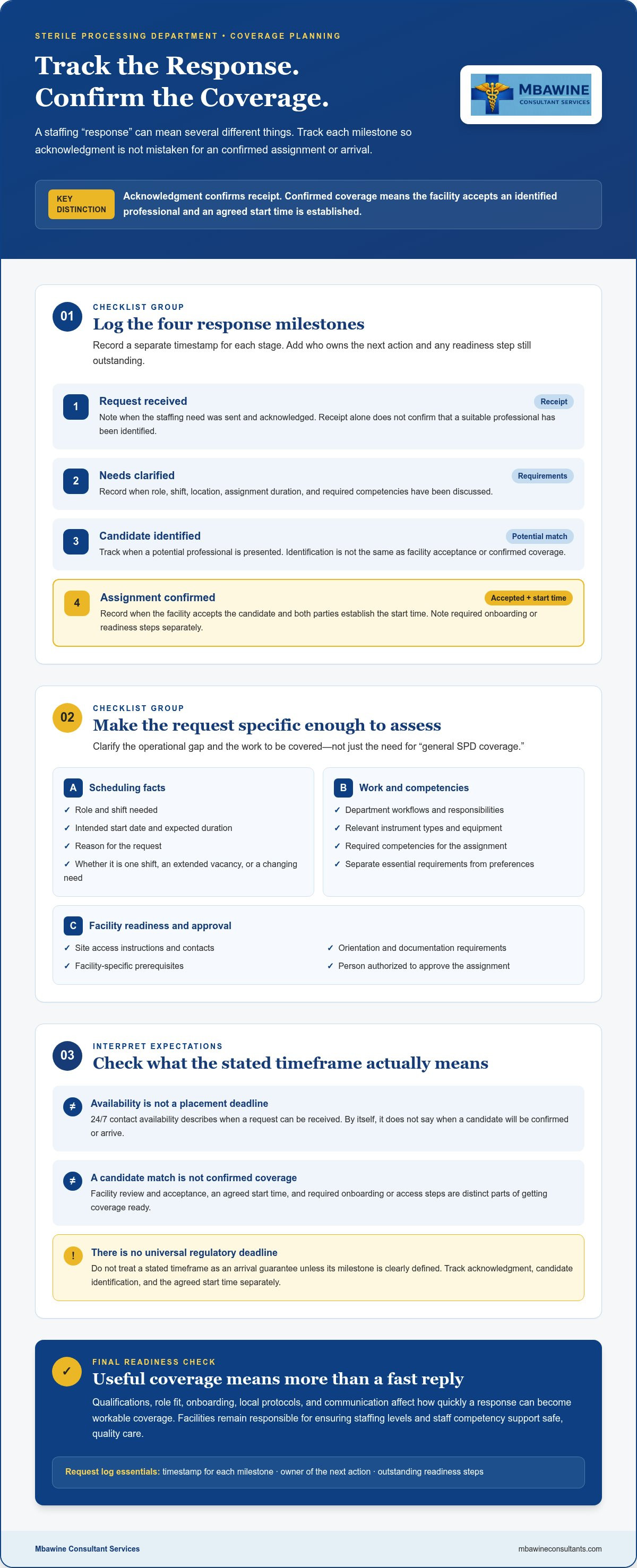
A sterile processing staffing request can pass through several stages before a professional begins work. The phrase “response time” may describe only the first acknowledgment, not completion of the staffing process or a worker’s arrival. Facilities assessing emergency SPD staffing response time expectations should identify the event that starts the clock and the milestone that stops it.
Response acknowledgment confirms that a request has been received; confirmed coverage means the facility has accepted an identified professional for an agreed assignment and start time. This distinction matters in a Sterile Processing Department (SPD), where coverage must align with technical responsibilities and department workflows, not simply fill a place on the schedule.
Record a separate timestamp for each stage instead of treating “response” as one event. The request receipt shows when the need entered the process. Substantive follow-up shows when someone began clarifying the assignment. The facility can then track when the requirements are clear enough to evaluate a staffing match.
For example, a message confirming receipt is useful communication, but it does not establish that a qualified candidate has been identified. Identifying a possible match is also distinct from facility acceptance, completion of required onboarding steps, and a confirmed first shift. Keeping these events separate makes status updates more actionable and helps leaders locate delays. A simple request log can include the date and time of each milestone, the person responsible for the next action, and any outstanding readiness step.
A single deadline would overlook the differences between staffing needs. A request for a particular role, shift, competency profile, or assignment duration may require a different matching process from a general coverage request. The facility’s priorities and the professional’s fit with department requirements also matter. Without a reliable, current source establishing an industry-wide deadline, facilities should not treat a commonly repeated timeframe as a universal benchmark.
Timing also depends on what must happen before work can begin. Facility access, orientation, and onboarding can affect the start of an assignment even after a candidate has been identified or accepted. Distinguish the time to acknowledge a request, the time to identify a candidate, and the agreed start time after facility requirements are addressed.
Finally, 24/7 contact availability describes when a request can be received. It does not, by itself, specify when a candidate will be confirmed or arrive. Make expectations useful by documenting each milestone and defining which one a stated timeframe refers to. That gives department leaders a clearer basis for escalation and coverage planning without assuming an unverified placement deadline.
A staffing request becomes actionable when the facility describes the operational gap clearly enough for a suitable match to be considered. A practical planning sequence moves from request, to needs clarification, to candidate matching, to facility review and assignment confirmation, and finally to the first shift. These are decision points, not a guaranteed timeline or a description of every staffing provider’s internal workflow. Keeping a record at each stage helps facilities interpret emergency SPD staffing response time expectations without mistaking candidate identification for completed coverage.
Start with the scheduling facts: the role needed, shift, intended start date, expected duration, and reason for the request. Clarify whether the gap concerns one shift, an extended vacancy, or a changing operational need. Defining the scope helps everyone assess the assignment rather than leaving its duration or purpose implicit.
Describe the department’s work and the competencies required for the assignment. Depending on the role, relevant context may include workflows, instrument types, equipment, and the responsibilities the incoming professional is expected to support. Separate essential requirements from preferences so a potential match can be assessed against the actual work, not a vague request for general SPD coverage.
Readiness also depends on local steps. Include instructions or contacts for site access, orientation, documentation, and facility-specific prerequisites, along with the person authorized to approve the assignment. The CDC Emergency Response Surge Staffing Toolkit offers a planning reference for organizing staffing during a surge. Facilities can adapt its broader preparedness approach to their own department processes without assuming it defines SPD-specific requirements.
Candidate matching is a proposed fit, not final authorization. The facility should review the available information about a candidate’s experience and relevant qualifications against the role’s stated requirements, then decide whether to accept the assignment. Screening and documentation depend on the applicable staffing arrangement and facility process. A response-time statement should not be read as evidence that any particular review has already occurred.
Once a candidate is accepted, assignment confirmation should capture the agreed role, shift, duration, reporting instructions, and start time. Keep this separate from site-specific orientation: a candidate’s background review and the facility’s introduction to local workflows are different readiness steps. The facility defines its protocols, access requirements, and orientation expectations, and should identify who will coordinate them before the first shift.
A concise handoff can prevent avoidable ambiguity. Document the coverage need, the facility’s decision on the proposed match, outstanding readiness steps, and confirmed start details. Facilities developing a longer-term SPD competency pipeline can also explore sterile processing class enrollment as a workforce-development resource.
Broad statements such as “rapid response” or “24/7 availability” do not show what a facility can expect at each stage of a staffing request. To compare options meaningfully, document the event that starts the clock, the milestone it measures, who communicates progress, and what happens if the need changes. An availability window describes when a request can be received; it does not, by itself, establish a placement deadline.
Response claims are comparable only when they measure the same milestone, under the same request conditions, and define the same endpoint. Use a consistent framework to assess emergency SPD staffing response time expectations alongside department fit and continuity of coverage.
Acknowledgment: Record whether the measure begins when a request is sent or received, and whether it ends with confirmation of receipt or substantive follow-up.
Candidate confirmation: Identify whether the endpoint means a potential candidate has been presented, the facility has reviewed that person, or the assignment has been accepted and confirmed.
Agreed start time: Clarify whether the stated time ends at an agreed future start or at the professional’s actual arrival and readiness to begin work.
Ongoing coverage: Establish how the coverage period is defined, who communicates schedule changes, and how escalation is handled if continuity is at risk.
For each milestone, note the clock’s starting event and stopping event. Distinguish routine requests from urgent requests, and specify whether after-hours communication changes the stated expectation or only the channel for submitting a request. Label each timeframe accurately: a target describes an intended outcome, a commitment states a defined obligation, and general availability indicates that contact may be possible. These terms are not interchangeable.
A quick candidate match is useful only if the person’s experience aligns with the assignment’s workflow, responsibilities, and supervision structure. Compare relevant sterile processing experience and credentials when the facility’s role requirements call for them. Also consider whether the person can complete local orientation and access steps before the agreed start. Speed alone does not demonstrate competency, facility authorization, or readiness to work within local protocols.
Include communication ownership in the comparison. The facility should know who provides status updates, who makes the acceptance decision, and who escalates a delay or change in coverage. These details make response commitments easier to assess operationally instead of relying on a broad speed claim.
Keep the comparison record specific to the staffing need. A timeframe for acknowledging a routine request cannot be assumed to apply to candidate confirmation for an urgent shift, and neither necessarily describes when ongoing coverage is secured. Defining the milestone, request conditions, and coverage endpoint lets leaders compare expectations consistently while keeping competency and readiness central to the decision.
Preparation can make a staffing request clearer and help facility leaders act promptly, but it cannot guarantee a faster placement. The goal is to reduce avoidable delays in defining the role, assessing a potential match, and preparing the department for the first shift. Current role descriptions, shift patterns, onboarding instructions, and escalation contacts give decision-makers a practical foundation before an urgent gap occurs.
For facilities assessing emergency SPD staffing response time expectations, readiness includes more than the speed of communication. Facility access, orientation, and clear supervision arrangements affect when a confirmed assignment can become effective coverage. Mbawine Consultant Services provides staffing and interim management services for sterile processing department needs.
Keep a request checklist available to the leaders responsible for coverage. Include the nature of the gap, the role and shift, the intended start date, and the expected assignment length. Describe relevant department workflows, instrument types, required experience, and the supervision structure for the assignment. Identify facility-specific access, orientation, and documentation steps that must be completed before work begins.
Review these details periodically. A role description that no longer reflects current responsibilities or shift patterns can create mismatched expectations when the department needs support.
Set an escalation path before a vacancy or absence becomes urgent. Name the person authorized to approve a staffing request and review candidate details, along with a backup decision-maker if the primary contact is unavailable. Establish the communication channel for urgent updates and a regular cadence for status checks. That way, the facility knows who owns the next decision instead of allowing the request to stall between teams.
Prepare a contingency plan for an uncovered shift and changing needs, such as an assignment that must extend or a different competency becoming essential. Identify who assesses operational priorities and communicates changes. This is a readiness measure, not a promise that staffing will be secured by a particular deadline.
Facilities can support longer-term workforce readiness through education alongside temporary coverage planning. Leaders building internal knowledge can explore sterile processing class enrollment as one component of staff development. Combined with current role information, clear approval authority, and prepared onboarding steps, this planning makes staffing discussions more precise while keeping expectations realistic.
The right support model depends on whether the facility is addressing a defined coverage gap or a broader leadership need. Response speed matters, but it should be assessed alongside role fit, department readiness, communication, and the terms governing the assignment. A clear decision process helps translate emergency SPD staffing response time expectations into practical coverage planning without treating any timeframe as a universal guarantee.
Temporary staffing can address a defined vacancy or scheduled shift that requires additional SPD personnel. Interim management is suited to a broader need involving leadership or operational oversight, rather than simply filling a shift. These are distinct service categories, not assurances of a particular response or start time. Assess the scope and duration of the need, the department’s supervision structure, and the required competencies to determine which model fits best. Mbawine Consultant Services provides healthcare temporary staffing and interim management for sterile processing needs.
For broader crisis planning, facilities can also review the emergency sterile processing staffing guide alongside their internal continuity procedures. Use those planning discussions to identify who can authorize coverage, which operational priorities apply, and how staffing needs may change as circumstances develop.
Document the terms in language that defines both the expectation and the process. A response-time statement is useful only when its start point and endpoint are clear, and when the facility understands which actions remain its responsibility. Avoid broad phrases that could mean an acknowledgment to one party and an on-site start to another.
Keep any response target specific to the agreed terms and request conditions. The facility should also establish how it will manage an uncovered shift while an assignment is being considered, rather than treating a candidate match as confirmed coverage.
Before the next urgent gap, review the internal approval path and ensure department leaders can distinguish a proposed match from an authorized assignment that is ready to start. For facilities developing staff knowledge and training pathways, explore sterile processing enrollment as an education resource separate from a facility staffing request.
Use your next staffing review to assign responsibility for updating role requirements, maintaining escalation contacts, and documenting how urgent coverage decisions will be made. A prepared process gives leaders a shared basis for interpreting emergency SPD staffing response time expectations and assessing whether a proposed assignment fits the department’s needs, without relying on an assumed arrival deadline.
Mbawine Consultant Services supports sterile processing departments through 24/7 emergency staffing, temporary staffing, and interim management. Specialized education and certification preparation can also contribute to longer-term workforce development. These are distinct forms of support, and education enrollment is not a facility staffing request.
For teams investing in sterile processing knowledge and professional development, take the next step and explore sterile processing enrollment. A deliberate approach to readiness can help your department respond to staffing pressures with greater clarity and confidence.
Emergency SPD staffing response time describes how long it takes to reach a defined point in handling a staffing request. That point could be receipt acknowledgment, a substantive update, candidate presentation, or an agreed assignment start. For useful tracking, record the date and time of each event in the facility’s request log. This helps leaders review communication and decision stages separately instead of interpreting one general timeframe as the entire placement process.
No. The phrase indicates that emergency staffing requests can be received around the clock; it does not, by itself, establish when a professional will be identified or arrive. For example, a request submitted outside regular business hours may be acknowledged before candidate matching and facility approval take place. Use the written staffing terms to understand which milestones are covered, and plan internal coverage until an assignment is confirmed.
There is no single placement timeframe that applies to every emergency request. Timing can depend on the required role, shift, experience, assignment length, candidate fit, and facility readiness steps. A request for a specialized workflow may involve different matching considerations from a general coverage need. Treat an estimate as meaningful only when its start point, endpoint, and applicable request conditions are defined in the relevant agreement.
Provide enough detail to assess the staffing need against actual department work. Identify the shift, start date, expected duration, responsibilities, relevant workflows, and required experience. State whether the assignment supports a specific work area or requires familiarity with particular instruments or equipment. Include a facility contact who can clarify details, along with applicable access, orientation, and documentation requirements, so readiness steps can be planned appropriately.
No. A quick match is not useful if the professional’s experience does not align with the assignment’s technical responsibilities or the department’s supervision structure. Consider the work to be performed, the level of familiarity required, and any qualifications the facility requires for the role. For instance, an assignment involving a specialized workflow may call for experience beyond general department familiarity. Readiness also depends on completing facility-specific orientation and access steps.
An agreement should define how response milestones are measured, including the event that starts each timeframe and what counts as completion. It should also state communication responsibilities, escalation contacts, assignment approval steps, and the facility’s requirements for qualifications, orientation, and access. Clarify how changes to shift duration or coverage needs will be handled. Specific terms make expectations interpretable; a broad phrase such as “rapid response” does not establish a universal deadline.

Article by
Mba Akuribila
Mba‑Akuribila is a healthcare leader, educator, and founder of Mbawine Consultants, a Bronx‑based institution recognized nationwide for advancing excellence in sterile processing and allied health workforce development. Born in Bongo in Ghana’s Upper East Region, his journey from rural beginnings to national impact reflects a lifelong commitment to service, empowerment, and community advancement.
For over two decades, he has trained sterile processing employees, mentored, and placed thousands of healthcare professionals across the United States. Through Mbawine Consultants, he established one of the country’s most trusted Sterile Processing Certification Test Prep Programs, preparing new Americans and career‑changers for successful entry into the field. The organization, as at 2026, has graduated more than 15,000 sterile processing technicians who now serve in hospitals, ambulatory centers, dental practices, and reprocessing facilities nationwide.
Under his leadership, Mbawine Consultants has expanded into a full Healthcare Staffing Agency, connecting nurses and allied health professionals to meaningful employment opportunities. His team also provides Interim Management Services, supporting hospitals and surgical centers with experienced leaders who stabilize operations, strengthen compliance, and improve workflow efficiency.
As a former surgical technician, sterile processing manager, educator, and system‑wide director, Mba‑Akuribila brings deep expertise to Sterile Processing Consulting, helping healthcare facilities elevate quality, safety, and regulatory readiness.
His work in the United States and Ghana continues to reflect his core philosophy: service above self, opportunity for all, and excellence without compromise.


