

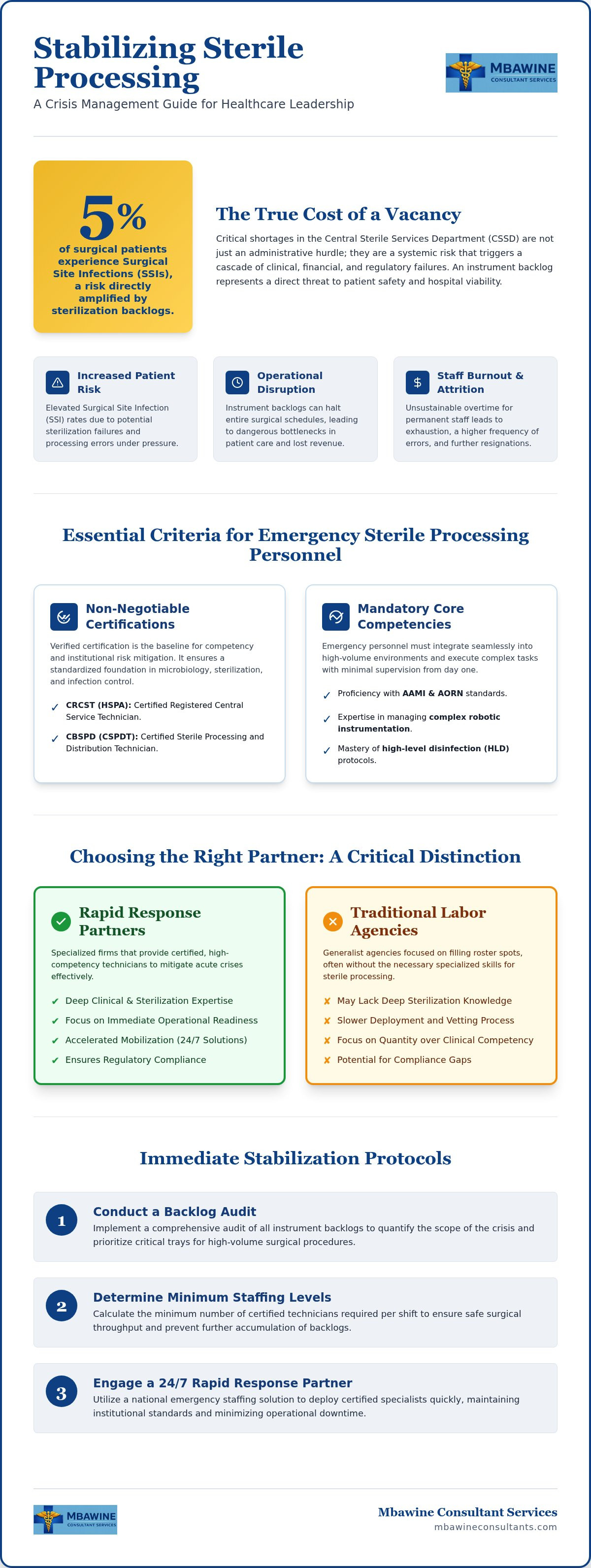
With up to 5% of surgical patients experiencing surgical site infections, the integrity of the sterilization process remains the most significant variable in modern perioperative safety. When a healthcare facility encounters sudden vacancies or an overwhelming surge in surgical volume, the acquisition of qualified emergency sterile processing staffing becomes a critical clinical intervention rather than a mere administrative task. You recognize that an instrument backlog isn't simply a logistical delay; it represents a systemic risk that threatens surgical throughput, invites scrutiny from regulatory bodies like The Joint Commission, and exacerbates the exhaustion of your permanent workforce through unsustainable overtime requirements.
This comprehensive guide details the precise protocols necessary to stabilize your department during a staffing crisis while maintaining the rigorous technical standards your patients deserve. We'll explore the integration of certified interim specialists, the preservation of institutional compliance, and the strategic management of workflow to ensure that your facility continues to operate with clinical excellence and unwavering safety. By implementing these authoritative crisis management strategies, leadership can protect both patient outcomes and the long-term health of their internal teams during periods of extreme operational pressure.
Within the high-pressure environment of the modern surgical suite, emergency sterile processing staffing is defined as the accelerated mobilization of certified, high-competency technicians to mitigate acute personnel deficits. The Central sterile services department serves as the clinical foundation of any surgical institution; it is the engine that drives procedural throughput. When this engine falters due to vacancies, the consequences extend far beyond administrative inconvenience. Critical vacancies in this department directly correlate with elevated surgical site infection (SSI) risks. Research indicates that up to 5% of surgical patients experience infections, many of which are linked to sterilization failures. Backlogs in decontamination and assembly don't merely cause minor delays. They can effectively halt an entire surgical schedule within hours, leading to dangerous bottlenecks in patient care.
The financial implications of a depleted sterile processing team are immediate and severe. The cancellation of even a single surgical case can result in thousands of dollars in lost revenue, not including the subsequent costs of administrative rescheduling and resource reallocation. Beyond the balance sheet, the psychological impact on the remaining permanent staff is profound. Burnout becomes an institutional contagion when technicians are forced into mandatory overtime to compensate for empty shifts. This exhaustion leads to a higher frequency of processing errors and further attrition. Long-term damage to the facility's reputation is also a significant concern. When surgeons lose confidence in tray readiness or instrument integrity, they may choose to move high-revenue procedures to competing facilities that demonstrate better operational stability.
Staffing levels are a primary indicator for Joint Commission and CMS surveyors during unannounced inspections. When a department is understaffed, the ability to maintain rigorous documentation standards often collapses. Regulatory bodies don't grant leniency for staffing shortages; they expect every instrument to meet the same high standards regardless of personnel count. Facilities must ensure that every professional acquired through emergency sterile processing staffing meets national certification requirements, such as the HSPA CRCST or CBSPD CSPDT designations. In states like New York, New Jersey, and Pennsylvania, these certifications are legally mandated. Failure to provide documented proof of competency for every person on the floor can lead to immediate citations or a loss of accreditation. Maintaining a baseline of certified expertise is a non-negotiable requirement for institutional risk management.
To maintain clinical continuity during a staffing crisis, the selection process for emergency sterile processing staffing must prioritize candidates who possess immediate operational readiness. It's not sufficient to simply fill a roster; the personnel must exhibit a deep comprehension of AAMI and AORN standards to ensure every tray meets rigorous safety benchmarks. This requires a level of expertise that allows for the seamless integration into high-volume environments where errors can result in catastrophic patient outcomes. Professionals entering a department in a crisis state must be prepared to execute complex tasks with minimal supervision, ensuring that the chain of infection control remains unbroken despite the urgency of the situation.
A verified CRCST or CBSPD certification serves as the non-negotiable baseline for any emergency hire. Certified technicians consistently outperform uncertified labor in high-pressure environments because they possess a standardized foundation of knowledge regarding microbiology, sterilization cycles, and infection control. Healthcare leadership must prioritize the verification of these credentials through official HSPA or CBSPD databases to mitigate institutional risk. While many facilities struggle with retention and recruitment strategies, the immediate solution during a crisis is the deployment of staff who are already validated by industry-recognized bodies. For facilities looking to elevate their internal standards and ensure long-term quality, exploring Mbawine CRCST preparation programs ensures that future staff members are equipped with this essential expertise.
Beyond certification, emergency personnel must demonstrate proficiency in managing complex robotic instrumentation and high-level disinfection (HLD) protocols. They're expected to operate diverse steam and low-temperature sterilizer models without the need for extensive orientation. Modern departments rely heavily on surgical asset tracking software and inventory management systems; therefore, a technician's ability to navigate these digital tools is critical for maintaining documentation accuracy. Effective emergency deployment relies on competency-based onboarding, which is defined as a specialized process that validates a technician's practical skills through direct observation and standardized assessment rather than relying solely on a resume. This approach ensures that temporary staff can adapt to specific facility workflows while maintaining the highest levels of sterilization integrity. If your department requires immediate, high-level expertise to stabilize operations, you can contact us for specialized support to bridge your personnel gaps.
The selection of a staffing partner during an operational crisis requires a discernment of their core competencies. While traditional staffing agencies maintain vast databases of general healthcare workers, they frequently lack the clinical depth necessary to vet technicians for high-acuity sterile processing environments. In contrast, rapid response partners specialize exclusively in sterilization and decontamination, ensuring that every professional deployed understands the technical nuances of complex robotic instrumentation and orthopedic tray assembly. Choosing emergency sterile processing staffing from a specialized firm ensures that the personnel are not just "placeholders" but are clinically proficient experts who can uphold institutional safety standards without extensive remedial training.
Specialized firms often distinguish themselves by providing comprehensive interim management to oversee temporary staff performance. This layer of leadership is vital during a crisis, as it provides a singular point of accountability and ensures that the temporary workforce aligns with the facility’s specific SOPs and regulatory requirements. This oversight minimizes the burden on existing hospital leadership, allowing them to focus on broader institutional goals while the SPD remains stabilized and compliant.
Traditional recruitment models often prioritize volume and speed of placement over clinical precision. This frequently results in the deployment of "travelers" who, while certified, may lack the specialized expertise required for specific facility challenges like advanced lumen inspection or AI-powered borescope technology. A multi-facility review of 200 hospitals revealed that 2.0% of trays failed inspection, with nearly 19% showing residual bioburden; these statistics highlight the necessity for elite-level scrutiny that generalists may overlook. A partner that integrates professional education into its business model, such as specialized CRCST training, offers a superior caliber of "emergency consultants." These individuals are trained to act as guardians of industry standards, ensuring that every instrument processed meets the highest clinical benchmarks. Because these consultants are vetted by peers who understand the intricacies of the department, the risk of technical failure is significantly mitigated.
In the current August 2026 healthcare environment, where the U.S. Bureau of Labor Statistics projects a 10 percent growth in demand for equipment preparers through 2034, the competition for talent is intense. Facilities facing a sudden surge in surgical volume or an unexpected workforce exodus require a partner with 24/7 availability. Specialized firms are structured to handle the intensive administrative burdens of credentialing and background verification at an accelerated pace, often reducing lead times from weeks to hours. This agility is essential for maintaining surgical throughput and preventing the financial losses associated with procedural delays. By securing a partner that specializes in emergency sterile processing staffing with national reach and immediate support, healthcare leaders can stabilize their departments with the confidence that compliance and safety remain uncompromised. If your facility requires immediate intervention to maintain these standards, you can contact us for specialized support to bridge your personnel gaps.
Stabilization of a department during a personnel crisis necessitates a methodical approach that transcends simple labor replacement. Immediate action begins with a comprehensive audit of current instrument backlogs to categorize trays by clinical urgency rather than sheer volume. Once the backlog is quantified, leadership must determine the minimum staffing levels required to maintain safe throughput without compromising sterilization integrity. Securing an emergency sterile processing staffing partner with a national reach is essential for facilities that require rapid, high-competency support across multiple shifts. This partnership allows for the implementation of a rapid orientation process that focuses specifically on facility-specific safety protocols, ensuring that temporary technicians are immediately productive within your unique environment.
Direct communication with the Operating Room (OR) remains the most critical component of crisis management. By identifying essential trays required for the next 48 hours, the department can streamline its workflow to support high-turnover surgical specialties, such as orthopedics or cardiovascular services. Managing "loaner" tray volume becomes especially important during a staffing emergency; these trays often require complex processing that can overwhelm a skeleton crew. Establishing a temporary moratorium on non-essential loaner sets or prioritizing them based on confirmed surgical cases prevents the decontamination area from becoming a bottleneck. This focused prioritization ensures that the most critical procedures proceed without delay while the department works toward full operational capacity.
Crisis stabilization isn't only about technical execution; it requires the presence of seasoned interim management to maintain department morale and institutional standards. These leaders provide the necessary oversight to ensure that Quality Assurance (QA) checks, including biological monitoring and chemical indicator verification, remain frequent and meticulously documented. An experienced interim manager acts as a guardian of industry standards, preventing the shortcuts that often occur when internal staff feel burnt out by excessive overtime. As the department stabilizes, the interim leader facilitates the transition from emergency staffing back to permanent operations, ensuring that new hires are integrated into a department that has maintained its clinical rigor throughout the crisis. For facilities seeking to build this level of expertise within their own teams, enrolling in our professional certification classes provides a pathway to long-term operational resilience and technical mastery.
Mbawine Consultant Services provides a sophisticated framework for institutional recovery through its 24/7 national emergency sterile processing staffing and specialized consulting services. Rather than offering a superficial labor solution, our approach focuses on the clinical stabilization of the department by deploying technicians who are deeply integrated into our culture of excellence. Our consulting services go beyond immediate crisis response to identify the underlying systemic issues and root causes of personnel turnover within your facility. By conducting a detailed assessment of operational workflows and management structures, we provide healthcare leadership with a roadmap to transition from reactive crisis management to proactive departmental sustainability. This methodological approach ensures that once stabilization is achieved, the department possesses the structural integrity to maintain high standards independently.
We provide specialized interim management to bridge the critical gap between acute personnel shortages and long-term operational stability. These seasoned leaders are prepared to oversee the technical performance of temporary staff while simultaneously mentoring internal teams to align with national benchmarks. This dual focus on immediate output and long-term professional development distinguishes our consulting model from traditional recruitment agencies. By positioning our experts as clinical partners, we help facilities navigate the complexities of regulatory compliance and surgical throughput during their most challenging periods.
The caliber of our personnel is a direct result of our internal pedagogical standards. Our sterile processing classes are designed to exceed the baseline requirements of national certification, fostering a level of technical mastery that's required in high-stakes medical environments. By maintaining this rigorous educational pipeline, we ensure that our emergency staff members are not just technicians but clinical consultants capable of upholding the highest registers of patient safety. Mbawine serves as a guardian of industry standards, positioning the professionalization of the sterile processing field as a critical component of institutional risk management and public health. This synergy between our training programs and our staffing solutions guarantees a workforce that's prepared for the most complex robotic and orthopedic instrumentation challenges.
Initiating an engagement for emergency sterile processing staffing requires a structured assessment of your current departmental needs and a commitment to interim leadership. When requesting support, facility leaders should prepare a comprehensive summary of existing backlogs, current shift vacancies, and specific equipment profiles to ensure a precise match with our consulting experts. Preparing your department for an interim management engagement involves establishing clear lines of communication and granting our leadership team the authority to implement necessary process improvements. This collaborative effort ensures that the gap between crisis and operational stability is closed with clinical precision and administrative efficiency. To secure your department's future, you may enroll in our professional programs or request staffing support here to begin the stabilization process.
Stabilizing a Sterile Processing Department during a personnel crisis requires more than just filling shifts; it demands a clinical intervention that prioritizes patient safety and regulatory compliance. By integrating certified professionals who understand the technical nuances of complex instrumentation, healthcare facilities can effectively mitigate the risks of surgical site infections and procedural delays. The successful resolution of a staffing emergency relies on the implementation of methodical stabilization strategies, including rigorous instrument audits and the utilization of specialized emergency sterile processing staffing partners who offer more than just traditional labor.
Mbawine Consultant Services stands as a guardian of industry standards, providing the 24/7 national emergency response and comprehensive SPD consulting necessary to bridge the gap between crisis and operational excellence. Our focus on specialized CRCST certification training ensures that every technician we deploy possesses the technical mastery required to navigate modern surgical demands. It's through interim leadership and a commitment to professionalization that your institution can transform a period of vulnerability into a foundation for long-term departmental health. We invite you to Secure Certified Emergency Staffing and Professional Training to ensure your facility remains a beacon of clinical safety and technical precision. Your commitment to excellence starts with the right partnership.
The typical response time for emergency sterile processing staffing is characterized by immediate 24/7 availability designed to address acute department deficits across the nation. Specialized partners maintain a robust network of certified technicians who are prepared for rapid mobilization to stabilize surgical throughput. This accelerated deployment model focuses on significantly reducing the lead time between an identified vacancy and professional placement, ensuring that critical sterilization workflows remain uninterrupted during institutional crises.
Professional certification through HSPA or CBSPD serves as the mandatory baseline for all emergency sterile processing personnel. In states such as New Jersey, New York, and Pennsylvania, certification is a legal requirement for anyone performing sterilization duties. Maintaining these standards ensures that every technician possesses the foundational knowledge of microbiology and infection control necessary to uphold institutional safety during high-pressure staffing crises and surge periods.
Competency's verified through a specialized onboarding process that evaluates a technician's proficiency with specific steam and low-temperature sterilizer models. Emergency staff are vetted for their expertise in managing complex robotic instrumentation and their ability to navigate various surgical asset tracking platforms. This assessment ensures that temporary personnel can integrate into diverse facility workflows with minimal orientation, maintaining the technical integrity of the sterilization cycle throughout the engagement.
Specialized sterile processing firms provide comprehensive interim management to oversee department operations and temporary personnel performance. These seasoned leaders bridge the gap between acute instability and long-term operational health by mentoring internal staff and identifying systemic workflow inefficiencies. Having an interim manager on-site ensures that the department maintains rigorous quality assurance standards and documentation accuracy while leadership focuses on permanent recruitment efforts and long-term departmental stabilization.
A specialized partner offers deep clinical expertise that general healthcare staffing agencies often lack in the technical field of sterilization. These firms utilize peer-to-peer vetting processes to ensure that every technician possesses the advanced skills required for high-acuity environments. They don't just provide labor; they integrate professional education into their business model. This results in a higher caliber of personnel who are trained as dedicated guardians of public safety.
Securing qualified emergency sterile processing staffing ensures that a department continues to meet ANSI/AAMI ST79 and the new ST108:2023 water quality standards during personnel shortages. Certified emergency technicians are trained to adhere to these rigorous national guidelines, preventing the shortcuts that often lead to regulatory citations. This commitment to compliance protects the facility from the scrutiny of governing bodies like The Joint Commission while maintaining the highest levels of patient safety.

Article by
Mba Akuribila
Mba‑Akuribila is a healthcare leader, educator, and founder of Mbawine Consultants, a Bronx‑based institution recognized nationwide for advancing excellence in sterile processing and allied health workforce development. Born in Bongo in Ghana’s Upper East Region, his journey from rural beginnings to national impact reflects a lifelong commitment to service, empowerment, and community advancement.
For over two decades, he has trained sterile processing employees, mentored, and placed thousands of healthcare professionals across the United States. Through Mbawine Consultants, he established one of the country’s most trusted Sterile Processing Certification Test Prep Programs, preparing new Americans and career‑changers for successful entry into the field. The organization, as at 2026, has graduated more than 15,000 sterile processing technicians who now serve in hospitals, ambulatory centers, dental practices, and reprocessing facilities nationwide.
Under his leadership, Mbawine Consultants has expanded into a full Healthcare Staffing Agency, connecting nurses and allied health professionals to meaningful employment opportunities. His team also provides Interim Management Services, supporting hospitals and surgical centers with experienced leaders who stabilize operations, strengthen compliance, and improve workflow efficiency.
As a former surgical technician, sterile processing manager, educator, and system‑wide director, Mba‑Akuribila brings deep expertise to Sterile Processing Consulting, helping healthcare facilities elevate quality, safety, and regulatory readiness.
His work in the United States and Ghana continues to reflect his core philosophy: service above self, opportunity for all, and excellence without compromise.


