

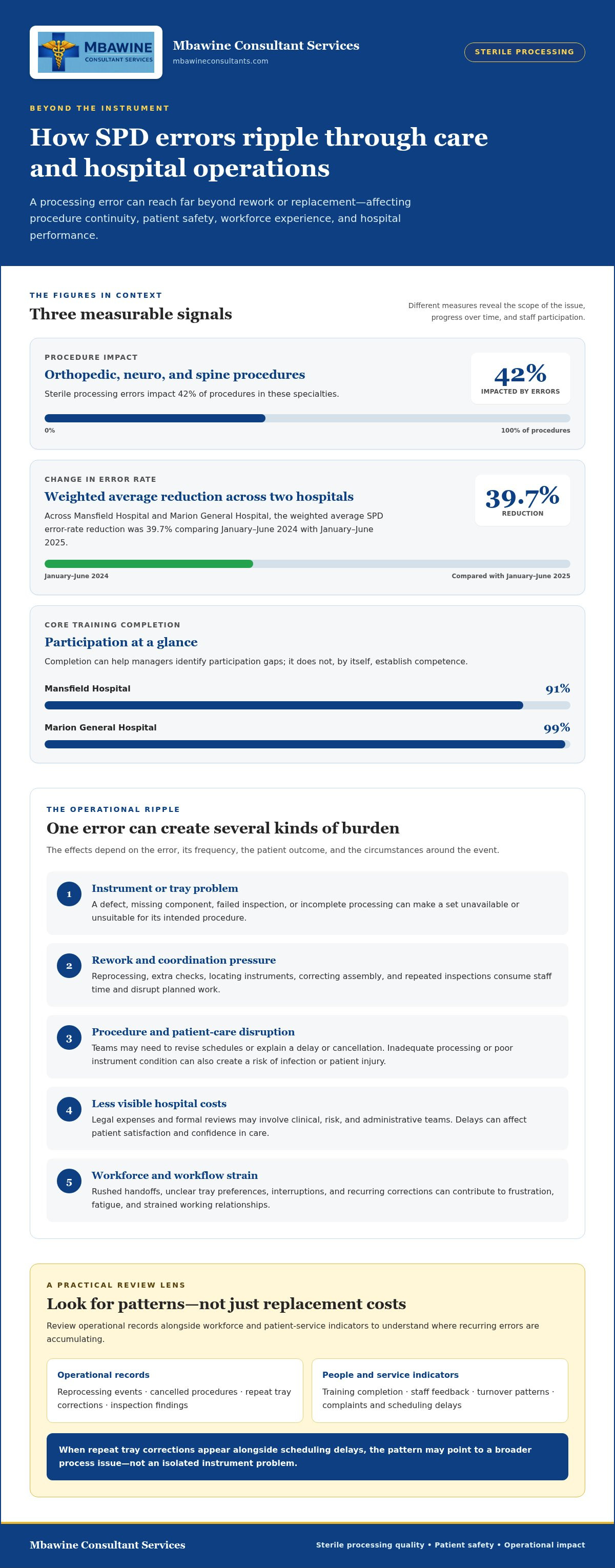
These figures show why the consequences extend beyond replacing instruments or reprocessing a tray.
It’s understandable to focus first on the visible expense of a delayed procedure, a replacement, or extra staff time. Yet sterile processing department (SPD) errors can also put patients at risk and create less visible costs, including legal expenses, operational disruption, and effects on staff morale and patient confidence.
This article explains how SPD errors can contribute to patient harm and financial losses, and why the total varies with the type and frequency of errors and their consequences. It also covers direct and indirect costs, what hospital-level estimates reveal about annual losses, and how improvements to sterile processing practices can affect the financial picture.
Soft costs arise when an SPD error affects more than an instrument or the immediate workflow. A delayed procedure, incomplete record, or tray that fails inspection can consume staff time, disrupt coordination, and undermine confidence in patient care. These effects may be harder to assign to a single budget line than replacement expenses, but they still influence hospital performance.
Legal expenses can arise when an error contributes to patient harm or triggers a formal review. Hospitals may need to preserve records, examine sterilization documentation, interview staff, and respond to claims. This work involves clinical, risk, and administrative teams. The financial effect depends on the circumstances, including the patient’s outcome, the available documentation, and the scope of the review.
A cancelled or delayed procedure can also affect patient satisfaction. If a required instrument set is unavailable because it must be reprocessed, for example, clinical teams may need to revise schedules and explain the disruption. Clear communication matters, but it cannot remove the operational burden or restore the original appointment.
Staff morale is affected by whether employees have the time and preparation to complete each task correctly. Repeated instrument defects, rushed handoffs, and unclear tray configuration preferences can create frustration between SPD personnel and operating-room teams. Disagreements over tray contents, for instance, can lead to extra checks and strained working relationships.
Training completion offers one measurable view of staff engagement. Mansfield Hospital staff had a 91% completion rate for the core training program, while Marion General Hospital staff had a 99% completion rate. Completion alone does not establish competence, but it can help managers identify participation gaps and connect training with observed work practices.
Daily workload links efficiency with retention. When employees spend time correcting assembly errors, locating missing instruments, or repeating inspections, fewer resources remain for planned work. Frequent rework can also make roles less predictable. Tracking recurring errors alongside turnover patterns helps leaders see whether process friction is affecting team stability.
Staffing pressure can add to fatigue when urgent cases compete with routine processing. A team facing a backlog may encounter more interruptions and handoffs, raising the chance that essential details are missed. Managers can review workload distribution, shift handovers, and recurring overtime to identify where capacity or process design is adding pressure.
Training and process improvements can affect both quality and workload. Across Mansfield Hospital and Marion General Hospital, the weighted average SPD error-rate reduction was 39.7% from January-June 2024 compared with January-June 2025. That result connects fewer errors with a more reliable workflow, while also underscoring the value of measuring changes over defined periods.
To assess soft costs, review operational records alongside workforce and patient-service indicators. Consider cancelled procedures, reprocessing events, complaints, training completion, and staff feedback together. A rise in repeat tray corrections alongside scheduling delays, for example, points to a broader process issue rather than an isolated instrument problem.
Sterile processing errors can interrupt the chain between decontamination and safe instrument use. If cleaning, inspection, assembly, packaging, or sterilization is incomplete, a set may be unavailable or unsuitable for its intended procedure. The concern is especially consequential in complex specialties: sterile processing errors impact 42% of orthopedic, neuro, and spine procedures.
Hospitals face different sterile-processing challenges than they did 10 years ago, partly because instruments and procedures have become more complex. A device with narrow channels, multiple components, or specialized handling needs can require careful processing and inspection. If a defect or residue is missed, staff may need to remove the item from use, replace the set, and reassess the procedure plan.
Infections and patient injury are possible consequences when an instrument is inadequately processed or in poor condition. The pathway depends on the failure: ineffective cleaning can leave soil behind, while a damaged or incorrectly assembled instrument can affect its function. A delayed or cancelled procedure can also disrupt patient care, even when staff identify the problem before use.
How can businesses detect and correct SPD errors? Review each processing stage, from cleaning and inspection through assembly, sterilization, storage, and distribution. Document the specific failure and affected set. If a missing component is found during final inspection, for example, hold the set, correct the assembly, and record the cause for trend review.
Software updates and data quality reports can support the review when teams validate records against the physical workflow. After an update changes a tracking screen or required field, compare the recorded instrument identity, cycle details, and status with the corresponding load documentation. Blank fields or conflicting identifiers give managers a specific discrepancy to investigate rather than relying on memory.
Pre-authorization quality assurance serves a different purpose from sterile release checks. Before a procedure is authorized or scheduled, teams can compare case details with the requested instruments and identify mismatches early. This review may prevent avoidable scheduling confusion, but it cannot establish that an instrument has been correctly processed or is ready for use.
What controls can prevent SPD errors and reduce financial risk? Use documented checks at each handoff, clear escalation procedures when a set fails inspection, and periodic reviews of error patterns. Pair these controls with staff training and follow-up audits. A recurring assembly discrepancy, for example, may show that work instructions need clarification.
Reducing risk requires attention to both technical controls and staff capability. Teams strengthening foundational knowledge can explore sterile processing learning opportunities as one way to reinforce accurate, consistent practices.
Replacing a damaged instrument is only one part of the financial consequence. A hospital must also identify the affected item, remove it from circulation, and maintain procedure readiness. A missing instrument in a specialty set, for example, may require replacing that component and coordinating additional steps before the set can return to service.
Purchase records show direct replacement expenses, but not every operational effect. When assessing a damaged instrument, managers should also record the time spent locating it, documenting the issue, and adjusting inventory. If a compatible replacement isn't immediately available, teams may need to reorganize sets or revise planned procedures.
Instruments in a set are designed to function together. Replacing one item may require confirming that the new component fits the intended configuration and can be processed correctly. A substitute with different dimensions, for example, may affect assembly or storage. Cost reviews should therefore account for compatibility, inspection, and any additional processing before release.
Repeated losses can make replacement needs seem routine rather than exceptional. Group incidents by instrument type, damage, and processing stage to find patterns. If the same item repeatedly becomes unusable after handling or inspection, the cause may lie in workflow or training. Counting purchases alone would miss that underlying issue.
Inventory buffers can obscure the true impact, too. A spare instrument may prevent an immediate delay, but using it reduces reserve stock. Managers can document each substitute used and the resulting inventory level. This record helps distinguish a single replacement from a growing need to replenish several sets.
Separate replacement expenses from the labor and disruption associated with them. Staff may spend time searching for a missing component, checking nearby sets, and updating inventory records. That work uses capacity that could support routine processing. Recording each step makes the broader cost visible without assigning unsupported dollar values.
A practical assessment follows each incident from discovery to resolution: identify the instrument, document its condition, record its disposition, and note workflow changes. Comparing records across SPD units can reveal whether damage clusters around a particular task or handoff. This evidence helps direct corrective action toward the process causing repeat losses.
This shows why prevention belongs in the financial analysis alongside replacement purchases. A hospital’s mission depends on reliable instrument availability, and tracking recurring causes helps leaders focus improvement efforts where they can reduce avoidable losses.
Annual estimates show how recurring SPD failures can add up beyond isolated replacement purchases. The financial impact of SPD errors varies by facility because incident frequency, operational consequences, and accounting methods shape reported totals.
The Ohio-based hospital study separated hard and soft costs. Reviewing these categories separately helps hospital leaders understand whether direct expenses or broader operational effects account for more of the estimated burden.
Facility-level estimates also vary. These estimates describe costs before implementation, not a universal annual figure for hospitals.
The financial impact of SPD errors becomes more visible when leaders aggregate facility-level records. Consistent definitions help compare departments and prevent unlike cost categories from being treated as equivalent.
What industries are most financially affected by SPD errors? The available estimates concern hospitals and health systems, including Mansfield Hospital and OhioHealth. They show financial exposure in healthcare facilities but do not rank industries against one another.
Annual totals are more useful when facilities define their components clearly. Leaders can distinguish reprocessing, replacement, and labor expenses from indirect operational effects, for example. They can then compare consistent categories across reporting periods, identify cost patterns, and assess whether a particular process area contributes disproportionately.
How do SPD errors affect financial statements, audits, and investor decisions? Recorded corrective work and replacement expenses can affect operating costs, while disrupted procedures can affect revenue. More generally, immaterial error corrections have increased since about 2004 and are associated with modestly and discernibly negative share returns.
Immaterial errors can also signal potential future material or immaterial reporting errors, material weaknesses in internal controls, and SEC comment letters. They provide a more frequent, less severe signal of potential audit or reporting issues than material errors corrected by restatements. These accounting findings concern reporting errors generally, not direct estimates of SPD losses.
Hospital leaders can make annual estimates more useful by connecting them with operational records. Compare incident categories, affected sets, and resulting expenses across facilities and reporting periods. This clarifies how local patterns contribute to broader totals and supports more focused decisions about reducing recurring losses.
One SPD error can affect several financial measures through a single operational disruption. If a required set is unavailable, a procedure may be delayed, rescheduled, or cancelled. That can disrupt planned services, while reprocessing, replacement, and additional labor raise expenses. The financial impact of SPD errors depends on the incident, its operational consequences, and the time needed to resolve it.
Revenue can be affected when a delay changes which services a facility can deliver. A procedure postponed because its instrument set needs correction, for example, may leave staff and operating-room capacity unused. The financial effect depends on whether the appointment can be rescheduled and how the delay affects other planned cases. Tracking disruptions alongside SPD incidents helps reveal this connection.
Expenses rise through direct corrective work and the resources it consumes. A facility may need additional processing, replacement inventory, overtime, or administrative follow-up. This hospital-specific estimate shows how large accumulated losses can become, not a standard cost for every facility.
Cash flow concerns the timing of incoming and outgoing funds. Replacement or corrective-work expenses may occur before related revenue arrives. If errors also disrupt procedure schedules, service delivery and associated payments may shift. Finance and SPD teams can compare incident dates, expense records, and affected schedules to understand how operational events influence cash planning.
Profit is affected when expenses increase, revenue is disrupted, or both happen together. This represents a savings opportunity, not guaranteed profit. The financial impact of SPD errors on results depends on how expense reductions and revenue changes interact.
To analyze the effect, separate each incident into its financial pathways. Record whether it created additional work, used replacement inventory, disrupted a scheduled service, or required an administrative response. Then compare those records with departmental expense and revenue reports. Repeated set corrections alongside schedule changes, for example, may show one process issue affecting both operating costs and service capacity.
Training can support consistent processing and reduce avoidable rework when staff understand required sequences and documentation. Facilities reviewing error patterns can use sterile processing classes to strengthen relevant workforce knowledge. Pair learning with operational measures, such as recurring error categories and schedule disruptions, to assess whether process performance improves over time.
Accounting data-entry errors can also cause monetary losses through billing mistakes and operational losses when decisions rely on incorrect data. A duplicated entry, for example, can charge the same amount more than once.
Mbawine Consultant Services offers Sterile Processing classes for professionals and healthcare teams looking to strengthen their knowledge of processing workflows and error prevention. When recurring errors point to gaps in practice or process, Healthcare Sterile Processing Consulting can help facilities assess operational challenges. Healthcare Temp staffing and Interim Management can also support facilities with staffing or leadership needs affecting daily SPD operations.
The next step depends on whether the primary need is staff learning, operational assessment, temporary coverage, or interim leadership. Each addresses a different part of sterile processing performance, so identifying the underlying challenge helps determine what support would be useful.
Contact Mbawine Consultant Services or visit mbawineconsultants.com to learn more.
The financial impact of SPD errors becomes more actionable when leaders treat it as an operational signal, not just an accounting result. Regular reviews can connect error patterns with staffing, training, and process decisions, helping teams choose a focused improvement priority and assess whether it addresses the underlying cause.
Different challenges may call for different forms of support. Mbawine Consultant Services offers Sterile Processing classes for workforce learning, Healthcare Temp staffing for staffing needs, and Interim Management for leadership support. Each option addresses a distinct operational challenge, so start by identifying where the facility needs added capability.
For teams ready to strengthen sterile processing knowledge, explore Sterile Processing classes. A deliberate next step can help translate financial awareness into more consistent practices and a stronger foundation for patient care.
Common SPD errors include incomplete cleaning, missed inspection defects, incorrect tray assembly, packaging problems, and inaccurate cycle documentation. An assembly error might place the wrong instrument in a set, while a documentation mismatch can make a correctly processed load difficult to trace. These failures differ in cause and consequence, so classifying incidents by process stage helps teams identify patterns and target corrective action.
There is no single average that applies to every business or hospital. These are facility-specific estimates, not a national benchmark. Costs depend on error frequency, affected instruments, staff time, procedure disruption, and how the facility defines and records direct and indirect losses.
SPD errors can create legal exposure when an instrument-processing failure contributes to patient injury or prompts a formal investigation. The facility may incur costs reviewing records, responding to a claim, and defending its actions. Fines or penalties depend on the facts and applicable requirements; they do not automatically follow every processing error. Complete, accurate documentation helps establish what happened and how staff responded.
These examples reflect different measures: one is an estimated facility cost, the other a potential system savings opportunity. Neither represents a guaranteed outcome.

Article by
Mba Akuribila
Mba‑Akuribila is a healthcare leader, educator, and founder of Mbawine Consultants, a Bronx‑based institution recognized nationwide for advancing excellence in sterile processing and allied health workforce development. Born in Bongo in Ghana’s Upper East Region, his journey from rural beginnings to national impact reflects a lifelong commitment to service, empowerment, and community advancement.
For over two decades, he has trained sterile processing employees, mentored, and placed thousands of healthcare professionals across the United States. Through Mbawine Consultants, he established one of the country’s most trusted Sterile Processing Certification Test Prep Programs, preparing new Americans and career‑changers for successful entry into the field. The organization, as at 2026, has graduated more than 15,000 sterile processing technicians who now serve in hospitals, ambulatory centers, dental practices, and reprocessing facilities nationwide.
Under his leadership, Mbawine Consultants has expanded into a full Healthcare Staffing Agency, connecting nurses and allied health professionals to meaningful employment opportunities. His team also provides Interim Management Services, supporting hospitals and surgical centers with experienced leaders who stabilize operations, strengthen compliance, and improve workflow efficiency.
As a former surgical technician, sterile processing manager, educator, and system‑wide director, Mba‑Akuribila brings deep expertise to Sterile Processing Consulting, helping healthcare facilities elevate quality, safety, and regulatory readiness.
His work in the United States and Ghana continues to reflect his core philosophy: service above self, opportunity for all, and excellence without compromise.


