

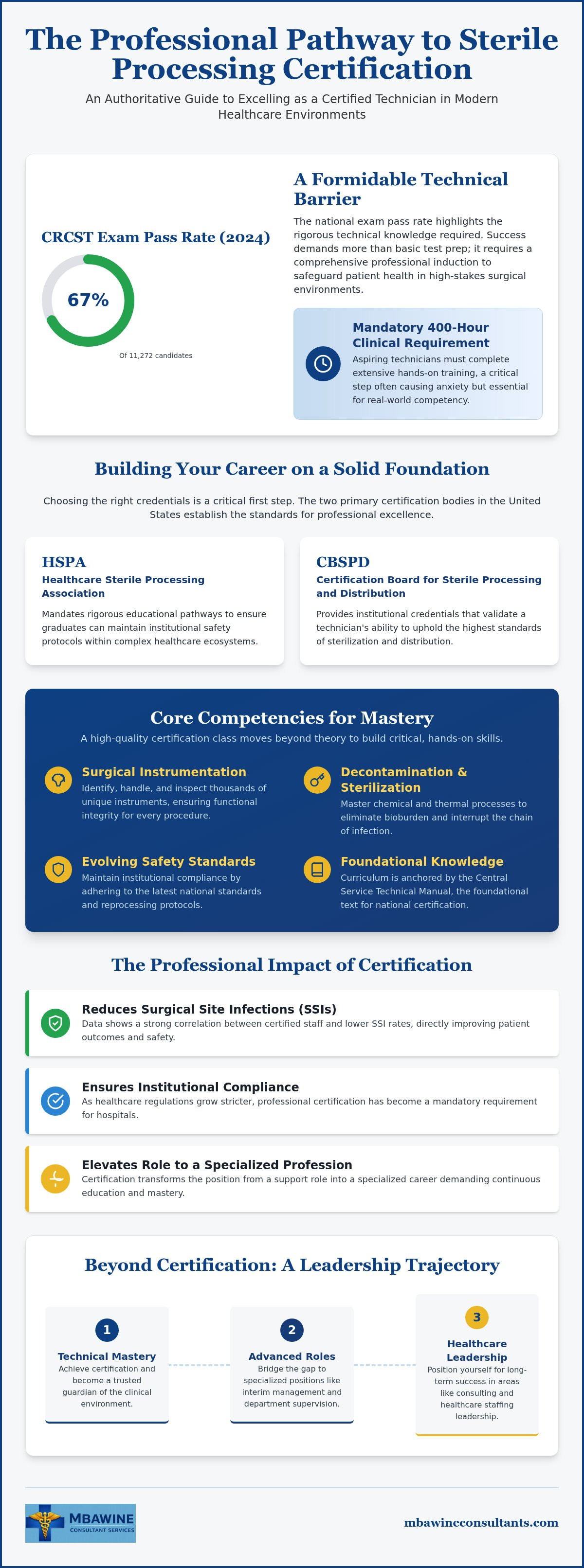
In 2024, approximately 67% of the 11,272 candidates who challenged the CRCST exam achieved a passing score, a statistic that highlights the formidable technical barrier to entry in this specialized medical field. For those evaluating a sterile processing certification class Bronx educational institutions provide, the challenge lies in distinguishing between rudimentary test preparation and a truly comprehensive professional induction. It's common for aspiring technicians to feel anxiety regarding the mandatory 400-hour clinical requirement or the perceived complexity of national exams. You're likely aware that obtaining these credentials isn't merely a regulatory hurdle; it's a critical validation of your ability to safeguard patient health within high-stakes surgical environments.
This article offers an authoritative analysis of the educational pathways and professional standards necessary to excel as a certified technician. We'll clarify the distinctions between HSPA and CBSPD certification bodies to ensure your career foundation is built upon appropriate institutional credentials. You'll gain a thorough understanding of the technical competencies required to pass the CRCST exam on your first attempt, alongside a roadmap for securing a stable, high-paying position in a premier healthcare facility. Our analysis also examines how advanced training programs bridge the gap between entry-level requirements and the technical mastery required for long-term leadership.
The Central Sterile Services Department (CSSD) functions as the primary safeguard within modern healthcare infrastructure, acting as the definitive barrier between environmental contamination and patient safety. Sterile processing isn't a peripheral utility; it's a mission-critical discipline that underpins the success of every invasive medical procedure performed today. The evolution of sterilization standards has transitioned from rudimentary manual cleaning to sophisticated technical reprocessing protocols that address the intricate complexities of modern surgical instrumentation. This professionalization is driven by an ethical obligation to maintain public safety through the rigorous application of validated scientific methods and institutional standards.
Maintaining an aseptic environment requires a meticulous, systematic approach designed to interrupt the chain of infection at every possible juncture within the surgical suite. Technicians must master the nuances of chemical and thermal processes, ensuring that high-level disinfection is achieved without compromising the structural integrity of precision medical devices. This mastery begins with a deep understanding of the biological challenges that exist on used equipment. Bioburden is defined as the population of viable microorganisms on a device or instrument prior to sterilization, and it represents the fundamental challenge that all reprocessing protocols are designed to overcome.
As healthcare regulations become increasingly stringent, professional certification has emerged as a mandatory requirement for institutional compliance and patient advocacy. Enrolling in a comprehensive sterile processing certification class Bronx students and national professionals utilize ensures that technicians are prepared for the high-stakes environment of the modern operating room. Certification effectively elevates the department from a traditional support role to a specialized profession that demands continuous education and technical mastery. It's no longer sufficient to simply follow a manual; technicians must understand the underlying science of their craft.
Data suggests a strong correlation between the presence of certified sterile processing staff and a measurable reduction in surgical site infections (SSIs), which remain a significant cause of patient morbidity. By achieving these credentials, individuals transition from a basic employment mindset to a dedicated career in healthcare sterilization. This professional advocacy is essential for those seeking a sterile processing certification class Bronx or elsewhere, as it establishes a standard of excellence that protects both the patient and the healthcare institution. This path ensures that the technician is recognized not just as a worker, but as a guardian of the clinical environment.
A professional curriculum is anchored by the Central Service Technical Manual, which serves as the foundational text for national certification. This manual provides the systematic framework required to transition from basic cleaning to advanced reprocessing. Mastery of surgical instrumentation is a primary competency, requiring technicians to identify thousands of unique tools, understand their specific handling requirements, and perform meticulous inspection protocols to ensure functional integrity. Aspiring professionals often seek a sterile processing certification class Bronx students can rely on to bridge the gap between theoretical knowledge and clinical application. You can explore our comprehensive sterile processing education programs to see how these standards are integrated into a formal syllabus.
The science of sterilization involves a deep understanding of various modalities, including saturated steam, ethylene oxide (EtO), and low-temperature hydrogen peroxide plasma. Each method possesses specific parameters for concentration, temperature, and exposure time that must be strictly monitored to achieve a validated sterile state. You'll learn that the selection of a sterilization modality is determined by the material composition of the medical device and its intended use. Understanding these complex reprocessing requirements is a core component of any sterile processing certification class Bronx programs offer, ensuring that graduates are prepared for the high-stakes environment of a modern surgical department.
Technicians must conduct a detailed study of pathogenic microorganisms and their varying levels of resistance to sterilization modalities. This includes understanding the specific environmental controls, such as pressure differentials and airflow patterns, that maintain the integrity of the sterile storage area. Adherence to standards set by the Association for the Advancement of Medical Instrumentation (AAMI) and the Association of periOperative Registered Nurses (AORN) remains the benchmark for professional excellence. It's essential to enroll in a program that prioritizes these clinical standards to ensure patient safety and institutional compliance.
Modern departments manage high-value surgical assets and specialized instrument sets that require sophisticated inventory management. Utilizing electronic tracking systems ensures accountability and regulatory compliance throughout the instrument's lifecycle, from decontamination to point-of-use. This logistical mastery is vital for maintaining the efficiency of the surgical schedule and minimizing institutional risk. For further reading on evolving industry expectations, consult Healthcare Sterilization: 2026 Professional Standards. These competencies ensure that the technician functions as a critical link in the healthcare supply chain.
The selection of an educational modality is a pivotal decision that directly impacts a candidate's ability to master complex sterilization protocols. Prospective students often evaluate the merits of a sterile processing certification class Bronx candidates might pursue against the flexibility of national digital offerings. While traditional in-person labs offer immediate tactile feedback, modern instructor-led web conferencing has established a new standard for national accessibility. These digital platforms maintain academic rigor through real-time content sharing and interactive discussions, ensuring that remote students receive the same depth of instruction as those in a physical classroom. It's vital to ensure that any chosen program, regardless of its delivery method, facilitates the necessary clinical arrangements required to meet national standards.
Technical mastery is best achieved through a hybrid model that synthesizes theoretical knowledge with intensive clinical experience. High-quality programs utilize advanced audio and video conferencing to deliver life content, allowing students to engage with instructors and peers from any location. This ensures that the foundational science of microbiology and instrumentation is fully understood before entering a healthcare facility. The 'Fast Track' preparation model is a condensed, intensive curriculum designed specifically for experienced professionals who require a structured review to validate their existing skills through national certification.
The quality of a certification program is fundamentally tied to the expertise of its leadership. Learning from highly credentialed experts who possess real-world experience in interim management and consulting provides a level of professional insight that self-paced, unguided modules cannot replicate. These mentors guide students through specialized test preparation materials, including comprehensive box sets for CRCST and CHL certifications, which are essential for navigating the complexities of the national exams. You can Review our current class schedule and enrollment options to identify the modality that best aligns with your professional trajectory. This structured guidance ensures that candidates are not merely studying for an exam but are preparing for the rigorous demands of a modern sterile processing department.
Achieving professional credentials in sterile processing requires a methodical progression through several critical phases, each designed to ensure the candidate possesses the technical mastery required for patient safety. The first step involves completing a structured educational program that adheres strictly to the standards established by the Healthcare Sterile Processing Association (HSPA) or the Certification Board for Sterile Processing and Distribution (CBSPD). Selecting a high-quality sterile processing certification class Bronx candidates and national applicants utilize ensures that the curriculum is fully aligned with current industry regulations and technical manuals. Following the educational phase, candidates must accumulate 400 hours of hands-on clinical experience, a mandatory requirement that validates technical proficiency in an active healthcare environment. Utilizing advanced study aids, such as the CRCST Box Set, is essential for deep knowledge retention and successful exam navigation. Candidates should then participate in rigorous review sessions and final master examinations to identify knowledge gaps before applying for the national certification exam. Once certified, maintaining these credentials requires a commitment to ongoing professional development through annual continuing education credits.
The 400-hour clinical requirement serves as a vital bridge between classroom theory and the complex realities of a hospital environment. This period isn't merely a duration of time; it's a structured induction where candidates must document their proficiency across specific domains, including decontamination, prep and pack, and sterilization. Rigorous documentation protocols are essential for verifying these hours to the certifying body and ensuring institutional compliance. You can learn more about our CRCST certification preparation and how we facilitate these critical clinical arrangements to support your professional trajectory.
Success on the national exam demands more than rote memorization. It requires the ability to apply situational analysis to complex sterile processing scenarios that occur in real-time surgical environments. Candidates must understand the specific weighting of exam domains, which range from foundational cleaning techniques to intricate regulatory compliance standards. This strategic mindset allows technicians to navigate the high-pressure environment of the testing center with confidence and precision. For a deeper analysis of this process, consult our Sterile Processing Classes: Certification Guide. To begin your journey toward technical mastery and career stability, we invite you to enroll in our upcoming session and secure your place in this mission-critical field.
Mbawine Consultant Services operates at the intersection of high-level professional education, institutional interim management, and specialized healthcare staffing. This integrated model ensures that the technical competencies taught in a sterile processing certification class Bronx candidates attend are directly applicable to the operational demands of premier medical facilities. By performing expert needs assessments, the organization acts as a guardian for healthcare institutions, identifying vulnerabilities in the sterilization cycle and implementing corrective actions that uphold the highest standards of patient safety. This guardianship extends beyond simple compliance, encompassing a holistic review of departmental efficiency and the implementation of advanced technical standards that protect the institution's clinical reputation. This synergy between education and leadership allows the brand to act as a bridge between entry-level certification and advanced technical mastery, fostering an environment where technical reliability is the institutional baseline.
Interim leadership is a critical component in maintaining departmental stability during institutional transitions or rigorous regulatory audits. These specialized services provide facilities with experienced oversight that ensures uninterrupted compliance with national sterilization standards while optimizing internal workflow processes. For a detailed analysis of these functions, see The Strategic Role of Sterile Processing Interim Leadership in Institutional Excellence. Having an expert mentor to oversee employee training and workflow optimization transforms the department from a reactive unit into a proactive center of clinical excellence. This leadership is essential for departments seeking to resolve backlog issues or prepare for upcoming accreditation surveys without compromising surgical instrument integrity.
The journey doesn't conclude once a sterile processing certification class Bronx or national students have finished. Mbawine actively connects certified alumni with healthcare facilities through both temporary and permanent staffing solutions, ensuring that institutions have access to a highly credentialed workforce. The availability of 24/7 emergency staffing is vital for hospitals to maintain uninterrupted surgical services, especially during periods of unexpected volume or personnel shortages. The transition from a certified technician to a leadership or consulting role is supported by a network of seasoned mentors who understand the path to institutional management. By bridging the gap between classroom theory and hospital reality, the staffing model provides a direct pathway for dedicated professionals to achieve career stability. We encourage you to contact us to discuss professional consulting or staffing needs and explore how our comprehensive support can advance your professional trajectory within this mission-critical field.
The transition from an entry-level perspective to a career defined by leadership and specialized expertise is predicated on establishing oneself as a certified professional through rigorous academic and clinical validation. We've examined how the synergy between a comprehensive technical curriculum and documented clinical experience forms the essential foundation for success within the modern surgical suite. Whether you're evaluating a sterile processing certification class Bronx candidates rely on or a national digital modality, the ultimate objective remains the mastery of sterilization science to ensure the highest standards of patient safety. This professional journey requires a lifelong commitment to the meticulous protocols that define the central sterile services department.
Our preparatory programs are guided by highly credentialed industry experts who provide the comprehensive clinical arrangements and career support necessary to navigate the mandatory 400-hour requirement with institutional precision. With a proven track record in CRCST and CHL exam preparation, we ensure that every candidate is prepared to meet the high-stakes demands of modern healthcare facilities. We invite you to enroll in our professional sterile processing certification program today to secure your future as a guardian of clinical excellence. Your dedication to technical mastery is the first step toward a stable and rewarding career.
The choice between the Healthcare Sterile Processing Association (HSPA) and the Certification Board for Sterile Processing and Distribution (CBSPD) depends on your specific career goals and employer preferences. HSPA offers the CRCST credential, which mandates 400 hours of hands-on experience, while CBSPD provides the CSPDT certification. Most national healthcare facilities recognize both organizations, though HSPA is often regarded as the gold standard for clinical depth and professional advocacy within the industry.
A high school diploma or equivalent represents the primary institutional prerequisite for entering this specialized field. Candidates should also possess a foundational understanding of medical terminology to navigate technical manuals effectively. Enrolling in a sterile processing certification class Bronx or national candidates prefer often requires a commitment to both academic rigor and the subsequent 400-hour clinical rotation. This ensures that every participant is prepared for the high-stakes environment of a modern surgical department.
You can complete the theoretical portion of your training online through live web conferencing or self-paced modules. However, full certification requires hands-on experience that cannot be replicated in a virtual environment. While national programs provide the necessary academic foundation, the mandatory 400 clinical hours must be performed in a physical healthcare facility under professional supervision to validate technical competency. This hybrid approach ensures graduates possess both theoretical knowledge and practical mastery.
Reputable training programs establish formal partnerships with healthcare facilities to facilitate clinical rotations for their students. This structured arrangement ensures that you aren't left to secure these hours independently, which can be a significant barrier to entry for many new technicians. These clinical arrangements allow you to document your proficiency in decontamination, sterilization, and instrument assembly within an active surgical environment, ensuring you meet the rigorous documentation standards required for national certification.
A comprehensive program typically spans 12 to 16 weeks, depending on the intensity of the curriculum and the frequency of class sessions. This timeframe allows for a deep study of the Central Service Technical Manual alongside preparation for the national exam. Fast-track options may exist for experienced professionals, but most students benefit from a methodical pace that ensures mastery of complex microbiology and infection control standards before they begin their clinical hours.
Advanced professionals can pursue the Certified Healthcare Leader (CHL) or Certified Instrument Specialist (CIS) credentials to advance their careers. These specialized certifications are designed for those transitioning into interim management or leadership roles within the department. They focus on complex instrument reprocessing, fiscal management, and regulatory compliance. These credentials provide the technical mastery needed to oversee entire sterile processing operations and personnel while maintaining the highest institutional safety standards.
A professional preparation box set typically includes the latest Central Service Technical Manual and a comprehensive workbook designed for technical mastery. These resources provide the situational analysis and practice examinations necessary to navigate the national certification blueprints effectively. Choosing a sterile processing certification class Bronx students and national applicants utilize ensures these materials are fully aligned with current HSPA standards. These study aids are critical for achieving a passing score on the first attempt.
Certification is increasingly becoming a legal requirement in several states, where technicians must obtain credentials within a specific timeframe of their hire date. Even in states without specific legislation, most premier healthcare facilities require certification to maintain institutional compliance and patient safety standards. Holding these credentials validates your technical expertise and commitment to professional excellence in a high-stakes environment. It also positions you for higher-paying opportunities and long-term career stability within the healthcare sector.

Article by
Mba Akuribila
Mba‑Akuribila is a healthcare leader, educator, and founder of Mbawine Consultants, a Bronx‑based institution recognized nationwide for advancing excellence in sterile processing and allied health workforce development. Born in Bongo in Ghana’s Upper East Region, his journey from rural beginnings to national impact reflects a lifelong commitment to service, empowerment, and community advancement.
For over two decades, he has trained sterile processing employees, mentored, and placed thousands of healthcare professionals across the United States. Through Mbawine Consultants, he established one of the country’s most trusted Sterile Processing Certification Test Prep Programs, preparing new Americans and career‑changers for successful entry into the field. The organization, as at 2026, has graduated more than 15,000 sterile processing technicians who now serve in hospitals, ambulatory centers, dental practices, and reprocessing facilities nationwide.
Under his leadership, Mbawine Consultants has expanded into a full Healthcare Staffing Agency, connecting nurses and allied health professionals to meaningful employment opportunities. His team also provides Interim Management Services, supporting hospitals and surgical centers with experienced leaders who stabilize operations, strengthen compliance, and improve workflow efficiency.
As a former surgical technician, sterile processing manager, educator, and system‑wide director, Mba‑Akuribila brings deep expertise to Sterile Processing Consulting, helping healthcare facilities elevate quality, safety, and regulatory readiness.
His work in the United States and Ghana continues to reflect his core philosophy: service above self, opportunity for all, and excellence without compromise.


