

A flexible endoscope can pass through every reprocessing station, yet a missed check at one stage can undermine the entire workflow. Reliable outcomes depend on completing each validated step, not on equipment alone. For teams seeking flexible endoscope reprocessing best practices 2026, the practical challenge is turning device-specific instructions and applicable guidance into consistent daily work.
Requirements can vary by endoscope model, reprocessing equipment, and manufacturer instructions. This guide explains the purpose of each stage, from point-of-use precleaning and transport through leak testing, manual cleaning, inspection, disinfection or sterilization as applicable, drying, and storage. It also highlights key checks, documentation, and common process failures. ANSI/AAMI ST91:2021 is a foundational reference, while manufacturer instructions remain central to implementation. Before changing procedures, facilities should verify which current requirements apply. Structured education, documented competency, and clear local procedures help staff understand both the steps and the reasons behind them.
Flexible endoscope reprocessing is the device-specific sequence of cleaning, disinfection or sterilization as applicable, and post-process handling that prepares a reusable endoscope for its next use. Cleaning removes soil and organic material. High-level disinfection inactivates microorganisms to the level specified for that process. Disinfection depends on effective cleaning first. The principles of disinfection help explain why removing contamination and applying the validated process are separate but connected controls.
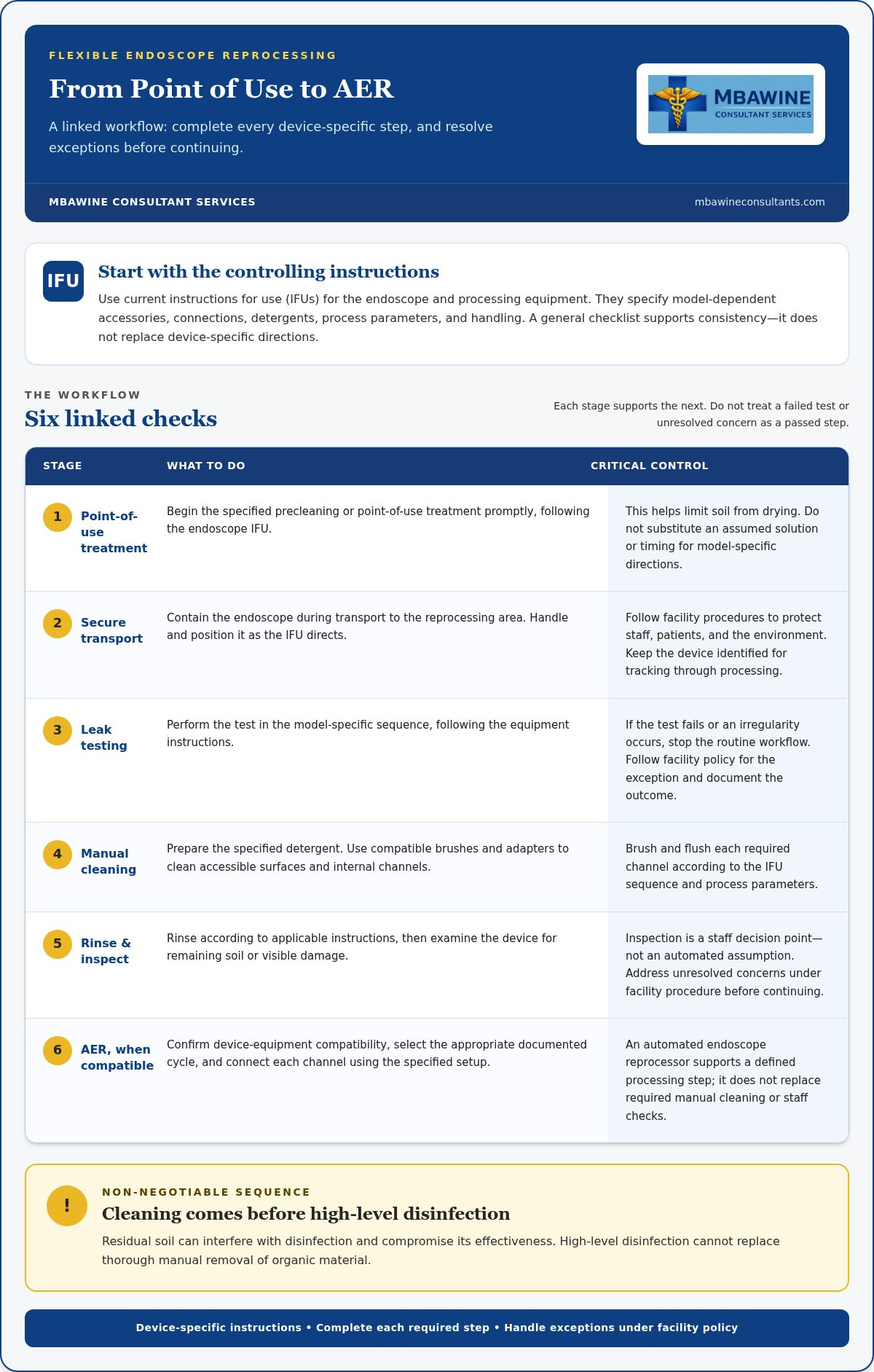
The workflow links point-of-use treatment, transport, cleaning, inspection, disinfection or sterilization, drying, and storage. Each stage supports the next, so a missed or incomplete step can compromise the process. Flexible endoscope reprocessing best practices 2026 start with the instructions for the specific device and equipment. A general checklist can support the work, but it cannot replace those instructions.
Endoscopes may have long, narrow internal channels and delicate components that are difficult to access, brush, flush, inspect, and dry. The device’s channel configuration and design determine which cleaning adapters, brushes, solutions, and processing methods are appropriate. A procedure suitable for one model may not work for another.
Unlike many heat-tolerant instruments that undergo routine steam sterilization, flexible endoscopes require the reprocessing method specified for the device and its intended use. Some may be compatible with sterilization, while others require high-level disinfection. Don’t assume all models tolerate the same chemicals, temperatures, connections, or cycle parameters.
Use current manufacturer instructions for use (IFUs) for the endoscope, accessories, detergents, and automated processing equipment. Along with facility policy, these instructions define the procedure, including required connections, process parameters, and handling. If instructions appear inconsistent, use the facility’s established review process to resolve the discrepancy before changing procedures.
ANSI/AAMI ST91:2021 remains a foundational reference for flexible and semi-rigid endoscope reprocessing. Relevant CDC and FDA guidance may also inform facility practice. Check each source’s current edition, scope, and applicability before citing a recommendation or revising procedures. Standards provide a framework; they do not replace device-specific IFUs or competency assessment.
Use the endoscope and processing equipment instructions for use (IFUs) as the controlling references. A checklist can make the workflow more consistent, but it cannot replace model-specific directions for accessories, connections, detergents, process parameters, or handling. These flexible endoscope reprocessing best practices 2026 follow a linked sequence, with each step completed and exceptions handled under facility policy.
Cleaning must precede high-level disinfection because residual soil can interfere with the disinfection process and compromise its effectiveness. High-level disinfection cannot replace thorough manual removal of organic material.
Staff need to understand why each handoff and check matters, rather than simply memorize a sequence. Sterile processing classes can build broader procedural knowledge as facilities reinforce consistent practice.
An automated endoscope reprocessor (AER) runs a defined cycle. It does not determine whether the endoscope was cleaned adequately, connected correctly, or compatible with that cycle. The flexible endoscope reprocessing best practices 2026 framework treats hands-on work, visual assessment, and automated processing as distinct controls. Each is governed by the applicable endoscope, detergent, and reprocessor instructions for use (IFUs), along with facility policy.
Use a systematic approach, not just a quick external check. Examine accessible surfaces and channels using the methods and tools specified by the relevant IFUs and local procedure. If facility policy requires additional cleaning-verification methods, apply them as directed. These methods provide a distinct check and should not be confused with visual inspection.
If residue remains or damage is visible, don’t continue as though the device has passed. Follow the endoscope IFU and facility policy for further cleaning, assessment, or removal from service, and record the exception through the established process. Applicable instructions and procedures, not an assumed universal threshold, determine acceptance criteria and next steps.
Before starting a cycle, staff must confirm compatibility, select the documented cycle, and establish each channel connection according to the endoscope and AER IFUs. Incorrect setup can undermine the intended process even if the equipment completes a cycle. Staff remain responsible for these checks and for responding to alarms, interruptions, or other exceptions under facility policy.
Automation can standardize specified cycle functions and produce process information for documentation. It cannot correct incomplete manual cleaning, identify every concern that requires human assessment, or replace required inspection. Training helps staff understand this division of responsibility and apply it consistently across devices and procedures.
Reprocessing doesn’t end when a disinfection or sterilization cycle finishes. Residual moisture, unsuitable storage, or an incomplete handoff can compromise the processed device. Use the endoscope and storage-system instructions for use (IFUs), facility procedures, and applicable current guidance to determine how to dry, store, and release the device. ANSI/AAMI ST91:2021 is a foundational reference, but recommendations must be checked for current applicability to the device and facility.
Thorough drying helps limit moisture remaining in channels and on surfaces after processing. Current guidance recommends forced-air drying, with a minimum of 10 minutes cited. Before adopting this as a local requirement, staff should confirm it aligns with applicable IFUs and facility procedures. Store the endoscope as directed by its IFU and the storage system instructions, protecting it from contamination and damage during handling.
Before release, confirm all required processing steps are complete and the device has been stored or transported using the facility’s defined controls. If storage conditions fall outside procedure, the device is mishandled, or a processing exception occurs, pause release and follow local policy to determine whether reassessment or reprocessing is required. A completed cycle alone doesn’t establish readiness.
Complete records support traceability and help teams review deviations. Facility documentation should capture the endoscope’s identification, relevant cycle information, operator, and any exception and its disposition, as defined by local policy. Routine process monitoring and record review are distinct from microbiological surveillance or testing. Check current authoritative recommendations and facility requirements before describing surveillance methods or presenting them as routine practice.
A practical handoff check can include:
Consistent records and handoffs rely on staff understanding both the procedure and its rationale. Explore the sterile processing certification guide for foundational education, and enroll in sterile processing classes to strengthen your professional knowledge.
Reliable practice depends on staff applying the correct instructions at each step, recognizing process deviations, and following a clear escalation pathway. To put flexible endoscope reprocessing best practices 2026 into facility procedures, use a structured improvement sequence that connects device instructions, staff responsibilities, competency assessment, and ongoing review.
Clear procedures make requirements usable at the workstation. Include checkpoints for key handoffs, such as transfer to cleaning, transition to automated processing, and post-process release. Explain how to manage a failed check, incomplete record, or equipment interruption under facility policy. Facility education and department-level support can help teams implement procedures consistently. Explore sterile processing services for relevant support.
Competency should reflect each person’s assigned work, not an assumed universal role or assessment frequency. Conduct initial and ongoing review according to facility policy, including when responsibilities, devices, instructions, or procedures change. Structured sterile processing education reinforces the principles that help staff perform tasks consistently and understand why each control matters.
Use documented observations, process records, and audit findings to identify repeated deviations, unclear instructions, or handoff problems. When changes occur, review relevant procedures against current manufacturer instructions and verified standards, then record corrective actions and follow-up. This makes review a practical learning process rather than a document-only exercise.
Build broader professional knowledge through sterile processing education.
Reliable flexible endoscope reprocessing depends on a coordinated sequence, device-specific instructions, and staff judgment at critical checkpoints. Manual cleaning and inspection remain essential even when automated equipment is used. Thorough drying, appropriate storage, and complete documentation support a controlled handoff. Applying flexible endoscope reprocessing best practices 2026 means turning current instructions into procedures staff can follow, assess, and improve.
This work is ongoing. Review process deviations and audit findings, reinforce role-specific competency, and update local procedures when applicable instructions or guidance change. Structured education can strengthen broader sterile processing knowledge and help teams build consistent practices. Mbawine Consultant Services provides in-person and online sterile processing classes, employee education tailored to healthcare sterilization standards, and sterile processing consulting and interim management services to support workforce and department development.
Explore sterile processing education and take a purposeful next step toward stronger knowledge, clearer procedures, and a more consistent reprocessing team.
Yes. Manual cleaning generally precedes high-level disinfection because disinfection cannot make inadequate soil removal acceptable. The endoscope and equipment instructions for use (IFUs) specify the required steps, tools, detergent, and sequence, so a generic checklist isn’t a substitute for device-specific directions. Follow current instructions and facility procedures, document deviations, and resolve exceptions through the established process before moving forward.
No. An automated endoscope reprocessor performs its specified cycle, but it doesn’t replace required manual cleaning or staff judgment. Correct device compatibility, channel connections, and cycle selection remain essential, and the equipment cannot correct every upstream error. Follow the endoscope and reprocessor IFUs, along with facility policy, to determine the required manual steps and automated process for each device.
Follow applicable current guidance, the endoscope IFU, the storage system instructions, and facility procedures. Thorough drying and appropriate storage help protect the processed device from residual moisture, contamination, and damage. Use the specified drying and storage methods rather than assuming one time limit or storage condition applies to every model. Document handling issues or other events that require reassessment before the endoscope is released for use.
Stop the workflow and follow the endoscope IFU and facility procedure. A failed leak test, visible damage, or unresolved soil shouldn’t be treated as a passed check or allowed to move forward routinely. Document the finding, use the established escalation pathway, and determine the next step under the approved process. Don’t return the device to use until the concern has been addressed according to applicable instructions and policy.
There isn’t one assessment interval that applies to every facility, role, and task. Facilities should define expectations based on staff responsibilities, current guidance, manufacturer instructions, and local policy. Assessment should establish whether staff can perform assigned steps, document required information, and respond appropriately to deviations. Review the approach when procedures, responsibilities, devices, or instructions change, and document results according to facility requirements.
Records should support traceability and show that the required workflow was completed under the facility’s approved procedure. Depending on applicable requirements, documentation may include device identification, cycle information, operator details, and exceptions or corrective actions. Check record fields and retention requirements against current applicable standards, regulations, manufacturer instructions, and facility policy. Complete, reviewable records help teams investigate deviations and identify recurring process concerns.
Facilities shouldn’t assume a new universal reprocessing requirement took effect simply because it is 2026. ANSI/AAMI ST91:2021 remains a foundational reference, while current applicability should be verified alongside relevant guidance and device-specific IFUs. The FDA’s Quality Management System Regulation became effective February 2, 2026, but it concerns medical device manufacturers and should not be misrepresented as a universal facility reprocessing procedure. Review and approve local changes through established processes, then communicate them and update staff training.

Article by
Mba Akuribila
Mba‑Akuribila is a healthcare leader, educator, and founder of Mbawine Consultants, a Bronx‑based institution recognized nationwide for advancing excellence in sterile processing and allied health workforce development. Born in Bongo in Ghana’s Upper East Region, his journey from rural beginnings to national impact reflects a lifelong commitment to service, empowerment, and community advancement.
For over two decades, he has trained sterile processing employees, mentored, and placed thousands of healthcare professionals across the United States. Through Mbawine Consultants, he established one of the country’s most trusted Sterile Processing Certification Test Prep Programs, preparing new Americans and career‑changers for successful entry into the field. The organization, as at 2026, has graduated more than 15,000 sterile processing technicians who now serve in hospitals, ambulatory centers, dental practices, and reprocessing facilities nationwide.
Under his leadership, Mbawine Consultants has expanded into a full Healthcare Staffing Agency, connecting nurses and allied health professionals to meaningful employment opportunities. His team also provides Interim Management Services, supporting hospitals and surgical centers with experienced leaders who stabilize operations, strengthen compliance, and improve workflow efficiency.
As a former surgical technician, sterile processing manager, educator, and system‑wide director, Mba‑Akuribila brings deep expertise to Sterile Processing Consulting, helping healthcare facilities elevate quality, safety, and regulatory readiness.
His work in the United States and Ghana continues to reflect his core philosophy: service above self, opportunity for all, and excellence without compromise.


