

Behind every successful surgical intervention lies a rigorous, invisible framework of infection prevention that dictates the safety and viability of the modern clinical environment. Professionals entering the field of sterile processing often find themselves overwhelmed by the dense technical complexity of ANSI/AAMI ST79:2026 standards or the specific requirements of various national certification bodies. It's understandable to feel a sense of trepidation when confronted with the high-stakes responsibility of medical device reprocessing and the academic rigor required for national certification. This comprehensive guide serves as a definitive roadmap for those seeking to master the sterilization lifecycle while navigating the professional demands of the CRCST examination. We'll examine the critical phases of decontamination and sterilization, evaluate the strategic requirements for various credentialing bodies, and outline the clear progression from entry-level technician roles to advanced leadership and consulting opportunities. By establishing a foundation of technical excellence and regulatory compliance, practitioners can transform a specialized trade into a sophisticated career dedicated to the preservation of public health and institutional integrity.
Sterile processing represents the systematic and highly regulated cycle of medical device reprocessing that ensures every surgical instrument is rendered safe for patient use. This complex operation occurs within the Central Sterile Services Department (CSSD), a facility that functions as the logistical and clinical heart of any modern hospital. The primary objective of this department is the total elimination of microbial life on reusable medical equipment, which directly prevents the catastrophic occurrence of surgical site infections (SSIs). It's a role that demands absolute precision; a single oversight in the decontamination or sterilization phase can lead to patient morbidity or mortality. Precision is mandatory. Every technician carries the professional responsibility of ensuring that every instrument returned to the surgical field is both functional and sterile.
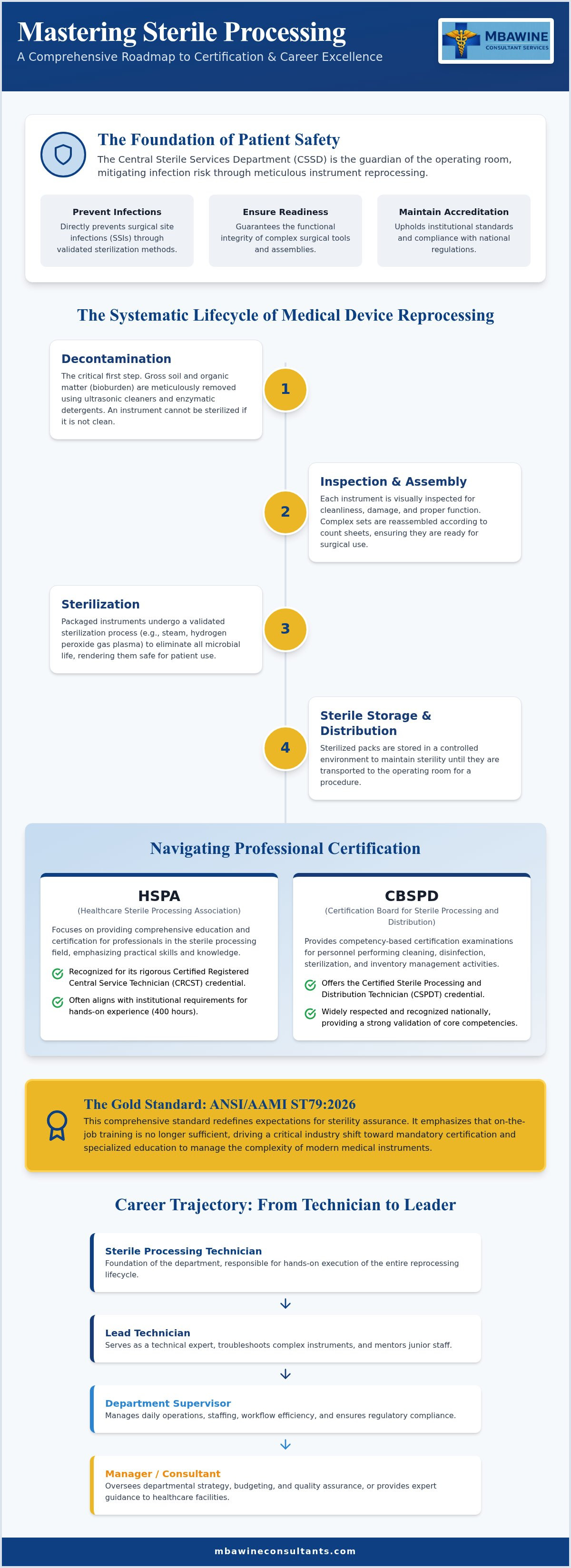
The industry has transitioned from rudimentary instrument washing to a specialized science governed by rigorous technical protocols. Current ANSI/AAMI ST79:2026 standards have redefined the expectations for healthcare facilities, shifting the focus toward a comprehensive system of sterility assurance. These updated guidelines emphasize that on-the-job training is no longer sufficient to manage the complexities of modern laparoscopic and robotic instrumentation. Professionalization is replacing casual instruction as the industry norm. Consequently, 2026 standards highlight a critical movement toward mandatory certification for all personnel. This shift ensures that every technician possesses the theoretical knowledge required to navigate the bioburden challenges of contemporary medicine. For many, enrolling in specialized training programs has become the essential first step in meeting these heightened institutional requirements.
Technicians serve as the essential, yet often unseen, partners to surgical teams. There's a direct, measurable correlation between the quality of instrument decontamination and the success of surgical outcomes. If an instrument's integrity is compromised or its functionality is hindered by residual debris, the entire surgical procedure is at risk. This professional responsibility goes beyond simple compliance; it's a commitment to advocacy for patient safety. Treating sterile processing as a mission-critical healthcare discipline transforms the department from a support service into a guardian of institutional standards. Practitioners must maintain a watchful eye on every phase of the lifecycle to protect the vulnerable patients they serve.
The efficacy of sterile processing hinges on a unidirectional flow that prevents cross-contamination. This lifecycle begins in the decontamination area, where physical and chemical cleaning agents remove gross soil from surgical assets. It's the most critical step. If an instrument isn't clean, it can't be sterilized. Professional technicians must understand the mechanical action of ultrasonic cleaners and the chemistry of enzymatic detergents to achieve validated results. For those pursuing this path, researching comprehensive Sterile Processing Technician career information provides a clear perspective on the technical expectations and regulatory demands of the role.
Removing organic matter is the essential precursor to all subsequent sterilization efforts. Bioburden is defined as the number of microorganisms contaminating an object before sterilization, and its presence creates a physical shield that prevents sterilants from reaching the device surface. Ultrasonic cleaning utilizes cavitation to dislodge debris from intricate serrations and lumens. Enzymatic detergents, specifically formulated with proteases or lipases, break down protein and fat deposits. Soil acts as a shield. This scientific approach ensures that the bioburden is reduced to levels that permit successful sterilization.
Verification is not a suggestion; it's a regulatory mandate. Technicians utilize three distinct monitoring tools to ensure cycle efficacy. Physical monitors record time, temperature, and pressure. Chemical indicators provide a visual confirmation that specific parameters were met. Biological indicators, the most stringent test, use highly resistant spores to prove microbial kill. Documenting these results is vital for institutional accountability and regulatory compliance. Maintaining the sterile chain during transport requires strict adherence to environmental controls. Professionals who wish to deepen their technical expertise often find that enrolling in specialized certification courses is the most effective way to master these complex monitoring requirements.
The choice of sterilization modality depends on the device's heat and moisture sensitivity. Saturated steam remains the gold standard for most instruments, while ethylene oxide or low-temperature hydrogen peroxide gas plasma is reserved for delicate electronics or heat-sensitive polymers. Once processed, the sterile barrier must be protected. Storage areas must maintain a temperature between 68°F and 73°F and humidity between 30% and 60% according to AAMI ST79 standards. This ensures the integrity of the packaging remains intact until the point of use in the surgical suite. Precision is non-negotiable in sterile processing workflows.
Achieving professional certification is the definitive benchmark for competency in the sterile processing field. The Healthcare Sterile Processing Association (HSPA) offers the Certified Registered Central Service Technician (CRCST) credential, which currently serves as the primary standard for institutional hiring. While the Certification Board for Sterile Processing and Distribution (CBSPD) provides an alternative pathway through the CSPDT certification, the HSPA model is often prioritized by major health systems due to its rigorous hands-on mandates. Specifically, the CRCST requires 400 hours of documented clinical experience, which can be completed before or within six months of passing the exam. This requirement ensures that technicians don't just understand theory; they must apply technical standards in high-pressure environments. You can prepare for your CRCST certification by engaging with mentor-led training that aligns with these national expectations.
The CRCST examination is a comprehensive assessment that spans seven critical domains. These include microbiology, infection control, decontamination, and sterilization processes. Success requires more than rote memorization. It demands a deep understanding of how technical standards like AAMI ST79 apply to daily workflows. Effective study strategies involve consistent review of instrument identification and the science of microbial kill. For a detailed breakdown of available educational pathways, refer to our Sterile Processing Classes: Certification Guide. This resource outlines how to structure your study time for maximum retention and first-time success.
Certification isn't a one-time achievement. It's a commitment to lifelong learning. HSPA requires annual recertification, which involves the submission of 12 continuing education units (CEUs). These units ensure that technicians stay current with evolving technology and shifting regulatory protocols. CBSPD follows a different cycle, requiring renewal every five years. Beyond the foundational technician role, many professionals pursue specialized credentials. Certifications in endoscopy reprocessing or surgical instrumentation provide a competitive edge in the labor market. These advanced designations demonstrate a technician's dedication to the highest levels of clinical excellence in sterile processing and patient safety.
The professional journey within sterile processing extends far beyond the foundational duties of instrument decontamination and assembly. While entry-level certification establishes baseline competency, the trajectory for dedicated practitioners leads toward specialized roles such as Lead Technician, Department Supervisor, and Central Service Manager. Progression into these tiers requires a shift from technical execution to strategic oversight. Leaders must develop the analytical skills necessary for department-wide optimization, including the management of instrument turnaround times and the synchronization of reprocessing schedules with the fluctuating surgical volume of the operating room. This advancement also necessitates a mastery of financial management and resource allocation to ensure the department remains both compliant and cost-effective. You can gain insight into these successful professional transitions by choosing to meet our staff and alumni who have navigated these advanced pathways.
Institutional transitions or sudden vacancies within the Central Service Department often create high-stakes leadership gaps that can jeopardize patient safety and operational efficiency. There is a growing demand for interim SPD managers who possess the technical authority to stabilize departments during these critical periods. These professionals act as vital bridges, ensuring that institutional standards remain uncompromised while permanent leadership is recruited. They're adept at conducting immediate gap analyses and implementing standardized workflows that align with the latest clinical evidence. Mastery of current regulatory requirements is essential for this role. For a comprehensive overview of the technical landscape these leaders must navigate, review our guide on Healthcare Sterilization: 2026 Professional Standards.
Experienced practitioners may eventually transition from clinical practice into the specialized field of sterile processing consulting. This elite career path focuses on assisting healthcare facilities with the complexities of regulatory compliance, workflow efficiency, and large-scale department redesign. Consultants utilize their deep institutional knowledge to conduct comprehensive assessments, identifying bottlenecks in the sterilization lifecycle and implementing corrective action plans that align with AAMI and Joint Commission standards. They often serve as expert advisors during facility accreditation processes, providing the specialized knowledge required to defend complex reprocessing protocols. This role often involves advising on staffing solutions and interim management strategies to ensure long-term institutional health.
Advancing to these leadership and consulting tiers requires a commitment to advanced education and mentor-led professional development. If you're prepared to move beyond the technician role and establish yourself as a leader in the field, enroll in our advanced training programs to begin your professional transformation.
The mastery of sterile processing demands a pedagogical framework that transcends the limitations of generic vocational instruction. While basic training programs may provide a cursory overview of instrument cleaning, they frequently fail to address the complex regulatory and clinical nuances required for institutional excellence. Expert-led education provides a comprehensive synthesis of technical standards and real-world application. At Mbawine Consultant Services, we integrate our deep clinical expertise with a rigorous educational syllabus to ensure that every student is prepared for the technical and ethical demands of the modern Central Service Department. Our curriculum is designed to bridge the gap between theoretical knowledge and the high-stakes reality of surgical support, offering both in-person and online sterile processing classes to accommodate the diverse needs of the healthcare workforce.
Mastering complex sterilization concepts is most effective when guided by those who have navigated the field's highest levels of leadership. Our mentorship-driven approach leverages decades of real-world experience in interim management and institutional consulting to provide a classroom environment that is both academically reliable and practically relevant. These professional consulting insights allow us to translate abstract technical standards into actionable clinical protocols. By participating in this mentor-led environment, students gain a sophisticated understanding of how their daily actions impact institutional safety and regulatory compliance. We invite you to explore our full range of services to understand the depth of expertise that informs our educational offerings.
The professionalization of the Central Service Department necessitates a commitment to customized training programs that are rigorously tailored to the evolving technical requirements of modern healthcare. Whether pursuing the CRCST credential or seeking to advance into leadership roles, establishing a foundation of technical mastery is the first step toward a lifetime of professional achievement. Our programs are meticulously structured to prepare technicians for national certification while instilling a deep sense of clinical responsibility. This field carries a unique gravity; it's a discipline where technical precision is the primary safeguard against patient harm. Those who choose this path are rewarded with a career of profound importance, serving as the essential guardians of surgical integrity. To begin your journey toward technical mastery and professional leadership, enroll in our professional sterile processing classes today and secure your place at the forefront of healthcare safety.
The transition from technical execution to clinical leadership requires a synthesis of hands-on experience and academic rigor. Mastering the sterile processing lifecycle ensures that you remain at the forefront of patient safety while meeting the stringent requirements of modern healthcare facilities. Achieving national certification is the definitive step toward professional autonomy and career longevity in this specialized field. It's a commitment that demands precision and a deep understanding of evolving regulatory standards.
Mbawine Consultant Services stands as a dedicated mentor-led institution, offering expert-led certification preparation and comprehensive consulting expertise. Our programs are designed to meet the highest professional standards, bridging the gap between entry-level training and advanced technical mastery. By choosing a curriculum rooted in real-world staffing and management experience, you're investing in a future defined by institutional leadership and clinical excellence. It's a significant commitment to public health that begins with specialized education. To take the next step in your professional journey, Enroll in Mbawine Consultant Services Professional Classes today. Your pathway to becoming a certified industry leader is within reach.
The primary duties involve the systematic cleaning, inspection, and sterilization of surgical instrumentation within the Central Service Department. Technicians must disassemble complex tools to remove bioburden and utilize specialized mechanical washers or ultrasonic cleaners. Once decontaminated, instruments are meticulously inspected for functionality and assembled into sets. These professionals then select the appropriate sterilization modality to ensure microbial elimination while maintaining the integrity of the medical device.
While federal mandates vary, 2026 industry standards like ANSI/AAMI ST79:2026 strongly emphasize mandatory certification for all reprocessing personnel. Most healthcare institutions now require certification as a prerequisite for employment or a condition of continued tenure. This shift reflects a global commitment to patient safety and the professionalization of the sterile processing field. Certification ensures that technicians possess the specialized knowledge required to manage the high-stakes environment of modern surgical support.
The timeline for completing sterile processing training typically spans several months, depending on the intensity of the educational program. Comprehensive courses often require 12 to 16 weeks of theoretical instruction followed by the mandatory 400 hours of hands-on clinical experience. This practical component is essential for achieving full certification. Students must balance academic study with institutional rotations to master the technical complexities of instrument reprocessing and regulatory compliance.
The primary distinction lies in the clinical experience requirements and the recertification cycles of each governing body. HSPA requires 400 hours of hands-on experience and annual renewal with 12 continuing education units. Conversely, CBSPD requires 12 months of full-time employment and renewal every five years. Both organizations provide nationally recognized credentials, but many health systems prefer the HSPA CRCST designation due to its rigorous emphasis on documented practical hours and annual academic updates.
Yes, professional institutions like Mbawine Consultant Services offer flexible online classes designed to accommodate the schedules of working healthcare professionals. These digital programs deliver the same rigorous academic content as in-person sessions, focusing on microbiology, sterilization science, and AAMI standards. While the theoretical portion is completed virtually, students must still fulfill the practical 400-hour requirement in a clinical setting. This hybrid approach ensures that graduates possess both the conceptual knowledge and technical proficiency.
As of May 2025, the national median wage for medical equipment preparers was approximately $47,700 per year, which translates to a rate of $22.93 per hour. Experienced professionals in the top 10% of the field earned around $69,950 annually. Salary levels are often influenced by geographic location and the possession of advanced certifications. Certified technicians typically command higher compensation than their non-certified counterparts due to their verified technical expertise and commitment to industry standards.
Candidates for the CRCST certification must pass a comprehensive examination covering seven functional domains and document 400 hours of hands-on experience. The initial exam fee is $140, which also applies to any necessary retakes. The experience hours must be completed within six months of passing the exam if they weren't finalized beforehand. This dual requirement ensures that every certified technician has demonstrated both theoretical competence and practical skill in a live clinical environment.
Prospective technicians typically secure hands-on clinical experience through internships, volunteer positions, or entry-level employment within a hospital Central Service Department. Many specialized training programs assist students in finding clinical rotations at partner facilities to fulfill the 400-hour requirement. It's essential to ensure that the facility follows AAMI standards and that a supervisor can officially document the hours. This practical immersion is a critical component of the professionalization process for any aspiring technician.

Article by
Mba Akuribila
Mba‑Akuribila is a healthcare leader, educator, and founder of Mbawine Consultants, a Bronx‑based institution recognized nationwide for advancing excellence in sterile processing and allied health workforce development. Born in Bongo in Ghana’s Upper East Region, his journey from rural beginnings to national impact reflects a lifelong commitment to service, empowerment, and community advancement.
For over two decades, he has trained sterile processing employees, mentored, and placed thousands of healthcare professionals across the United States. Through Mbawine Consultants, he established one of the country’s most trusted Sterile Processing Certification Test Prep Programs, preparing new Americans and career‑changers for successful entry into the field. The organization, as at 2026, has graduated more than 15,000 sterile processing technicians who now serve in hospitals, ambulatory centers, dental practices, and reprocessing facilities nationwide.
Under his leadership, Mbawine Consultants has expanded into a full Healthcare Staffing Agency, connecting nurses and allied health professionals to meaningful employment opportunities. His team also provides Interim Management Services, supporting hospitals and surgical centers with experienced leaders who stabilize operations, strengthen compliance, and improve workflow efficiency.
As a former surgical technician, sterile processing manager, educator, and system‑wide director, Mba‑Akuribila brings deep expertise to Sterile Processing Consulting, helping healthcare facilities elevate quality, safety, and regulatory readiness.
His work in the United States and Ghana continues to reflect his core philosophy: service above self, opportunity for all, and excellence without compromise.


