

In the high-stakes environment of modern surgical care, the margin for error in instrument sterilization is non-existent, yet many practitioners remain tethered to outdated protocols that fail to meet the rigorous institutional standards of 2026. You likely recognize that while the regulatory landscape in NY. New York doesn't legally mandate certification, the professional reality is that elite healthcare facilities now treat HSPA and CBSPD credentials as non-negotiable benchmarks for departmental safety and operational excellence. This creates a challenging environment for those seeking to advance, as the distinction between national standards and state-specific preferences often leads to professional stagnation or anxiety over exam readiness.
This article provides an authoritative analysis of the current sterile processing landscape, offering the clarity you need to navigate complex regulatory expectations and the demands of the CRCST examination. We'll examine the requirements for HSPA and CBSPD accreditation, identify the criteria for elite training classes, and outline the systematic approach required to transition from entry-level duties to advanced technical mastery. By the end of this guide, you'll possess a structured roadmap for achieving professionalization and securing your role as a guardian of public safety within the healthcare infrastructure.
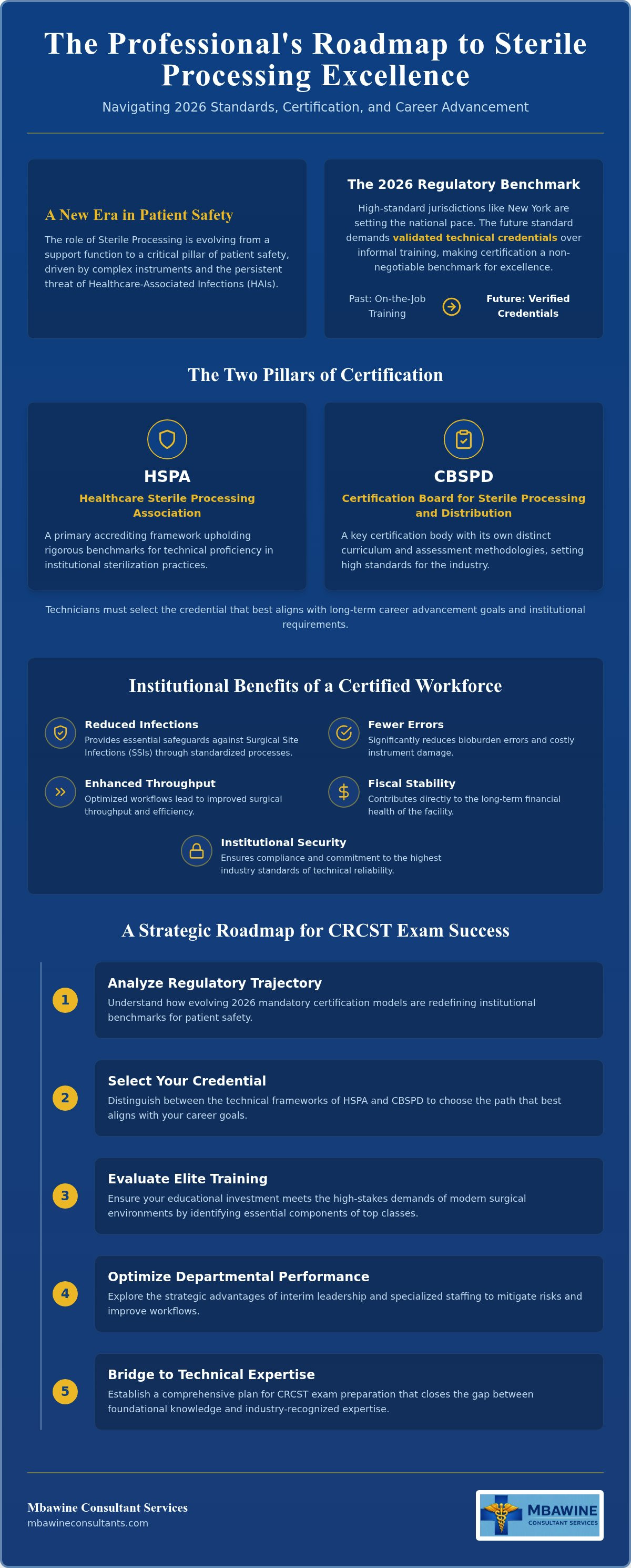
The professionalization of the Central Sterile Services Department (CSSD) represents a fundamental shift in how modern healthcare institutions perceive the integrity of the sterilization cycle. Historically categorized as a secondary support function, the department has transitioned into a critical pillar of patient safety where technical mastery directly influences the success of invasive clinical procedures. As we approach 2026, the industry is witnessing an unprecedented drive toward institutional accountability, a movement largely spurred by the high regulatory benchmarks established in influential jurisdictions like NY. New York. This evolution isn't merely an administrative change; it's a mission-driven response to the escalating complexity of surgical instrumentation and the persistent threat of Healthcare-Associated Infections (HAIs) that demand a sophisticated, standardized workforce.
High-standard jurisdictions serve as the vanguard for national SPD protocols, creating a systemic ripple effect that elevates institutional expectations across the entire healthcare landscape. The transition from voluntary participation to compulsory certification in major healthcare markets reflects a growing consensus that patient lives depend on standardized, verifiable expertise rather than informal, on-the-job training. In this context, NY. New York has long been recognized as a primary influence in advocating for the professionalization of the technician workforce, providing a model for how state-level oversight can enhance public safety. The Professional Standard of 2026 dictates that sterile processing practitioners must possess validated technical credentials to ensure the systematic elimination of microbial pathogens in increasingly complex surgical environments.
Beyond the immediate requirements of regulatory compliance, the deployment of a certified workforce provides essential safeguards against surgical site infections (SSIs) by ensuring every instrument undergoes a rigorous, standardized decontamination and sterilization process. When technicians possess advanced technical mastery, the department experiences a significant reduction in bioburden errors and instrument damage, which directly correlates to enhanced surgical throughput and long-term fiscal stability for the facility. This economic efficiency is paired with the institutional security that arises from a workforce deeply committed to the highest industry standards of technical reliability. To optimize these complex workflows and ensure departmental excellence, many facilities look toward external expertise for guidance. Explore our specialized sterile processing consulting services to learn how comprehensive assessment and interim leadership can transform underperforming sterilization departments.
Professional mastery within the central service environment is predicated on a comprehensive understanding of two primary accrediting frameworks: the Healthcare Sterile Processing Association (HSPA) and the Certification Board for Sterile Processing and Distribution (CBSPD). While both organizations uphold rigorous benchmarks for technical proficiency, their specific curricula and assessment methodologies differ in their approach to institutional sterilization practices. In the highly competitive medical landscape of NY. New York, technicians must integrate these national standards with the foundational requirements of CDC Sterilizing Practices to ensure absolute clinical compliance. This technical foundation is essential for mastering the complexities of modern instrument decontamination, which requires precise knowledge of microbial inactivation and chemical compatibility.
Achieving the Certified Registered Central Service Technician (CRCST) designation remains the industry's most recognized milestone for entry-level professionalization. As of 2026, the HSPA mandates a rigorous combination of theoretical knowledge and practical application, requiring candidates to complete 400 hours of hands-on clinical experience before full certification is granted. This dual-requirement system ensures that technicians aren't merely proficient in academic concepts but are also capable of executing complex sterilization cycles under the pressure of a high-volume surgical department. Candidates should be prepared for the $140 examination fee, while those pursuing the CBSPD Technician (CSPDT) path should account for a $135 fee and specific application deadlines, such as the October 27, 2026, cutoff for the late-year exam cycle. For those seeking to master these technical requirements, you can review our CRCST certification preparation resources to build a foundation of technical excellence.
Beyond the foundational CRCST credential, the pursuit of specialized certifications such as the Certified Instrument Specialist (CIS) and the Certified Endoscope Reprocessor (CER) distinguishes high-performing technicians in the professional marketplace. These advanced designations focus on the intricate maintenance of complex surgical sets and the highly specialized protocols required for flexible endoscope reprocessing. In 2026, healthcare facilities are increasingly prioritizing candidates with these multi-disciplinary skills, often resulting in accelerated career trajectories and enhanced compensation structures. You may find additional context on these evolving requirements in our analysis of Healthcare Sterilization: 2026 Professional Standards. Mastering these advanced competencies is not merely a personal achievement but an institutional necessity to maintain the highest levels of patient safety. If you are ready to begin your journey toward technical mastery, we invite you to enroll in our professional training programs to ensure you meet the rigorous demands of the modern sterile processing field.
The evolution of professional education in the sterile processing field has necessitated a significant departure from the historically prevalent model of informal, on-the-job apprenticeship toward a structured, academically rigorous syllabus. This transition is vital because modern surgical instrumentation requires a depth of theoretical understanding that cannot be adequately conveyed through observational learning alone. In highly regulated environments like NY. New York, the distinction between a technician who has merely completed hours and one who has mastered a comprehensive curriculum is increasingly evident in departmental safety records. This transition ensures that the technical workforce in NY. New York remains at the forefront of global sterilization standards, providing a level of institutional reliability that protects both the patient and the healthcare facility from the consequences of procedural errors.
A comprehensive sterile processing curriculum in 2026 must integrate the latest ANSI/AAMI standards with practical simulation labs that mirror the high-pressure environment of a modern Central Sterile Services Department. When evaluating potential programs, candidates should scrutinize the credentials of the instruction staff, ensuring they possess not only national certification but also documented experience in departmental leadership. Programs that emphasize exam-focused preparation strategies typically yield higher CRCST pass rates, providing a more reliable return on the student's educational investment. While online platforms offer logistical convenience, the most effective educational models often utilize a hybrid approach, combining digital theoretical modules with intensive, in-person technical labs where students can handle instrumentation in a controlled, educational setting.
The ultimate metric of an elite sterile processing class is its ability to facilitate a seamless transition into the professional workforce through robust clinical placement and networking opportunities. Elite educational programs act as a bridge between the classroom and the facility, ensuring that graduates aren't only theoretically proficient but are also socially and professionally integrated into the industry. This professionalization leads to greater long-term career stability and institutional trust, as certified technicians are recognized as essential guardians of patient safety. If you're seeking to establish a foundation of technical mastery and secure your position in this vital field, we encourage you to enroll in our upcoming professional sterile processing classes to begin your journey toward industry-recognized excellence.
Institutional excellence in the sterile processing domain is inextricably linked to the stability of departmental leadership and the technical caliber of the workforce. In the complex healthcare markets of NY. New York, facilities often face a workforce crisis that threatens to compromise the sterilization cycle and patient safety. Strategic staffing solutions and interim management provide the necessary scaffolding to maintain institutional standards during periods of transition or unforeseen vacancies. This ensures that the high-register benchmarks for accreditation are met without interruption. Leadership continuity is a prerequisite for the systematic oversight of decontamination protocols and the maintenance of complex surgical inventories.
Expert assessment is required to identify systemic bottlenecks that impede the flow of sterile goods from decontamination to the surgical suite. By implementing lean management principles, consultants can streamline processes and reduce waste without sacrificing the rigorous safety protocols required by 2026 standards. These assessments are critical for departments facing audits or those seeking to align with the professionalization models discussed in previous sections. For a deeper analysis of these methodologies, review The 2026 Guide to Sterile Processing Consultant Services. Identifying these inefficiencies is the first step toward achieving the technical mastery that defines elite healthcare facilities.
The sudden departure of key personnel or seasonal spikes in surgical volume can create dangerous gaps in a facility's sterilization capacity. Addressing these challenges requires access to a pool of high-competency temporary professionals who've undergone a rigorous vetting process. In 2026, the standard for temp staffing has shifted away from general healthcare labor toward specialized technicians who possess validated credentials. This specialized approach is detailed in Emergency Sterile Processing Staffing: A Comprehensive Guide. By utilizing 24/7 emergency staffing, institutions in NY. New York can ensure continuity of care while maintaining the technical mastery required for surgical success. To prepare your own staff for these high-level expectations, you can enroll in our professional training programs to secure a foundation of industry-recognized expertise.
Mbawine Consultant Services operates as a dedicated guardian of industry standards, bridging the critical gap between foundational entry-level competency and advanced technical mastery. We recognize that the rigorous regulatory environment within NY. New York serves as a significant harbinger for national trends, necessitating a proactive and sophisticated approach to departmental optimization. Our mission transcends the simple provision of training; we strive to foster a comprehensive culture of technical excellence that permeates every level of the Central Sterile Services Department. By integrating elite educational frameworks with specialized staffing solutions, we provide a holistic foundation for institutional safety and operational reliability in the high-stakes medical field.
The synergy between our educational programs and our professional staffing initiatives allows us to address the specific needs of healthcare facilities with unparalleled precision. We don't merely fill vacancies. We deploy technicians who have been trained to meet the highest benchmarks of clinical compliance and technical proficiency. This dual focus ensures that our partners in NY. New York and across the nation have access to a workforce capable of navigating the complex sterilization cycles required by modern surgical instrumentation. Our approach positions us not just as a service provider but as a strategic mentor and institutional advocate for public safety.
Our pedagogical approach deliberately exceeds the baseline criteria established by national accrediting bodies to ensure our students are prepared for the most demanding professional environments. We focus on the technical realities of the 2026 CRCST examination, providing a structured syllabus that emphasizes microbial inactivation, chemical compatibility, and the systematic management of bioburden. The historical success rate of our alumni reflects the efficacy of our exam-focused preparation and our commitment to professionalization. If you wish to investigate the professional outcomes of our graduates, you may connect with our staff and alumni network to gain insight into their successful career trajectories.
Beyond individual technician training, we serve as an essential partner for healthcare leadership by providing customized training solutions and interim management services. Our consultants conduct thorough assessments to identify departmental bottlenecks and implement lean management principles that enhance efficiency without compromising safety. Engaging our team for interim leadership ensures that your facility maintains continuity of care and remains prepared for rigorous accreditation audits. We invite you to contact Mbawine Consultant Services for a professional consultation to discuss how we can support your commitment to sterilization excellence and institutional safety.
The path to professionalization in the sterile processing field requires a deliberate commitment to technical mastery and regulatory compliance. The shifting mandates in NY. New York serve as a critical catalyst for elevating institutional standards across the nation. Success in this high-stakes environment isn't guaranteed by experience alone. It demands a rigorous understanding of the HSPA and CBSPD frameworks alongside a structured approach to exam preparation. By integrating elite educational protocols with specialized interim leadership and national staffing expertise, healthcare facilities can effectively mitigate the risks associated with workforce instability.
Mbawine Consultant Services remains a dedicated advocate for this industry-wide transformation, providing the pedagogical rigor necessary for high CRCST success rates and the specialized management solutions required for departmental optimization. Whether you're an individual seeking to solidify your career trajectory or an institution aiming for operational excellence, the transition to a certified, highly competent workforce is the most reliable safeguard for patient safety. Enroll in our professional Sterile Processing Classes today to ensure you meet the high-register benchmarks of 2026. Your commitment to excellence is the foundation of a safer healthcare future.
While New York state law does not universally mandate certification for all technicians, the vast majority of healthcare institutions require it as a condition of employment. Facilities prioritize candidates with validated credentials to ensure compliance with infection control protocols and patient safety benchmarks. In 2026, the professionalization of the field means that uncertified practitioners face significant limitations in career advancement and institutional trust within high-volume surgical environments.
The professional standards established in NY. New York often serve as a regulatory blueprint for other jurisdictions across the United States. By pioneering rigorous oversight and mandatory certification models, these standards drive the national conversation toward higher institutional accountability. This influence ensures that national accrediting bodies like HSPA and CBSPD continuously refine their curricula to meet the evolving technical demands of modern, high-stakes healthcare environments.
The Certified Registered Central Service Technician (CRCST) designation, issued by the Healthcare Sterile Processing Association (HSPA), remains the most widely recognized credential in the industry. This certification is highly regarded by healthcare facilities for its rigorous assessment of technical knowledge and its mandatory 400-hour clinical experience requirement. Achieving this designation signals a technician's mastery of the complex sterilization cycles and decontamination protocols essential for maintaining surgical integrity.
You can complete the theoretical portion of your sterile processing classes through online platforms, which offer flexibility for working professionals. However, the 400-hour clinical experience required for full CRCST certification must be performed in a physical healthcare environment under professional supervision. Mbawine Consultant Services provides both in-person and online educational pathways designed to bridge the gap between academic theory and the practical demands of a functioning sterile processing department.
Enrolling in an elite sterile processing program typically requires a high school diploma or an equivalent General Education Development (GED) certificate. Candidates must also demonstrate a commitment to technical precision and the ability to follow complex, multi-step protocols. While prior healthcare experience isn't strictly required, a foundational understanding of medical terminology can be beneficial for students navigating the dense technical curricula found in high-register professional training programs.
Interim management improves department outcomes by introducing seasoned leadership to optimize workflows and ensure regulatory compliance during periods of transition. These professionals conduct thorough assessments to identify bottlenecks in the sterilization cycle and implement lean management principles that enhance efficiency. By providing specialized oversight, interim managers help departments maintain the high standards of patient safety and technical mastery required for successful accreditation audits and surgical throughput.
The primary difference lies in the accrediting bodies and their specific curricula, though both HSPA and CBSPD aim to validate a technician's technical mastery. HSPA's CRCST certification requires 400 hours of clinical experience and focuses heavily on technical decontamination skills. In contrast, the CBSPD offers the CSPDT credential with slightly different examination fees and administrative deadlines. Both certifications are respected by elite healthcare facilities throughout NY. New York and the broader national market.
Becoming a certified technician generally requires three to six months of formal classroom education followed by the completion of 400 hours of hands-on clinical experience. The duration of the educational program depends on the intensity of the syllabus and whether the student chooses a full-time or part-time schedule. Once the educational and clinical components are completed, candidates must pass a national examination to achieve their professional designation and enter the workforce.

Article by
Mba Akuribila
Mba‑Akuribila is a healthcare leader, educator, and founder of Mbawine Consultants, a Bronx‑based institution recognized nationwide for advancing excellence in sterile processing and allied health workforce development. Born in Bongo in Ghana’s Upper East Region, his journey from rural beginnings to national impact reflects a lifelong commitment to service, empowerment, and community advancement.
For over two decades, he has trained sterile processing employees, mentored, and placed thousands of healthcare professionals across the United States. Through Mbawine Consultants, he established one of the country’s most trusted Sterile Processing Certification Test Prep Programs, preparing new Americans and career‑changers for successful entry into the field. The organization, as at 2026, has graduated more than 15,000 sterile processing technicians who now serve in hospitals, ambulatory centers, dental practices, and reprocessing facilities nationwide.
Under his leadership, Mbawine Consultants has expanded into a full Healthcare Staffing Agency, connecting nurses and allied health professionals to meaningful employment opportunities. His team also provides Interim Management Services, supporting hospitals and surgical centers with experienced leaders who stabilize operations, strengthen compliance, and improve workflow efficiency.
As a former surgical technician, sterile processing manager, educator, and system‑wide director, Mba‑Akuribila brings deep expertise to Sterile Processing Consulting, helping healthcare facilities elevate quality, safety, and regulatory readiness.
His work in the United States and Ghana continues to reflect his core philosophy: service above self, opportunity for all, and excellence without compromise.


