

What if a disinfection cycle meets its specified parameters, yet the device still isn’t ready for safe use? High-level disinfection for semi-critical devices depends on more than the disinfection step itself. Correct classification, effective cleaning, and close adherence to device and disinfectant instructions all support a reliable process. When responsibilities or workflow expectations are unclear, even a carefully run cycle may not address risks created earlier in reprocessing.
That uncertainty is understandable. Semi-critical devices contact mucous membranes or non-intact skin and require at least high-level disinfection, but identifying which devices fall into this category is only the first step. Staff must also translate Spaulding Classification, manufacturers’ instructions for use, and applicable standards into repeatable practice, with appropriate process controls and documentation.
This guide explains how classification informs reprocessing decisions, why thorough cleaning is essential, and which workflow controls support consistent results. It also covers documentation and staff competency, including how structured sterile processing education can help reinforce standards-aware practice.
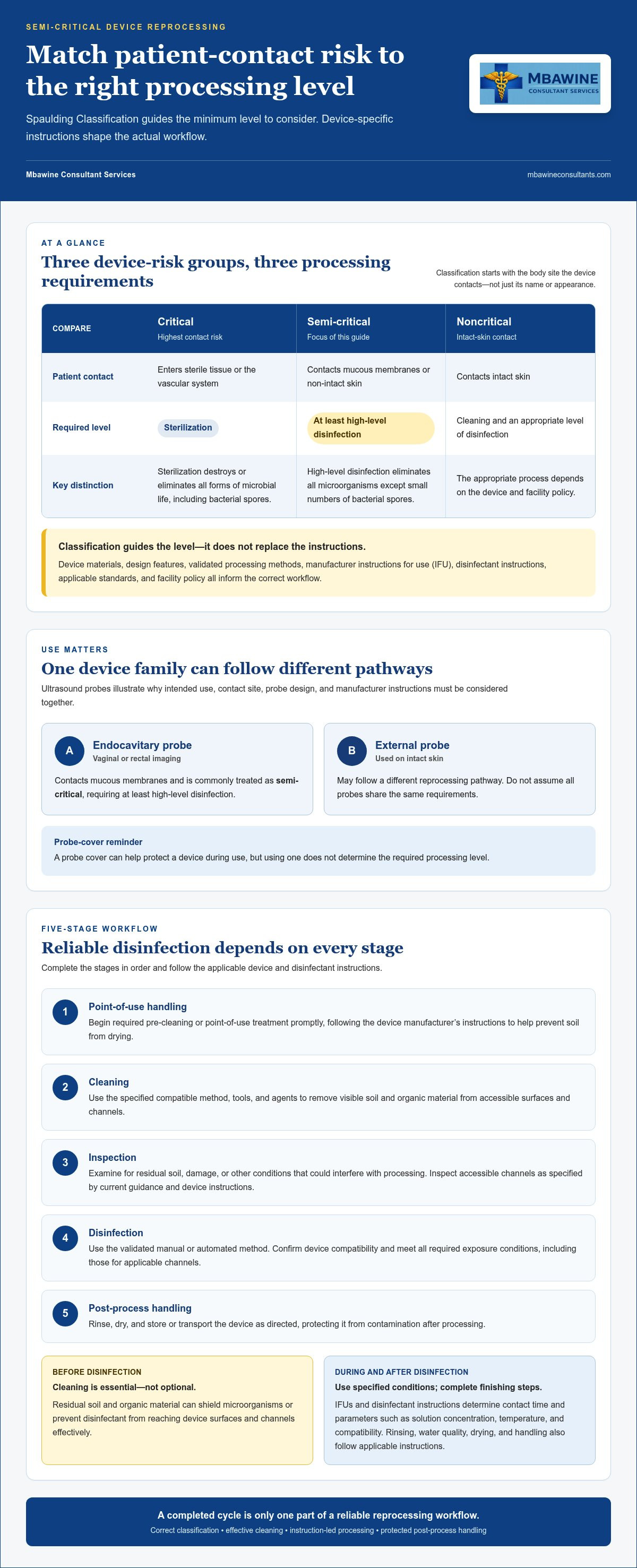
High-level disinfection is a reprocessing method that eliminates all microorganisms from a device except small numbers of bacterial spores. It is not sterilization: sterilization destroys or eliminates all forms of microbial life, including bacterial spores. For reusable devices that contact mucous membranes or non-intact skin, high-level disinfection is generally the minimum required processing level under the Spaulding Classification framework.
Understanding high-level disinfection for semi-critical devices starts with the device’s intended patient contact, not simply its name or appearance. Classification indicates the processing level to consider, while the device manufacturer’s instructions for use (IFU), disinfectant instructions, and applicable standards guide how to carry out that process.
The Spaulding Classification groups reusable medical devices according to the body sites they contact:
This framework links patient-contact risk to the required reprocessing level. It does not replace device-specific instructions: materials, design features, and validated processing methods can affect the appropriate workflow. Staff should follow the relevant IFUs and facility policy rather than choose a generic method based only on the device category.
Ultrasound probes illustrate why intended use matters. An endocavitary probe, such as one used for vaginal or rectal imaging, contacts mucous membranes and is commonly treated as semi-critical. An external probe used on intact skin may follow a different reprocessing pathway. A probe cover can help protect a device during use, but staff should not assume that using one determines the required processing level.
Classification depends on the specific device and its intended use. Probe design, contact site, and manufacturer instructions all matter, so ultrasound probes should not be assumed to share one reprocessing pathway. Applying the Spaulding framework alongside current device and disinfectant instructions helps staff identify the appropriate level before selecting a process.
High-level disinfection for semi-critical devices is reliable only when each reprocessing stage is completed in the correct order and according to applicable instructions. Cleaning is essential before high-level disinfection because residual soil and organic material can prevent the disinfectant from reaching device surfaces and channels effectively.
A practical workflow has five stages:
Disinfection does not replace cleaning. Soil left on a device may shield microorganisms from the disinfectant, so staff should use the device-specific method to clean external surfaces, joints, and channels. Inspection gives staff an opportunity to identify remaining debris or damage that needs attention before processing continues. The CDC guidance on disinfection and sterilization provides further context on risk-based reprocessing principles.
Do not rely on a general exposure time or solution condition. The disinfectant instructions and device IFU determine the required contact time and parameters, which may include solution concentration, temperature, and compatibility requirements. Staff must ensure the entire device, including applicable channels, is exposed as directed. Manual and automated methods can differ in setup and monitoring; neither is universally appropriate, so use the validated method specified for the device and facility process.
Post-process requirements matter, too. Rinsing, water quality, drying method, and handling must follow applicable instructions. Completing the exposure does not eliminate the need for correct finishing steps. For staff seeking a stronger foundation in sterile processing practice, explore sterile processing classes that support consistent, standards-aware work.
Reprocessing deviations can occur at several points, not only during disinfectant exposure. In high-level disinfection for semi-critical devices, rushed cleaning, overlooked instructions, incomplete exposure, and unsuitable post-process handling are preventable process risks. Address them through clear procedures, staff competency, and records that help reveal when an established workflow was not followed.
Time pressure can lead staff to shorten point-of-use treatment or cleaning, leaving soil in areas that are difficult to see or access. Inspection may then be rushed, or staff may proceed without resolving visible residue or identifying device damage. These gaps matter because later processing steps depend on preparing the device as directed.
Another risk is relying on memory for parameters that vary by device, disinfectant, and method. A remembered contact time, solution condition, or equipment setup may not match the current instructions. Post-process steps also require attention: incorrect rinsing, incomplete drying, or handling that exposes a processed device to contamination can undermine the workflow. Requirements for these actions are device- and process-specific. Facility procedures should reflect the applicable instructions rather than assume one method fits every device.
Documentation supports traceability by recording required process information and making deviations easier to identify and review. Depending on facility procedure, records may capture device identification, process parameters, cycle or solution details, and the staff member responsible. Complete, legible records help teams investigate an unexpected result, recognize recurring workflow gaps, and direct corrective action.
If a required step is omitted, staff should follow facility procedures and the applicable device and disinfectant instructions rather than improvise a remedy. The process may require escalation to a designated supervisor, documentation of the deviation, and a decision about whether the device can be reprocessed or must be handled another way. The appropriate response depends on the specific device, process, and local policy, so no single corrective action applies universally.
Records should describe the deviation and actions taken in accordance with facility documentation requirements. Review can then establish whether the issue arose from unclear instructions, workflow design, equipment, or a training need. When a procedure changes or a competency gap is observed, focused instruction and competency reassessment can reinforce the correct steps before staff resume the affected task. A systematic response treats deviations as opportunities to strengthen process reliability while maintaining accountability.
A checklist makes required steps visible and supports consistent practice, but it must reflect the device, validated process, facility policy, and current authoritative guidance. Use the points below as a framework for local procedures, not as a substitute for manufacturer instructions or professional standards.
Do not copy cycle settings or exposure parameters from one device to another without validation. Similar appearance does not establish that devices share compatible materials, channels, or processing instructions. For broader context on evolving professional expectations, read the 2026 professional standards guide.
Reliable high-level disinfection for semi-critical devices depends on staff understanding why steps are required and how to perform them consistently. Facility competency processes may use direct observation to assess whether personnel follow the applicable procedure, use supplies correctly, and complete required records. Documented assessment helps identify where additional instruction or retraining is appropriate, particularly after a procedure changes or a process gap is observed.
Records should be complete enough to support traceability and review under facility policy. They can help a team determine whether required steps were documented, identify deviations, and guide follow-up without assuming that one response fits every situation. Keep checklist content current as device instructions, facility procedures, or authoritative guidance are updated.
For continued professional development, explore sterile processing education options, then enroll in sterile processing classes to strengthen broader knowledge and support standards-aware practice.
Consistent reprocessing requires more than remembering a sequence of steps. Staff need to understand how device classification, effective cleaning, validated process controls, and accurate documentation work together, then apply that understanding within facility procedures. Education supports sound judgment when instructions change or a device raises a question that routine practice alone cannot resolve.
Competent practice connects foundational principles with precise execution. Staff must recognize how intended patient contact informs processing, understand that cleaning precedes disinfection, and follow the applicable device, disinfectant, and equipment instructions. They also need to record required information and respond appropriately when a step cannot be completed as directed. These skills support reliable high-level disinfection for semi-critical devices without treating one workflow as suitable for every device.
Ongoing education can reinforce these connections as device instructions, facility procedures, and authoritative guidance are revised. Competency assessment adds an applied dimension: observation and review can show whether a person can carry out the procedure consistently, not just describe it. When a process gap is identified, focused retraining can address the specific step and help staff return to practice with clearer expectations.
Structured sterile processing classes provide broader professional preparation by building knowledge of reprocessing principles and standards-aware practice. Mbawine Consultant Services offers in-person and online classes for learners seeking to strengthen their sterile processing foundation. This education supports continued learning; it is not a guarantee of certification or a substitute for device-specific instruction and facility competency requirements.
For learners pursuing certification preparation, the CRCST preparation resources offer relevant next-step information. Continued development is most effective when foundational study is paired with current workplace procedures, access to applicable instructions, and competency review for assigned tasks.
To continue building your sterile processing knowledge, explore sterile processing class enrollment.
Reliable reprocessing is built across the entire workflow. Spaulding Classification helps establish the required processing level, while device-specific instructions guide cleaning, disinfection, and post-process handling. Clear documentation and competency review help teams recognize deviations and reinforce consistent practice.
For high-level disinfection for semi-critical devices, understanding the rationale behind each step matters as much as following the procedure. Staff need to apply current instructions and facility practices carefully, especially as processes or device requirements change. Ongoing sterile processing education can support that understanding and strengthen standards-aware practice.
Mbawine Consultant Services offers in-person and online sterile processing classes, along with specialized training and employee education related to healthcare sterilization standards. For broader professional learning, explore sterile processing class enrollment.
With sound knowledge, careful application, and continued competency development, sterile processing professionals can contribute to more consistent reprocessing practices. Keep building the expertise that supports safe, dependable work.
Devices that contact mucous membranes or non-intact skin are generally classified as semi-critical and require at least high-level disinfection. Endocavitary ultrasound probes are familiar examples, but classification depends on how a particular device is intended to be used. Not every device within a broad category follows the same pathway. Staff should identify the device and intended use, then follow its current manufacturer instructions and applicable standards to determine the appropriate reprocessing method.
Cleaning removes soil and organic material that can remain on device surfaces or within channels and interfere with subsequent processing. It is a required step before high-level disinfection, not an alternative to it. Staff should use cleaning methods and compatible supplies specified for the device, inspect as directed, and then complete the required disinfection and post-process steps. A disinfection cycle alone does not correct inadequate cleaning that occurred beforehand.
No. High-level disinfection and sterilization are distinct processes with different outcomes and applications. High-level disinfection does not reliably eliminate high numbers of bacterial spores, while sterilization is intended to eliminate all forms of microbial life. Spaulding Classification helps guide the required processing level, but it must be applied alongside device design, intended use, current instructions, and facility procedures. Do not substitute one process for another for convenience.
Staff should follow the applicable device, disinfectant, and equipment instructions, verify required process parameters, and document the work according to facility procedures. Records support traceability and help teams review whether essential steps were completed. Competency assessment, including direct observation where appropriate, can identify gaps in practice. If a step is missed or a deviation occurs, staff should document and escalate it under facility procedures rather than improvise a corrective response.
Residual soil or organic material may interfere with disinfection, which is why thorough cleaning must precede the disinfection step. If staff identify inadequate cleaning or another process deviation, they should follow the device instructions and facility procedures for handling the device, documentation, escalation, and corrective action. A completed disinfection cycle does not resolve a missed cleaning step. The response should follow established policy rather than rely on assumptions.
No. Reprocessing requirements vary with device design, intended use, material compatibility, manufacturer instructions, and applicable standards. A method or cycle setting that applies to one device should not automatically be transferred to another, even if the devices appear similar. Staff should identify the specific device, consult current instructions, and follow facility procedures for its reprocessing pathway, including cleaning, disinfection, rinsing, drying, and handling requirements.

Article by
Mba Akuribila
Mba‑Akuribila is a healthcare leader, educator, and founder of Mbawine Consultants, a Bronx‑based institution recognized nationwide for advancing excellence in sterile processing and allied health workforce development. Born in Bongo in Ghana’s Upper East Region, his journey from rural beginnings to national impact reflects a lifelong commitment to service, empowerment, and community advancement.
For over two decades, he has trained sterile processing employees, mentored, and placed thousands of healthcare professionals across the United States. Through Mbawine Consultants, he established one of the country’s most trusted Sterile Processing Certification Test Prep Programs, preparing new Americans and career‑changers for successful entry into the field. The organization, as at 2026, has graduated more than 15,000 sterile processing technicians who now serve in hospitals, ambulatory centers, dental practices, and reprocessing facilities nationwide.
Under his leadership, Mbawine Consultants has expanded into a full Healthcare Staffing Agency, connecting nurses and allied health professionals to meaningful employment opportunities. His team also provides Interim Management Services, supporting hospitals and surgical centers with experienced leaders who stabilize operations, strengthen compliance, and improve workflow efficiency.
As a former surgical technician, sterile processing manager, educator, and system‑wide director, Mba‑Akuribila brings deep expertise to Sterile Processing Consulting, helping healthcare facilities elevate quality, safety, and regulatory readiness.
His work in the United States and Ghana continues to reflect his core philosophy: service above self, opportunity for all, and excellence without compromise.


