

The obvious choice may be the wrong one: hiring a permanent leader won’t necessarily resolve a specific operational challenge, and bringing in a consultant won’t fill an ongoing leadership vacancy. When deciding whether to hire a consultant or a new SPD manager, start by identifying what the department needs most: sustained day-to-day leadership, focused expertise, or both.
Leadership coverage, performance concerns, and compliance responsibilities can all create pressure to act. But the decision affects more than who manages the next shift or project. It shapes continuity, staff development, and the department’s ability to address underlying issues over time.
This guide compares interim management, consulting, and permanent SPD leadership. You’ll learn how to distinguish a temporary coverage or expertise gap from a lasting leadership need, when a combined approach may make sense, and how to plan next steps that maintain continuity.
Start by identifying the primary gap. Is the department missing consistent leadership coverage, struggling with a defined operational issue, or facing both needs? The distinction matters: a vacant manager position needs clear interim accountability, while recurring workflow or training concerns may call for a focused assessment, even when a manager is in place.
Sterile processing supports instrument availability and coordination with perioperative teams. Staff also need clear daily priorities, escalation pathways, and assigned responsibilities. The Central Sterile Services Department (CSSD) overview provides background on the department’s functions. For facility leaders, the practical question is whether a leadership role is uncovered or whether processes and staff capabilities need focused attention.
Interim SPD leadership provides temporary operational oversight. Consulting assesses or addresses a defined department need without taking on the ongoing leadership role.
A vacancy, planned leadership transition, or temporary absence can leave staff unsure who sets priorities, makes routine decisions, and communicates with perioperative partners. Assign an accountable leader for daily coordination, and clarify which responsibilities remain with facility leadership while coverage is arranged.
Keep continuity separate from recruitment. Interim management can address a temporary leadership gap while the facility determines its longer-term staffing plan. It does not, on its own, determine whether the permanent role’s responsibilities or structure should change.
When workflow, training, or performance concerns recur, define what needs examination before choosing an intervention. For example, identify where handoffs may be breaking down, whether staff have consistent process guidance, or which workflow steps need review. These questions help frame an assessment; they do not establish a cause by themselves.
Consulting fits a defined scope, such as reviewing a particular process or identifying training needs. Set specific objectives and a review point. Ongoing management is different because it involves continuing leadership responsibilities. An assessment can inform decisions, but no single intervention guarantees compliance or a particular operational result.
If leadership coverage and process concerns occur together, treat them as related but distinct needs. First clarify who directs daily work, then decide whether a focused assessment is also needed. This helps the facility maintain continuity while addressing the underlying priorities.
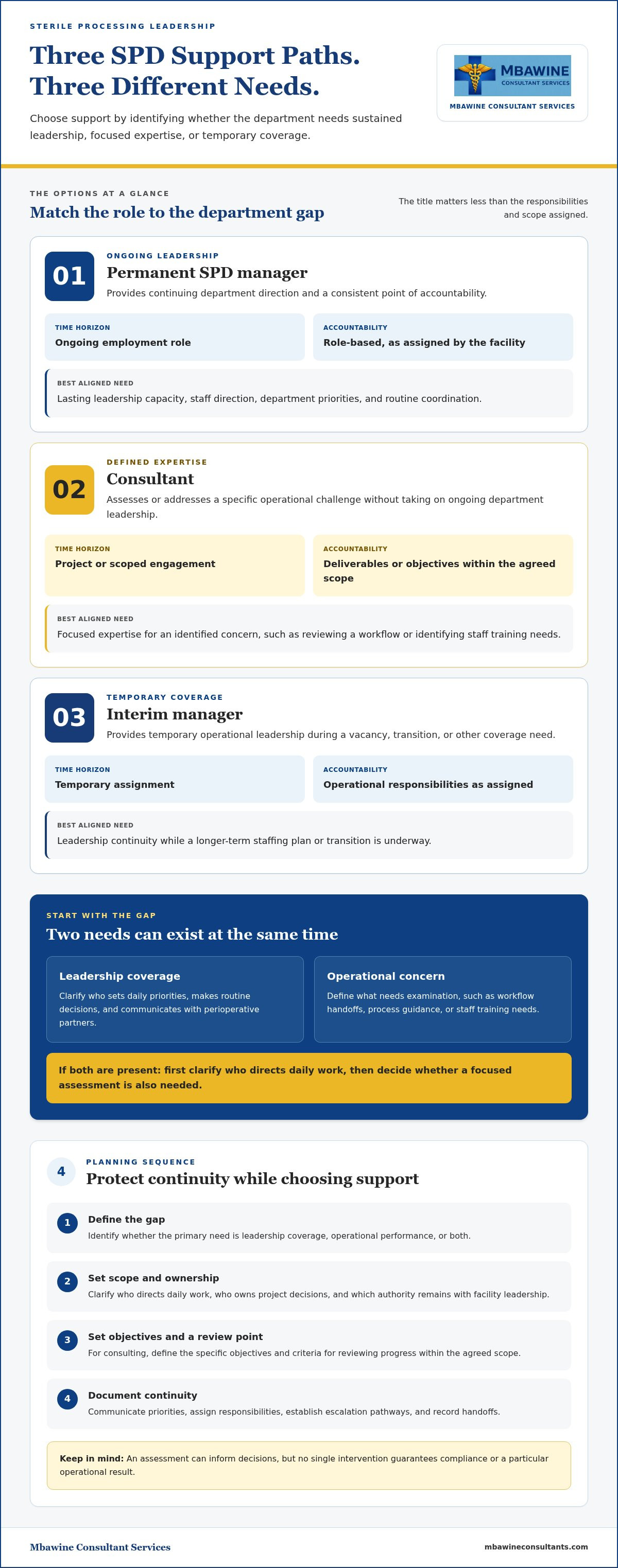
The choice is not simply between an employee and an outside specialist. A permanent SPD manager, an interim leader, and a consultant address different needs. The title alone doesn’t define the work: the assigned responsibilities and engagement scope do. Use the comparison below to clarify the distinction before deciding whether to hire a consultant or a new SPD manager.
| Option | Purpose | Time horizon | Accountability | Intended department need |
|---|---|---|---|---|
| Permanent SPD manager | Provide continuing department leadership | Ongoing employment role | Role-based, as assigned by the facility | Lasting leadership capacity and staff direction |
| Consultant | Assess or address a defined challenge | Project or scoped engagement | Deliverables or objectives within the agreed scope | Focused expertise for an identified operational need |
| Interim manager | Provide temporary operational leadership | Temporary assignment | Operational responsibilities as assigned | Leadership continuity during a vacancy or transition |
A permanent manager can provide ongoing direction to staff, set department priorities, and coordinate with facility stakeholders, including teams that depend on reliable sterile processing operations. The role can also serve as a consistent point of accountability for routine decisions and communication. Its actual authority depends on the facility’s structure and assigned responsibilities, so define the role rather than relying on the title alone.
Recruitment and onboarding take planning, and the department may need a continuity arrangement while that work proceeds. A permanent appointment is suited to an ongoing leadership need, but it should not be expected to resolve every operational concern automatically. Specify the role’s authority, priorities, and relationship to other facility responsibilities so the incoming manager knows what they own.
Consulting brings specialist attention to a defined assessment, challenge, or improvement objective. The scope might include examining a workflow or identifying staff training needs. It is distinct from assuming continuing ownership of department operations. Facilities considering sterile processing consulting services can define the issue, expected work, and criteria for reviewing the engagement.
Interim management provides temporary operational leadership, with responsibilities set by the facility, during a transition or other coverage need. A specialist can also address a defined operational question without becoming the department’s ongoing leader. Clarify who directs daily work, who owns project decisions, and which authority remains with facility leadership to avoid gaps or overlapping responsibilities.
These options can complement workforce development rather than replace leadership or consulting. If staff education is part of the department’s capability plan, sterile processing class enrollment offers a way to explore educational support alongside the chosen staffing approach.
Use a short, documented assessment before selecting an intervention. Consider what needs attention, who can take responsibility, and how the facility will decide whether the approach remains appropriate. A temporary issue may still need specialized assessment, while a lengthy recruitment process does not by itself mean permanent leadership is the only need.
Use interim leadership for temporary coverage, consulting for defined improvement work, and a permanent manager for lasting leadership needs. If more than one gap exists, address continuity and focused work separately instead of expecting a single role to resolve both.
Consider the scope of the concern as well as its duration. A bounded issue can affect multiple teams, while a temporary coverage gap can still demand sustained operational attention. Map the affected work and decision-makers, then determine whether internal leaders can maintain daily oversight without neglecting other responsibilities.
Temporary interim sterile processing leadership can form part of a broader plan that also addresses longer-term role coverage. Define how temporary responsibilities fit the facility’s management structure and how decisions will be handed back or reassigned.
Document the objective, the person responsible for each decision, the communication path, and the evidence to review. For a scoped assessment, specify the question the work should answer. For leadership coverage, define operational responsibilities and reporting relationships. Set review points early enough to adjust scope and ownership if department needs change.
If staff development is part of the identified need, sterile processing classes can support workforce education alongside, not in place of, the leadership or consulting approach selected for the department.
Selecting an interim leader, consultant, or permanent manager is only part of the decision. A deliberate transition plan keeps current work, decision-making, and staff communication clear as responsibilities change. A documented handoff preserves department knowledge and gives incoming leadership a reliable starting point, without assuming that any staffing arrangement will automatically produce a particular result.
Before the transition begins, establish what must continue, who has authority, and how the facility will review progress. Keep the plan specific to the department’s needs:
Staff engagement also needs attention. Explain what is changing, what is staying the same, and where staff should direct operational questions. This gives employees a clearer basis for carrying out assigned work and raising relevant concerns during the transition.
A useful handoff is more than a transfer of files. The outgoing or interim leader and incoming manager should review active priorities, unresolved issues, key contacts, decision pathways, and open commitments. Schedule time for questions, and clarify which responsibilities transfer to the new manager and which remain with facility leadership. Adapt the format and timing to the facility’s employment structure and operational needs.
When a temporary leader has supported the department, interim sterile processing leadership can be one part of the wider transition plan. Documenting the handoff reduces reliance on informal recollection and helps the incoming manager understand the context behind open decisions, not just their status.
Use the review period to distinguish a temporary coverage issue from needs that remain, such as continuing leadership responsibilities or staff skill development. If education aligns with an identified workforce need, sterile processing education and classes can support ongoing development. Review progress against the facility’s objectives and document follow-up decisions without treating the review as proof of a guaranteed result.
For staff whose development plan includes formal learning, explore sterile processing class enrollment as a practical next step. Education can complement clear leadership and documented processes, while the facility retains responsibility for defining roles, priorities, and measures of progress.
Once a facility has identified its primary need, match it with the right form of support. Mbawine Consultant Services provides sterile processing consulting, interim management, temporary staffing, and education for sterile processing professionals. These options address different needs: a department may require temporary leadership, focused expertise, staffing capacity, or staff development.
Interim management provides temporary leadership support for department operations, including during a transition. Sterile processing consulting gives facilities expertise to address a defined department concern. To frame a focused assessment, explore sterile processing consultant services in relation to the operational question that needs an answer.
Temporary staffing provides personnel support when a facility needs additional staffing capacity. It is not a substitute for management authority or a consulting assessment. Mbawine also provides in-person and online sterile processing classes for workforce education and skill development. Education can complement operational support, while the facility continues to define staff roles and department priorities.
These services are not interchangeable. Temporary leadership can address a coverage need, consulting can focus on a defined question, staffing can provide personnel support, and education can address a learning priority. Choose the combination that fits the department’s needs and the responsibilities the facility intends to address.
Before choosing a service, state the immediate operational question clearly. Does the department need temporary leadership coverage, expertise focused on a particular concern, additional staffing support, or education for sterile processing personnel? A defined objective helps facility leaders identify the type of support needed and communicate its purpose.
Facilities deciding whether to hire a consultant or a new SPD manager can use that question to connect the choice to continuity and longer-term capability. Identify who retains decision-making responsibility, what the support should address, and how the facility will review whether the approach remains aligned with its needs. Clear expectations keep operational ownership with the facility and make the purpose of external support more precise.
For professionals pursuing sterile processing education, explore sterile processing class enrollment as a workforce development option. A defined objective, appropriate expertise, and clear responsibilities give department leaders a practical basis for action while supporting continuity through change.
The decision to hire a consultant or a new SPD manager is easier when it leads to a defined next step rather than an open-ended search for a quick fix. Clarify the department’s immediate need, who will own the response, and what capability must remain after temporary support ends. This keeps continuity and workforce development in view as leaders choose an approach.
Mbawine provides sterile processing consulting and interim management, temporary and emergency staffing, and in-person and online classes. Each offers a different form of support for department needs. If education is part of ongoing professional development, identify the learning opportunity that aligns with staff priorities.
Explore sterile processing education and enrollment to take a practical step toward developing knowledge and supporting your department’s long-term capability.
No. An SPD consultant provides expertise within a defined scope, while an interim SPD manager takes on temporary leadership responsibilities assigned by the facility. A consultant might assess a specific workflow; an interim manager may direct department operations during a leadership absence. Document decision authority and reporting relationships before work begins so staff know who advises, who approves changes, and who manages daily operations.
Yes. A facility can use consulting support for a defined need while recruiting for an ongoing leadership role, provided responsibilities and communication are clear. For example, a consultant could assess a specific process while an internal leader remains accountable for daily decisions. Keep the recruitment process, consulting scope, and operational reporting lines distinct so the consultant’s work does not create uncertainty about the future manager’s authority.
Consider interim SPD management when a department needs temporary leadership coverage, such as during a vacancy, planned transition, or manager absence. It can be useful when routine decisions, staff direction, or communication with other departments would otherwise lack a clearly assigned owner. Define the interim role’s authority, review points, and handoff expectations within the facility’s management structure.
A transition plan should give the incoming manager enough context to act without relying on informal updates. Include current priorities, pending decisions, unresolved concerns, key contacts, and the person responsible for each open item. Share access or process information through the facility’s established channels and schedule a direct handoff. Clarify which responsibilities transfer to the manager and which remain with other facility leaders.
Evaluate consulting against the agreed scope, not an assumed outcome. For a workflow assessment, review whether the agreed observations, analysis, or recommendations were completed and whether decision-makers received the information needed for next steps. Track follow-up actions, assigned owners, and unresolved questions. Then decide whether the original scope is complete, needs adjustment, or has surfaced a separate need requiring ongoing ownership.
Yes. Training can support workforce development when leaders identify a specific knowledge or skill need, such as a process staff must understand consistently. Mbawine Consultant Services offers in-person and online sterile processing classes designed to prepare professionals for certification. Connect learning objectives to identified needs, then consider how staff will apply and reinforce that learning in their roles.
The facility should explicitly assign oversight to an accountable leader within its management structure, rather than leaving staff to infer who makes operational decisions. Clarify who handles daily direction, escalations, and communication with relevant departments. If internal leadership capacity is insufficient, interim management can provide temporary operational leadership under responsibilities set by the facility. Recruitment and temporary coverage can proceed as related but separate workstreams.

Article by
Mba Akuribila
Mba‑Akuribila is a healthcare leader, educator, and founder of Mbawine Consultants, a Bronx‑based institution recognized nationwide for advancing excellence in sterile processing and allied health workforce development. Born in Bongo in Ghana’s Upper East Region, his journey from rural beginnings to national impact reflects a lifelong commitment to service, empowerment, and community advancement.
For over two decades, he has trained sterile processing employees, mentored, and placed thousands of healthcare professionals across the United States. Through Mbawine Consultants, he established one of the country’s most trusted Sterile Processing Certification Test Prep Programs, preparing new Americans and career‑changers for successful entry into the field. The organization, as at 2026, has graduated more than 15,000 sterile processing technicians who now serve in hospitals, ambulatory centers, dental practices, and reprocessing facilities nationwide.
Under his leadership, Mbawine Consultants has expanded into a full Healthcare Staffing Agency, connecting nurses and allied health professionals to meaningful employment opportunities. His team also provides Interim Management Services, supporting hospitals and surgical centers with experienced leaders who stabilize operations, strengthen compliance, and improve workflow efficiency.
As a former surgical technician, sterile processing manager, educator, and system‑wide director, Mba‑Akuribila brings deep expertise to Sterile Processing Consulting, helping healthcare facilities elevate quality, safety, and regulatory readiness.
His work in the United States and Ghana continues to reflect his core philosophy: service above self, opportunity for all, and excellence without compromise.


