

What if the mistakes that undermine your sterile processing certification exam aren’t proof that you lack knowledge, but signs that your preparation system needs attention? Learning how to avoid common certification exam mistakes starts with recognizing how rushed reading, second-guessing, and confusion between similar terms or procedural steps can affect performance, even when you’ve studied the material.
It’s understandable to wonder whether disappointing practice results reflect knowledge gaps or test-taking habits. Turning study hours into exam readiness takes more than reviewing facts. It calls for a structured way to revisit sterile processing concepts, identify recurring errors, and practise reading questions carefully under pressure.
This article explains how to spot preventable preparation and test-day mistakes, organize focused concept review, and assess what your practice results are telling you. It also explains when structured instruction may help you prepare more systematically. Mbawine Consultant Services offers online and in-person sterile processing classes designed to support certification preparation.
You may perform sterile processing tasks confidently at work and still find certification questions unfamiliar. That doesn’t mean you’re unqualified. It can reflect the shift from carrying out a routine to selecting the most accurate response in a structured testing environment. Understanding how to avoid common certification exam mistakes starts by treating preventable errors as preparation or decision-making issues, not as proof that you can’t learn the material.
Some errors begin before exam day: studying topics that don’t match the current exam, relying on recognition instead of retrieval, or reviewing missed questions without figuring out why the answer was wrong. Other errors happen while answering, such as overlooking a qualifier, misreading a scenario, rushing, or changing a considered response without a clear reason. Use the current handbook, blueprint, and policies from your certifying organization, since exam content and requirements can differ.
Preventable mistakes generally fall into four areas: preparation, knowledge retrieval, question reading, and time management. A recurring habit can affect more than one item. For example, skimming a question may cause you to miss a condition that changes which response best fits the scenario.
For instance, you may understand the stages involved in processing an instrument set yet have difficulty explaining the purpose of a step or applying the concept to a changed scenario. Track the type of error, not just your score. Broader effective study skills, including active learning and planned review, can make preparation more deliberate.
Workplace experience builds practical familiarity, while an exam may assess whether you can identify a principle, explain its rationale, or apply it to details presented in writing. A task that feels automatic in a familiar workflow may be less obvious when a question describes a different situation and asks for the most appropriate response.
Read each scenario for its stated conditions rather than filling in details from your usual workplace routine. Ask what the prompt specifically requires, which information it provides, and whether a qualifier changes the task. Experience can provide valuable context, but it doesn’t automatically establish readiness or predict failure. Focused review can connect practical knowledge with the precise concepts your certifying organization expects candidates to understand.
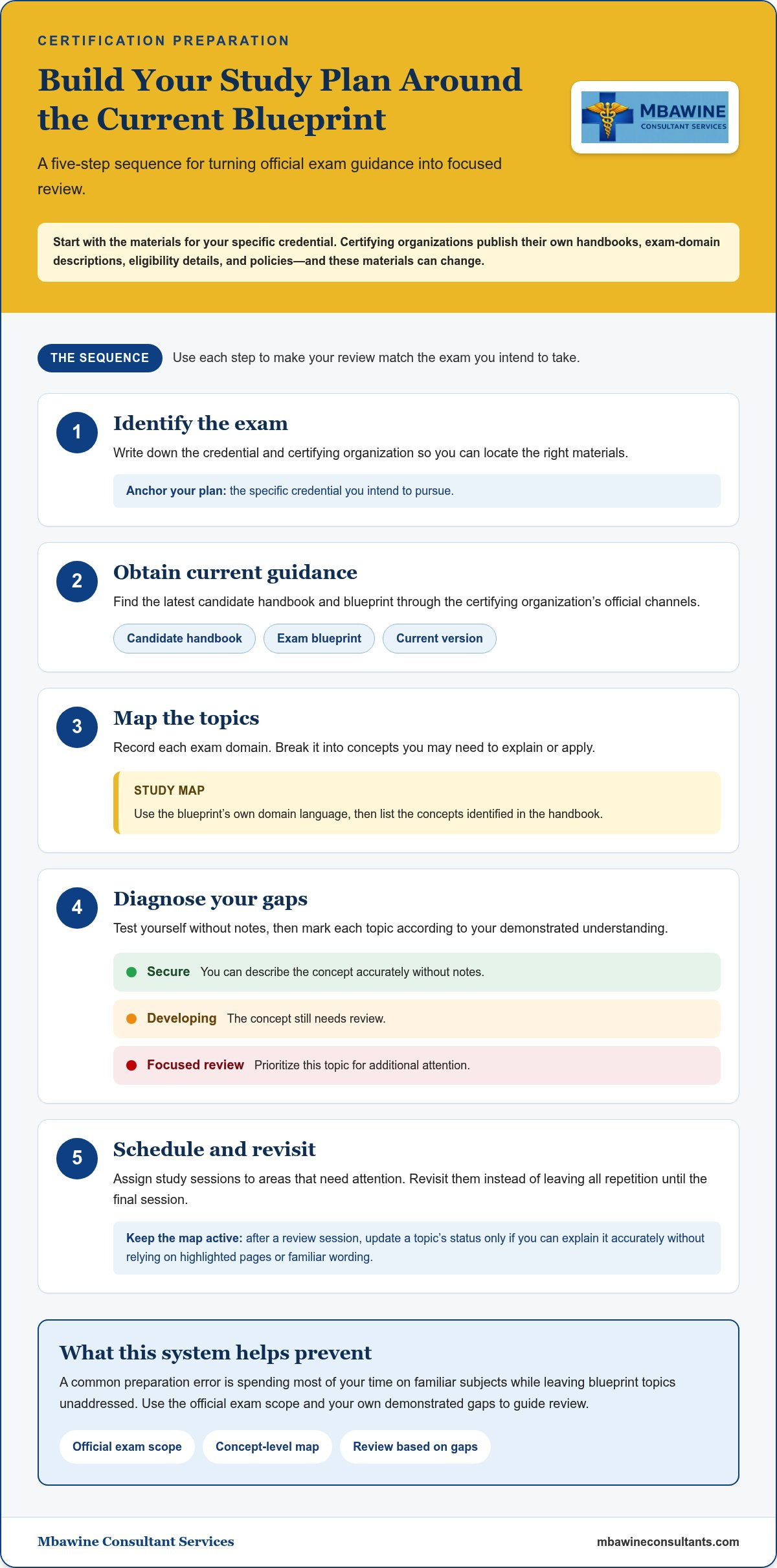
A study plan is most useful when it reflects the certification exam you intend to take, rather than a general collection of sterile processing topics. Certifying organizations publish their own handbooks, exam-domain descriptions, eligibility details, and policies, and these materials can change. Start with the official resources for your specific credential, and confirm that you’re using current versions before building your schedule.
Use this sequence to turn the exam blueprint into a practical preparation system:
Use the blueprint’s own domain language in your study map. This keeps your review aligned with the stated exam scope and helps prevent a common preparation error: spending most of your time on familiar subjects while overlooking topics that need work. For broader pathway context, review this CRCST certification guide alongside the current requirements from the relevant certifying body.
Break each official domain into specific concepts you can explain, distinguish, or apply. For example, instead of writing “sterilization,” list the individual processes or principles within that domain that your handbook identifies. Mark each concept secure, developing, or requiring focused review, then prioritize according to your demonstrated gaps and the blueprint’s emphasis. This makes your plan responsive to both the exam outline and your actual understanding.
Keep the map active. After a review session, update a concept’s status only if you can describe it accurately without relying on a highlighted page or familiar wording. If organizing your study independently proves difficult, structured sterile processing classes can provide a guided way to study certification-related concepts. Candidates considering formal preparation can explore sterile processing class enrollment.
Rereading can make material feel familiar without showing whether you can recall it independently. Close your notes and explain a process in your own words, answer practice questions, or describe why a step matters. Then check the relevant material and correct any gaps. Return to difficult concepts in later sessions so review is spread over time rather than concentrated in one final study period.
As you practise, distinguish recognition from recall: knowing a term when you see it is different from retrieving its meaning and using it appropriately. Ask yourself what principle a concept represents and how it relates to the stated domain. This cycle of recall, checking, and spaced review is a practical foundation for how to avoid common certification exam mistakes. Use official materials as the authority for exam scope and requirements.
A missed practice question is useful only if you understand what caused the error. Repeating the same study activity without diagnosing the problem can use up time without addressing the underlying gap. Before changing your approach, determine whether the miss came from unfamiliar content, weak recall, a misunderstood term, misreading the prompt, overthinking, or poor pacing. Each cause calls for a different response.
Study methods serve different purposes, and none is best for every candidate. Choose the method that addresses the difficulty you’ve identified:
If a concept is genuinely unfamiliar, return to a reliable reference and clarify its meaning before testing yourself. If you can explain it while reading but not with your notes closed, use retrieval practice. If you know the concept but choose an incorrect response, inspect how you interpreted the question. Practice items can help expose that distinction, while instructor-led study may add structure when you need guidance connecting concepts.
Classify errors before deciding what to change. A question missed because you didn’t know a concept calls for content review; one missed because you overlooked a qualifier calls for careful reading practice. A pattern of late-session errors may point to pacing rather than knowledge. An error log turns these observations into a record you can use.
| Error type | Likely cause | Corrective action |
|---|---|---|
| Knowledge | The concept is unfamiliar or incomplete. | Review the relevant material, then explain it without notes. |
| Terminology | Similar terms are being confused. | Define each term and distinguish its meaning in context. |
| Question reading | A qualifier or scenario detail was overlooked. | Identify the task and key conditions before evaluating options. |
| Pacing or overthinking | Too much time is spent reconsidering an answer. | Practise a deliberate response process and track time use. |
For each missed item, record the topic, your selected response, the correct rationale, and your reason for the error. Avoid simply copying the right answer. Write down the distinction or clue you missed. Review the log regularly, look for recurring categories, and use those patterns to choose your next study activity. This turns how to avoid common certification exam mistakes into a diagnostic process, rather than a vague instruction to study harder.
Rushing isn’t the only risk during an exam. You can read quickly, recognize familiar sterile processing terminology, and still answer the wrong question if you overlook a scenario’s conditions or the task the prompt sets. A consistent process helps separate what the question states from what you assume, while giving you a reasoned basis for selecting and reviewing responses.
Apply the same sequence to each item:
Similar subject matter can support different questions: one may ask what should happen first, while another asks why a step matters or which response best fits a stated situation. Those tasks aren’t interchangeable. Look for words that establish priority, sequence, or an exception, then read them in the context of the scenario. Don’t assume every exam uses the same phrasing or that a familiar workplace routine supplies details the prompt hasn’t given.
For example, if a scenario describes a specific condition, base your reasoning on that condition rather than importing a different circumstance from your experience. A response that sounds generally reasonable may not address the stated task. Evaluate the available options against the wording instead of guessing beyond what the question says.
Reconsider an answer when you identify concrete evidence, such as a missed qualifier or a detail that changes how an option fits the scenario. Changing it only because uncertainty feels uncomfortable is different. If you’re unsure, return to the prompt, identify the task again, and compare the options with the evidence it provides.
Timing and navigation rules vary, so rely on the official instructions for your exam platform. Follow its guidance on permitted review, marking, and returning to questions rather than assuming you can move freely between items. In practice sessions, note where you tend to spend extra time or rush, then adjust your pace without imposing a universal time limit. A deliberate method is a practical part of how to avoid common certification exam mistakes.
If guided preparation would help you practise applying sterile processing concepts systematically, enroll in a sterile processing class.
Independent study can be sufficient when your knowledge gaps are narrow, you can identify them reliably, and you can explain relevant concepts without depending on notes. In that situation, focused reading and regular self-testing may provide the structure you need. The important question is whether your approach is producing clear evidence of understanding, not simply whether you’ve spent time studying.
Repeated errors call for a closer look. If the same foundational topics remain unclear, you struggle to distinguish related concepts, or your practice review repeatedly reveals gaps you can’t resolve, guided instruction may help organize what to study and how concepts connect. Experience in a sterile processing setting can contribute valuable context, but it doesn’t guarantee exam readiness. A class can support learning, but it can’t guarantee a certification result.
Use self-directed review when you can name the specific topic you need to strengthen, locate relevant material, and assess whether your understanding has improved. Consider structured instruction when difficulties span multiple concepts or keep returning despite focused review. Sterile processing classes can provide organized education alongside independent study. Choose support according to the gap, not simply because one format seems more familiar.
Base your decision on patterns over time. One unfamiliar term may need only targeted clarification; repeated difficulty explaining how concepts relate may point to a need for broader instruction. Similarly, if you understand the material but frequently misread prompts, practise question interpretation rather than assuming more content review alone will solve the problem. Diagnose first, then choose a learning approach that addresses the cause.
Mbawine Consultant Services provides online and in-person sterile processing classes designed to prepare professionals for certification. Structured education can help candidates organize their learning and build understanding of sterile processing concepts and healthcare sterilization standards. The online and in-person formats offer different ways to engage with instruction. You remain responsible for continued review and for consulting the current guidance of your certifying organization.
Candidates pursuing the CRCST pathway can review information about CRCST certification preparation as part of planning their studies. This can connect general preparation decisions with the credential pathway they’re considering. Keep the current certifying-body handbook and blueprint central to your plan, since those materials define the applicable exam guidance and requirements.
Understanding how to avoid common certification exam mistakes includes recognizing when independent study is no longer addressing recurring gaps. If guided instruction fits your preparation needs, review enrollment options for sterile processing classes and consider how structured study could complement your ongoing review.
Make your next study decision from evidence, not exam anxiety. Choose a recurring difficulty from your practice review, decide what would demonstrate stronger understanding, and build that check into your next study cycle. This keeps preparation responsive: your plan can develop as your knowledge grows instead of relying on hours logged or confidence alone.
That is a practical foundation for how to avoid common certification exam mistakes: treat each result as information, then use it to guide your next action. If guided certification preparation would help you sustain that process, consider whether structured sterile processing education fits your learning needs. Instruction can support professional understanding, while exam readiness still depends on your continued study and the current guidance of your certifying organization.
Review enrollment options for sterile processing classes to choose a preparation path that supports your next step. Consistent, purposeful study can help you approach the certification process with greater clarity and confidence.
Use a repeatable check before selecting an answer: confirm what the prompt asks, identify the details that affect the response, and compare your choice with those details. To learn how to avoid common certification exam mistakes, review practice errors for patterns rather than treating every miss as a broad knowledge gap. For example, if you repeatedly overlook a condition in a scenario, practise identifying that condition before considering the answer options.
There isn’t one mistake that applies to every candidate or certification. Preparation can falter when study isn’t aligned with current objectives, when learners depend on familiarity instead of recall, or when they rush through questions. In sterile processing, use your certifying organization’s current materials to define what to review. Then examine your own practice results: repeated errors in one area offer a more useful starting point than assumptions about what other candidates commonly get wrong.
Change an answer when you identify a specific reason the original choice doesn’t fit, such as a detail in the scenario you overlooked. Don’t revise solely because you feel uncertain. If the exam platform permits marking and returning to items, follow its instructions and revisit the prompt before deciding. During practice, note what evidence led you to change an answer and whether that evidence was present in the question. This keeps review focused on reasoning rather than anxiety.
Classify missed practice items by cause. If you can’t explain the underlying concept, review that content; if you understood it but misread a condition or ran out of time, practise interpretation or pacing. For example, after a missed item, explain the concept aloud, then summarize what the question asked. If the first step is difficult, focus on knowledge; if the second is, focus on reading strategy. Track patterns across sessions before changing your plan.
A class may help if you need an organized way to approach foundational concepts or would benefit from guided instruction. Mbawine Consultant Services provides sterile processing classes for professionals preparing for certification, with online and in-person learning formats. Instruction can support your understanding of sterile processing concepts and healthcare sterilization standards, but it can’t guarantee an exam result. Continue to use your certifying organization’s current candidate materials and maintain an active study routine.
Keep the final review focused rather than attempting to relearn every subject. Revisit a concise set of notes or a few recurring errors, and confirm the exam’s instructions using official materials. Avoid adding unfamiliar study resources at the last moment, since they may distract from areas you already know need attention. Make practical preparations that help you arrive ready to follow the exam process, and leave enough time for rest.
Start with the official score report and the certifying organization’s current retake guidance. If the report identifies weaker domains, use them to prioritize review; if it doesn’t, examine your practice log for recurring content or test-taking errors. Before attempting the exam again, build a study plan around those findings and verify current eligibility, application, and retake requirements in official materials. A result is information for planning your next preparation cycle, not a complete measure of your professional potential.

Article by
Mba Akuribila
Mba‑Akuribila is a healthcare leader, educator, and founder of Mbawine Consultants, a Bronx‑based institution recognized nationwide for advancing excellence in sterile processing and allied health workforce development. Born in Bongo in Ghana’s Upper East Region, his journey from rural beginnings to national impact reflects a lifelong commitment to service, empowerment, and community advancement.
For over two decades, he has trained sterile processing employees, mentored, and placed thousands of healthcare professionals across the United States. Through Mbawine Consultants, he established one of the country’s most trusted Sterile Processing Certification Test Prep Programs, preparing new Americans and career‑changers for successful entry into the field. The organization, as at 2026, has graduated more than 15,000 sterile processing technicians who now serve in hospitals, ambulatory centers, dental practices, and reprocessing facilities nationwide.
Under his leadership, Mbawine Consultants has expanded into a full Healthcare Staffing Agency, connecting nurses and allied health professionals to meaningful employment opportunities. His team also provides Interim Management Services, supporting hospitals and surgical centers with experienced leaders who stabilize operations, strengthen compliance, and improve workflow efficiency.
As a former surgical technician, sterile processing manager, educator, and system‑wide director, Mba‑Akuribila brings deep expertise to Sterile Processing Consulting, helping healthcare facilities elevate quality, safety, and regulatory readiness.
His work in the United States and Ghana continues to reflect his core philosophy: service above self, opportunity for all, and excellence without compromise.


