

The integrity of modern surgical outcomes rests not merely upon the skill of the surgeon, but upon the invisible, rigorous precision of the sterile processing department. You likely recognize that entering this high-stakes environment requires more than just technical interest; it demands a commitment to institutional standards and public safety that few other healthcare roles require. This comprehensive 2026 guide provides the definitive roadmap for how to become a sterile processing technician, offering a structured pathway to navigate the complexities of national certification and professional mastery within the medical field. We will examine the distinct requirements of the HSPA and CBSPD, detail the strategies necessary to secure your CRCST credential on the first attempt, and outline the methodical process for obtaining the 400 hours of clinical experience essential for long-term career stability. As the average annual salary for these professionals reaches approximately $57,186, the transition from an aspiring candidate to a certified expert requires a clear understanding of the academic and practical milestones ahead. By following this professional prospectus, you'll establish a foundation for excellence in a field where meticulous attention to detail is the primary guardian of patient health.
The Sterile Processing Technician serves as the critical foundation for all surgical interventions. In the high-stakes environment of a modern hospital, these professionals act as the primary line of defense against infection, ensuring that every instrument used in a procedure is free from microbial life. As you explore how to become a sterile processing technician, it's essential to understand that this role has evolved from a support function into a highly specialized technical discipline. By 2026, the healthcare industry has shifted decisively toward mandatory national certification for all practitioners. This change reflects a growing recognition of the technician as a guardian of public health and institutional safety standards. Understanding how to become a sterile processing technician involves recognizing that technical proficiency must be paired with an unwavering dedication to professional ethics.
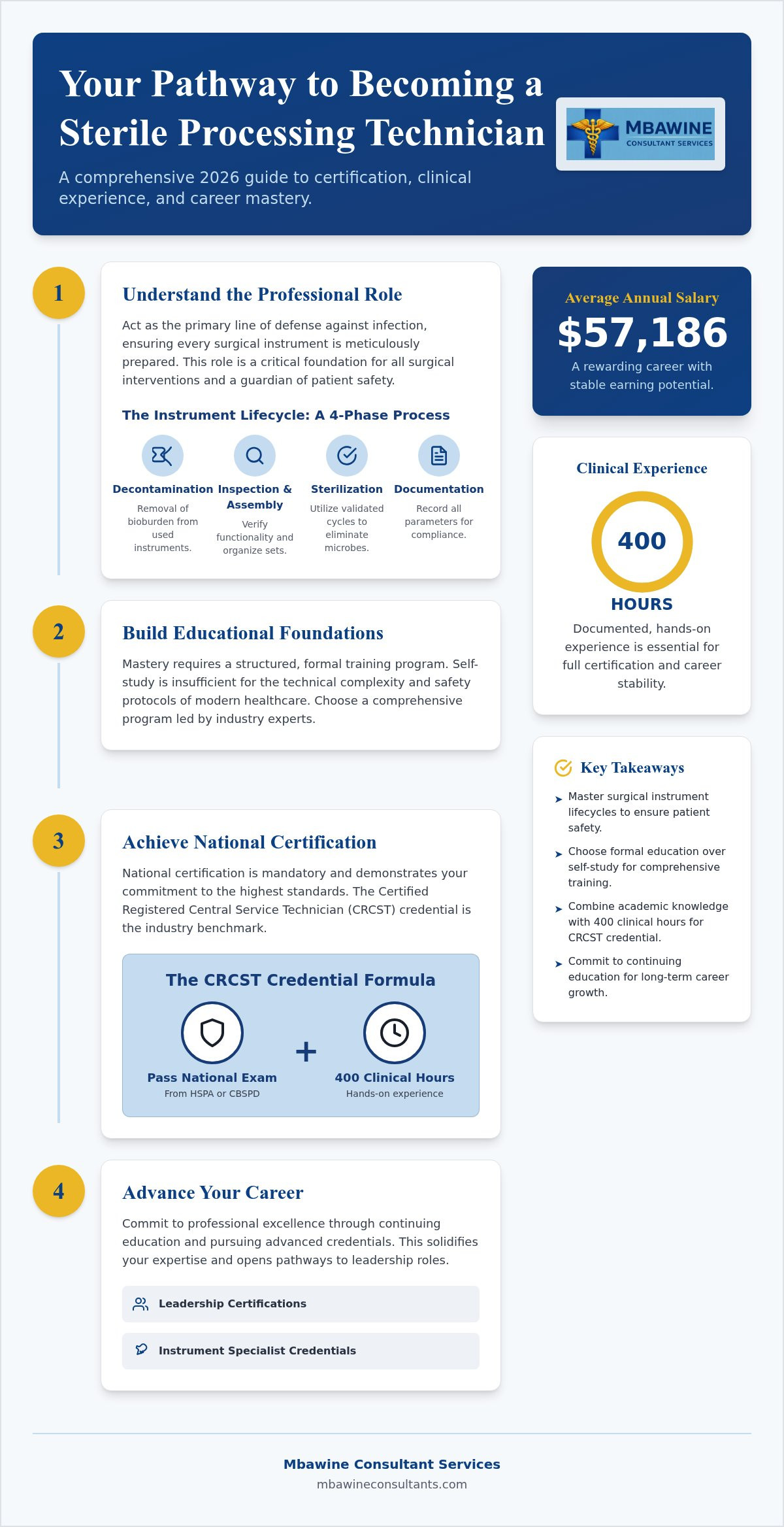
The workflow within the Central Sterile Services Department (CSSD) follows a rigorous, unidirectional path designed to prevent cross-contamination. This lifecycle begins in decontamination, moves through meticulous inspection and assembly, and culminates in advanced sterilization processes. Each step requires absolute adherence to manufacturer instructions for use (IFU) and regulatory protocols. Every instrument set must be handled with the knowledge that a human life depends on the technician's precision.
The prevention of healthcare-acquired infections (HAIs) is the central mission of the sterile processing department. Technicians maintain a symbiotic relationship with the Operating Room, ensuring that surgical teams have the precise tools required for complex procedures without delay. This collaboration isn't merely operational; it's deeply ethical. A single oversight in the cleaning process can lead to catastrophic patient outcomes. Consequently, the technician's commitment to detail serves as a silent, yet powerful, advocacy for patient safety and clinical excellence.
Daily operations demand mastery over a variety of high-level disinfection and sterilization technologies. Technicians must be proficient in mechanical cleaning methods, ultrasonic cleaners, and various sterilization modalities, including steam, ethylene oxide, and hydrogen peroxide plasma. The process involves several distinct phases:
Meticulous documentation isn't just a clerical task. It's a legal and professional requirement that validates the efficacy of the sterilization process. This systematic approach ensures that every medical device remains a safe, reliable tool for the surgical team.
Achieving professional mastery in healthcare sterilization requires a foundational education that transcends basic rote memorization. As you investigate how to become a sterile processing technician, you'll find that the complexity of modern medical instrumentation necessitates a structured, formal training program rather than independent study. Self-directed learning often fails to address the nuanced technical requirements and the systematic safety protocols mandated by institutional governing bodies. A professionally designed curriculum ensures that candidates develop a deep understanding of the regulatory frameworks and clinical standards that define the field in 2026.
The commitment to this career path involves both temporal and financial investments. Most comprehensive programs span several months, reflecting the density of information required for national certification. Choosing a program led by industry subject matter experts provides an authoritative bridge between academic theory and the high-stakes environment of the sterile processing department. This investment in high-level training serves as the primary safeguard for your future career stability and professional reputation.
A rigorous training program must cover a diverse array of technical subjects. Essential topics include microbiology, human anatomy, and stringent infection control protocols. Students must also master the identification and care of complex surgical instruments, a skill set that is vital for preventing perioperative complications. Mbawine's Sterile Processing Education is specifically engineered to prepare students for these real-world scenarios by integrating theoretical knowledge with practical application. This ensures that graduates don't just pass an exam but possess the technical competence required by premier healthcare facilities. Engaging in a specialized sterile processing technician training curriculum provides the rigorous assessment needed to meet these high industry expectations.
The choice between learning modalities often depends on an individual's professional schedule and preferred instructional style. Many aspiring professionals benefit from the flexibility offered by online sterile processing technician programs, which allow for a methodical progression through the material without the constraints of a physical classroom. However, in-person instruction remains a superior option for those seeking immediate, hands-on feedback during the acquisition of technical skills. Regardless of the format, it's imperative to ensure that the chosen program aligns with the standards of the Healthcare Sterile Processing Association (HSPA) as you determine how to become a sterile processing technician in a competitive market. For those ready to begin their journey, you can review our upcoming enrollment dates to find a schedule that meets your professional objectives.
To understand how to become a sterile processing technician, one must view the process as a multi-stage professional evolution that culminates in national recognition. The journey begins with the completion of a recognized training program, which provides the theoretical framework necessary for clinical application. Following academic instruction, candidates must accumulate 400 hours of hands-on clinical experience. This practical phase ensures that the technician can apply sterilization principles in a live healthcare environment. Data from the U.S. Bureau of Labor Statistics indicates that medical equipment preparers play an increasingly vital role in the healthcare economy, reinforcing the value of this specialized credential.
Once the educational and experiential requirements are met, the candidate applies for the Certified Registered Central Service Technician (CRCST) examination. The current application fee for this attempt is $140. Success on this examination marks the transition from a student to a credentialed professional, establishing a verifiable standard of expertise that healthcare facilities prioritize during the hiring process.
The Healthcare Sterile Processing Association (HSPA) serves as the premier governing body, setting the benchmarks for sterilization practices globally. Obtaining the CRCST certification is widely regarded as the gold standard for those seeking to demonstrate their commitment to patient safety. Candidates may pursue either full or provisional status. Full certification is granted to those who complete their 400 hours of experience before the exam, while provisional status allows candidates to pass the examination first, provided they document their clinical hours within six months of the testing date. This flexibility is a key component for those determining how to become a sterile processing technician while balancing existing professional obligations.
Achieving success on the first attempt requires a methodical approach to study. Aspiring technicians should utilize a combination of specialized study guides and practice examinations to identify areas of technical weakness. Professional test-preparation classes offer a structured environment that mirrors the complexity of the actual assessment, providing candidates with the confidence needed to perform under pressure. The CRCST exam is a rigorous assessment of technical and ethical competence. By prioritizing comprehensive preparation, candidates ensure they meet the high-level knowledge requirements of modern sterile processing departments.
The completion of 400 hours of documented clinical experience represents a non-negotiable professional milestone in your journey of learning how to become a sterile processing technician. This practical phase isn't merely a certification requirement; it's the essential bridge between theoretical knowledge and the institutional excellence required in a live surgical environment. Finding facilities willing to host students for clinical rotations remains one of the most significant challenges for aspiring technicians. Securing these opportunities requires a proactive approach to professional networking and a clear understanding of institutional expectations. Integrating staffing and interim management solutions into the broader SPD ecosystem provides a vital bridge for those transitioning from academic study to professional practice.
During these clinical hours, the candidate's focus must remain on mastering the core technical areas of the department. This includes decontamination, preparation and packaging, sterilization, and sterile storage management. Meticulous conduct and a commitment to safety are critical, as these rotations often serve as an extended job interview. To further strengthen your candidacy, utilizing professional verification services like workreferences.com can help ensure your clinical experience and professional background are accurately presented to potential employers. Documentation is paramount; every hour must be verified by a department supervisor and submitted according to HSPA protocols to ensure the transition from provisional to full certification. This systematic verification process ensures that every certified professional has demonstrated competence in a high-stakes clinical setting.
Building a professional resume that highlights specialized sterilization training is the next step in workforce integration. You'll need to emphasize your familiarity with specific sterilization modalities and your adherence to regulatory standards. Joining a staff and alumni network offers a distinct advantage, providing access to a community of experienced professionals and potential career placements. These networks often provide the professional advocacy necessary to secure roles in premier healthcare facilities. Leveraging temp staffing solutions allows newly certified technicians to gain experience in diverse healthcare environments, from large level-one trauma centers to specialized ambulatory surgery centers. This exposure builds the technical versatility required for long-term career growth. To begin your professional journey with a curriculum that prioritizes clinical readiness, you can enroll in our specialized training program today.
As you master the complexities of the sterile processing department, you'll find that hands-on experience is the ultimate validator of your expertise. By successfully navigating your clinical hours and integrating into the workforce, you establish yourself as a vital component of the surgical team. This commitment to practical excellence is what distinguishes a certified professional in the competitive healthcare landscape of 2026. Understanding how to become a sterile processing technician requires recognizing that your education and your clinical experience are two parts of a single, unified professional foundation.
Achieving your initial credential represents the first milestone in a professional lifecycle dedicated to surgical safety. However, the comprehensive path of how to become a sterile processing technician who excels in leadership requires a commitment to perpetual development. In a field governed by rapid technical evolution and rigorous safety mandates, professional stagnation is a risk to institutional integrity and patient outcomes. Gaining a deeper understanding of global auditing and verification through International Associates Limited can help leaders maintain these high standards across their organizations. Leadership in this discipline is defined by an ongoing pursuit of mastery that extends far beyond the entry-level examination. This commitment to excellence ensures that you remain a vital asset to your surgical team and a guardian of public health.
The transition from a technician to a subject matter expert involves a methodical approach to advanced education. By pursuing specialized knowledge, you position yourself for roles that carry greater responsibility and higher compensation. Understanding how to become a sterile processing technician with a focus on long-term growth means recognizing that your education is a continuous process rather than a one-time event.
To maintain an active Certified Registered Central Service Technician (CRCST) status, professionals must adhere to annual recertification requirements. This process involves the completion of 12 continuing education units (CEUs) and a $50 renewal fee. These credits ensure that you stay current with the 2026 professional standards and the latest AAMI guidelines. Attending national conferences and participating in professional webinars provides access to high-level knowledge that is essential for maintaining departmental excellence. This structured approach to learning validates your ongoing competence and commitment to the highest industry standards.
Experienced technicians often advance into lead, supervisor, or departmental manager positions. To facilitate this transition, many professionals pursue advanced credentials such as the Certified Instrument Specialist (CIS) or the Certified Healthcare Leader (CHL). These certifications demonstrate a specialized understanding of complex instrumentation and organizational management. Additionally, the role of Sterile Processing Consultant Services has become increasingly significant in the 2026 healthcare landscape. Experienced professionals can leverage their expertise to provide high-level consulting or interim leadership, optimizing department operations and mentoring the next generation of technicians. This trajectory from entry-level practitioner to specialized consultant offers a robust framework for career stability and professional influence within the medical field.
The journey toward professional mastery in the sterile processing department requires a methodical integration of academic rigor and clinical application. By understanding the specific requirements for the CRCST credential and navigating the 400-hour hands-on milestone, you position yourself as a guardian of patient safety within the healthcare ecosystem. This guide has detailed the essential roadmap for how to become a sterile processing technician in 2026, emphasizing that success is predicated on choosing a curriculum aligned with national standards. The standards are high. It's a path that demands precision, but the rewards of career stability and professional influence are substantial.
Mbawine Consultant Services offers an expert-led curriculum specifically engineered to ensure first-attempt examination success. Whether you require the flexibility of online learning or the direct feedback of in-person instruction, our programs provide the authoritative bridge to your professional goals. Beyond the classroom, our students benefit from access to a national network of healthcare staffing opportunities, facilitating a seamless transition into the workforce. We invite you to Enroll in Mbawine's Professional Sterile Processing Classes Today to begin your advancement toward institutional leadership. Your commitment to this high-stakes field is a vital contribution to public health and surgical excellence.
A high school diploma or an equivalent GED credential is a standard prerequisite for entering the sterile processing field. Most accredited training programs and certification boards require proof of secondary education before a candidate can enroll or sit for national examinations. This requirement ensures that technicians possess the foundational literacy and mathematical skills necessary to interpret complex manufacturer instructions for use and maintain precise documentation throughout the sterilization lifecycle.
The duration of a sterile processing program depends on the instructional format and the candidate's pace. Most comprehensive programs, such as those offered by Mbawine Consultant Services, typically range from four to eight months. This timeframe allows for the thorough acquisition of technical knowledge in microbiology while providing the necessary window for those learning how to become a sterile processing technician to begin accumulating the 400 hours of clinical experience required for full national certification.
You may take the CRCST examination before completing your clinical hours by applying for provisional certification status. Under this pathway, candidates have six months from the date of passing the exam to document and submit their 400 hours of hands-on experience to the HSPA. Failure to meet this deadline results in the forfeiture of the passing score; this requires the candidate to retake the assessment to achieve full professional credentialing.
The primary difference lies in the governing bodies and specific credentialing requirements. The Healthcare Sterile Processing Association (HSPA) issues the CRCST, which is widely regarded as the industry gold standard and requires 400 clinical hours. The Certification Board for Sterile Processing and Distribution (CBSPD) offers the CSPDT credential. While both are recognized, the CRCST is often preferred by premier healthcare facilities due to its rigorous emphasis on documented practical experience and technical mastery.
Online sterile processing classes are highly effective when they utilize a curriculum designed by industry subject matter experts. These programs offer the flexibility needed for working professionals while maintaining the same rigorous academic standards as traditional classrooms. However, technical skill acquisition is best supported when online instruction is paired with a dedicated clinical rotation. This hybrid approach ensures that students master the theoretical concepts of how to become a sterile processing technician before applying them in a live clinical setting.
The total cost of becoming a certified professional includes tuition for a training program and the national examination fees. For 2026, the HSPA CRCST exam fee is $140, while the CBSPD charges $135 for its certification attempt. Tuition costs for specialized training programs vary based on the provider and the depth of the curriculum. Candidates should also account for the $50 annual renewal fee and the costs associated with earning 12 continuing education units each year.
If you don't pass the certification exam on your first attempt, you're permitted to retake the assessment after a mandatory waiting period. The HSPA requires a six-week interval between attempts to allow for additional study and remediation. It's advisable to utilize professional test-prep resources or specialized classes during this time to address technical weaknesses. Focused preparation is essential, as each subsequent attempt requires a new application and the payment of the standard examination fee.
Sterile processing technicians find professional opportunities in various healthcare settings beyond traditional hospital environments. These include ambulatory surgery centers, specialized dental clinics, and outpatient diagnostic facilities. Additionally, experienced professionals can transition into roles within medical device manufacturing or specialized consulting firms. The demand for sterile processing expertise extends to any facility that utilizes reusable medical instrumentation, providing technicians with a diverse range of environments for career growth and long-term stability.

Article by
Mba Akuribila
Mba‑Akuribila is a healthcare leader, educator, and founder of Mbawine Consultants, a Bronx‑based institution recognized nationwide for advancing excellence in sterile processing and allied health workforce development. Born in Bongo in Ghana’s Upper East Region, his journey from rural beginnings to national impact reflects a lifelong commitment to service, empowerment, and community advancement.
For over two decades, he has trained sterile processing employees, mentored, and placed thousands of healthcare professionals across the United States. Through Mbawine Consultants, he established one of the country’s most trusted Sterile Processing Certification Test Prep Programs, preparing new Americans and career‑changers for successful entry into the field. The organization, as at 2026, has graduated more than 15,000 sterile processing technicians who now serve in hospitals, ambulatory centers, dental practices, and reprocessing facilities nationwide.
Under his leadership, Mbawine Consultants has expanded into a full Healthcare Staffing Agency, connecting nurses and allied health professionals to meaningful employment opportunities. His team also provides Interim Management Services, supporting hospitals and surgical centers with experienced leaders who stabilize operations, strengthen compliance, and improve workflow efficiency.
As a former surgical technician, sterile processing manager, educator, and system‑wide director, Mba‑Akuribila brings deep expertise to Sterile Processing Consulting, helping healthcare facilities elevate quality, safety, and regulatory readiness.
His work in the United States and Ghana continues to reflect his core philosophy: service above self, opportunity for all, and excellence without compromise.


