

Last Updated: August 30, 2026
Before evaluating sterile processing consultants, document your current state and biggest operational pain points. Are surgical cases delayed because instrument trays aren't ready? Are staff working excessive overtime? Do you have compliance gaps? Are you struggling with retention or competency issues? The specific problems you're solving will shape the type of consultant expertise you need.
Map your current workflow from decontamination through sterilization to storage and delivery. Identify where delays happen, where quality issues occur, and where staff struggle most. Consider your facility's scope too, a five-person sterile processing department in an ambulatory surgical center has completely different needs than a 20-person department in a 500-bed hospital. Consultants experienced with your facility size and case volume are more likely to deliver practical solutions.
Document your current staffing levels, certifications, and turnover rates. Understanding your team's competency gaps helps you evaluate whether a consultant should focus on education and training or operational restructuring.
A comprehensive sterile processing department assessment is the foundation of any successful consulting engagement. It's a systematic evaluation of your processes, staff capabilities, equipment, compliance status, and performance metrics.
The assessment should examine your decontamination protocols, cleaning validation, staff adherence to standard operating procedures, and equipment maintenance. Evaluate your sterilization processes, are sterilizers calibrated and maintained? Are you running biological and chemical indicator tests appropriately? Do you have documentation proving sterilization efficacy?
Assess your sterile storage environment for climate control, logical organization, and cross-contamination risks. Evaluate your inventory and instrument management systems, can you track instruments from point of use to sterilization to storage? Review your staff's knowledge and competency beyond certifications. Can technicians troubleshoot equipment issues and identify quality problems before instruments reach the operating room?
Finally, review your compliance documentation for equipment maintenance, sterilizer validation, staff competencies, and incident investigations. Understanding your compliance baseline helps a consultant identify risks and prioritize improvements.
The credentials of your potential consultant directly impact the quality of guidance you'll receive.
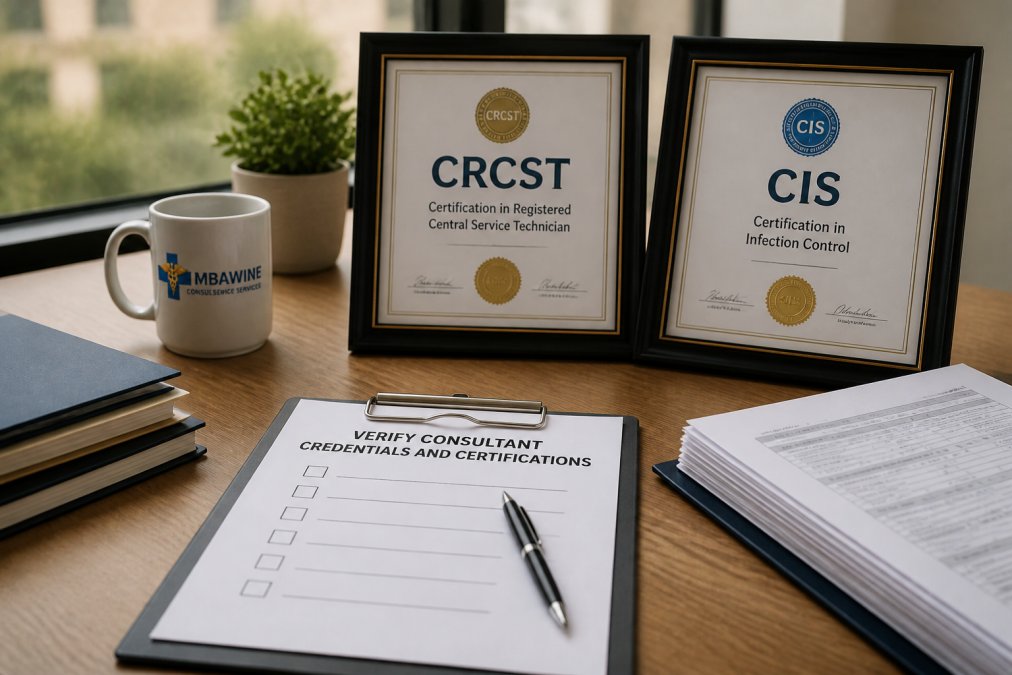
Start by verifying CRCST (Certified Registered Central Service Technician) or CIS (Certified Instrument Specialist) certification through the certifying body. These certifications require documented work experience and passing a comprehensive exam. Ask about current licensure in your state and additional relevant certifications like CHL (Certified Healthcare Leader) or specialized training in surgical services management.
Request references from previous consulting engagements, specifically from facilities similar to yours. Ask whether recommendations were practical, implementation was smooth, and results were measurable. Verify that the consultant carries professional liability insurance.
Ask directly about the consultant's current involvement in sterile processing. Are they still working in a department or consulting full-time? A consultant who maintains hands-on experience understands modern equipment, current regulations, and current staffing challenges better than someone who left the field years ago.
Your staff's certification levels directly impact your department's operational efficiency and compliance. Ask the consultant about their approach to staff development and certification preparation.
Understand their certification preparation methods. Do they offer flexible learning options like audio modules, video content, and web conferencing that fit busy technicians' schedules? Ask about their approach to exam content coverage, practice exams, and addressing common weak areas. Discuss realistic timelines and pass rates rather than unrealistic promises.
Ask whether the consultant will work with your existing staff or bring in outside instructors. If bringing in outside trainers, verify those instructors' credentials and experience. Position certification as part of a comprehensive improvement strategy, not just a checkbox exercise.
Before signing any consulting agreement, understand exactly what you're paying for and what the consultant will deliver.
A clear contract specifies the scope of work. Will they conduct an assessment, provide a written report, develop an improvement plan, oversee implementation, or provide ongoing support? Understand the timeline and specific deliverables, written assessment, improvement plan, staff training, performance metrics.
Ask about the pricing model. Some consultants charge by the day, others by the project. Some offer interim management or certification training with ongoing support. Discuss what happens if you're not satisfied with the work and whether the consultant offers performance commitments. Ask about ongoing support availability after the formal engagement ends.
Understand payment terms and cancellation clauses. Can you structure payments around milestones? What happens if you need to end the engagement early? Understanding these details protects you before you sign.
A sterile processing compliance audit checklist ensures you evaluate consultants systematically.
| Evaluation Area | Key Questions | Priority |
|---|---|---|
| Credentials | Current CRCST/CIS certification? State licensure current? Additional relevant certifications? | High |
| Experience | Years in sterile processing? Facility size experience? Specific expertise areas? | High |
| References | Previous client references available? Similar facility sizes? Measurable results? | High |
| Scope Clarity | Assessment process defined? Deliverables specified? Timeline clear? | High |
| Staff Training | Certification prep approach? Flexible learning options? Track record? | Medium |
| Implementation Support | Will they guide implementation? Measure results? Provide ongoing support? | High |
| Compliance Knowledge | Current regulatory knowledge? State-specific requirements? Accreditation experience? | High |
| Communication | Clear explanations? Responsive to questions? Collaborative approach? | Medium |
| Problem-Solving | How do they handle unexpected issues? Adaptable to your facility? | Medium |
| Cost Structure | Pricing transparent? Payment terms reasonable? Value justified? | Medium |
Use this checklist when interviewing potential consultants. Rate each area based on your conversation. High-priority areas are non-negotiable. Red flags include: a consultant who can't clearly explain their approach, one who makes unrealistic promises, someone who doesn't ask questions about your situation, dismissal of your concerns or existing staff, or inability to provide current references.
The true test of a consulting engagement is whether improvements actually stick and produce measurable results.

Identify specific metrics you'll track before the consultant arrives. What will success look like, reduced surgical delays, faster instrument turnaround, lower staff turnover, fewer compliance issues, improved certifications, increased operating room throughput? Establish baseline measurements before the consultant starts so you can measure improvement afterward.
Ask the consultant how they'll track progress and whether they'll conduct follow-up assessments. Discuss sustainability from the start, what will happen after they leave? Will they provide training materials and document new processes so improvements aren't dependent on any single person? Some consultants offer follow-up assessments at 90 days, 180 days, or one year to help you maintain improvements.
Calculate the financial impact. If the consultant helps you reduce surgical delays, improve compliance, or reduce staff turnover, what's the revenue or cost savings? Document everything the consultant delivers to help you maintain improvements and provide evidence of work done.
Choosing the right sterile processing consultants requires careful evaluation of credentials, experience, approach, and measurable outcomes. At Mbawine Consultants, we understand that selecting a partner to improve your sterile processing department is a significant decision. Our highly credentialed experts bring current CRCST and CIS certifications, hands-on experience in departments like yours, and proven track records of sustainable improvements. We offer flexible learning options including audio, video, and web conferencing for staff certification preparation, interim management support when you need operational expertise, and measurable performance metrics that demonstrate ROI. Get started with Mbawine Consultants and transform your sterile processing department into an efficient, compliant, and high-performing operation that supports your surgical services and your bottom line.
Look for CRCST (Certified Registered Central Service Technician) or CIS (Certified Instrument Specialist) credentials, which demonstrate mastery of sterilization standards and reprocessing protocols. Many consultants also hold CHL (Certified Healthcare Leader) certifications. Verify current certification status through the Certification Board for Sterile Processing and Distribution, and ask for proof of continuing education credits. Active, current certifications indicate the consultant stays updated on regulatory changes and best practices.
Consultants identify workflow bottlenecks, optimize instrument tray turnaround times, and streamline decontamination and sterilization protocols. They assess staffing levels, recommend layout improvements, and implement process standardization. Through operational assessments and change management support, they help reduce surgical delays, lower infection control risks, and increase operating room throughput.
Ask about their experience with facilities similar to yours in size and complexity, their specific approach to gap analysis, and how they handle resistance to change from existing staff. Request references from at least three recent clients and ask about their methodology for staff training and compliance audits. Inquire about their experience with your facility's specific sterilization equipment and whether they offer interim management support. Ask how they measure success and what metrics they track post-consultation to ensure sustainability of improvements.
Track metrics before and after consulting, including instrument tray turnaround time, surgical case delays, staff turnover, and compliance audit scores. Monitor operating room efficiency gains, which often translate to increased surgical capacity and revenue. Calculate staff training costs saved through structured programs and reduced infection control incidents. Request that your consultant establish baseline performance metrics at the start and provide reports showing progress.
This article was written using GrandRanker


