

Feeling confident during a sterilization audit does not depend on having every answer memorized. It comes from following current procedures, knowing where to find relevant evidence, and responding clearly when a question catches you off guard. It is understandable to feel pressure when an auditor reviews your work, especially if you worry that an observation reflects personal failure. An audit is a review of processes and evidence, not a judgment of your worth.
This guide offers practical ways to prepare for audit conversations, respond calmly when you need to verify information, and use feedback to support improvement. You’ll learn how routine workflows and reliable records contribute to readiness, what to say when you’re unsure, and how sterile processing education can reinforce professional knowledge. The goal is a clear response strategy that keeps attention on safe, consistent processes and continuous improvement.
Audit confidence means being able to explain the process you follow, locate relevant evidence, and communicate accurately within the review’s scope. It does not mean guaranteeing compliance or expecting zero findings. No technician should be expected to recall every detail from memory or treat an observation as a verdict on personal worth. An audit examines processes and evidence against the criteria applicable to that review. Its purpose is to assess how work is performed and documented, not to measure an individual’s value.
Consistent daily practice builds a stronger foundation than last-minute memorization. Follow current facility procedures, understand which tasks fall within your role, and know where approved guidance and records are kept. A quick review before an audit can refresh your awareness, but it cannot replace sound routine practice or department direction. The broader meaning of sterilization, distinct from disinfection, is outlined in Sterilization (microbiology). Audit expectations, however, depend on the criteria and facility procedures that apply to the review.
It looks like a calm, factual explanation of the work you perform, supported by approved documentation when needed. If asked to describe a process, explain the steps you’re responsible for and, when appropriate, demonstrate the established procedure as written. Referring to an approved record is responsible practice, not a failure of memory. Confidence also means avoiding speculation: distinguish what you know from what you need to verify, and don’t make claims that go beyond the evidence.
Being observed can make familiar tasks feel unusually exposed, and an unfamiliar question can create pressure to answer immediately. That reaction is understandable, especially when your work contributes to patient safety and must follow established processes. Still, a routine audit is not inherently a punishment. Its scope may cover particular processes or evidence, and an observation may identify a question to clarify or a practice to improve rather than prove personal failure. Department-wide preparation matters too. A broader review of readiness can complement the individual habits built through consistent work and clear communication.
To reinforce that foundation in your daily role:
These habits cannot promise a particular audit outcome, but they give you a professional way to explain what you do and support your answers with evidence. That is the practical basis of feeling confident during a sterilization audit.
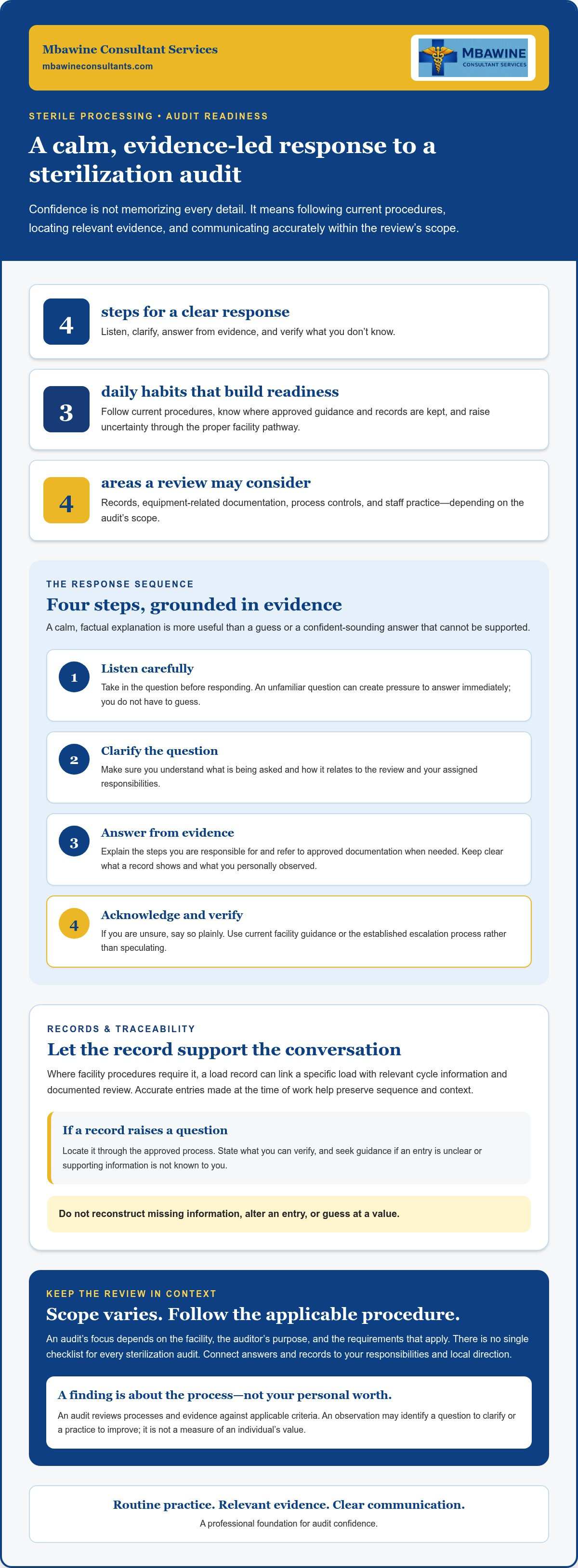
An audit’s focus depends on the facility, the auditor’s purpose, and the requirements that apply to the review. There is no single checklist for every sterilization audit. Depending on its scope and local procedures, a review may consider records, equipment-related documentation, process controls, or staff practice. Focus on the parts connected to your assigned responsibilities and follow facility direction rather than assuming every audit examines every area.
A sterilization load record illustrates how evidence can connect work to a process. Where facility procedures require it, records may link a specific load to relevant cycle information and documented review. Accurate entries made at the time of the work preserve its sequence and context, allowing authorized reviewers to trace what was recorded without relying only on recollection. The information required and how it is recorded or accessed must follow current facility procedures and applicable requirements.
Complete, legible records help show whether required steps were documented. Handle them through approved systems and access procedures. If asked to locate evidence, use the designated recordkeeping process and follow direction about who may retrieve or explain it. Don’t reconstruct missing information, alter an entry, or guess at a value. If a record raises a question, describe what you can verify and use the facility’s established escalation process.
For example, if a question concerns a particular load, locate the appropriate record according to local procedure. Then distinguish what the record shows from what you personally observed. If an entry is unclear or you’re unsure where supporting information is maintained, say so plainly and seek guidance through the proper channel. An accurate answer is more useful than a confident-sounding response that cannot be supported.
An auditor may ask about an assigned task or request a demonstration, depending on the review. Respond within your role, describe the procedure you follow, and refer to current facility guidance or applicable training when needed. References such as The Joint Commission, DNV, CMS, or AAMI matter only when they apply to the facility and audit in question. Don’t assume every organization or review uses the same criteria.
Keep the connection between action and evidence clear. If you perform a task, explain the relevant steps as established locally. If a record or decision belongs to another role, identify the appropriate pathway rather than speaking beyond your responsibility. This helps an auditor understand how staff practice relates to documented controls without turning a question into speculation. For foundational learning, sterile processing classes provide structured educational support alongside facility procedures.
Before responding, consider whether the question concerns your work, a specific record, or a broader departmental process. This distinction helps you answer at the right level and locate appropriate evidence. It also makes feeling confident during a sterilization audit more practical: connect your contribution to the procedures and records that support the work, while leaving broader interpretations to the people responsible for them.
An unexpected question can create pressure to respond immediately, but a brief pause is more professional than a rushed guess. Use this sequence to keep the conversation factual and within your role:
Pause, listen to the full question, and clarify its scope if necessary. Then explain the process you actually follow without adding steps or details you can’t support. For example: “I follow the current procedure for this task. I can show you the approved instruction.” If the question concerns a decision outside your responsibility, identify the person or established channel that can address it.
State the limit plainly: “I’m not certain, and I don’t want to guess. I can refer to the approved record or ask my supervisor.” If you notice a discrepancy, describe what you observed and follow facility procedures for reporting or correcting it. Don’t alter or recreate documentation to make it appear complete. Any later review, correction, or education should follow the authorized process and remain separate from what you can verify during the conversation.
A useful response is grounded in evidence, not just polished wording:
| Response approach | Example | Why it helps or hinders |
|---|---|---|
| Evidence-based | “The procedure I follow is here. I can show you the relevant section.” | Connects the answer to an approved reference without claiming more than it supports. |
| Transparent uncertainty | “I don’t know that detail. I’ll use the facility’s process to verify it.” | Communicates a knowledge limit and identifies a responsible next step. |
| Speculation | “I think we usually do it this way.” | Blurs personal recollection and established procedure. |
| Defensiveness or over-explanation | Arguing about the question or adding unrelated details. | Can obscure the facts the auditor is trying to understand. |
If you discover that your first answer was incomplete, correct it calmly with verified information and follow facility direction about any further action. Feeling confident during a sterilization audit doesn’t mean knowing every answer on demand. It means communicating what you know accurately, acknowledging what you don’t, and taking the appropriate next step.
A personal routine makes preparation manageable without creating a second set of rules. It should reinforce department policy and leadership direction, not replace them. Focus on what belongs to your role: the procedures you use, the records and approved references you may access, and the pathway for raising questions. A review of broader healthcare sterilization standards can add context, while facility procedures remain the working reference for your assigned duties.
Start with the tasks you perform instead of trying to memorize every department process. Revisit current procedures and training relevant to your responsibilities, and make sure you know where approved references and records are maintained under facility policy. If instructions seem unclear or inconsistent with your training, raise the question through an established supervisory or education channel before the audit. That gives the appropriate people a chance to address it through the proper process.
When department leadership permits, a brief practice conversation or mock observation can help you rehearse explaining a familiar task. Keep it grounded in actual procedures: describe what you do, locate the relevant reference, and practise identifying when a question needs escalation. These exercises are optional preparation methods, not a substitute for formal department-wide readiness activities or a universal requirement for every facility.
During the review, carry out the observed task as established, answer within your knowledge and role, and follow facility direction about documentation or access. Afterward, relay observations or questions through approved channels, taking care not to disclose protected information. An observation may prompt clarification, follow-up, or education. It does not automatically establish individual failure. Broader information about healthcare sterilization standards can help put local procedures in context.
Organize your routine into three stages:
Keep the routine proportionate. A focused review of your own responsibilities is more useful than trying to prepare for every possible question or process. This approach supports feeling confident during a sterilization audit while keeping facility policy, leadership direction, and patient safety at the center of your work. To strengthen your professional foundation, enroll in sterile processing classes for structured educational support alongside workplace procedures.
Foundational knowledge helps sterile processing professionals explain why a task is performed as established, recognize when a question needs further review, and communicate within the limits of their role. Education can reinforce consistent practice, but it does not replace facility-specific procedures or guarantee an audit outcome. The procedures and direction applicable to your workplace remain authoritative for your work there.
Different learning approaches serve different purposes. Self-review can help you revisit a specific topic or prepare a question for a supervisor. Facility education can address local procedures, role expectations, and workplace practices. Structured sterile processing classes can support broader foundational learning and certification preparation. These approaches can complement one another. The most useful starting point depends on your learning goals, responsibilities, and the knowledge you want to strengthen.
Additional learning may help when a procedure feels unfamiliar, a knowledge gap persists, responsibilities change, or the same question comes up repeatedly in daily work. Use education to build understanding, then apply it through current facility procedures and appropriate workplace guidance. For broader context on certification preparation, consult CRCST certification information alongside the requirements and direction relevant to your role.
Mbawine Consultant Services offers in-person and online sterile processing classes, including certification preparation and employee education. These classes provide educational support, not a promise of audit results or a substitute for facility training and policies. Consider what you need to learn: a focused review of a topic, reinforcement of workplace expectations, or a more structured foundation in sterile processing concepts. Address workplace-specific questions through your facility’s established education or supervisory channels.
Online and in-person classes offer different ways to engage with instruction. Consider which setting aligns with your learning preferences and goals. Match the subject matter to your current responsibilities or certification preparation needs, and keep facility procedures as the reference for local work. Choose learning that supports practical understanding without overstating what a class can establish.
Professional confidence develops through learning that can be applied thoughtfully: understand the underlying concepts, follow the procedure that governs your work, and recognize when clarification is needed. That combination can support accurate communication and a steadier approach to review, without making any single course a measure of personal worth or audit readiness on its own. To build your knowledge through structured instruction, explore enrollment in sterile processing classes.
Use an audit as a prompt for intentional development, not as a judgment of your worth. Choose one area where deeper understanding would help you communicate or perform with greater assurance, then identify a practical learning step that fits your role and goals. Progress comes from building knowledge over time and applying it thoughtfully within your facility’s procedures.
Mbawine Consultant Services supports professional development through in-person and online sterile processing classes, certification preparation, and employee education. The company also provides sterile processing consulting and interim management to support department operations. These services support learning and operations; they do not promise a particular audit result. If structured education fits your next step, explore sterile processing classes and enrollment.
Feeling confident during a sterilization audit is not about having every answer ready. It is about continuing to strengthen your knowledge, acting responsibly, and being willing to learn. Each deliberate step can help you approach your work with greater clarity and professional confidence.
Yes. Feeling nervous can be a normal response to having your work reviewed, particularly if you’re new to audits or unsure what questions may come up. The feeling doesn’t mean you’re unprepared or that you’ve done something wrong. Before the review, identify a person or approved channel for questions outside your responsibility. This can help you stay focused on the task and communicate clearly.
No. An audit doesn’t necessarily mean the department expects a problem. Reviews may have different purposes, such as assessing a process, checking documentation, or identifying areas for clarification or improvement. The intent and scope depend on the facility and the review. Department leadership can explain why a review is taking place and what staff are expected to do.
An internal quality audit is generally organized within the facility to review its own processes, while an external survey is conducted by an outside organization or evaluator. Their purposes, criteria, and terminology can differ, and “survey” may refer to a particular external review context. Neither label alone tells you exactly what will be examined. Follow facility direction and focus on the scope communicated for that specific review.
Yes. Asking for repetition or clarification helps you answer the question that was actually asked instead of guessing at its meaning. You might say, “Could you clarify which part of the process you’re asking about?” or “Would you repeat the question, please?” Then respond within your role using what you can verify. If the question concerns another responsibility, explain that boundary and use the facility’s established channel for follow-up.
Don’t make an undocumented change or attempt to conceal the original entry. Follow your facility’s approved process for reporting and correcting documentation, and seek direction from the appropriate supervisor if you’re unsure how to proceed. Be clear about what you noticed and when you noticed it. Corrections must preserve the integrity of the record and comply with the applicable facility procedure. Never guess at missing information or backdate an entry.
A new technician can build confidence by becoming familiar with assigned duties, asking questions during training, and learning where relevant workplace guidance is maintained. Practise explaining a task in plain, accurate terms, and identify which questions should go to a supervisor or educator. Structured sterile processing education can strengthen foundational knowledge, while facility-specific instruction remains essential for local procedures. With experience, it becomes easier to distinguish what you know from what needs verification.
Not necessarily. The terms and their significance depend on the review process. An observation may be feedback or a noted concern, while a formal finding may be recorded through the auditor’s established process against applicable criteria. Don’t assume an observation automatically has the same status as a formal finding. Ask your supervisor how the facility documents and follows up on audit feedback, and use that process to understand any responsibilities assigned to you.

Article by
Mba Akuribila
Mba‑Akuribila is a healthcare leader, educator, and founder of Mbawine Consultants, a Bronx‑based institution recognized nationwide for advancing excellence in sterile processing and allied health workforce development. Born in Bongo in Ghana’s Upper East Region, his journey from rural beginnings to national impact reflects a lifelong commitment to service, empowerment, and community advancement.
For over two decades, he has trained sterile processing employees, mentored, and placed thousands of healthcare professionals across the United States. Through Mbawine Consultants, he established one of the country’s most trusted Sterile Processing Certification Test Prep Programs, preparing new Americans and career‑changers for successful entry into the field. The organization, as at 2026, has graduated more than 15,000 sterile processing technicians who now serve in hospitals, ambulatory centers, dental practices, and reprocessing facilities nationwide.
Under his leadership, Mbawine Consultants has expanded into a full Healthcare Staffing Agency, connecting nurses and allied health professionals to meaningful employment opportunities. His team also provides Interim Management Services, supporting hospitals and surgical centers with experienced leaders who stabilize operations, strengthen compliance, and improve workflow efficiency.
As a former surgical technician, sterile processing manager, educator, and system‑wide director, Mba‑Akuribila brings deep expertise to Sterile Processing Consulting, helping healthcare facilities elevate quality, safety, and regulatory readiness.
His work in the United States and Ghana continues to reflect his core philosophy: service above self, opportunity for all, and excellence without compromise.


