

What if the quickest correction to an incomplete set is not the safest one? When an instrument is missing or its identity is uncertain, visual memory alone cannot establish that a tray is complete. Knowing how to fix instrument set assembly errors means following a traceable verification process, not guessing under time pressure.
Assembly teams work under pressure to keep sets moving, but an efficient correction must still include the required checks and documentation. If the set list, facility procedure, and manufacturer’s instructions appear to conflict, pause and use the facility’s escalation process instead of choosing a reference by assumption. This guide explains how to identify the discrepancy, verify the applicable instructions, correct the set, record the action, and decide when further review is needed.
Recurring errors can also point to gaps in process consistency or technician knowledge. Structured sterile processing classes and employee training can reinforce sound assembly practices alongside facility procedures and manufacturer instructions. A repeatable approach helps resolve discrepancies and address conditions that may allow them to recur.
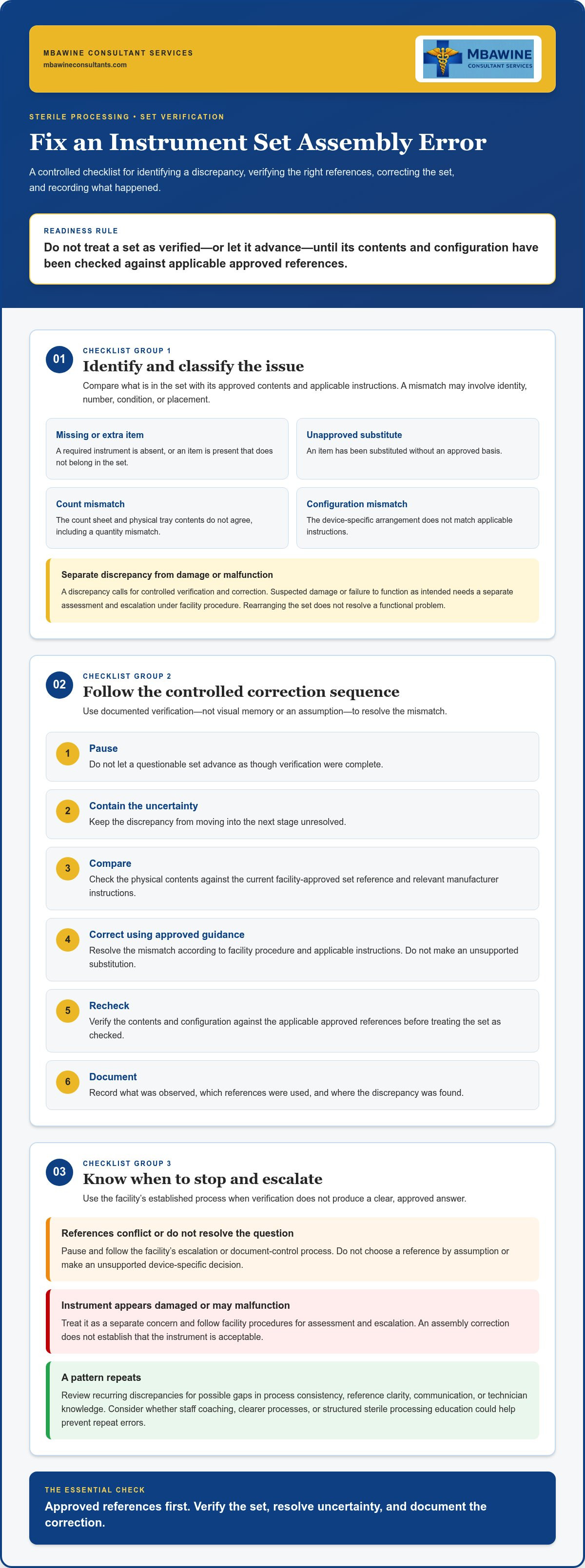
An instrument set is ready to advance only after its contents and configuration have been checked against the applicable approved references. A discrepancy can be easy to miss: an item may be obscured among similar instruments, a substitute may look equivalent, or the count sheet may not match the contents. The receiving team relies on the set to meet procedural requirements, not simply to look complete.
An instrument set assembly discrepancy is a mismatch between the assembled set and its approved contents or applicable instructions. An instrument malfunction is a failure to function as intended. The distinction helps determine the next step. A discrepancy calls for controlled verification and correction. Suspected damage or malfunction requires a separate assessment and escalation under facility procedure. Rearranging the set cannot resolve a functional problem.
Incomplete, incorrect, damaged, or improperly arranged contents can delay confirmation that a set is suitable for use and affect procedural readiness. A set should not be treated as verified simply because it has reached a packing or review stage. Follow facility procedures and the manufacturer’s device-specific instructions, including configuration requirements. If references conflict or do not resolve the question, pause and escalate through the facility’s established process instead of making an unsupported substitution.
An error is an identifiable mismatch between the assembled set and its approved contents or instructions. It may involve an item’s number, identity, condition, or placement. Compare the physical contents with the current approved set reference and relevant manufacturer instructions to distinguish an actual discrepancy from an unfamiliar but permitted configuration.
Visible damage is not merely a count or arrangement issue. If an instrument appears damaged, treat that as a separate concern and follow facility procedures for assessment and escalation. Do not assume an assembly correction makes the instrument acceptable.
Do not let a questionable set advance as though verification were complete. Moving it forward without resolving the mismatch can carry uncertainty into the next stage, where the discrepancy may be harder to identify or correct. Pausing gives staff the opportunity to compare the set with approved references and determine whether the issue involves an omission, identification problem, configuration difference, or suspected damage.
Consistent assembly supports reliable handoffs and gives downstream staff a clear basis for assessing set readiness. It does not establish that every other processing requirement has been met. Each required check remains governed by facility procedure and applicable manufacturer instructions. A systematic approach to how to fix instrument set assembly errors starts with defining the discrepancy, containing uncertainty, and avoiding assumptions about device-specific decisions.
A discrepancy shows what is wrong, but not why it happened. Look beyond the tray itself and consider whether the reference, identification method, workflow, communication, or competency expectations contributed. Treat each factor as a question to investigate, not a conclusion about who is at fault. A missing item might result from an assembly lapse, an outdated count sheet, or an unclear handoff.
Record what was observed, which references were used, and where the discrepancy was found. Reviewing these details across incidents can help distinguish an isolated event from a process condition affecting multiple sets or staff members.
Start with the current facility-approved set list and applicable manufacturer instructions. A generic contents list or familiar routine must not override approved facility documentation. If the set list and count sheet differ, use the facility’s document-control process to determine which reference is current before drawing conclusions or making changes.
Identification can be difficult when instruments have similar shapes or names. Check whether the approved reference provides reliable distinguishing cues, such as a precise instrument name or another facility-approved identifier. The CDC guidelines on sterilizing practices offer broader guidance for healthcare reprocessing. Device-specific decisions still depend on the applicable manufacturer instructions and facility procedures.
Look for revision-related inconsistencies. A count sheet that has not kept pace with an approved set change can prompt repeated mismatches, even when staff follow the version available at their workstation. Record the documents consulted and the discrepancy found so responsible facility personnel can address conflicting or unclear references through the proper process.
Review how the work was performed without assuming that workload or an interruption caused the error. Consider whether the process involved interruptions, competing tasks, an unclear handoff, or uncertainty about who was responsible for final verification. Also check whether staff follow consistent inspection steps or rely on different sequences.
Compare documented observations across occurrences. A single discrepancy may call for focused follow-up. Repeated discrepancies involving the same reference, instrument identification, or workflow step may indicate a broader process issue. Keep notes factual and avoid speculation about intent or competence.
Recurring errors warrant process review as well as individual coaching. When the evidence points to a knowledge gap, structured education can reinforce assembly practices alongside facility procedures and manufacturer instructions. Mbawine Consultant Services offers sterile processing classes and certification preparation. Staff seeking further learning can explore sterile processing education options.
A visual review can help staff notice an obvious omission, misplaced item, or apparent arrangement concern. But it does not, by itself, confirm that every item matches the approved set configuration or that device-specific instructions have been followed. A tray can look orderly while still containing a count mismatch or an incorrect instrument.
Compare informal visual review with a documented check against the facility-approved set reference. The facility’s approved process and applicable manufacturer instructions govern the verification method. A checklist or other verification aid supports that work; it does not replace required inspection, staff competency, or local policy.
During a visual review, staff may spot an empty position, an item that appears out of place, or a visible condition requiring further assessment. Appearance alone may not distinguish similar instruments, confirm quantities, or establish whether a device is configured according to its instructions. Use visual observation as one part of verification, not as a substitute for required documented checks.
An approved count sheet or checklist gives staff a repeatable reference for checking item identity, quantity, and arrangement. It can also record what was reviewed and make discrepancies easier to describe consistently. Before using one, confirm that it identifies the set clearly, reflects approved revisions, and provides a defined way to record exceptions.
| Evaluation area | Informal visual review | Structured verification |
|---|---|---|
| Consistency | May vary with the reviewer and the order of inspection. | Uses an approved sequence or reference to support a repeatable check. |
| Traceability | May leave little detail about what was assessed. | Can document the reference used and the discrepancy found, as facility policy requires. |
| Discrepancy detection | Can reveal visible omissions or arrangement concerns. | Supports item-by-item comparison, including quantity and identification. |
| Dependence on memory | Relies more heavily on familiarity and recall. | Anchors the check to an approved reference, while still requiring staff judgment. |
If a checklist appears outdated, lacks revision control, or does not support clear discrepancy recording, raise it as a process gap through facility channels. Current applicable requirements and facility policy should guide any revision. Structured sterile processing education can reinforce consistent use of references and verification practices. Technicians can explore sterile processing classes as part of professional learning.
How to fix instrument set assembly errors depends on reliable comparison, not on choosing between “looking carefully” and following a checklist. Use visual attention alongside the required structured process, and document findings as the facility requires.
Correcting a discrepancy is not simply a matter of adding or replacing an item. Resolve it within your assigned competency, verify the resulting set, and preserve an accurate record of the action. Facility policy and applicable manufacturer instructions govern device-specific decisions. This sequence supports that process but does not replace local requirements.
Pause, contain, compare, correct, recheck, document, and escalate when needed. Apply the steps in order, following facility procedures.
If correcting the assembly could affect packaging integrity or processing status, do not assume the set can continue through the workflow unchanged. Follow the facility’s established response for the specific condition, including any required assessment or reprocessing steps. The appropriate action depends on local policy and applicable instructions. This guide does not establish universal acceptance criteria or timing.
Keep the record factual and neutral. Describe what did not match, where it was identified, which approved reference informed the review, and what corrective action and recheck were completed. Follow facility policy for reporting and communication. Clear records help designated personnel distinguish an isolated discrepancy from a recurring pattern without assigning blame based on assumptions.
For technicians strengthening their foundational practice, structured sterile processing classes can complement facility procedures and manufacturer instructions. Build your assembly knowledge through formal education by enrolling in sterile processing classes.
A controlled approach to how to fix instrument set assembly errors keeps the correction traceable: resolve the discrepancy, verify the work, record the facts, and escalate unresolved concerns rather than allowing uncertainty to move forward.
Correction resolves the immediate discrepancy. Prevention requires examining whether the same conditions remain for the next set. Review documented occurrences for patterns, including the types of mismatch, references in use, workflow stage where they were found, and reported barriers to verification. A recurring count-sheet mismatch, for example, may call for clarification or controlled revision of the reference. An observed knowledge gap may call for targeted coaching.
Keep individual learning and system improvement distinct, but address both when the evidence supports it. Coaching can reinforce a defined step when an employee needs practice. Process review is necessary when instructions are unclear, approved references are difficult to access, handoffs leave responsibility uncertain, or the same discrepancy appears across staff or shifts. Do not treat a recurring pattern as proof of individual fault.
Assess assembly competency using facility-approved set references and observed practice, not memory-based questions alone. The observation should reflect the approved workflow, including how the technician identifies the set, compares contents, and completes required checks. Document the assessment and any coaching or follow-up according to facility policy. Reassess consistently under the facility’s competency and documentation requirements.
Onboarding and refresher education can reinforce shared expectations, particularly when set references or procedures change. Ensure learning materials align with current facility documents and applicable manufacturer instructions. Education supports staff knowledge; it does not authorize substitutions or replace local procedures. If a reference appears incomplete or inconsistent, route the concern through the facility’s designated process rather than asking individual technicians to resolve document conflicts independently.
Use a practical prevention review to turn findings into specific actions:
This approach supports consistent practice without assuming every error has the same cause. For technicians seeking to strengthen their professional knowledge alongside facility-based training, CRCST preparation can provide a relevant educational pathway. Structured sterile processing education can reinforce foundational assembly knowledge, while facility procedures and manufacturer instructions remain the working references for each set.
Applying this prevention cycle helps teams move beyond repeated correction toward informed improvement. To build your knowledge through sterile processing education, enroll in a sterile processing class.
Each documented discrepancy can inform improvement when teams treat the record as a learning tool rather than a scorecard. Discuss what would make the correct action easier to recognize and repeat, such as clearer access to references, a more consistent handoff, or focused practice with a specific assembly task. Assign follow-up through established facility processes, then use later observations to assess whether the change addresses the identified gap.
This approach keeps attention on professional judgment and the conditions surrounding the work. Technicians can strengthen their knowledge, while leaders can use recurring patterns to identify where communication, workflow, or training needs attention. A disciplined learning culture supports sound practice without treating any single intervention as a guarantee that errors will not recur.
For technicians ready to continue developing their sterile processing knowledge, enroll in sterile processing education. Mbawine Consultant Services offers in-person and online classes, certification preparation, and employee training to support continued learning alongside facility procedures and manufacturer instructions.
There is no universally established ranking of instrument set assembly errors, so the most common issue can vary by facility, set, and workflow. A missing instrument or a mismatch between a tray and its count sheet is a readily identifiable example. Review discrepancy records by set and error type to distinguish recurring omissions from identification, configuration, or documentation problems.
First, follow facility policy to hold the set from advancing while you establish what is missing. Compare the contents with the current approved set reference and applicable manufacturer instructions, then use the facility’s process to obtain or account for the required item. Do not substitute an instrument based on appearance or memory. After an authorized correction, complete the required verification and document the result. These steps are central to how to fix instrument set assembly errors consistently.
Resolve a mismatch under facility policy before treating the set as verified. If the tray contains an item omitted from the count sheet, for example, do not assume the sheet is incomplete or change it informally. Determine which approved reference applies and route conflicting or outdated documentation through the facility’s document-control process. Record the discrepancy as required, and follow local direction on the set’s status while it is under review.
Pause the affected work and use the facility’s escalation pathway instead of interpreting an unclear instruction independently. Identify the set and the specific point of uncertainty, then consult the current facility-approved reference and applicable manufacturer instructions. If those sources conflict or leave the device-specific configuration unresolved, refer the question to the designated supervisor or other responsible personnel. Document the uncertainty and direction received according to local policy so the ambiguity can be addressed.
Document observable facts using the facility’s required reporting method. Include the set identifier, the specific mismatch, where it was detected, the reference used, and the action taken, along with any verification or escalation details required by policy. For example, record that a named item was absent at final review rather than writing a judgment about why it was missing. Clear, neutral records help authorized reviewers evaluate patterns and follow up appropriately.
Repeated discrepancies call for review of both the work process and relevant competency evidence. Compare records to see whether the same item, reference, set revision, or handoff is involved, then route identified concerns through facility channels. Depending on the findings, a recurring mismatch may warrant clarification of an approved document or targeted coaching. Avoid assuming a single cause before reviewing the documented observations.
Structured training can strengthen technicians’ knowledge and support consistent work practices, particularly when paired with observation and facility-based competency checks. It should reinforce, not replace, local procedures and manufacturer instructions. Mbawine Consultant Services provides specialized sterile processing classes in person and online, as well as certification preparation for sterile processing professionals. This education supports continued learning but does not guarantee error-free performance or replace facility-specific instruction.

Article by
Mba Akuribila
Mba‑Akuribila is a healthcare leader, educator, and founder of Mbawine Consultants, a Bronx‑based institution recognized nationwide for advancing excellence in sterile processing and allied health workforce development. Born in Bongo in Ghana’s Upper East Region, his journey from rural beginnings to national impact reflects a lifelong commitment to service, empowerment, and community advancement.
For over two decades, he has trained sterile processing employees, mentored, and placed thousands of healthcare professionals across the United States. Through Mbawine Consultants, he established one of the country’s most trusted Sterile Processing Certification Test Prep Programs, preparing new Americans and career‑changers for successful entry into the field. The organization, as at 2026, has graduated more than 15,000 sterile processing technicians who now serve in hospitals, ambulatory centers, dental practices, and reprocessing facilities nationwide.
Under his leadership, Mbawine Consultants has expanded into a full Healthcare Staffing Agency, connecting nurses and allied health professionals to meaningful employment opportunities. His team also provides Interim Management Services, supporting hospitals and surgical centers with experienced leaders who stabilize operations, strengthen compliance, and improve workflow efficiency.
As a former surgical technician, sterile processing manager, educator, and system‑wide director, Mba‑Akuribila brings deep expertise to Sterile Processing Consulting, helping healthcare facilities elevate quality, safety, and regulatory readiness.
His work in the United States and Ghana continues to reflect his core philosophy: service above self, opportunity for all, and excellence without compromise.


