

Last Updated: September 7, 2026
Earning your sterile processing certification is the most direct route into a stable, in-demand allied health career. The credential most employers recognize is the Certified Registered Central Service Technician (CRCST), awarded after you complete a formal education component, log hands-on clinical hours, and pass a national certification exam. This guide from Mbawine Consultants breaks down the exact sequence of steps, from choosing an accredited program to planning your re-certification.
The path breaks down into six concrete phases: completing an accredited program, fulfilling clinical hours, meeting CRCST exam requirements, preparing for the test, passing it, and maintaining your credential.
Sterile processing certification is the professional credential that validates your ability to decontaminate, inspect, assemble, and sterilize surgical instrumentation safely. Before you enroll anywhere, you need to confirm you meet the baseline eligibility criteria that every accredited program enforces.
You must hold a high school diploma or GED and be comfortable with basic medical terminology and infection control concepts. Most programs also expect you to meet the physical demands of the role, including standing for long shifts, lifting heavy instrument trays, and tolerating warm, humid environments near autoclaves.
You should also verify that the program you choose is accredited. Accreditation directly affects your eligibility for the national certification exam and whether your clinical hours will count toward your credential. A program that lacks proper accreditation can force you to repeat coursework.
Your formal education begins with an accredited sterile processing program that teaches the core competencies of the field. These programs cover the full scope of central service work, including instrument decontamination, sterilization protocols, surgical tray assembly, sterile storage, and aseptic technique.
Most programs blend classroom instruction with supervised lab practice, and many offer flexible online components for the didactic portion. If you are working full-time, look for programs with audio, video, and web conferencing options. Hands-on lab sessions must typically be completed in person at a training facility that simulates a real sterile processing department.
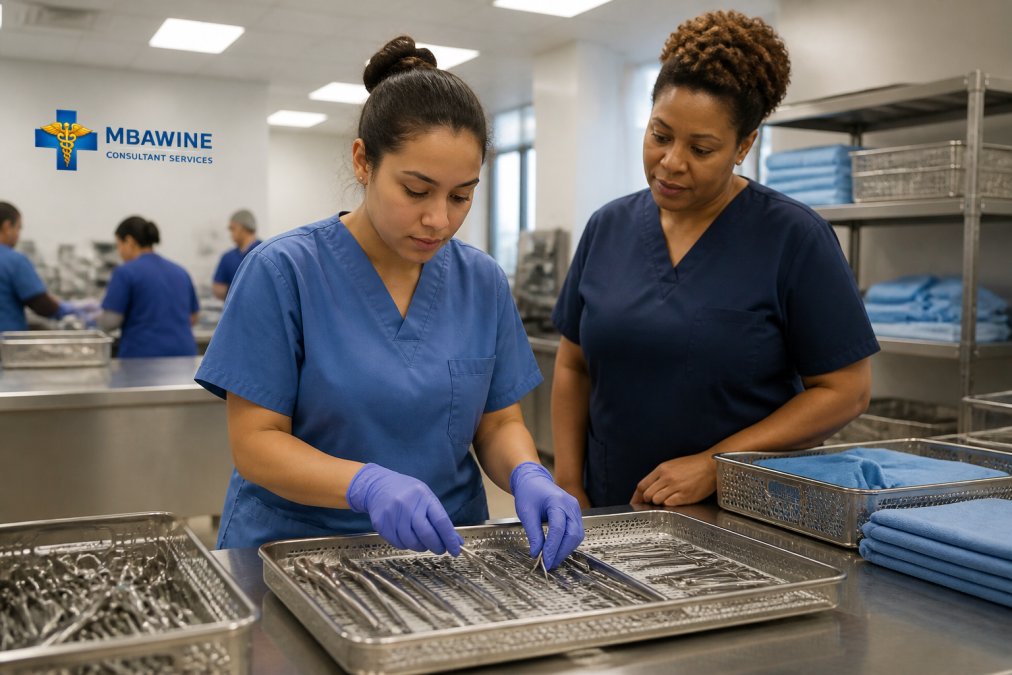
Program length varies, but a common structure runs several months of combined instruction and lab work, covering autoclave operation, biological and chemical indicators, and regulatory compliance standards.
Hands-on clinical experience is where classroom theory becomes practical skill. To qualify for the CRCST exam, you must complete a required number of clinical hours working in a real sterile processing environment under supervision.
These hours are typically completed through a clinical internship or on-the-job training placement arranged by your program, working alongside experienced technicians on decontamination, tray assembly, sterilizer operation, and sterile storage while internalizing PPE and safety protocols.
Treat this phase as an extended job interview, departments frequently hire technicians who impressed them during their rotation.
The CRCST credential is administered by the Healthcare Sterile Processing Association (HSPA), and its exam requirements are specific. To sit for the national certification exam, you must complete an accredited sterile processing program and fulfill the clinical hour requirement through hands-on experience.
The exam is administered at a prometric testing facility, covering decontamination, sterilization protocols, surgical instrumentation identification, infection control, and sterile storage management.
Before scheduling your exam, confirm that your program's accreditation and clinical hours meet the eligibility criteria. The certification body publishes the official requirements, so review them before you commit to a program.
Passing the national certification exam requires deliberate, structured preparation; relying on memory from coursework alone is rarely sufficient. Here is how to build a study plan that mirrors what successful candidates do.
The HSPA publishes a detailed content outline that breaks the exam into weighted domains. Download the outline first, then use it as your checklist. If you can confidently explain each line item in your own words, you are on track.
Your program's textbook is your baseline, but it is not enough. The HSPA offers its own study resources, including a practice exam that mirrors the real test. Many candidates also use workbooks accompanying standard central service textbooks, which often contain application-based questions.
Treat exam prep like a part-time job, dedicating consistent time each week. Break sessions into focused blocks, one day on decontamination, one on sterilization parameters, one on tray assembly, one on practice questions, and reserve the final week for full-length timed exams.
Build dedicated study sessions around infection control and sterilization protocol questions, which require precise knowledge of parameters like temperature and exposure times. Use flash cards to memorize specific numbers, such as minimum steam sterilization temperature or exposure times for chemical indicators.
The computer-based exam typically consists of 150 scored questions plus a few unscored pilot questions, with roughly three hours to complete it. With four-option multiple choice, reading the stem carefully and looking for keywords helps narrow down the correct response.
After your first practice exam, categorize every missed question: misreading or a genuine knowledge gap? For knowledge gaps, re-read the textbook chapter; for misreads, slow down and practice reading questions aloud. This diagnostic approach is far more effective than re-reading the entire textbook.
If balancing preparation with full-time work, look for prep programs with flexible, self-paced modules. The key is consistency over intensity.
On exam day, you will report to a prometric testing facility and complete the computer-based test, which is scored immediately. You will receive your results before you leave the testing center.
If you pass, you earn the CRCST credential, the benchmark most hospitals and surgical facilities require for central service technician positions. With it, you can pursue entry-level roles in hospital sterile processing departments, ambulatory surgical centers, and third-party reprocessing facilities.
If you do not pass on your first attempt, you are typically allowed to retake the exam after a waiting period. Use the score report to identify weak areas and adjust your study plan.
Earning your CRCST is not a one-time achievement. The credential must be maintained through continuing education and periodic re-certification.
HSPA requires certified technicians to earn continuing education units (CEUs) each re-certification cycle to stay current with evolving sterilization technologies, infection control guidelines, and regulatory standards, through workshops, conferences, online courses, and professional development activities.
Planning for re-certification from the start prevents a last-minute scramble. Track your CEU progress and keep documentation of every completed activity. Some technicians also pursue advanced credentials, such as the Certified Instrument Specialist (CIS) or the Certified Healthcare Leader (CHL) for management roles.
| Credential | Focus Area | Best For |
|---|---|---|
| CRCST | Core sterile processing | Entry-level technicians |
| CIS | Surgical instrumentation | Specialists in tray assembly |
| CHL | Department leadership | Technicians moving into management |
Sterile processing offers a stable and growing career pathway within allied health. Certified technicians are needed in every hospital and surgical facility, and the role is fundamental to patient safety.
Phase 1: Student and Clinical Rotator (Months 0-6) During your program and clinical hours, you are a trainee learning to decontaminate instruments, assemble trays, and operate sterilizers under supervision. Departments frequently hire technicians who impressed them during their rotation.
Phase 2: Entry-Level Technician (Years 0-2) Your first job will likely be in a hospital central sterile processing department or ambulatory surgical center, handling decontamination, assembly, and sterilization under a supervisor.
Phase 3: Senior Technician and Specialty Roles (Years 2-5) With experience, you can move into senior technician roles handling complex instrumentation, training new staff, and troubleshooting sterilization issues. Some pursue the Certified Instrument Specialist (CIS) credential to specialize in tray assembly and instrument repair; others move to third-party reprocessing facilities, which offer different scheduling options.
Phase 4: Team Lead and Department Supervisor (Years 5-8) Technicians who demonstrate leadership potential often move into team lead positions coordinating daily workflow and shift assignments. The next step is department supervisor, overseeing staff, budgets, and compliance programs. The Certified Healthcare Leader (CHL) credential signals you have the operational and management knowledge to run a department.
Phase 5: Department Manager and Beyond (Years 8+) At the manager level, you are responsible for the entire sterile processing operation, including staffing, regulatory compliance, and coordination with surgical services. Some managers move into consulting roles or vendor positions with sterilization equipment manufacturers, where their technical expertise is highly valued.
The role involves physical and mental demands. You will be on your feet for most of a shift in a warm, humid environment, lifting instrument trays that can weigh 20 to 30 pounds and handling sharp instruments. The work is repetitive but requires constant vigilance.
Cost is a major barrier for many aspiring technicians, but resources exist. Many hospitals offer employer-sponsored tuition reimbursement, especially if you commit to working at the facility for a set period. Some community colleges and vocational schools offer payment plans, the federal Pell Grant can apply to accredited certificate programs, and some states offer workforce development grants. Before enrolling, ask about scholarships and exam voucher inclusion.
For technicians interested in leadership, the CHL credential, combined with demonstrated operational knowledge, positions you for roles overseeing sterile processing departments, including managing staff, budgets, and compliance programs.
Most candidates complete the process in 4 to 12 months. An accredited sterile processing program typically takes 4 to 6 months of coursework. You then need to finish 400 hours of hands-on clinical experience, which many programs integrate into the curriculum. Once those requirements are met, you can schedule your CRCST exam. Studying for the national certification exam usually takes 4 to 8 weeks. The total timeline depends on whether you study full-time or balance coursework with a job.
Yes, you can challenge the CRCST exam without completing a formal program. You must have a high school diploma or GED and document 400 hours of hands-on sterile processing clinical experience. Many technicians gain these hours through on-the-job training. However, candidates who complete an accredited sterile processing program often feel better prepared for the exam content, including topics like decontamination, sterilization protocols, and surgical instrumentation. Self-study using official preparation materials is also essential for passing without formal schooling.
CRCST stands for Certified Registered Central Service Technician and is the foundational credential for sterile processing professionals. It covers the full scope of central service work, including decontamination, assembly, and sterilization. CIS stands for Certified Instrument Specialist and is an advanced credential focused specifically on surgical instrumentation. After earning your CRCST, you can pursue CIS to demonstrate expertise in instrument identification, assembly, and tray preparation. Many technicians pursue CIS to qualify for higher-level roles and increased pay.
Costs vary based on your chosen path. An accredited sterile processing program can vary in cost depending on the institution. The CRCST exam voucher has a fee, with discounts often available to students who complete accredited programs. You will also need study materials. Some employers reimburse certification costs or offer tuition assistance. Check with local hospitals and training providers for scholarship or financing options before committing.


