

Sterile processing is not merely a technical support function; it is the foundational safeguard of surgical integrity and patient safety within the modern healthcare infrastructure. Obtaining your sterile processing certification represents a rigorous commitment to these clinical standards, yet many aspiring professionals find themselves stalled by the complexities of credentialing. You might feel overwhelmed by the divergent requirements of the Healthcare Sterile Processing Association (HSPA) versus the Certification Board for Sterile Processing and Distribution (CBSPD). This confusion is often compounded by the daunting prospect of completing 400 hours of hands-on clinical experience before achieving full status.
We understand that the path to becoming a Certified Registered Central Service Technician (CRCST) or a CSPDT requires more than just basic study; it demands a structured, academic approach to complex decontamination protocols. This comprehensive guide provides a professional roadmap to help you manage these institutional requirements and secure your role in a high-standard facility. We'll examine specific educational pathways, clarify the logistical hurdles of clinical hours, and outline the long-term trajectory of a career dedicated to medical excellence. By following this methodical framework, you'll be prepared to meet the rigorous demands of the certification exam on your first attempt.
A sterile processing certification is the definitive benchmark for validating a technician's technical competency in the intricate science of medical device reprocessing. It serves as a formal attestation that an individual possesses the specialized knowledge required to navigate the complex decontamination and sterilization cycles that modern surgery demands. The clinical importance of this credential cannot be overstated. There's a direct, measurable link between the expertise of certified professionals and the successful mitigation of healthcare-associated infections (HAIs). As we approach 2026, the industry is witnessing a decisive shift toward mandatory certification in an increasing number of states. This movement reflects a growing institutional recognition that standardized training is non-negotiable for public safety. Beyond immediate compliance, obtaining your sterile processing certification establishes the necessary foundation for advanced career trajectories, including leadership, interim management, and specialized consulting roles within high-standard healthcare systems.
The stakes of surgical instrumentation are absolute. A single failure in the sterilization process can lead to catastrophic clinical outcomes, making the technician's role one of profound consequence. Every instrument set processed represents a silent contract of trust between the sterile processing department and the patient on the operating table. This ethical responsibility requires a deep understanding of microbiology, biofilm formation, and mechanical function. By mastering these protocols, the technician functions as an indispensable guardian within the perioperative team. They ensure that surgical integrity is never compromised by preventable contamination, acting as the final line of defense before an instrument enters a sterile field.
Formal credentialing has fundamentally reshaped the perception of the field, facilitating a transition from what was once viewed as unskilled labor to a specialized healthcare profession. This professionalization directly impacts institutional trust, patient outcomes, and individual salary benchmarks. Facilities increasingly prioritize certified staff to meet rigorous accreditation standards and ensure operational reliability across the board. For those seeking a deeper analysis of these evolving benchmarks, the Healthcare Sterilization: 2026 Professional Standards provides essential context on the institutional expectations for modern practitioners. This recognition isn't just about status. It's about building a sustainable career path that offers long-term stability, professional respect, and the opportunity to lead within the evolving healthcare landscape.
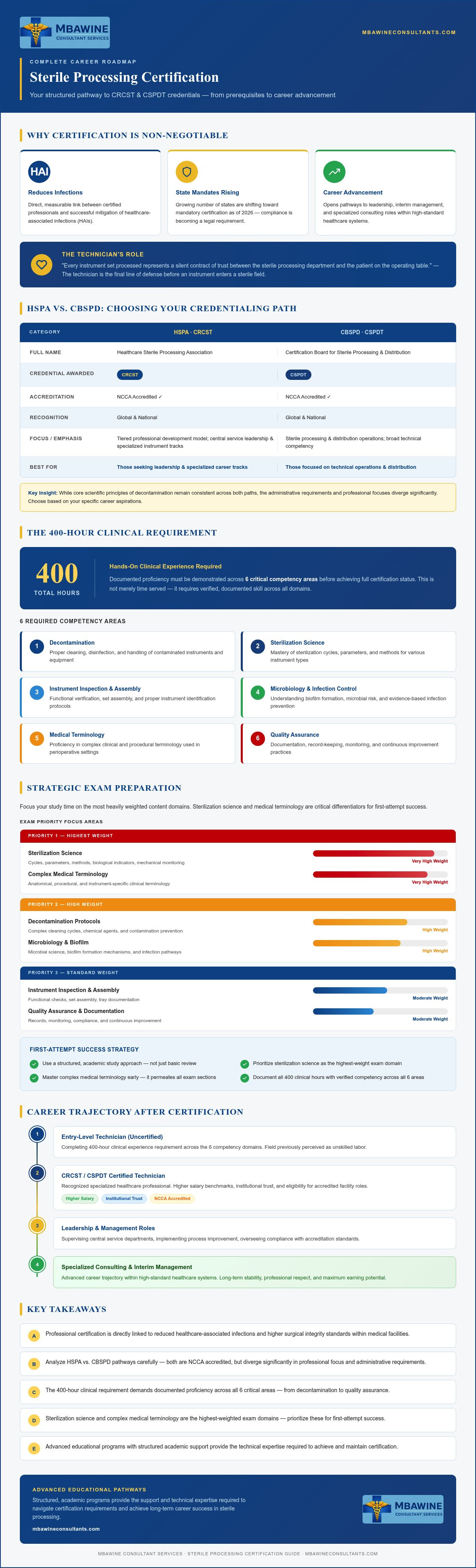
Selecting the appropriate body for your sterile processing certification requires a thorough understanding of the institutional differences between the Healthcare Sterile Processing Association (HSPA) and the Certification Board for Sterile Processing and Distribution (CBSPD). Both organizations are recognized globally and nationally; they maintain accreditation under the National Commission for Certifying Agencies (NCCA) standards. This accreditation ensures that both the Certified Registered Central Service Technician (CRCST) and the Certified Sterile Processing and Distribution Technician (CSPDT) designations meet the highest rigor of professional assessment. While the core scientific principles of decontamination remain consistent, the administrative requirements and professional focuses of these two pathways diverge significantly.
The HSPA emphasizes a tiered professional development model that prioritizes central service leadership and specialized instrument tracks. Its primary credential, the CRCST, is designed for technicians who seek a structured path toward advanced roles. These include the Certified Instrument Specialist (CIS) for those focusing on complex surgical tools or the Certified Healthcare Leader (CHL) for aspiring management professionals. This organization requires an annual renewal process, mandating 12 continuing education (CE) credits to ensure that practitioners remain current with evolving clinical standards. For those seeking detailed academic support, reviewing these CRCST Certification Details will provide a clear framework for exam preparation.
The CBSPD utilizes a competency-based approach for its CSPDT examination. This focuses on the practical application of reprocessing standards across diverse healthcare environments. Unlike the HSPA's annual requirement, the CBSPD operates on a five-year recertification cycle. This requires technicians to accumulate 50 points through various professional activities or by retaking the examination. This longer cycle often appeals to professionals working in specialized clinics or ambulatory surgery centers where departmental structures may differ from large-scale hospital environments. It's a robust alternative that maintains high standards of technical excellence.
Determining which path aligns with your long-term career goals is a critical first step in your professional journey. Both pathways demand a commitment to lifelong learning and technical precision as you pursue your sterile processing certification. Whether you pursue the CRCST or the CSPDT, a structured educational foundation is essential for success. You can enroll in specialized classes today to begin your comprehensive preparation under expert mentorship. This ensures you're not just passing a test but mastering a profession.
Achieving full sterile processing certification through the HSPA requires a rigorous synthesis of theoretical knowledge and documented technical proficiency. The 400-hour clinical requirement is a mandatory prerequisite designed to ensure that candidates have encountered the real-world complexities of a high-volume department before they're fully credentialed. For those who successfully pass the board examination prior to completing their hands-on training, the organization grants a "Provisional Certification" status. This designation is temporary; it requires the technician to complete and submit their verified hours within six months of the exam date to avoid credential forfeiture. This structure reinforces the industry's commitment to ensuring that every certified professional possesses both the academic foundation and the practical skill set necessary for patient safety.
To satisfy these institutional requirements, a candidate must demonstrate competency across six distinct operational domains. These areas represent the complete lifecycle of medical device reprocessing:
Within the decontamination area, technicians must master both manual scrubbing techniques and the sophisticated operation of mechanical washers or ultrasonic cleaners. This phase is critical because it involves the comprehensive removal of bioburden and the management of hazardous materials. Following decontamination, the inspection and assembly of complex surgical sets demand an acute attention to detail. Technicians must verify the mechanical functionality of each instrument before proceeding to the sterilization stage. Technical mastery of various modalities, including saturated steam, Ethylene Oxide (EtO), and hydrogen peroxide plasma, is essential for maintaining the surgical field's integrity.
Standardized documentation is the only mechanism for proving clinical proficiency to credentialing bodies. Technicians should utilize a structured log to track their hours across the six required domains daily. This log must be meticulously reviewed and signed by a Sterile Processing Manager or a designated supervisor. Their attestation serves as a professional guarantee of the candidate's technical skills. For students currently enrolled in Sterile Processing Classes, securing a clinical internship is a vital step toward completing these hours. We recommend proactive communication with local healthcare facilities to establish these educational partnerships early in the training process.
Achieving a passing score on the board exam requires a strategic approach that prioritizes high-weight content areas. The examination isn't a general assessment; it's a specialized evaluation where decontamination and sterilization protocols often account for the majority of the scored content. To successfully navigate the 150-question test, candidates must master the scientific principles behind microbial destruction and the mechanical complexities of reprocessing equipment. It's also vital to develop a high proficiency in medical terminology and basic anatomy. Understanding how a specific instrument interacts with human tissue provides the necessary context for effective assembly and sterilization. We recommend a structured study timeline of 12 to 16 weeks to ensure deep retention of these technical concepts. Relying on professional practice exams during this period allows you to identify specific knowledge gaps before sitting for the actual sterile processing certification board.
While self-study remains an option, the efficacy of formal educational consulting far exceeds independent review for most candidates. Complex subjects like microbiology and infection control require the nuanced explanation that only instructor-led training can provide. These programs bridge the gap between reading a textbook and applying clinical standards in a high-pressure environment. If you're uncertain about your current level of preparation, you should Schedule a Consultation to evaluate your readiness. Expert mentorship ensures that your study efforts are directed toward the most critical regulatory and technical requirements, helping you avoid the common pitfalls that lead to exam failure.
The modern sterile processing certification exam has transitioned from simple rote memorization to sophisticated application-based testing. You'll encounter scenarios that require you to synthesize your knowledge of pH levels, water quality, and sterilization parameters to solve clinical problems. This shift reflects the high-stakes nature of the surgical environment where split-second technical decisions impact patient safety.
Managing the technical complexity of the 150-question computer-based testing (CBT) experience requires both mental stamina and professional focus. We advise candidates to practice under timed conditions to simulate the pressure of the testing center environment. This preparation transforms the examination from a source of anxiety into a formal validation of your professional expertise. To secure your success and ensure you're prepared for the rigors of the field, you can enroll in our comprehensive preparation course today.
Mbawine Consultant Services provides a high-level educational framework that serves as a professional bridge between foundational knowledge and technical mastery. This methodology integrates the academic rigor of in-person instruction with the strategic flexibility of online sterile processing classes. This dual-delivery model ensures that students nationwide can access specialized training that aligns precisely with the latest 2026 healthcare sterilization standards. It’s a systematic approach. By prioritizing a thorough understanding of microbiology and infection control, we prepare our students to meet the rigorous demands of credentialing bodies and foster the deep technical expertise required in modern surgical environments.
Our curriculum focuses on the entire reprocessing cycle, from decontamination to final distribution, while emphasizing strict regulatory compliance. We don't just teach the "how" but the "why" behind every complex protocol. Mbawine consultants serve as seasoned mentors, bringing decades of clinical experience to the classroom. This mentorship is crucial for managing the high-stakes environment of a sterile processing department. To begin your journey toward achieving your sterile processing certification, we invite you to Enroll in Upcoming Classes today.
Obtaining your sterile processing certification is a significant milestone, but it’s only the initial phase of a sophisticated professional trajectory. Mbawine supports its alumni as they transition into advanced roles, including interim management and specialized consulting. The industry's demand for certified expertise has never been higher, particularly as facilities seek to optimize departmental excellence through structured oversight. Our Sterile Processing Consultant Services provide a model for institutional improvement that technicians can eventually lead.
The Mbawine alumni network acts as a professional gateway to national staffing solutions, connecting certified individuals with high-standard healthcare facilities. Whether you're seeking healthcare temp staffing or looking to enter interim management, our platform provides the necessary professional bridge. Our staffing solutions prioritize certified expertise, ensuring that our graduates are positioned in environments where their skills are valued and utilized. This comprehensive ecosystem ensures that your education translates directly into career longevity and leadership opportunities. We're dedicated to your success from the first day of class through your transition into senior professional practice. This commitment to excellence helps our students secure roles in facilities that maintain the highest standards of patient safety and surgical integrity.
Achieving your sterile processing certification represents a profound commitment to the foundational principles of surgical integrity and patient safety within the modern healthcare infrastructure. This professional journey requires a meticulous synthesis of academic knowledge and documented technical proficiency across the entire instrument reprocessing cycle. By navigating the specific requirements of the HSPA and CBSPD credentialing bodies, you'll establish a baseline of excellence that's recognized by high-standard healthcare facilities nationwide. Success in this high-stakes field isn't merely about passing an examination; it's about developing the critical thinking skills necessary to manage the complex decontamination and sterilization challenges of modern medicine.
Mbawine Consultant Services provides the specialized training and expert mentorship required to ensure your success on the first attempt. Our comprehensive online and in-person delivery models are led by authoritative healthcare consultants who are dedicated to the professionalization of the central service field. Secure your future in healthcare—Enroll in our professional Sterile Processing classes today. We're committed to supporting your transition into a specialized role where your expertise acts as a vital safeguard for public health.
The primary distinction lies in the credentialing body and the administrative maintenance of the designation. The Certified Registered Central Service Technician (CRCST) is granted by the HSPA and necessitates an annual renewal cycle alongside 400 hours of clinical experience. Conversely, the Certified Sterile Processing and Distribution Technician (CSPDT) is administered by the CBSPD and utilizes a five-year recertification period. Both pathways for sterile processing certification are accredited under NCCA standards to ensure technical competency.
Most candidates complete their examination at an authorized computer-based testing (CBT) center such as Prometric or Pearson VUE to ensure a secure and standardized environment. While some organizations have explored remote proctoring options, the high-stakes nature of the medical field typically requires physical attendance at a proctored facility. This institutional oversight maintains the integrity of the assessment process and prevents unauthorized access to examination materials during the testing session.
The duration of the certification process varies based on your educational pathway and the speed at which you complete the 400-hour clinical requirement. A structured study timeline generally spans 12 to 16 weeks of academic preparation followed by approximately ten weeks of full-time clinical rotations. Most professionals achieve full status within four to six months. This timeline ensures that you've developed both the theoretical knowledge and the practical proficiency required for surgical safety.
If a candidate doesn't achieve a passing score, they're permitted to retake the examination after a mandatory waiting period, which is typically six weeks for HSPA candidates. You'll be required to submit a new application and remit the associated examination fee for each attempt. We recommend utilizing this interim period to engage in professional sterile processing classes to address specific knowledge gaps and ensure a successful outcome on the subsequent attempt.
The 400 hours of clinical experience aren't strictly required before sitting for the HSPA examination; however, they're mandatory for achieving full certification status. Candidates who pass the exam without their hours are granted a "Provisional Certification" that remains valid for six months. During this timeframe, the technician must document and submit their verified hours to the credentialing body. Failure to complete this requirement within the designated period results in the forfeiture of the credential.
Candidates are required to remit a standardized application fee to their chosen credentialing body to cover the costs of the examination and administrative processing. These fees are established by the HSPA or CBSPD and are non-refundable in most circumstances. It's essential to verify the current 2026 HSPA exam fee structures directly through the official organization handbook, as institutional costs are subject to periodic adjustments based on evolving regulatory and administrative requirements.
Maintenance of your professional credential requires a commitment to lifelong learning through the accumulation of continuing education (CE) credits. HSPA requires the submission of 12 credits annually to ensure practitioners remain current with evolving sterilization technologies and clinical standards. CBSPD utilizes a different framework, requiring 50 points over a five-year recertification cycle. This ongoing professional development is critical for maintaining your status and ensuring the continued safety of the surgical instrumentation you process.
While sterile processing certification isn't currently mandated by federal law across all 50 states, an increasing number of state legislatures are passing statutes that require formal credentialing for all reprocessing technicians. Regardless of local legal requirements, most high-standard healthcare facilities prioritize or exclusively hire certified professionals to meet accreditation benchmarks. This industry shift reflects a broader professional commitment to standardized patient safety through validated technical expertise and rigorous academic training.

Article by
Mba Akuribila
Mba‑Akuribila is a healthcare leader, educator, and founder of Mbawine Consultants, a Bronx‑based institution recognized nationwide for advancing excellence in sterile processing and allied health workforce development. Born in Bongo in Ghana’s Upper East Region, his journey from rural beginnings to national impact reflects a lifelong commitment to service, empowerment, and community advancement.
For over two decades, he has trained sterile processing employees, mentored, and placed thousands of healthcare professionals across the United States. Through Mbawine Consultants, he established one of the country’s most trusted Sterile Processing Certification Test Prep Programs, preparing new Americans and career‑changers for successful entry into the field. The organization, as at 2026, has graduated more than 15,000 sterile processing technicians who now serve in hospitals, ambulatory centers, dental practices, and reprocessing facilities nationwide.
Under his leadership, Mbawine Consultants has expanded into a full Healthcare Staffing Agency, connecting nurses and allied health professionals to meaningful employment opportunities. His team also provides Interim Management Services, supporting hospitals and surgical centers with experienced leaders who stabilize operations, strengthen compliance, and improve workflow efficiency.
As a former surgical technician, sterile processing manager, educator, and system‑wide director, Mba‑Akuribila brings deep expertise to Sterile Processing Consulting, helping healthcare facilities elevate quality, safety, and regulatory readiness.
His work in the United States and Ghana continues to reflect his core philosophy: service above self, opportunity for all, and excellence without compromise.


