

A staffing gap is not solved by asking the remaining team to absorb every task. Knowing how to handle a sudden SPD staffing shortage means setting clear priorities, bringing in temporary support where it fits, and assigning additional duties only to employees trained to perform them. Cross-training can widen the team’s response options and reduce reliance on a single person for essential work.
Filling uncovered shifts may be the first concern, but the response also needs to protect employees already carrying the department’s workload. Clear communication, realistic assignments, and support for breaks help staff stay focused while leaders address the shortage.
This article explains how temporary staffing can ease immediate pressure, how employee engagement can support retention, and how deliberate cross-training can prepare a team for added responsibilities. It also looks at why shortages can develop quickly, so department leaders can address urgent gaps and strengthen their longer-term staffing plans.
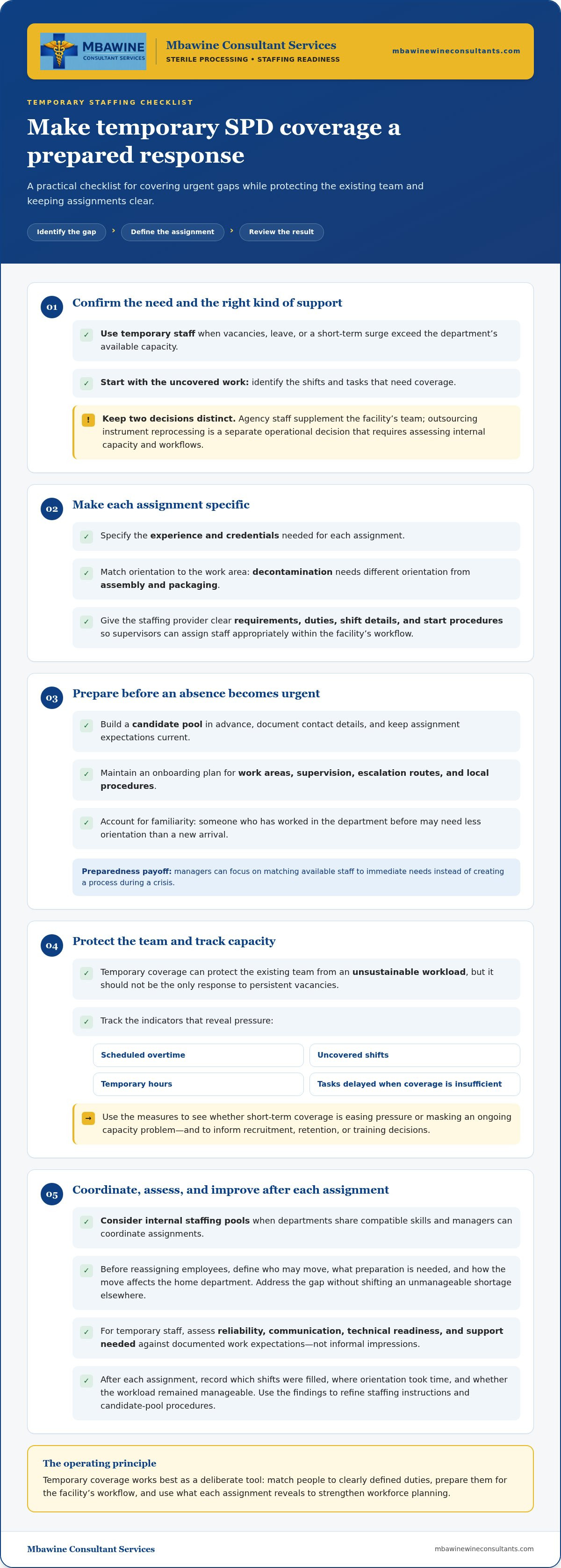
Use temporary sterile processing staff when vacancies, leave, or a short-term surge exceed the department’s available capacity. Outsourcing instrument reprocessing is a separate operational decision: assess whether internal capacity and workflows can support the work. Agency staff, by contrast, supplement the facility’s team within its staffing model.
Start by identifying uncovered shifts and tasks, then specify the experience and credentials needed for each assignment. A technician assigned to decontamination needs different orientation from one supporting assembly and packaging. Give the staffing provider clear requirements, duties, shift details, and start procedures. Specific instructions help temporary staff learn the facility’s workflow and enable supervisors to assign each person appropriately.
Do not wait for an urgent absence to establish a staffing relationship. Build a candidate pool in advance, document contact details, and keep assignment expectations current. Someone who has previously worked in the department may need less orientation than a new arrival. Maintain a practical onboarding plan covering work areas, supervision, escalation routes, and local procedures. Managers can then focus on matching available staff to immediate needs instead of creating a process during a crisis.
Temporary coverage can protect the existing team from an unsustainable workload, but it should not be the only response to persistent vacancies. Consider overtime and temporary staffing as separate parts of the plan. Track scheduled overtime, uncovered shifts, temporary hours, and tasks delayed when coverage is insufficient. These measures show whether short-term coverage is easing pressure or masking an ongoing capacity problem, and can inform decisions about recruitment, retention, or training.
Some hospital and health systems create internal staffing pools to temporarily reassign employees during peak demand. This can provide another source of coverage when departments share compatible skills and managers coordinate assignments. Define who may be reassigned, what preparation they need, and how the move affects their home department. A transfer should address a genuine workload gap without shifting an unmanageable shortage elsewhere.
Temporary assignments can also help evaluate potential future employees. Supervisors can assess reliability, communication, technical readiness, and the support a worker needs to perform assigned duties. If a substitute fits the team and the facility has an ongoing vacancy, that experience may inform hiring decisions. Base assessments on documented work expectations, not informal impressions.
Review the coverage plan after each assignment. Record which shifts were filled, where orientation took time, and whether the workload remained manageable. Use the findings to refine staffing instructions and candidate-pool procedures. Preparation makes temporary staffing a deliberate tool during a sudden shortage, rather than an improvised substitute for workforce planning.
No single headcount or workload benchmark fits every sterile processing department. Set local expectations by comparing surgical demand, instrument volume and complexity, available staff, and sustainable productivity. Revisit those measures when case volume or work mix changes instead of treating historical staffing levels as permanent standards.
During a shortage, explain what has changed, which tasks take priority, and how leaders are addressing the gap. Give employees specific information, such as which work can be deferred and who will reassess assignments during the shift. Clear updates reduce uncertainty and help the team coordinate around patient-care needs without implying that every task can proceed at its usual pace.
Protect work-life balance through practical scheduling. Review overtime distribution, consecutive demanding shifts, missed breaks, and requests for schedule adjustments. Encourage staff to take available breaks and avoid relying on the same employees for every extra assignment. A brief daily check-in can reveal when someone is becoming overwhelmed, before fatigue affects concentration or their willingness to stay in the department.
Match employees to duties they can perform competently, rather than assigning work simply to fill a gap. Before reallocating tasks, supervisors can review each person’s demonstrated skills, current responsibilities, and need for guidance. If an employee is not prepared for a function, keep it with a qualified colleague and identify an appropriate training path. This builds capacity without treating unfamiliar duties as interchangeable.
Use regular one-on-ones to discuss workload, morale, and barriers to completing assigned work. Ask focused questions: Which part of the shift feels least manageable? What change would make the work more sustainable? Record recurring concerns, agree on a practical follow-up, and revisit it. Make recognition specific by acknowledging a colleague’s contribution to a difficult shift or a team’s coordination around changing priorities.
When employees leave, ask what influenced their decision and look for patterns in their responses. Scheduling strain, limited development, unclear expectations, and insufficient management support may call for different retention actions. Keep conversations respectful and use common themes to guide department changes, not to pressure departing staff. Stay interviews with current employees can surface similar concerns while there is still time to respond.
Development can also strengthen engagement when employees see a path to expand their skills and responsibilities. Identify learning goals during performance conversations, then align them with department needs and available supervision. Explore structured sterile processing learning as one way to support professional development. Track whether agreed actions improve workload concerns, participation, and employees’ willingness to remain with the team.
There is no universal minimum staffing level or workload benchmark for sterile processing departments. Set local expectations using surgical demand, instrument volume and complexity, available staff, and sustainable productivity. Reassess them when case volume or work mix changes.
Added hours cannot replace preparation. Before extending a shift or reallocating duties, identify the tasks that need coverage and match them to employees’ demonstrated skills. A technician familiar with decontamination may still need guided practice before taking on another processing stage. Clear assignments and access to a knowledgeable mentor help staff know when to proceed and when to seek support.
There is no single staffing benchmark for every sterile processing department. In states that require sterile processing technician certification, training programs help candidates meet that requirement. Align competency preparation with applicable state requirements and facility procedures, then document the training and assessment relevant to each assigned task.
To prioritize instrument sets and urgent cases, coordinate with surgical teams and use current case demand, scheduled procedures, and set availability to guide sequencing. Identify time-sensitive needs first, communicate changes to affected departments, and reassess priorities as the schedule shifts. This keeps the team focused on work that directly supports planned patient care.
Build competency through instruction, demonstration, and repeated practice. Simulation and hands-on learning can help technicians rehearse decontamination, instrument-set handling, and tray assembly and wrapping. A mentor can observe performance, give specific feedback, and identify where more practice is needed. Cross-train employees after hiring, but assign new responsibilities only after appropriate preparation and assessment.
Preparation must continue as procedures and surgical techniques change. Schedule regular training when new instruments or workflows affect sterile processing tasks, and communicate revised procedures to employees before they encounter them during a demanding shift. A brief demonstration followed by supervised practice gives staff an opportunity to clarify steps and apply feedback.
For workforce planning, identify employees who could build skills for high-need tasks and create professional development paths. Career lattices can help entry-level workers see opportunities for continued growth in healthcare. Pair development with mentoring and clear learning objectives. Training connected to real department needs can support both capability and retention.
Emergency staffing preparedness depends on having a usable plan before an absence occurs. Keep role expectations, orientation materials, escalation contacts, and shift priorities accessible to supervisors. When additional staff arrive, explain the workflow and who provides oversight. Consider software, automation, or training to support a short-staffed team, while assessing whether each option fits the department’s actual tasks.
After a high-pressure period, review which duties required extra supervision and where coverage remained difficult. Use those observations to update training plans, mentorship assignments, and emergency procedures. These steps prepare staff for added responsibilities without confusing coverage with competency.
A sudden vacancy can expose how little staffing margin an organization has. An absence, resignation, or unexpected leave can reduce coverage before recruitment or reassignment takes effect. For example, a team of eight lost half its members within one week. Such a rapid change can leave experienced employees managing unfamiliar workload patterns while routine work continues.
A vacancy may take months to fill, followed by months of onboarding. A department can therefore remain below its funded headcount even when its staffing plan appears complete on paper. Leaders should compare actual capacity with surgical demand instead of relying only on historical staffing levels. This review can show whether the shortage stems from open roles, lengthy onboarding, increased demand, or several causes at once.
Turnover can become self-reinforcing. Healthcare professionals have reported leaving positions because they feel overworked and burned out. When departures leave fewer people to handle the same workload, pressure on remaining staff can grow, making retention harder. Approximately three in ten healthcare workers considered leaving the medical profession. Treat repeated absences, persistent overtime, and departure patterns as signals to examine workload and workplace practices.
Delays in instrument processing can reduce the sets available for scheduled procedures and force operating room teams to reconsider case timing. Fewer SPD staff also limit the department’s ability to complete work at the planned pace. Communicate capacity limits early, since late notice leaves less time to adjust schedules and coordinate priorities.
Use a consistent update process with operating room teams. State which sets are ready, which cases may be affected, and when the next update will arrive. If a required set is not yet available, explain the constraint and share its expected readiness based on the department’s current work queue. Update the information as processing progresses or case priorities change. Do not present an estimate as a confirmed completion time.
Turnover has organizational costs beyond the immediate vacancy. Examine why employees leave rather than treating each departure as an isolated hiring problem. Review exit feedback alongside workload, overtime, vacancies, and onboarding demands to identify recurring conditions managers can address.
When a shortage forces reduced capacity, leaders may need to decrease production, reduce hours, or limit services. Make operational adjustments clear to affected teams and explain which work remains a priority. A prompt review of demand, available staff, and delayed tasks helps managers communicate the department’s limits and plan a more sustainable response.
To decide how to handle a sudden SPD staffing shortage, start with a same-shift capacity review. The SPD lead should compare trained staff on hand with scheduled work, urgent requests, and the current queue. Identify which tasks must continue, which can wait, and where coverage is missing. Share the priority plan with the operating room and other affected teams, then update it as staffing or demand changes.
Assign work according to demonstrated competence, not simply availability. A supervisor can map employees to tasks they are prepared to perform and note where oversight is needed. Do not place someone in an unfamiliar role without appropriate instruction. If an employee can support one workflow stage but not another, assign the task they are prepared for and keep other duties with qualified staff.
Use cross-functional collaboration to ease pressure when colleagues can take on appropriate support tasks. Agree on the work, boundaries, and reporting route before assigning it. For example, a partner department may coordinate requests or relay status updates, while trained SPD staff retain responsibility for technical processing. This offers practical support without treating distinct roles as interchangeable.
Give temporary staff explicit instructions at the start of an assignment. Explain the work area, expected duties, local workflow, supervisor, and escalation process. Provide relevant procedures and clarify how to report a delay or uncertainty. A named point of contact helps temporary workers resolve questions and keeps supervisors informed about coverage gaps.
Create backup coverage for critical roles. Identify positions where an absence could interrupt essential workflow, then designate a primary and secondary backup. Document who can cover each function and what preparation they need. Review the plan during the shift, since a designated backup may already be handling another priority when a new gap appears.
Keep a concise, current record of staffing, workload, delayed tasks, and decisions. A shared shift log can show who owns each priority, what remains incomplete, and when leaders last reviewed capacity. Use it during handoffs so the next supervisor can understand the situation without piecing together separate conversations. The record can also help distinguish a temporary backlog from a recurring workflow problem.
A written playbook clarifies how to handle a sudden SPD staffing shortage when coverage and priorities change during a shift. At shift end, compare planned priorities with completed work, assign an owner to unresolved tasks, and communicate relevant status changes to affected teams. If immediate coverage exposes a recurring competency gap, include it in the department’s training plan. Explore sterile processing classes to support structured skills development alongside the immediate staffing response.
Mbawine Consultant Services offers Sterile Processing classes for professionals and facilities seeking structured learning to support workforce development. When a staffing shortage reveals skill gaps or a need to prepare employees for new responsibilities, classes can complement the department’s training and competency plans. The right next step depends on the facility’s needs: strengthen staff knowledge, add temporary coverage through Healthcare Temp staffing, or address broader operational challenges through Healthcare Sterile Processing Consulting or Interim Management.
These services support different parts of a staffing response, from professional development to workforce and management needs. Consider them when planning future coverage or seeking support beyond immediate shift assignments. Contact Mbawine Consultant Services to discuss your department’s needs.
The next staffing gap may arrive before a department can revise its plan. Use each shortage to identify where decisions slowed, which roles lacked backup, and what information teams needed sooner. Assign responsibility for keeping response steps current. A designated owner can help ensure staffing contacts, competency records, and communication practices remain useful as schedules and personnel change.
Knowing how to handle a sudden SPD staffing shortage means more than filling an immediate shift. It also means building a workforce that can respond without relying on unprepared employees. Set a specific next step for your department, such as reviewing role coverage or identifying a development priority. Mbawine Consultant Services offers Sterile Processing classes, Healthcare Temp staffing, and Interim Management to support workforce and operational needs.
Connect with Mbawine Consultant Services about your department’s needs. A deliberate next step can help your team strengthen readiness and sustain its work.
Cross-training gives a department more options when a shift or workflow loses coverage. A skills matrix, for example, can show which trained employees can support specific tasks, helping supervisors assign work without relying on one person. It also helps employees understand how their tasks connect across the department. Review the matrix regularly so it reflects current competencies, not just completed training.
Start by matching the proposed assignment to the employee’s demonstrated skills and orientation. Introduce unfamiliar tasks through instruction and supervised practice, then document the competencies assessed before assigning independent work. For redeployment, clarify the employee’s role, supervisor, and escalation process before the shift begins. A hospital can use a task-specific skills record to distinguish work an employee has observed from work they’re prepared to perform.
For temporary staffing, costs depend on required credentials, shift pattern, assignment duration, and coverage scope; pricing is provided after a quote request. Turnaround depends on candidate availability, role fit, scheduling, and facility onboarding. Outsourced reprocessing costs and timing depend on the work scope, instrument volume, and logistics. Define required tasks and expected workflow before comparing options so the estimate reflects the actual need.
Managers can monitor overtime distribution, unfinished work, and handoff quality together, rather than treating hours worked as the only signal. Set a clear escalation point for an employee who cannot complete assigned work safely or needs additional guidance. Use a shift handoff record to identify outstanding tasks and ownership. These steps help supervisors intervene early and avoid adding duties without considering existing assignments.
Start with the facility’s internal float pool, existing substitute roster, and relationships with sterile processing training programs. These resources can help leaders identify candidates familiar with local workflows. Mbawine Consultant Services provides Healthcare Temp staffing and 24/7 Emergency Staffing nationally, giving facilities another resource to consider for staffing needs. Prepare role requirements and shift details so the coverage request is clear.

Article by
Mba Akuribila
Mba‑Akuribila is a healthcare leader, educator, and founder of Mbawine Consultants, a Bronx‑based institution recognized nationwide for advancing excellence in sterile processing and allied health workforce development. Born in Bongo in Ghana’s Upper East Region, his journey from rural beginnings to national impact reflects a lifelong commitment to service, empowerment, and community advancement.
For over two decades, he has trained sterile processing employees, mentored, and placed thousands of healthcare professionals across the United States. Through Mbawine Consultants, he established one of the country’s most trusted Sterile Processing Certification Test Prep Programs, preparing new Americans and career‑changers for successful entry into the field. The organization, as at 2026, has graduated more than 15,000 sterile processing technicians who now serve in hospitals, ambulatory centers, dental practices, and reprocessing facilities nationwide.
Under his leadership, Mbawine Consultants has expanded into a full Healthcare Staffing Agency, connecting nurses and allied health professionals to meaningful employment opportunities. His team also provides Interim Management Services, supporting hospitals and surgical centers with experienced leaders who stabilize operations, strengthen compliance, and improve workflow efficiency.
As a former surgical technician, sterile processing manager, educator, and system‑wide director, Mba‑Akuribila brings deep expertise to Sterile Processing Consulting, helping healthcare facilities elevate quality, safety, and regulatory readiness.
His work in the United States and Ghana continues to reflect his core philosophy: service above self, opportunity for all, and excellence without compromise.


