

Last Updated: September 14, 2026
Implementing sterile processing infection control starts with four things: a written gap analysis, current standard operating procedures, a trained observer, and executive sign-off on staff time. Without all four, most departments stall at documentation and never reach practice change.
Sterile processing infection control is the system of policies, zoning rules, monitoring, and staff competency checks that prevent contaminated surgical instruments from reaching patients.
Here's what to have in hand before Step 1:
The first step is to walk the physical path a contaminated instrument takes, from the operating room door to sterile storage, and write down every handoff. Most departments find at least one point where clean and dirty items share space or air.
Start at the decontamination room. Follow the tray through manual cleaning, ultrasonic cleaning, and thermal disinfection. Note where personal protective equipment is donned and doffed, and whether that boundary holds during a busy shift.
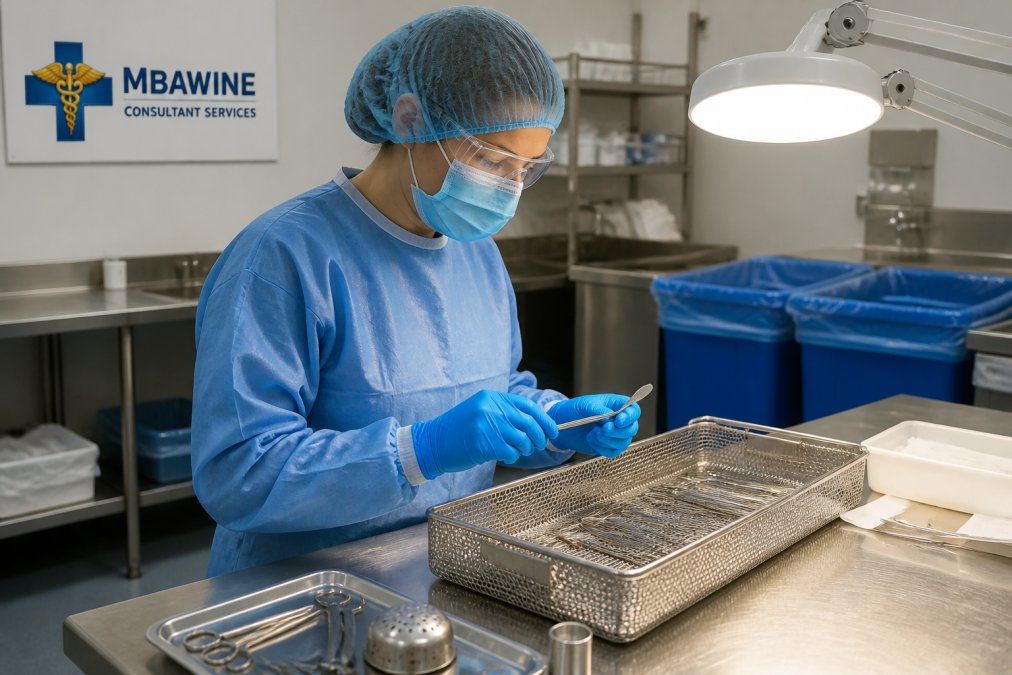
Then move to the preparation and packaging area. Watch how instrument tray assembly is verified, what packaging materials are used, and whether chemical indicators are placed correctly. Finish in sterile storage, checking storage conditions and shelf-life labeling.
Write the map as a simple flow, not a narrative. You'll use it as the backbone of your audit checklist in Step 2.
An SPD infection control audit checklist is a scored list of observable conditions and practices, reviewed on a fixed schedule, with results tied to corrective action. It converts your workflow map into something a supervisor can verify in 20 minutes.
Build the checklist around what you can see, not what you assume. Each item should be answerable yes or no by someone standing in the room. Where the item depends on a monitoring result, tie it to the specific indicator or test, not a vague "sterilizer passed."
| Frequency | Audit Item | What to Check |
|---|---|---|
| Daily | PPE compliance | Mask, eye protection, gloves, gown at decontamination |
| Daily | Zone separation | No clean items in the dirty zone, doors closed |
| Daily | Chemical indicator check | External CI on every package; internal CI inside every tray |
| Daily | Load release | Physical monitors (time, temperature, pressure) recorded before release |
| Weekly | Ultrasonic cleaning test | Cavitation test result logged |
| Weekly | Detergent efficacy | Concentration and temperature within range |
| Weekly | Sterilizer cleaning | Chamber drain strainer and interior inspected |
| Monthly | Biological indicators | Spore test results for every autoclave, incubated per manufacturer instructions |
| Monthly | Staff competency | Spot-check instrument inspection technique |
| Monthly | Documentation review | Logs complete, signed, and dated |
A checklist that only asks "did the autoclave pass?" misses the mechanics that surveyors probe. Build these into the items:
Most guides stop at the checklist. The practical value is in what you do when an item fails. Build a short corrective-action line into each row so the supervisor knows the next step without escalating:
The checklist is not a compliance artifact, it is the front end of a corrective-action loop. A checklist that does not name the fix for each failure just documents the problem.
AAMI standards for sterile processing are the technical baseline your checklist should mirror. The most relevant documents are the ST79 family for steam sterilization and sterility assurance, ST55 for table-top sterilizers, and ST58 for chemical sterilants and high-level disinfection. The comprehensive guide to reprocessing reusable medical devices sits alongside them as the umbrella reference.
You don't need to memorize every clause. You need to know which standard governs each step in your workflow and be able to point to it during an audit. Cross-reference your checklist items against the standard that covers them.
For a deeper reference, the AAMI standards and guidance library publishes the current editions and revision schedules.
Four requirements from these standards that departments routinely miss:
The standards require traceability, the ability to connect a sterilizer load to the items that went through it and, if needed, to the patients who received them. Paper logs make that traceability slow and error-prone.
A basic instrument tracking system can capture sterilizer cycle data automatically, flag missed biological indicators, and tie each tray to its load record. Barcode scanning at each handoff removes the guesswork about which tray went through which cycle. That is not a replacement for the standards, it is the mechanism that makes compliance with them auditable in minutes instead of hours.
Start small. Automate one thing first: sterilizer cycle logging. Once that is reliable, add tray-level tracking, then staff competency reminders. Departments that try to digitize everything at once usually abandon the project halfway through.
Sterile processing staff training programs work best when they're short, repeated, and tied to a competency check. A single annual session does not change behavior on the floor.
Break training into modules that match your workflow: decontamination and PPE, manual and ultrasonic cleaning, instrument inspection, tray assembly and packaging, sterilization monitoring, and sterile storage. Deliver each module in 20 to 30 minutes, then observe the technician performing the task.
Documentation is where most programs fall apart. For each technician, keep a dated record showing the module completed, the observer's name, and the result.
Mbawine Consultants builds these programs around flexible audio, video, and web-conferencing modules, which matters for technicians working 12-hour shifts who cannot attend in-person sessions. Their instructors hold current certifications.
Digital tracking replaces paper logs with timestamped, searchable records.
Even a basic system can capture sterilizer cycle data automatically, flag missed biological indicators, and alert a supervisor when a competency check is overdue. Barcode scanning at each handoff removes the guesswork about which tray went through which cycle.
Start small. Automate one thing first: sterilizer cycle logging. Once that's reliable, add tray-level tracking, then staff competency reminders. Departments that try to digitize everything at once usually abandon the project halfway through.
Compliance failures cluster around a handful of recurring causes. Fixing them is less about new equipment and more about removing the reason staff cut corners.
The four failures we see most often:
If your department has had past compliance issues, an outside review can help without turning into a blame exercise. Mbawine Consultants provides interim management and staffing support for facilities that need to fix problems while keeping the department running.
The mistakes that derail sterile processing infection control programs are predictable.
Treating training as a one-time event is the biggest one. Competency drifts, especially with new hires and float staff, and annual refreshers don't catch it.
Second, ignoring the infection preventionist until an audit. Bringing them in early, during checklist design, saves rework and builds the collaboration regulators expect to see.
Third, buying software before fixing the process. Automation amplifies whatever workflow you already have, including a broken one.
Fourth, letting documentation lag behind practice. If the log doesn't match what happened on the floor, the log is a liability, not a defense.
For teams that need credentialed expertise on demand, Mbawine Consultants offers needs assessment and operational support for surgical and ambulatory-surgical facilities, alongside certification preparation for technicians moving into leadership roles.
Sterile processing infection control only holds when the workflow, the checklist, and the training reinforce each other. Most departments already know the standards; the gap is in consistent execution across every shift. Mbawine Consultants helps close that gap with credentialed instructors, remote learning modules built for working technicians, and interim management support for facilities that need to fix compliance issues without disrupting surgery schedules. Get started with Mbawine Consultants and build a sterile processing infection control program your whole team can sustain.
The five core principles are hand hygiene, personal protective equipment, environmental cleaning and disinfection, safe handling of surgical instruments, and waste segregation. In sterile processing, these translate to specific actions: washing hands before and after each tray, wearing gloves and gowns in decontamination, cleaning surfaces between cases, inspecting every instrument for bioburden, and separating contaminated items from clean ones. Each principle supports the others, and skipping one weakens the entire sterile processing infection control chain.
A working SPD infection control audit checklist covers six areas: decontamination room temperature and humidity logs, ultrasonic cleaner and washer-disinfector test results, instrument inspection records, sterilization cycle parameters including autoclave temperature and pressure, biological and chemical indicator results, and sterile storage conditions. Add a section for personal protective equipment compliance and hand hygiene observations. Review the checklist daily for critical items and monthly for documentation. Update it whenever AAMI standards for sterile processing change.
AAMI standards set the technical benchmarks that regulators and accreditors expect sterile processing departments to meet. They cover cleaning validation, packaging materials, sterile barrier system performance, sterilization cycle verification, and storage conditions. Following them is not optional if you want to pass a survey. Start by identifying which AAMI documents apply to your department, then build your standard operating procedures around their requirements. Document everything, because surveyors ask for evidence, not intentions.
Training fixes the gap between written policy and daily practice. Effective sterile processing staff training programs combine hands-on competency checks with written tests, covering instrument inspection, tray assembly, sterilizer loading, and PPE donning and doffing. Retrain whenever a new instrument set arrives or a compliance audit finds a repeat failure. Track completion dates and scores per technician so you can spot who needs coaching before a surveyor does. Refresher training every 12 months keeps skills current.


