

A defensible case for how to justify new sterilization equipment connects measured instrument demand and capacity gaps with operating costs, expected lifespan, and infection-prevention needs. Show how the equipment would address documented workflow constraints and support consistent, traceable processing. The case should rest on operational evidence, not the purchase alone.
It is understandable to focus first on the upfront cost, but that figure alone cannot show whether an investment is justified. A sound assessment considers the demands on the current process and the practical effects of its capacity, maintenance needs, and performance over time.
This article explains how to assess daily and peak instrument volumes, capacity and cycle flexibility, utilities and consumables, maintenance and lifespan, and infection-prevention priorities. It also shows how to bring those factors together in a clear, evidence-based investment case, including for laboratory sterilization needs.
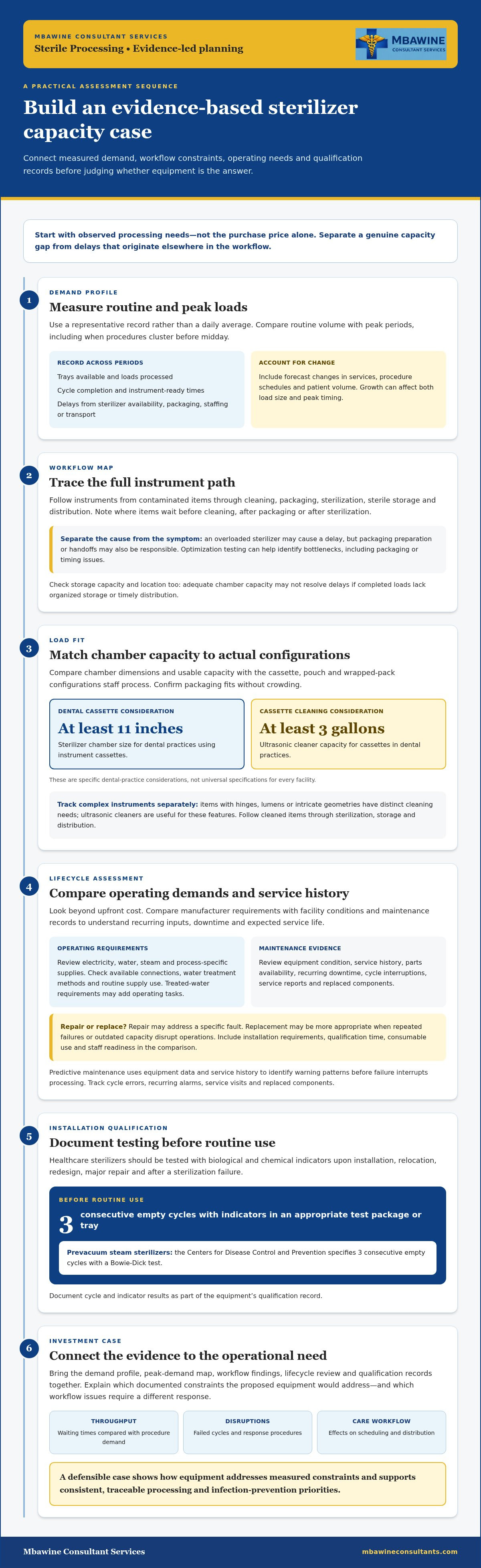
Start with a representative record of instrument loads, rather than relying on a daily average. Separate routine volume from peak periods, such as when procedures cluster before midday. Compare trays available, loads processed, cycle completion, and instrument-ready times across those periods. Record delays related to sterilizer availability, packaging, staffing, or transport. This grounds the equipment case in an observed constraint rather than a general desire for replacement. Include forecast changes in services, procedure schedules, and patient volume, since growth may affect both load size and peak timing.
Map the full path from contaminated instruments to sterile storage and distribution. Record where items wait before cleaning, after packaging, or after sterilization. A delay may stem from an overloaded sterilizer, but it may also arise during packaging preparation or handoffs between work areas. Optimization testing can help identify bottlenecks, including packaging or timing issues. Use the findings to distinguish a genuine capacity gap from a workflow problem that equipment alone will not solve.
Assess cassette and pouch processing against actual load patterns. Dental practices using instrument cassettes need sterilizers with a chamber of at least 11 inches, while ultrasonic cleaners used for cassettes need a capacity of at least 3 gallons. These are specific dental-practice considerations, not universal specifications for every facility. Compare chamber dimensions and usable capacity with the cassette, pouch, and wrapped-pack configurations staff process. Confirm that the expected packaging arrangement fits without crowding, since load configuration affects how the sterilization process is evaluated.
Include complex instruments in the demand assessment, especially items with hinges, lumens, or intricate geometries. Ultrasonic cleaners are useful for instruments with these features, so track them separately from simpler instruments when assessing the cleaning workflow. Then follow cleaned items through sterilization, sterile storage, and distribution. Storage capacity and location affect how quickly processed instruments return to use. A sterilizer with adequate chamber capacity may not resolve delays if completed loads lack organized storage or timely distribution.
Installation also requires validation, qualification, and records before routine use. Healthcare sterilizers should be tested with biological and chemical indicators upon installation, relocation, redesign, major repair, and after a sterilization failure. Before routine use, run three consecutive empty cycles with indicators in an appropriate test package or tray; for prevacuum steam sterilizers, the Centers for Disease Control and Prevention specifies three consecutive empty cycles with a Bowie-Dick test. Document cycle and indicator results as part of the equipment’s qualification record.
Finally, connect instrument turnaround with patient care and operational efficiency. Compare waiting times with procedure demand, and identify whether delayed sets affect scheduling or distribution. Record failed cycles and response procedures alongside normal throughput, so the proposal reflects both routine capacity and disruptions. A clear volume profile, peak-demand map, and documented installation testing provide a stronger basis for judging whether new equipment meets the facility’s actual processing needs.
Compare each sterilizer’s resource demands with facility operating conditions and maintenance records. This shows how recurring inputs, downtime, and expected service life affect the equipment’s overall value.
Utilities and consumables are the resources a sterilizer needs to operate, including electricity, water, steam, and process-specific supplies. Their use matters because recurring demands shape operating costs and can affect installation options. Compare manufacturer requirements with available connections, water treatment methods, and routine supply use. For example, a unit that requires treated water may add operating tasks alongside its sterilization cycles.
Compare repair and replacement by reviewing equipment condition, service history, parts availability, recurring downtime, and processing needs. Repair may address a specific fault, while replacement may be more appropriate when repeated failures or outdated capacity disrupt operations. The decision should also account for installation qualification and staff readiness. This comparison helps facilities weigh the remaining usefulness of the existing device against the operational impact of a new sterilizer.
To compare options, review maintenance records alongside cycle interruptions and service reports. Ask whether a repair resolves the underlying fault or only restores operation temporarily. A replacement assessment should include installation requirements, consumable use, and the time needed to qualify the equipment. These factors clarify the practical trade-offs without treating purchase price as the only measure of value. They also help distinguish a maintenance problem from a capacity or workflow constraint.
Predictive maintenance uses equipment data and service history to identify warning patterns before a failure interrupts processing. Track cycle errors, recurring alarms, service visits, and replaced components for each device. For example, repeated faults under similar operating conditions may warrant a closer maintenance review. This record supports planning for service intervals and potential downtime, rather than relying solely on reactive repairs after equipment stops working.
Water quality matters because sterilizer performance depends on meeting the manufacturer’s requirements. Compare facility water treatment and monitoring records with those specifications, then document deviations and corrective actions. Mineral deposits or unsuitable water conditions can affect operation and increase maintenance demands. Include water treatment supplies and related servicing in the operating assessment, so the comparison reflects the full resource burden, not just the sterilizer.
Estimate service life from equipment condition, maintenance history, parts support, and the facility’s changing processing requirements. A device that operates reliably may still constrain workflow if its capacity or cycle options no longer match demand. Conversely, replacement may add little value if the principal issue is inconsistent maintenance or staff practice. Staff training can support consistent equipment procedures and records; Sterile Processing classes can help build that operational foundation.
Match sterilizer capacity to the instruments, procedures, and cycle demands the facility handles. Surgical volume matters because tightly scheduled cases can concentrate instrument demand, while varied instruments may require different sterilization methods. Compare usable chamber space, load configuration, cycle duration, and compatibility with the devices being processed. The right capacity should support the actual workflow without relying on routinely overloaded or underused equipment.
Assess the pattern of surgical activity, not just total instrument volume. Identify procedure types, required instrument sets, and when those sets must be ready for reuse. A sterilizer’s stated chamber size does not show how many validated loads fit the facility’s packaging configurations. Compare expected loads with available cycle time, cleaning steps, staffing, and distribution. A larger chamber, for example, offers limited benefit if packaging preparation or load release remains the bottleneck.
Cycle flexibility matters when a facility processes both heat-resistant and delicate devices. Steam sterilization is commonly used for heat-resistant instruments, while low-temperature sterilization is used for more delicate instruments. Check which methods suit the materials and instructions for use of the devices in each load. A cycle appropriate for one instrument group may not suit another, so capacity planning should reflect the actual instrument mix, not chamber volume alone.
Cycle duration affects how facilities plan instrument availability around procedure schedules. Compare cycle requirements for representative loads, including wrapped sets, pouches, and delicate devices, rather than relying on one estimated turnaround time. Consider loading, unloading, cooling, and any monitoring or release procedures that affect when instruments can return to service. A realistic schedule shows whether equipment can support overlapping work without avoidable delays.
Practice size informs capacity, but procedure schedules and instrument mix determine whether selected equipment can keep pace. A single-room practice processing varied devices may need different cycle flexibility from a facility handling repeated, similar loads. Compare chamber dimensions with the cassettes, pouches, and other packaging configurations used in routine work. Then assess whether staff can load the chamber consistently without compromising the intended configuration.
Environmental and chemical considerations also affect equipment selection. Review each sterilization method against device material compatibility, available utilities, packaging, and the facility’s ability to maintain consistent operating conditions. A flexible unit can support varied loads only when staff follow the appropriate cycle and load configuration. Assess cycle records and performance reports alongside throughput, since documented results help show whether capacity supports reliable processing. This connects surgical volume and cycle options with practical operating requirements.
Equipment decisions should account for infection-prevention responsibilities as well as processing demand. Keeping outdated or unreliable equipment can increase infection risk, compliance problems, liability exposure, and loss of patient trust.
Sterilization demand and infection control are connected because every instrument load must move through a reliable, repeatable process before reuse. Approximately 1 in 31 hospitalized patients in the United States is affected by at least one healthcare-associated infection on any given day. For dental practices, processing volume, packaging, equipment performance, and staff practice all shape how well the workflow supports infection prevention.
Dental teams may access the sterilization area 80-120 times daily, making clear separation between contaminated and clean instruments important to daily operations. A dirty-to-clean workflow consistent with CDC and AAMI guidance helps prevent clean items from crossing paths with contaminated instruments. Equipment capacity should support that sequence rather than forcing staff to hold loads or disrupt established handling practices during busy periods.
Visual inspection alone may not reveal all contamination: one study found 84% of instruments had residual debris under microscopic examination, although 91% appeared clean visually. This example underscores why cleaning and sterilization are distinct parts of processing. Equipment investment should therefore be considered alongside the facility’s cleaning methods, packaging practices, monitoring, and staff adherence to the defined workflow.
Outdated or unreliable sterilizers cannot consistently support a facility’s processing needs and documented procedures. Failures can increase infection risk for patients and create compliance, liability, and trust concerns. In outpatient settings, breakdowns may reflect combined process, staffing, and environmental challenges, so assess equipment condition as part of the full workflow.
Overloaded sterilizers, incorrect packaging, and non-standardized processes are common errors in medical practices. A replacement unit cannot correct every issue on its own, but a capacity mismatch can put pressure on staff and contribute to inconsistent load handling. Review cycle interruptions, failed-cycle procedures, packaging configurations, and staff practices together to determine whether equipment reliability is a central problem.
Automated records and monitoring can support traceability by documenting cycle data, inspection trails, and performance reports. Weak documentation makes it harder to demonstrate compliance or respond effectively after a failed cycle. Assess whether current records capture cycle outcomes and indicator results, then identify gaps that new equipment or process changes could address.
Infection prevention also depends on the people operating the equipment. In outpatient settings, staffing and environmental challenges can compound process problems, so a reliability assessment should include training, workflow responsibilities, and response procedures. The investment case is strongest when it identifies which equipment limitations affect safe, consistent processing and which risks require operational changes alongside replacement.
A credible investment case connects equipment needs with measurable operating impact. For laboratory facilities, include acquisition, implementation, ongoing use, and the effect on consistent processing.
Equipment and installation costs include the purchase price and expenses needed to prepare, install, and qualify the sterilizer. The price depends on the equipment configuration and installation scope, and is provided after a quote request; factors include capacity, cycle requirements, site utilities, and required installation work.
Build the estimate around the complete project, not just the device. Include site preparation, utility connections, qualification activities, staff training, and consumables for routine use. A laboratory comparing benchtop equipment with external processing should also consider the time and workflow demands of each method. This broader estimate gives finance and operations teams a shared basis for review.
Return on investment compares an equipment project’s financial benefits with its total investment and operating costs. Estimate annual benefits using facility-specific evidence, such as reduced downtime, fewer processing delays, or lower reliance on third-party sterilization.
Subtract ongoing costs from annual benefits to find the net annual benefit. Divide the initial project investment by that net annual benefit to estimate the payback period. Use documented operating records and conservative assumptions. Separate measurable savings from benefits such as improved workflow consistency, which may be important without translating directly into cash.
Test the calculation under different operating conditions. For example, compare current instrument volume with projected laboratory demand, then assess how each scenario affects utilization and operating costs. Include maintenance, consumables, and staff time. A clear calculation makes assumptions visible and helps decision-makers understand which operational factors have the greatest influence on the business case.
Capital approval is the facility’s formal review of a proposed investment against operational priorities, budget capacity, and documented need. Prepare a proposal that combines the project estimate, demand evidence, lifecycle expenses, and expected operational benefits. Identify the department responsible for funding and the facility’s approval process.
Present alternatives in the same format: continued use, repair, and replacement. Explain how each option affects reliability, capacity, and consistent instrument processing. Include implementation requirements, qualification, monitoring, and staff readiness in the requested budget. This allows reviewers to assess the full operational commitment, not just the purchase.
Before submission, assign responsibility for tracking project costs and evaluating performance after installation. Define which records will demonstrate whether the sterilizer meets the facility’s needs, such as cycle data, downtime, and processing delays. Staff competency also supports consistent operation; enroll in Sterile Processing classes to strengthen the knowledge needed for sterile processing work.
Mbawine Consultant Services provides Sterile Processing classes and Healthcare Sterile Processing Consulting for professionals and facilities seeking to strengthen sterile processing operations. Classes offer structured learning for staff, while consulting can help facilities assess workflow, staffing practices, and operational priorities related to equipment decisions.
Consider training and operational assessment when your investment case identifies a need for stronger staff knowledge or a closer review of sterile processing operations. These supports can connect equipment plans with the people and workflows responsible for consistent instrument processing.
Contact Mbawine Consultant Services to discuss your sterile processing needs.
A sound equipment decision should also prepare the people and processes that will use the system. How to justify new sterilization equipment ultimately depends on whether a facility can integrate it into consistent daily operations, maintain staff readiness, and evaluate performance after implementation. Treat workforce preparation as part of the decision, not as a separate concern to address later.
Mbawine Consultant Services offers Sterile Processing classes, Healthcare Temp staffing, and Interim Management to support facilities with training and staffing needs. These services can be relevant when an investment plan identifies workforce preparation or management continuity as part of implementation. Connect your operational priorities with appropriate professional development as a next step.
Explore Sterile Processing class enrollment and take a considered next step toward strengthening your team’s readiness for equipment decisions.
A strong business case shows that the proposed equipment addresses a documented operational need and supports reliable processing. Link the request to a specific consequence, such as recurring workflow disruption, an equipment limitation affecting planned services, or difficulty maintaining consistent records. Compare the proposed investment with continued operation and repair, using facility data to explain the trade-offs. Include a review plan that assigns responsibility for assessing performance after implementation.
Assess whether available capacity can process the facility’s actual instrument mix within the required turnaround windows. Review load configurations, cycle options, release procedures, and how overlapping demand affects the next available load. For example, a laboratory processing heat-sensitive and heat-resistant instruments needs compatible methods and a realistic schedule for each. Evaluate usable capacity rather than relying only on the stated chamber size.
Applicable requirements depend on the facility, equipment, sterilization method, and devices being processed. Build a requirements matrix identifying relevant FDA, CDC, OSHA, and AAMI guidance for equipment selection, worker safety, process monitoring, and documentation. Map each requirement to a facility procedure, responsible role, and retained record. This helps distinguish equipment specifications from operational responsibilities and makes gaps easier to address during procurement and implementation.
Estimate lifecycle costs by separating one-time implementation expenses from recurring operating needs. Include site preparation, utility consumption, water treatment, consumables, scheduled maintenance, replacement parts, staff training, and expected downtime. Use invoices, service records, utility data, and training plans to develop facility-specific estimates. For example, track maintenance by device and compare recurring faults with service intervals. This gives a more useful forecast than considering acquisition costs alone.

Article by
Mba Akuribila
Mba‑Akuribila is a healthcare leader, educator, and founder of Mbawine Consultants, a Bronx‑based institution recognized nationwide for advancing excellence in sterile processing and allied health workforce development. Born in Bongo in Ghana’s Upper East Region, his journey from rural beginnings to national impact reflects a lifelong commitment to service, empowerment, and community advancement.
For over two decades, he has trained sterile processing employees, mentored, and placed thousands of healthcare professionals across the United States. Through Mbawine Consultants, he established one of the country’s most trusted Sterile Processing Certification Test Prep Programs, preparing new Americans and career‑changers for successful entry into the field. The organization, as at 2026, has graduated more than 15,000 sterile processing technicians who now serve in hospitals, ambulatory centers, dental practices, and reprocessing facilities nationwide.
Under his leadership, Mbawine Consultants has expanded into a full Healthcare Staffing Agency, connecting nurses and allied health professionals to meaningful employment opportunities. His team also provides Interim Management Services, supporting hospitals and surgical centers with experienced leaders who stabilize operations, strengthen compliance, and improve workflow efficiency.
As a former surgical technician, sterile processing manager, educator, and system‑wide director, Mba‑Akuribila brings deep expertise to Sterile Processing Consulting, helping healthcare facilities elevate quality, safety, and regulatory readiness.
His work in the United States and Ghana continues to reflect his core philosophy: service above self, opportunity for all, and excellence without compromise.


