

A completed sterilization cycle does not, by itself, prevent wet packs. To understand how to prevent wet packs in sterilization loads, assess steam quality, load arrangement, device instructions, sterilizer condition, and how packs cool after the cycle. Steam supplied to an autoclave should be 97% saturated and contain no more than 3% liquid, while adequate spacing and an unobstructed drain support steam circulation and moisture removal. Proper post-cycle handling matters too: packs need to cool before they’re handled or stored.
It’s understandable to focus first on the autoclave or load when visible moisture appears after processing. Yet several stages may contribute, from steam supply and pack preparation to handling as items cool. This guide explains how to prevent wet packs in sterilization loads and investigate recurring incidents, including loading, instructions for use, routine maintenance, and post-cycle handling. These factors work together to reduce moisture and support reliable sterile processing.
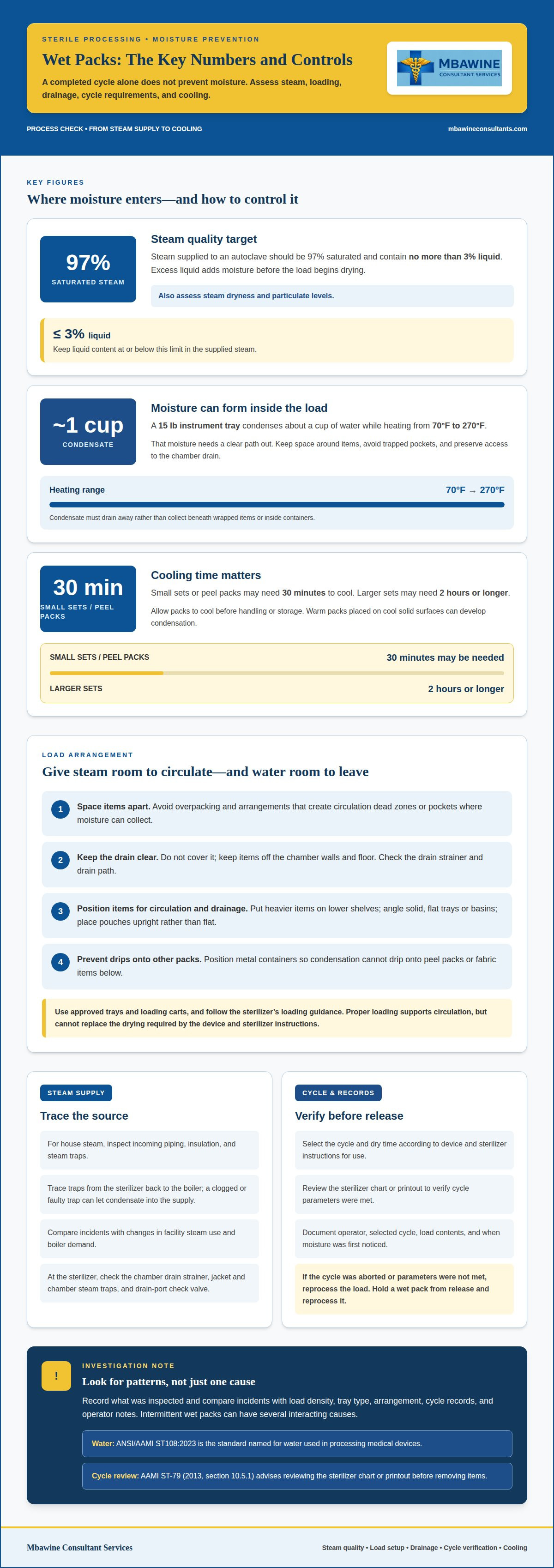
Steam quality is a primary consideration when investigating a wet pack. Steam supplied to an autoclave should be 97% saturated and contain no more than 3% liquid. Excess liquid entering the chamber adds moisture before the load begins drying. Steam should also meet acceptable dryness and particulate levels, because water carryover and particles can affect reliable processing. A wet load may therefore point beyond packaging or cycle settings, toward the steam supply itself.
Condensation also forms as instruments heat. A 15 lb instrument tray condenses about a cup of water while heating from 70°F to 270°F. That moisture must drain away rather than collect beneath wrapped items or inside containers. Assess load density alongside steam quality: closely packed items can restrict circulation and create chamber dead zones. Leave space around each item so steam can reach the load and moisture can move toward the drain.
For autoclaves supplied by house steam, inspect the incoming piping, insulation, and traps. Insulation reduces heat loss and condensate forming inside steam lines. A clogged or improperly functioning steam trap on the main line can allow condensate into the sterilizer supply, contributing to waterlogged loads. A useful inspection program traces steam traps from the sterilizer back to the boiler, rather than stopping at the equipment connection.
Boiler demand is another part of the investigation. Excessive demand on an in-house boiler can carry water into the steam supply, so compare wet-pack incidents with changes in facility steam use. If the system includes filters, include them in the facility’s established inspection process and assess particulate levels in the supplied steam. For new construction or system changes, consider steam supply design early, especially when facility staff have limited experience with these systems.
At the sterilizer, check the chamber drain strainer and keep the bottom drain clear. Inspect the jacket and chamber steam traps, along with the check valve at the drain port, to confirm they function properly. A blocked strainer or faulty trap can interfere with condensate removal even when incoming steam is suitable. Record what you inspect and whether the issue occurs with a particular load pattern. Intermittent wet packs can have several interacting causes.
Water quality also matters in medical-device processing. ANSI/AAMI ST108:2023 is the standard named for water used in processing medical devices, according to the Association for the Advancement of Medical Instrumentation (AAMI). Treat water and steam as related but distinct parts of the assessment: evaluate the supplied steam’s dryness and particulate levels, then inspect the drain path and traps. This sequence helps distinguish supply problems from chamber drainage or circulation problems.
Select the sterilization cycle and drying time according to the device and sterilizer instructions for use. When moisture appears, review cycle records and steam-quality checks. Space items apart, keep the chamber drain clear, and prevent items from touching the chamber walls or floor.
Positioning affects both steam circulation and condensate drainage. Place heavier items on lower shelves, and avoid stacking loads in ways that create pockets where moisture can collect. Angle solid, flat trays or basins to let steam escape. Place pouches upright rather than flat on shelves, and avoid complex packaging that restricts circulation. Position metal containers so condensation cannot drip onto peel packs or fabric items below.
Follow the sterilizer’s loading guidance and use approved trays and loading carts. Don’t overpack the chamber, cover the drain, or place items against the walls or bottom. During troubleshooting, compare wet-pack incidents with load density, tray type, and arrangement. If moisture appears only with particular sets or tray sizes, record the pattern and assess whether spacing or positioning is a factor. Proper loading supports circulation, but cannot make up for a cycle that does not provide the required drying.
Choose cycle parameters for the device and packaging being processed, including the required dry time. Some loads need longer drying, so use the applicable instructions rather than applying one setting to every load. Before removing items, examine and interpret the sterilizer chart or printout. AAMI ST-79 (2013, section 10.5.1) advises this review to verify that cycle parameters were met. Also document the operator, selected cycle, load contents, and time when moisture was first noticed. Those details can reveal recurring links to a specific load type, shift, or process.
If a cycle was aborted or its parameters weren’t met, reprocess the load rather than releasing it. Hold any wet pack discovered in Sterile Processing from release and reprocess it. Record the corrective action and retain cycle documentation for review. When troubleshooting, compare the sterilizer record with recent load and operator notes. Consider whether the pattern points to loading, cycle selection, or equipment operation, including changes in boiler demand.
After a completed cycle, allow packs to cool before handling or storage. Small sets or peel packs may need 30 minutes; larger sets may need two hours or longer. Warm packs placed on cool solid surfaces can develop condensation, so avoid that contact during cooling. Allow adequate aeration before storage, and use a temperature-sensing device to confirm room temperature when appropriate. For teams strengthening loading and cycle practices, Sterile Processing classes can support staff learning.
Use each medical device’s instructions for use (IFU) to guide preparation before loading it into an autoclave. The manufacturer’s directions explain how to configure the instrument for processing, including whether to disassemble components and which drying requirements apply. Don’t rely on a general routine when a device-specific instruction calls for a different preparation or drying step. Keep the relevant IFU available where staff assemble sets, so preparation and cycle selection reflect the device being processed.
For a multi-part instrument, disassemble the components as directed before cleaning, packaging, and sterilization. Check hinged or assembled items for surfaces that could retain moisture, and position them so concave areas don’t trap steam. For example, a bowl-shaped surface facing upward may collect condensate instead of draining. Follow the manufacturer’s configuration instructions for each instrument, since the correct arrangement depends on its design and intended processing method.
Packaging must be suitable for steam sterilization. Material not validated for steam processing can retain moisture and contribute to a wet pack. Match the packaging method to the device and its IFU, and avoid wrappers that are unnecessarily large. Excess wrapper material can create areas where moisture pools. Check that packaging doesn’t obstruct the instrument’s required configuration or prevent steam from reaching the surfaces specified in its processing instructions.
Heavy instrument sets need particular attention during preparation and loading. Follow the manufacturer’s directions for the set, then use the sterilizer’s established loading arrangement to support the pack and allow steam to circulate around it. Don’t position a set so that it blocks the chamber drain or creates a space where condensate can collect. If a heavy set repeatedly emerges wet, document its tray type and position, then compare these details with the set’s IFU and loading records.
Drying instructions vary by device. Some medical device instructions require longer drying times, so use the applicable IFU when setting or selecting the cycle. If a pack is wet, review device preparation, packaging, and recorded drying time together. This can show whether the instrument’s configuration or drying requirement differs from the routine used for other sets. Don’t respond to recurring moisture by changing a cycle without first comparing the manufacturer’s directions with the process record.
For a practical review, trace one affected set from preparation through removal. Confirm disassembly, check the packaging material and wrapper fit, inspect the instrument’s orientation, and compare the selected drying time with its IFU. Record the set and tray involved if the issue recurs. These details help distinguish an instrument-specific preparation problem from broader steam supply, loading, or drainage concerns.
Wet packs can result from operator error, sterilizer component failures, steam supply problems, or improper storage. Training should connect staff actions with equipment checks and load records. Before operating a sterilizer, staff should know how to select the correct cycle, assess the displayed parameters, and respond to an interrupted cycle. For example, a new or inexperienced operator may need focused instruction on interpreting cycle records and recognizing when a load must be held rather than released.
Build routine equipment checks into the workday. Daily biological and Bowie-Dick testing is recommended to assess sterilizer performance, including steam saturation and vacuum. These tests provide different information from a visual pack check: a dry-looking load alone does not establish that the sterilizer functioned correctly. Record test results and investigate unexpected outcomes through the facility’s established process before relying on subsequent cycles.
Confirm that the vacuum system functions and pulls a deep vacuum at the end of the cycle. A vacuum problem can interfere with moisture removal, so operators should recognize abnormal cycle behavior and report it promptly. Define and perform user-level maintenance procedures daily, weekly, and monthly, alongside regularly scheduled maintenance that includes annual maintenance. Keep completed maintenance records with sterilizer logs so you can compare service activity with wet-pack patterns.
Preventive checks should cover valves, steam traps, vacuum systems, chamber drain strainers, gauges, and door gaskets. A clogged strainer can obstruct drainage, faulty traps can affect condensate removal, and worn gaskets or inaccurate gauges can signal equipment problems. Follow the sterilizer’s maintenance procedures for each component, and document abnormalities, corrective actions, and the date the equipment returns to service. Don’t assume recurring moisture is a packaging issue before assessing equipment function.
Use incident records to narrow the investigation. Note when wet packs were first observed, which operator ran the cycle, the load or instrument set involved, and whether the problem followed recent maintenance. Record humidity in the area where packs are assembled and wrapped, since environmental conditions can inform troubleshooting. Compare incidents across shifts and operators to see whether the pattern follows a particular process, machine, or recent service event.
When a wet pack appears, hold affected items from release and investigate the cause before resuming routine processing on that sterilizer. Review cycle parameters, test results, maintenance records, and operator notes together, since several factors may contribute to one incident. A consistent daily routine, supported by scheduled maintenance and documented staff training, makes it easier to distinguish process variation from equipment malfunction and apply evidence-based corrective action.
Post-cycle handling can introduce moisture even after a sterilizer cycle completes. Once the door opens, residual moisture may condense on the load’s exterior as items cool. Handle packs only after they’ve cooled, and avoid placing warm packages on cool, solid surfaces. Contact can create condensation where the wrapper touches the surface. Keep cooling packs in a designated area where they won’t be disturbed, stacked, or exposed to conditions that could compromise their packaging.
Allow sterilized items adequate aeration before storage. Don’t move a load directly from the sterilizer into a crowded storage area, where close contact can restrict drying. Arrange packs so air can circulate around them, and handle them carefully to protect wrapper integrity. A pack that appears dry outside may still contain moisture inside, so inspect the full package rather than relying on one visible surface.
Visible moisture changes a pack’s status. Excess moisture can let microorganisms wick through the wrapping and recontaminate the contents. In Sterile Processing, hold wet packs from release and reprocess them. Drying after the cycle is not a substitute for reprocessing. If a wet pack reaches a sterile field, consider the field contaminated, along with anything its contents may have touched.
Respond to a wet pack by stopping further loads in that sterilizer while the underlying cause is investigated. Record the affected load, the location of moisture, and when it was discovered. Check whether moisture appears on the outside, inside, or both, and note whether it affects one package or several. ANSI/AAMI ST79 Annex O addresses moisture assessment. The CDC’s Guideline for Disinfection and Sterilization in Healthcare Facilities, dated 2008, includes sterilizing practices.
Use the incident record to distinguish condensation formed during cooling from moisture retained inside packaging. Compare the position of affected packs, how they were handled after removal, and whether nearby items were also wet. These observations help direct follow-up toward handling, load conditions, or sterilizer function. Keep affected items separate from released sterile supplies while staff document findings and take corrective action.
Reliable post-cycle practice depends on consistent staff understanding of cooling, inspection, aeration, and escalation. Enroll in Sterile Processing classes to build staff knowledge of safe pack handling and moisture response.
Mbawine Consultant Services offers Sterile Processing classes for professionals looking to strengthen their knowledge of loading, cycle records, moisture response, and post-cycle handling. When wet packs recur despite established procedures, Healthcare Sterile Processing Consulting can help facilities examine workflows and identify where staff practices or processing systems need attention. Interim Management and Healthcare Temp staffing can also support facilities with operational staffing needs while maintaining sterile processing functions.
Training helps teams apply consistent procedures, recognize wet-pack patterns, and document corrective actions. For facilities reviewing recurring moisture issues, consulting offers a practical way to assess sterile processing processes in context. Contact Mbawine Consultant Services to discuss Sterile Processing support for your team.
Turn recurring wet-pack observations into a defined improvement plan, with responsibilities for staff learning, process review, and follow-through. Teams can more consistently prevent wet packs in sterilization loads when they recognize patterns, document corrective actions, and apply procedures reliably across shifts. Training can support staff development, while Healthcare Temp staffing and Interim Management can address workforce and operational needs that affect process continuity.
Mbawine Consultant Services offers Sterile Processing classes, Healthcare Temp staffing, and Interim Management. Facilities can choose support that fits their priorities, whether strengthening team knowledge or maintaining operational capacity. A measured, consistent approach helps teams move beyond responding to individual wet packs and improve daily practice.
Explore Sterile Processing classes and take the next step toward strengthening your team’s sterile processing practice.
Wet packs occur when moisture remains visible on or inside several packages after a steam-sterilization load. The cause may involve steam quality, packaging, load arrangement, equipment performance, or cooling and handling after the cycle. To understand how to prevent wet packs in sterilization loads, trace the affected items through each stage rather than assuming the sterilizer alone is responsible. Note whether moisture is inside packages, outside them, or concentrated around particular sets.
Wet packs can result from interacting process and equipment issues, including condensate in the steam supply, blocked drainage, poor loading, and insufficient drying. Packaging that traps moisture or instruments positioned to retain condensate can also contribute. Start by comparing affected loads by set type, tray, cycle, operator, and sterilizer. A recurring association can narrow the investigation, while an intermittent pattern may point to several contributing conditions.
Moisture after steam sterilization may be residual condensate that did not leave the load during drying, or condensation that formed as packs cooled. Residual moisture can appear inside packaging, while moisture may also form on a load’s exterior after the sterilizer door opens. Record where the dampness appears and whether it affects one package or several items. Those observations help distinguish a cooling-related pattern from moisture retained during processing.
Arrange trays so steam can reach packages and moisture can drain, without crowding the chamber or blocking its drain. Keep packages from touching chamber walls or the floor, and avoid stacking that creates enclosed pockets. Place heavier items below lighter packs to reduce the chance of condensate dripping onto them. Angle solid, flat trays or basins to allow steam to escape, following the facility’s loading procedure.
Use packaging intended and validated for steam sterilization, and follow the device and packaging instructions for preparation. Material unsuitable for steam processing may retain moisture, while an oversized wrapper can create a pooling area around the item. Avoid unnecessarily complex packaging that impedes steam circulation. For a set that repeatedly emerges wet, compare the wrapper size and packaging method with the item’s configuration, then document whether the same packaging pattern occurs in other affected loads.
Allow packs to cool before handling or storage, since warm packages can develop condensation against a cool solid surface. Small sets or peel packs may need 30 minutes to cool; larger sets may need two hours or longer. A temperature-sensing device can help establish whether items have reached room temperature. Handle cooled packages carefully, allow adequate aeration before storage, and avoid stacking them in ways that restrict airflow or disturb packaging.
Hold the wet pack from release and reprocess it. Do not treat it as sterile. Stop further loads in the affected sterilizer while staff investigate the cause. Record the cycle, load contents, operator, discovery time, and location of the moisture, then compare these details with other incidents. If a wet pack has contacted a sterile field, consider the field and anything its contents may have touched contaminated, and follow facility procedures for corrective action.
Scheduled maintenance helps identify conditions that interfere with steam delivery, drainage, vacuum, or drying. Include the chamber drain strainer, steam traps, valves, vacuum system, gauges, and door gaskets in applicable maintenance checks. Perform user-level procedures on the established daily, weekly, and monthly schedule, alongside regular annual maintenance. Review maintenance records with wet-pack incident notes, since a recent service event or recurring component issue may help explain the pattern.

Article by
Mba Akuribila
Mba‑Akuribila is a healthcare leader, educator, and founder of Mbawine Consultants, a Bronx‑based institution recognized nationwide for advancing excellence in sterile processing and allied health workforce development. Born in Bongo in Ghana’s Upper East Region, his journey from rural beginnings to national impact reflects a lifelong commitment to service, empowerment, and community advancement.
For over two decades, he has trained sterile processing employees, mentored, and placed thousands of healthcare professionals across the United States. Through Mbawine Consultants, he established one of the country’s most trusted Sterile Processing Certification Test Prep Programs, preparing new Americans and career‑changers for successful entry into the field. The organization, as at 2026, has graduated more than 15,000 sterile processing technicians who now serve in hospitals, ambulatory centers, dental practices, and reprocessing facilities nationwide.
Under his leadership, Mbawine Consultants has expanded into a full Healthcare Staffing Agency, connecting nurses and allied health professionals to meaningful employment opportunities. His team also provides Interim Management Services, supporting hospitals and surgical centers with experienced leaders who stabilize operations, strengthen compliance, and improve workflow efficiency.
As a former surgical technician, sterile processing manager, educator, and system‑wide director, Mba‑Akuribila brings deep expertise to Sterile Processing Consulting, helping healthcare facilities elevate quality, safety, and regulatory readiness.
His work in the United States and Ghana continues to reflect his core philosophy: service above self, opportunity for all, and excellence without compromise.


