

Last Updated: October 8, 2026
Most sterile processing budget proposals fail because they ask for money without proving need. Administrators approve spending when risk, volume, and cost are tied together in plain numbers; a wish list gets deferred.
Departments that win funding treat the proposal as a business case, not a request form.
A wish list says "we need two new washer-disinfectors." A business case says "our units run at capacity, and a single failure stops instrument reprocessing for the OR." The first invites a no; the second invites a conversation.
A sterile processing budget is a financial plan covering the people, equipment, supplies, and space a department needs to reprocess surgical instruments safely.
Reviewers scan for three things:
Answer those on page one and your approval odds change.
Baseline data is the foundation of any credible proposal. Without it, every number is an opinion.
Pull twelve months of records. If your department still runs on manual logs, solve that first, paper records cannot support a serious budget justification.
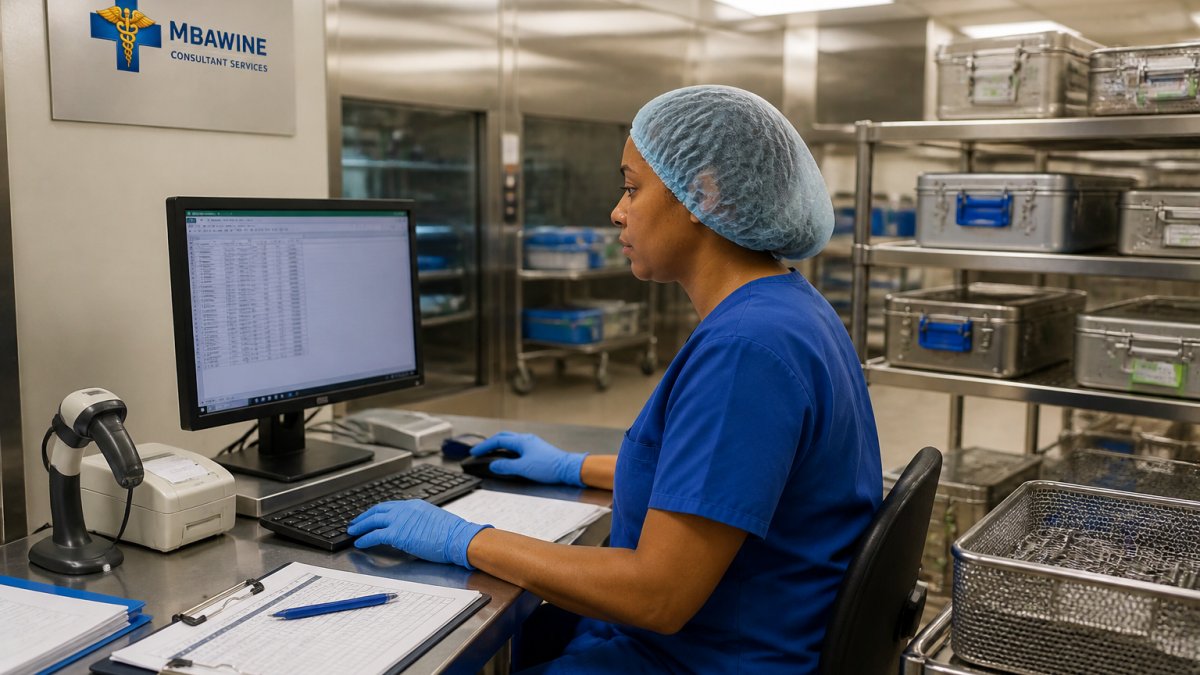
Case volume alone tells a thin story. Track workload evidence:
Two or three months of clean data beats a year of guesses. Document each number's source.
A sterile processing budget template is a reusable master file, not a one-year spreadsheet. Build it once and update the numbers each cycle. It has two layers: a line-item worksheet finance can audit, and a one-page narrative reviewers read.
Use these columns, each answers a reviewer's question.
| Column | What goes in it | Fill-in prompt |
|---|---|---|
| Line Item | Specific item or role | "What exactly are we buying or funding?" |
| Category | Capital or Operating | "Does finance code this as a one-time asset or a recurring cost?" |
| Quantity | Units, FTEs, or cases | "How many, and over what period?" |
| Unit Cost | Quoted or documented price | "What is the source of this number?" |
| Annual Total | Quantity x Unit Cost | "What hits the budget this fiscal year?" |
| Useful Life | Years of service | "How long before we ask again?" |
| Justification | One sentence tying to risk or volume | "What breaks or slows down if we say no?" |
| Source | Quote, log, or benchmark | "Where can a reviewer verify this?" |
That last column is the one most proposals skip, and the one that survives a challenge: point to the log entry for downtime, the vendor quote for price.
Finance reads the worksheet; leadership reads the narrative. Keep it to one page:
Before the proposal leaves your department, confirm each item:
Capital items are one-time purchases above a set dollar threshold, usually equipment with a useful life beyond one year. Operating expenses are recurring: supplies, labor, maintenance, training.
One gray area: instrument tracking software. Some facilities treat the license as operating and the server hardware as capital; others bundle both. Ask before you code it, a misclassified line item can cost a cycle.
A sterile processing budget justification connects each line item to a patient-safety or cost outcome. One paragraph per major request suffices.
Weak justification: "Our sterilizers are old."
Strong justification: "Both steam sterilizers are past their expected service life. Last quarter we logged 14 hours of unplanned downtime, and each hour delayed an average of three OR cases. Replacement removes that recurring risk and cuts maintenance spending on parts that are no longer under warranty."
Notice the structure: current state, measurable impact, proposed fix, expected result.
Total cost of ownership is the full cost across the equipment's working life: purchase price, installation, utilities, consumables, training, maintenance, and replacement. Reviewers care about this more than sticker price.
For ROI, frame the return in terms the hospital already tracks:
If a new instrument tracking system cuts two staff hours per day, that is roughly 500 hours a year returned to patient care. Put that number in the proposal.
Sterile processing department benchmarking compares your performance against published norms or similar facilities, answering the question every reviewer asks: "Is this normal?" Sources include professional associations, peer facilities of similar size, and internal year-over-year trends, even a rising rework rate supports your case.
Compare these areas:
Match your comparison to a facility of similar size and case mix. A small ambulatory surgery center should not benchmark against a large trauma hospital. The Association for the Advancement of Medical Instrumentation standards publishes guidance that helps frame these comparisons credibly.
A sterile processing budget proposal example shows the whole argument in one page. Here is a worked structure to copy, using a mid-size department. Every number is illustrative, replace each with your own documented figure.
Assumptions (state these openly at the top):
The ask:
The return:
Every number here traces back to a documented assumption. Here is the math.
Step 1, Quantify the downtime cost.
At $2,000 per delayed case, that is $84,000 per quarter, roughly $336,000 a year in avoidable cost.
Step 2, Quantify the overtime cost.
Overtime hours per quarter (60) x blended overtime rate = quarterly overtime spend
At $45 per hour blended, that is $2,700 per quarter, or $10,800 a year.
Step 3, Calculate simple payback.
Payback period = Capital cost / Annual savings
Step 4, Show total cost of ownership, not just purchase price.
| Cost element | What to include |
|---|---|
| Purchase price | Vendor quote, including freight |
| Installation | Rigging, utilities, steam and drain connections |
| Training | Vendor training hours for technicians |
| Consumables | Filters, gaskets, chamber cleaning supplies |
| Maintenance | Preventive maintenance contract, annual |
| Downtime risk | Expected unplanned service calls per year |
| Useful life | Expected service years before replacement |
| Replacement | Estimated future replacement cost |
Step 5, State the cost of inaction.
The reviewer's real question is never "how much does this cost?" It is "what does saying no cost us?" Lead every justification with the cost of inaction, and back it with a calculation the reviewer can follow.
Most proposals come back trimmed, not approved in full. Build three versions:
Contingency planning means naming what happens if funding is cut. If the sterilizer replacement is deferred, what is the backup plan? A shared service agreement? A rental unit?
Post-approval tracking matters just as much. Record actual spend against the approved budget monthly.
Track these after approval:
This is where financial management becomes a year-round habit instead of a once-a-year scramble.
Writing a sterile processing budget proposal is a skill, and like any skill in this field, it improves with training and repetition.
Start by collecting baseline data: instrument reprocessing volume, OR case volume, current staffing hours, and equipment age. Then organize costs into capital and operating categories, write a justification for each major request using measurable data, and present the proposal in a format that matches your facility's budget cycle. A sterile processing budget proposal works best when every dollar requested connects to a specific operational need, such as reducing turnover time or replacing equipment past its service life.
A complete proposal covers staffing and labor costs, supplies, equipment replacement and maintenance, space planning needs, training expenses, and any process improvement initiatives. Include baseline data showing current performance, a clear project scope, and a justification section that explains the cost of doing nothing. Adding a sterile processing budget template with line items for each category keeps the document consistent and makes it easier for administrators to compare your request against prior years.
Build the case around total cost of ownership, not just purchase price. Document the current equipment's age, repair frequency, downtime hours, and how often it fails during peak sterilization volume. Compare that against the new unit's expected service life, maintenance schedule, and capacity. A sterile processing budget justification that shows the old washer-disinfector broke down six times last year and cost more in repairs than a replacement lease will land better than a request based on age alone.
Track actual spending monthly against each budget line, flag variances above 10 percent, and document the reason (supply price increase, unexpected equipment repair, overtime spike). Review instrument tracking data and processing volume alongside financials so you can show administration whether higher costs came from more surgical volume or from inefficiency. This habit also strengthens next year's proposal because you can point to specific variances and explain how your new request prevents them from recurring.


