

Achieving the Certified Registered Central Service Technician (CRCST) designation serves as a definitive validation of a professional's technical proficiency and their unwavering commitment to the preservation of public health within the surgical environment. It's understandable that many candidates experience significant apprehension when confronted with the rigorous 400-hour clinical requirement or the intricate technical standards detailed in the most recent January 2026 HSPA Certification Handbook. Effective hspa certification exam prep requires more than rote memorization; it demands a comprehensive understanding of the systematic processes that govern decontamination, sterilization, and quality assurance. This masterclass is designed to provide the clinical insights and academic rigor necessary to master the certification exam while simultaneously elevating your professional trajectory.
We'll provide a detailed analysis of the essential sterile processing department workflows, interpret the evolving regulatory requirements for 2026, and establish a methodical framework for achieving both the CRCST credential and enhanced job security. By bridging the gap between entry-level expectations and advanced technical mastery, this guide ensures that you're prepared for the 150-question assessment and the high-stakes demands of the modern healthcare landscape.
The Healthcare Sterile Processing Association (HSPA) has transitioned from a voluntary membership body to a central authority that defines the technical and ethical boundaries of surgical support services. This evolution isn't merely administrative; it's a direct response to the rapid advancement of minimally invasive surgical technologies and the subsequent complexity of instrument reprocessing. Today, the association's standards are the foundation of modern perioperative safety. HSPA certification serves as the rigorous validation of sterile processing competency, ensuring that every technician possesses the systematic knowledge required to protect patient lives.
The Certified Registered Central Service Technician (CRCST) designation remains the industry benchmark because it balances theoretical knowledge with 400 hours of hands-on clinical experience. In 2026, the impact of mandatory certification is more pronounced than ever before. Healthcare facilities face significant institutional liability if they fail to employ certified staff, as credentialing is now viewed as a primary defense against healthcare-associated infections. For candidates, hspa certification exam prep is the first step in assuming this professional responsibility and joining the ranks of recognized healthcare experts.
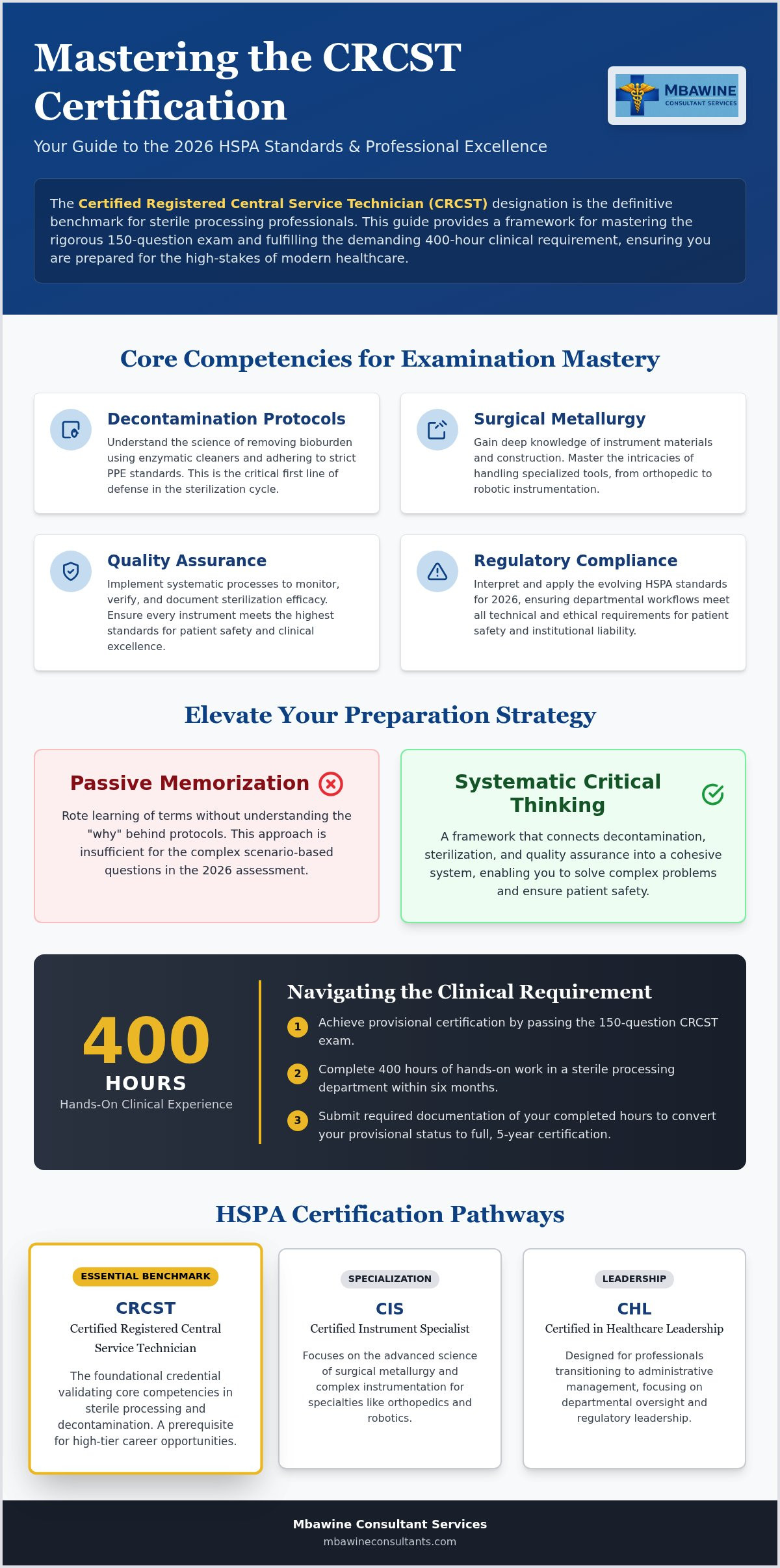
While the CRCST is the essential entry point, the sterile processing field offers specialized pathways for those seeking leadership or technical mastery. The Certified Instrument Specialist (CIS) focuses on the science of surgical metallurgy and the intricacies of orthopedic or robotic instrumentation. In contrast, the Certified in Healthcare Leadership (CHL) credential is designed for professionals transitioning into administrative management. The 2026 pilot examinations, including the CHL pilot scheduled for October 1-15, 2026, are currently refining the criteria for these leadership roles. These updates ensure that advanced practitioners are equipped to handle evolving regulatory requirements and complex departmental oversight.
Certification isn't just a badge; it's a prerequisite for high-tier career opportunities such as interim management and specialized healthcare staffing. It provides a platform for professional advocacy, allowing technicians to influence departmental workflows and safety protocols with the weight of recognized expertise. Engaging in a structured hspa certification exam prep program allows professionals to bridge the gap between basic task completion and advanced technical mastery. Those looking to begin this journey can review the Sterile Processing Classes: Certification Guide to understand the educational requirements and clinical milestones necessary for success. This credentialing process ultimately transforms a job into a mission-driven career focused on public safety.
Mastering the HSPA examination requires a transition from superficial familiarity with equipment to a profound understanding of the clinical rationale behind every protocol. Candidates must recognize the Vital Role of the Sterile Processing Department in mitigating cross-contamination and ensuring surgical efficacy. This technical mastery begins with a comprehensive hspa certification exam prep strategy that prioritizes the science of sterilization over simple term recognition. Professionals who understand the "why" behind the standards are better equipped to handle the high-stakes environment of the modern operating suite.
Decontamination is the essential first line of defense in the sterilization cycle. It involves the removal of bioburden, which is the quantity of microorganisms contaminating an object, through both chemical and mechanical means. Enzymatic cleaners aren't merely detergents; they utilize specific proteins to break down organic matter at a molecular level. Professionals must strictly adhere to regulatory standards for Personal Protective Equipment (PPE) within the decontamination suite, including fluid-resistant gowns, face shields, and specialized gloves. High-level disinfection (HLD) protocols must be executed with precision, ensuring that contact times and chemical concentrations meet established safety thresholds.
The assembly phase is governed by the technical requirements of ANSI/AAMI ST79. In 2026, these standards emphasize the integrity of the sterile barrier system and the science of surgical metallurgy. Technicians must select the appropriate containment method based on the intended sterilization modality. Common barrier systems include:
Quality assurance is maintained through a multi-tiered approach. This includes the use of internal and external chemical indicators to verify that sterilization parameters were met. Biological monitoring remains the only definitive method to confirm the lethality of the sterilization cycle by challenging the process with highly resistant spores.
Sterilization modalities vary based on the heat and moisture sensitivity of the surgical instruments. While saturated steam remains the most common method due to its efficacy and safety, heat-sensitive items require low-temperature hydrogen peroxide gas plasma or Ethylene Oxide (ETO) systems. Effective hspa certification exam prep includes understanding the physics of these processes, as well as the environmental controls necessary for sterile storage. Temperature and humidity must be strictly monitored to prevent the degradation of packaging materials and the growth of microorganisms. For those seeking to deepen their technical expertise through a structured curriculum, exploring professional sterile processing enrollment options is a prudent step toward certification success.
Relying exclusively on the 'Flashcard Trap' represents a significant strategic error in hspa certification exam prep. While the rote memorization of technical terminology provides a necessary baseline, it's ultimately insufficient for the 150-question CRCST assessment, which increasingly prioritizes the application of standards over simple identification. The examination is designed to test a candidate's ability to utilize a 'Critical Thinking Model' when confronted with complex sterilization scenarios, such as unexpected moisture in a rigid container or a failed chemical integrator. These situations require a professional to synthesize knowledge of thermodynamics, packaging integrity, and institutional policy to reach a safe, evidence-based conclusion.
The Mbawine Method is a synthesis of academic rigor and clinical application, providing a structured pathway for technicians to move beyond basic task completion. By integrating the insights of seasoned industry consultants into the foundational curriculum, this approach ensures that candidates don't just pass a test but emerge as guardians of patient safety. Structured sterile processing classes provide the formal environment necessary to transform disparate facts into a cohesive professional philosophy that supports long-term career growth.
HSPA examination prompts are frequently constructed with sophisticated 'distractor' answers that are designed to look plausible to an underprepared candidate. These distractors often describe common but incorrect departmental habits that contradict ANSI/AAMI ST79 standards. Deciphering situational judgment questions regarding department workflow requires an understanding of priority-setting and risk assessment in the decontamination and assembly areas. Professional sterilization education allows candidates to interpret these technical prompts through the lens of regulatory compliance rather than anecdotal experience, ensuring a higher probability of first-attempt success.
Solitary self-study is often characterized by a lack of clinical context, which can lead to confusion when technical standards overlap or conflict in real-world applications. Instructor-led training outperforms solitary study by providing a forum for the resolution of complex queries through direct interaction with experienced SPD leaders. When professionals Explore our Sterile Processing Education services, they gain access to consultant-level expertise that bridges the gap between theoretical requirements and the practical realities of a high-volume surgical facility. This mentorship is vital for those who aim to achieve not just certification, but a position of technical leadership within their respective institutions.
The 400-hour clinical requirement is often the most significant barrier for new entrants, yet it serves as the essential crucible where theoretical knowledge is forged into professional competence. Candidates can choose between Full Certification, achieved by completing the clinical hours prior to the assessment, and Provisional Certification, which allows the candidate to pass the exam first and subsequently submit documentation of their hours within six months. This temporal flexibility is a key component of modern hspa certification exam prep; it allows students to validate their academic understanding while actively seeking placement in a high-volume Sterile Processing Department (SPD). To achieve full credentialing, candidates must document a specific distribution of labor: 120 hours in decontamination, 120 hours in preparing and packaging, and 120 hours in sterilization and disinfection, with the remaining hours allocated to storage, distribution, and quality assurance. This structured breakdown ensures that every Certified Registered Central Service Technician (CRCST) possesses a comprehensive mastery of the entire sterilization cycle.
Securing a clinical site in a competitive healthcare environment requires a methodical and professional approach. Candidates should prepare a formal prospectus that outlines their educational background and their commitment to adhering to institutional safety protocols. It's often necessary to carry personal professional liability insurance, which demonstrates a high level of professional maturity and protects both the student and the host facility. Leveraging established staffing and alumni networks can provide critical leads, as these connections often bridge the gap between academic preparation and clinical entry. Many facilities prefer candidates who come from recognized programs that emphasize the gravity of the sterile processing role.
The clinical phase isn't merely a period of observation; it's a dedicated time to connect classroom theory to the physical handling of complex surgical trays. Technicians must internalize the nuances of instrument assembly and the specific parameters of various sterilization modalities while maintaining the highest levels of infection control. Adhering to Healthcare Sterilization: 2026 Professional Standards ensures that the hands-on experience aligns with current regulatory expectations and patient safety mandates. For those ready to formalize their journey through a rigorous educational framework, the opportunity to enroll in professional sterile processing classes provides the necessary foundation for both the exam and the clinical environment.
The Mbawine Advantage represents a paradigm shift in hspa certification exam prep by moving beyond the limitations of standard test-prep materials to provide a comprehensive professional foundation. Our curriculum is meticulously engineered by seasoned healthcare sterile processing consultants and industry leaders who possess an intimate understanding of the 2026 regulatory environment. This academic rigor is paired with the practical flexibility of online sterile processing classes, which are designed to accommodate the demanding schedules of working healthcare professionals. By integrating real-world staffing insights and interim management expertise into the educational process, we prepare students for the complexities of the modern job market. Our mission is to advocate for the professionalization of the sterile processing technician role, elevating it from a supportive function to a critical pillar of institutional patient safety.
There is a documented correlation between formal, instructor-led education and high first-time pass rates on the HSPA certification assessment. Mbawine provides students with access to proprietary study materials and simulated examination environments that replicate the pressure and technical complexity of the actual 150-question test. Unlike solitary study methods, our structured classes offer a platform for resolving intricate technical queries through direct interaction with experts who understand the clinical rationale behind the standards. Our commitment extends beyond the initial exam; we focus on long-term professional development, ensuring that our alumni possess the technical mastery required to pursue leadership roles such as the Certified in Healthcare Leadership (CHL) designation.
Navigating the transition from student to certified professional requires a methodical approach that aligns academic milestones with clinical requirements. We are currently accepting applications for our upcoming 2026 certification cohorts, providing a clear pathway for those seeking to secure their professional future in the sterile processing field. The onboarding process is designed to ensure that each student is fully prepared to enter the workforce as a highly competent technician, backed by the weight of a recognized educational ecosystem. To begin your journey toward technical mastery and career security, you should Enroll in our HSPA Certification Exam Prep Classes Today and establish yourself as a leader in healthcare sterilization.
The path to becoming a Certified Registered Central Service Technician requires a shift from passive study to the active mastery of clinical standards. Success in the 2026 healthcare landscape is predicated on a deep understanding of the systematic processes that ensure patient safety and institutional compliance. By choosing a structured approach to your hspa certification exam prep, you're not just preparing for a three-hour assessment; you're building the foundation for a resilient career. Our authoritative consulting-based curriculum is specifically aligned with the latest 2026 ANSI/AAMI standards, ensuring that your knowledge is both current and clinically relevant. Graduates of our program gain exclusive access to a national staffing and alumni network, providing essential support as they navigate the 400-hour clinical requirement and transition into high-stakes leadership roles. This commitment to excellence transforms the certification process into a definitive professional milestone that enhances both salary potential and job security. We invite you to secure your future in healthcare by enrolling in our 2026 HSPA Certification Prep. Your dedication to the highest standards of sterilization is the most critical asset in the modern surgical suite.
HSPA utilizes a scaled scoring system to determine the passing threshold for the CRCST exam, ensuring that variations in the difficulty of different test forms are accounted for. Candidates are required to answer a sufficient number of the 150 multiple-choice questions correctly within the allotted three-hour timeframe to meet this standardized benchmark. While the exact raw score isn't disclosed, achieving a passing mark validates that the technician possesses the essential competency required for safe practice.
Yes, you can sit for the examination through the provisional certification pathway. This option allows candidates to pass the assessment first; however, they must complete and document the required 400 hours of hands-on experience within six months of passing the exam. These hours must be distributed across specific domains, including decontamination and sterilization. Failure to submit this documentation within the six-month deadline results in the forfeiture of the provisional certification status.
Mbawine Consultant Services provides structured educational programs that are paced to ensure a comprehensive understanding of complex technical standards and clinical rationales. While the specific duration varies based on the delivery format and cohort schedule, each course is designed to allow students enough time to internalize the systematic processes required for the 2026 job market. This methodical approach ensures that technicians are prepared for both the certification exam and the high-stakes demands of the department.
The primary distinction between these credentials involves the certifying body and the specific requirements for clinical experience. The Healthcare Sterile Processing Association (HSPA) requires 400 hours of hands-on experience for its CRCST designation, whereas the Certification Board for Sterile Processing and Distribution (CBSPD) utilizes different eligibility pathways and a five-year renewal cycle. HSPA remains a widely recognized benchmark for facilities that prioritize a rigorous validation of clinical safety and systematic technical mastery in the sterile processing field.
Mbawine Consultant Services offers both in-person and online classes to accommodate the diverse needs of healthcare professionals across the country. The online format provides the flexibility required for individuals balancing current employment with their hspa certification exam prep, while in-person sessions offer a traditional classroom environment. Both delivery methods utilize an authoritative, consulting-level curriculum to ensure that all students achieve the technical proficiency necessary to protect patient lives and meet institutional standards.
Students enrolled in the Mbawine program receive a comprehensive suite of proprietary study materials designed to facilitate a deep understanding of sterilization standards. These resources include specialized training guides, instructional content tailored to the 2026 ANSI/AAMI standards, and access to simulated examination environments. These materials are curated to move beyond passive memorization, encouraging the development of critical thinking skills required to manage complex departmental workflows and ensure rigorous quality assurance in the surgical environment.
HSPA certifications must be renewed on an annual basis to ensure that technicians remain current with evolving industry standards and technical advancements. The renewal process requires the submission of a $50 fee and documentation of 12 continuing education (CE) credits earned during the previous year. Maintaining an active certification is a critical component of professional advocacy and institutional safety, as it demonstrates an ongoing commitment to excellence and the professionalization of the sterile processing role.
If you don't achieve a passing score on your first attempt, you're permitted to retake the examination after a mandatory waiting period. The fee to retake the CRCST exam is $140, which is identical to the initial application cost. Utilizing a structured hspa certification exam prep program through Mbawine Consultant Services significantly reduces the likelihood of a failed attempt by providing the clinical insights and academic rigor necessary for first-time success in the field.

Article by
Mba Akuribila
Mba‑Akuribila is a healthcare leader, educator, and founder of Mbawine Consultants, a Bronx‑based institution recognized nationwide for advancing excellence in sterile processing and allied health workforce development. Born in Bongo in Ghana’s Upper East Region, his journey from rural beginnings to national impact reflects a lifelong commitment to service, empowerment, and community advancement.
For over two decades, he has trained sterile processing employees, mentored, and placed thousands of healthcare professionals across the United States. Through Mbawine Consultants, he established one of the country’s most trusted Sterile Processing Certification Test Prep Programs, preparing new Americans and career‑changers for successful entry into the field. The organization, as at 2026, has graduated more than 15,000 sterile processing technicians who now serve in hospitals, ambulatory centers, dental practices, and reprocessing facilities nationwide.
Under his leadership, Mbawine Consultants has expanded into a full Healthcare Staffing Agency, connecting nurses and allied health professionals to meaningful employment opportunities. His team also provides Interim Management Services, supporting hospitals and surgical centers with experienced leaders who stabilize operations, strengthen compliance, and improve workflow efficiency.
As a former surgical technician, sterile processing manager, educator, and system‑wide director, Mba‑Akuribila brings deep expertise to Sterile Processing Consulting, helping healthcare facilities elevate quality, safety, and regulatory readiness.
His work in the United States and Ghana continues to reflect his core philosophy: service above self, opportunity for all, and excellence without compromise.


