

The credential with the longer renewal cycle isn’t automatically the better fit for your sterile processing career. In the HSPA certification vs CBSPD decision, the right choice depends on your eligibility, intended role, and ability to meet ongoing requirements, not on a universal winner.
HSPA’s CRCST is often cited as the field’s most widely recognized credential, while both HSPA and CBSPD certifications are valued by employers. Their pathways and maintenance schedules differ: HSPA certifications generally require annual renewal, while CBSPD recertification follows a five-year cycle, with continuing education requirements tied to the credential.
This comparison covers the organizations’ certification options, eligibility and experience requirements, exams, and renewal obligations. To weigh those details against your career goals, compare the credentials named in the roles you’re pursuing and confirm the current requirements for each pathway. Once you’ve chosen a credential, structured preparation can help focus your study. Mbawine Consultant Services offers in-person and online sterile processing classes designed to prepare professionals for certification.
The HSPA certification vs CBSPD decision involves credentials issued by two distinct organizations, not two names for the same qualification. Each organization sets its own certification pathways and requirements. A credential demonstrates assessed knowledge, but the right fit depends on whether you meet its eligibility criteria, the role you’re pursuing, and the credential a prospective employer identifies.
A certifying body establishes and awards a credential after candidates meet its requirements. A certification-preparation course provides instruction to help learners prepare, but does not itself award that credential. This distinction makes it easier to separate the organization responsible for certification from a training provider that supports exam preparation.
HSPA is the Healthcare Sterile Processing Association, which offers professional certification programs. Its Certified Registered Central Service Technician (CRCST) credential is intended for sterile processing professionals seeking recognition of their knowledge and competencies. HSPA also offers credentials in areas such as instrument specialization, endoscope reprocessing, and leadership.
CBSPD is the Certification Board for Sterile Processing and Distribution, a separate certifying organization. Its entry-level technician credential is the Certified Sterile Processing and Distribution Technician (CSPDT). Other CBSPD credentials cover areas including flexible endoscope reprocessing, ambulatory surgery sterile processing, surgical instrument specialization, and management.
Neither certifying organization should be confused with a preparation course. A course can organize instruction around sterile processing principles, while HSPA or CBSPD sets its own eligibility, examination, and credential requirements. For foundational context on the scientific principles behind a core part of the field, see Sterilization (microbiology).
Both organizations offer established credentials, but accreditation applies to specific certifications, not automatically to every program or credential an organization offers. HSPA’s CRCST is accredited by the National Commission for Certifying Agencies (NCCA) and the American National Standards Institute (ANSI). CBSPD holds NCCA accreditation for its Technician, Flexible Endoscope Reprocessor, and Management certifications. When reviewing formal recognition, check the accreditation information for the specific credential rather than assuming it applies across an entire organization.
Accreditation alone doesn’t determine whether a particular employer accepts a credential or establish an individual’s practical competence. Employers may specify HSPA, CBSPD, or an accepted credential in a job posting, and requirements can differ by position and workplace. Read the stated requirement, then compare it with the exact credential you’re considering and your eligibility. Make your decision on those practical factors rather than assuming one certifying body is universally preferred.
Requirements depend on the specific credential. Compare like with like: an entry-level technician certification against another entry-level technician certification, rather than applying one organization’s rules to all its programs. The details below reflect requirements available as of October 2026. Since handbooks and policies can change, use current official candidate materials before applying or planning continuing education.
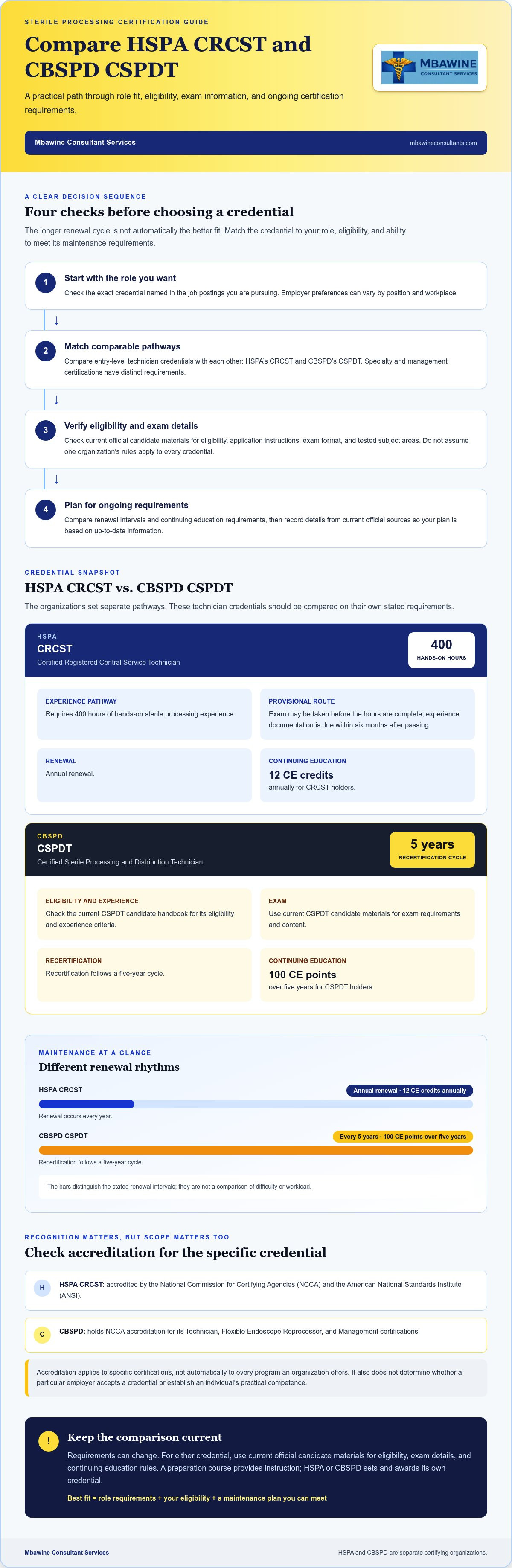
For HSPA’s CRCST, candidates need 400 hours of hands-on sterile processing experience. HSPA’s provisional route allows a candidate to take the exam before completing those hours, then submit documentation of the required experience within six months after passing. The CSPDT is CBSPD’s technician credential; consult the current CSPDT candidate handbook for its eligibility criteria. Specialty and management credentials have distinct requirements, so don’t assume the technician pathway applies to them.
| Comparison point | HSPA CRCST | CBSPD CSPDT |
|---|---|---|
| Eligibility and experience | Requires 400 hands-on hours; the provisional route permits exam-taking before hours are complete, with documentation due within six months after passing. | Check the current CSPDT candidate handbook for its eligibility and experience criteria. |
| Exam | Use the current CRCST candidate materials for exam requirements and content. | Use the current CSPDT candidate materials for exam requirements and content. |
| Renewal interval | Annual renewal. | Recertification every five years. |
| Continuing education | 12 CE credits annually for CRCST holders. | 100 CE points over five years for CSPDT holders. |
For either credential, official exam materials are the source for current format, application instructions, and tested subject areas. Use the current exam outline rather than relying on third-party summaries. Professional references, including the AAMI Standards for Medical Instrumentation, can provide context for sterile processing practice, but the certifying organization’s exam outline determines what candidates should prepare for.
In brief: CRCST requires annual renewal and 12 CE credits each year, while CSPDT recertification occurs every five years and requires 100 CE points across that cycle. These schedules describe how maintenance is structured, not which credential is easier to earn or keep. HSPA holders with more than one HSPA certification must complete an additional six CE credits per year for each extra certification. CBSPD’s five-year point requirements also vary by credential: CSPM requires 150 points, while CSPDT, CASSPT, CFER, and CSIS require 100.
Keep a record of the credential, handbook version, eligibility evidence, renewal interval, and CE rules you’re using. Revisit the official credential page before applying or renewing. After selecting a pathway, explore sterile processing class enrollment to add structured learning to your preparation.
The most useful credential connects your qualifications to the work you intend to do and matches the requirements of the roles you’re targeting. In the HSPA certification vs CBSPD decision, compare the exact credential names in relevant job postings, not just the organizations’ reputations. Requirements vary by employer, facility, and position, so don’t treat one listing as a universal preference.
HSPA’s CRCST may align with an entry-level goal in central service or sterile processing, particularly when the roles you’re pursuing name CRCST or accept it among their required credentials. Before planning an exam date, compare the experience pathway with your own circumstances. For a longer-term specialty direction, HSPA also offers credentials such as CIS for instrument specialization, CER for endoscope reprocessing, and CHL for leadership.
CBSPD’s CSPDT may suit candidates whose target technician positions specify that credential or accept it as an alternative. Its other credentials address distinct responsibilities, including ambulatory surgery sterile processing (CASSPT), surgical instrument specialization (CSIS), flexible endoscope reprocessing (CFER), and management (CSPM). Choose a specialty or management pathway because it fits your experience and intended duties, not simply because the title sounds like a faster route.
Neither certification guarantees employment, promotion, or a particular scope of responsibility. Employers make hiring and advancement decisions using their own criteria, which may include relevant experience, demonstrated competencies, and other qualifications in addition to certification. Treat a credential as one part of a broader career plan.
Use this decision matrix to narrow your options before committing to an application:
For example, if your preferred job postings name CRCST and you meet its pathway requirements, focus your preparation there. If a role specifies CSPDT or accepts it alongside another credential, compare that option with your eligibility and maintenance preferences. Record the exact credential language from several relevant postings, then verify the requirements in the certifying organization’s current materials. This turns a career preference into a documented decision instead of relying on broad claims about which certification employers value most.
A structured comparison turns a broad credential question into a decision you can document. For the HSPA certification vs CBSPD choice, assess your intended role, employer requirements, your eligibility, and your ability to manage exam preparation and renewal obligations. Review current job postings from across the United States, keeping in mind that requirements differ among employers and positions.
Work through these steps in order, recording the source and date you checked each requirement. Use the current official candidate handbook and credential page for the specific certification rather than older comparison articles or unsourced summaries.
After confirming the credential and its current exam outline, use the listed subject areas to organize your study. Compare each topic with your existing knowledge, identify areas that need focused review, and set a practical sequence for addressing them. This is more targeted than studying from a broad collection of materials without a clear connection to the selected exam.
For CRCST candidates, the CRCST certification preparation page provides a credential-focused starting point. Mbawine Consultant Services also offers in-person and online sterile processing classes designed to prepare professionals for certification. The classes provide structured education, but the relevant credentialing organization awards certification, and preparation cannot guarantee an exam result.
Keep a simple decision record with the credential title, handbook version or access date, eligibility evidence, target-posting requirements, exam outline, and renewal rules. If CRCST is your chosen pathway, enroll in sterile processing classes to begin structured preparation.
After comparing the HSPA certification vs CBSPD pathways and selecting a credential, base your preparation on that certification’s requirements and exam outline. Formal instruction can organize sterile processing concepts into a coherent course of study, clarify technical terminology, and highlight areas for further review. It supports learning, but doesn’t replace the certifying organization’s application, examination, or credential-awarding process.
Start with the current exam outline for your chosen credential. Use its objectives to organize review rather than assuming preparation for one certification automatically covers another. Build a study plan around your existing knowledge and work experience, then prioritize concepts that are unfamiliar or difficult to apply. This keeps preparation focused and connects technical terms to the processes they describe.
A systematic review can include:
Preparation works best when it reflects the candidate’s starting point. Someone with substantial hands-on experience may need to reinforce less familiar concepts, while a newer learner may need to build a broader foundation before concentrating on individual exam objectives. In either case, use current official exam materials to guide the scope of study. A course or study resource cannot guarantee a passing result.
Mbawine Consultant Services offers in-person and online sterile processing classes designed to prepare professionals for certification. Structured instruction provides a framework for studying core concepts and organizing review, while candidates remain responsible for confirming the requirements of their selected HSPA or CBSPD credential. Mbawine Consultant Services provides education, not certification; the relevant organization awards the credential after its requirements are met.
If you’re comparing learning options, the sterile processing classes certification guide can help you consider how structured education fits into your preparation. Once you’ve chosen a credential and reviewed its current exam outline, use that outline to direct your study and identify where instruction would be most valuable.
With your pathway selected and preparation priorities defined, take the next step by exploring enrollment in sterile processing classes. Focused instruction and a deliberate study plan can support your preparation while keeping credential requirements in view.
Turn your credential choice into a preparation plan you can maintain: work from its current exam objectives, make time for topics that need more study, and keep the certification requirements accessible as you progress. The HSPA certification vs CBSPD choice is a starting point for professional development, not a guarantee of a particular career outcome.
Mbawine Consultant Services offers specialized sterile processing education through in-person and online classes to support certification preparation. Instruction can help structure your study, while the certifying organization awards its credential. Choose the learning format that fits your needs and begin with a clear plan.
Enroll in sterile processing classes and take a purposeful next step toward your certification goals. A focused preparation plan can help build your foundation for continued growth in the field.
Neither is universally better. In the HSPA certification vs CBSPD comparison, the right fit depends on credential-specific eligibility, your intended role, employer requirements, and maintenance rules. Accreditation or renewal differences alone don’t establish career value: one credential may match a position’s requirements more closely than another. Compare current official requirements for the exact certifications and review relevant job postings, distinguishing mandatory qualifications from preferred ones. Certification may support your qualifications, but it can’t guarantee employment.
It may be possible to hold certifications from both organizations if you independently meet the current eligibility and examination requirements for each credential. Earning a technician certification from one organization doesn’t automatically grant a credential from the other. Before pursuing both, compare the current rules for each certification and consider whether it relates to your responsibilities, career plans, or employer’s stated qualifications. Track each credential’s maintenance obligations separately.
The total expense can include application, examination, renewal, and preparation costs, and official amounts may change. There isn’t one combined fee for every HSPA or CBSPD credential. Check the current fee schedule for the specific certification and application you’re considering, and separate examination or renewal charges from education and study-material expenses. This helps you plan without relying on outdated figures or applying another credential’s fee.
The consequences depend on the certifying organization and the specific credential. A certification may expire, and the organization may set a defined reinstatement process, but don’t assume its availability or conditions. Check the current renewal policy for the credential, including deadlines, continuing-education requirements, and steps that apply after a missed renewal. If your credential is nearing its deadline, use the official policy to identify the actions and timing that apply to your situation.
Employer acceptance varies by facility, position, and job posting, so don’t assume the credentials are treated identically everywhere. For roles you’re considering, read the minimum and preferred qualifications closely. A posting may name one credential, list alternatives, or emphasize experience. Compare several relevant postings to see what those employers specify. Meeting a certification requirement can support an application, but certification alone doesn’t guarantee a job offer.
No. A class can provide structured education and exam preparation, but certification is awarded by the relevant organization after you meet its requirements, including any required application and examination steps. Course completion is separate from eligibility, taking the exam, and receiving a credential. Mbawine Consultant Services offers in-person and online sterile processing classes to support preparation; enrollment doesn’t guarantee a passing result or certification. Confirm the current requirements for your chosen credential before applying.

Article by
Mba Akuribila
Mba‑Akuribila is a healthcare leader, educator, and founder of Mbawine Consultants, a Bronx‑based institution recognized nationwide for advancing excellence in sterile processing and allied health workforce development. Born in Bongo in Ghana’s Upper East Region, his journey from rural beginnings to national impact reflects a lifelong commitment to service, empowerment, and community advancement.
For over two decades, he has trained sterile processing employees, mentored, and placed thousands of healthcare professionals across the United States. Through Mbawine Consultants, he established one of the country’s most trusted Sterile Processing Certification Test Prep Programs, preparing new Americans and career‑changers for successful entry into the field. The organization, as at 2026, has graduated more than 15,000 sterile processing technicians who now serve in hospitals, ambulatory centers, dental practices, and reprocessing facilities nationwide.
Under his leadership, Mbawine Consultants has expanded into a full Healthcare Staffing Agency, connecting nurses and allied health professionals to meaningful employment opportunities. His team also provides Interim Management Services, supporting hospitals and surgical centers with experienced leaders who stabilize operations, strengthen compliance, and improve workflow efficiency.
As a former surgical technician, sterile processing manager, educator, and system‑wide director, Mba‑Akuribila brings deep expertise to Sterile Processing Consulting, helping healthcare facilities elevate quality, safety, and regulatory readiness.
His work in the United States and Ghana continues to reflect his core philosophy: service above self, opportunity for all, and excellence without compromise.


