

Technical mastery helps keep sterile processing operations compliant, but leadership requires a broader view of how decisions, staffing, and systems support patient safety. The hspa chl certification marks a move from procedural expertise to strategic oversight. Understanding eligibility and the leadership-focused exam can help you plan that next step.
If references to a 150-hour leadership requirement have left you unsure where you stand, the updated eligibility standards taking effect in October 2026 offer clearer criteria. Candidates need a current CRCST credential and must meet at least one qualifying experience or education pathway. If you have focused mainly on clinical and technical work, management concepts may feel less familiar, but leadership skills can be developed systematically.
This guide explains the eligibility pathways, experience and education standards, and a structured approach to preparing for the CHL exam. You’ll also learn how its four content domains assess planning, organizing, leading, and controlling, and how specialized sterile processing education can help connect technical knowledge with leadership concepts.
The Certified Healthcare Leader (CHL) credential is a professional certification for sterile processing department (SPD) management, offered by the Healthcare Sterile Processing Association (HSPA). It recognizes leadership knowledge beyond the technical competencies demonstrated through the Certified Registered Central Service Technician (CRCST) credential. In 2026, this distinction matters to SPD leaders responsible for coordinating people and processes while attending to quality, compliance, and patient safety.
A CHL may oversee sterilization workflows, personnel, departmental priorities, and systems used to monitor performance. The role goes beyond confirming that tasks are complete. Leaders organize resources, communicate expectations, address operational concerns, and help ensure that department practices align with applicable standards and institutional policies. Certification does not guarantee a particular outcome, but leadership knowledge can provide a more structured approach to these responsibilities.
Moving from technical work to departmental oversight changes the scope of responsibility. A technician applies procedures to individual tasks; a leader considers how staffing, workflow, training, equipment processes, and communication work together across the department. That broader perspective can help SPD professionals explain operational needs to institutional decision-makers and advocate for the department’s role in safe care.
Healthcare facilities need leaders who can combine technical understanding with management judgment. The CHL offers a structured way to develop and demonstrate leadership knowledge, but it does not guarantee promotion or employment. For professionals seeking advancement, it can support a pathway into supervisory and management responsibilities.
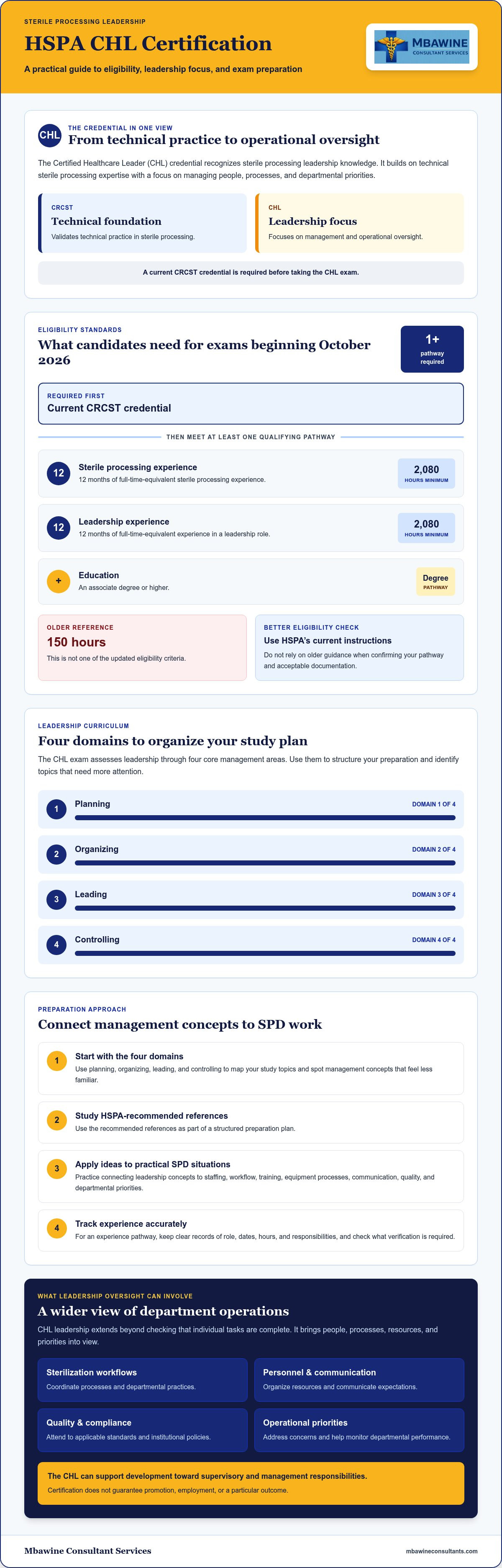
The CRCST establishes a technical foundation in sterile processing. The CHL builds on that foundation with management knowledge, including planning, organizing, leading, and controlling. HSPA requires candidates to hold a current CRCST credential before taking the CHL exam. The credentials serve different purposes: one validates technical practice, while the other focuses on leadership and operational oversight.
For exams beginning in October 2026, candidates must also meet at least one updated eligibility pathway: 12 months of full-time-equivalent experience in sterile processing, 12 months in a leadership role, or an associate degree or higher. Each experience pathway requires at least 2,080 hours. The often-mentioned 150-hour leadership milestone is not one of these updated criteria, so check HSPA’s current requirements instead of relying on older guidance. Professionals building their technical foundation can review CRCST certification preparation as a separate step toward leadership advancement.
The 150-hour leadership figure should not be treated as the current CHL eligibility standard. For exams beginning in October 2026, HSPA requires candidates to hold a current CRCST credential and meet at least one of three pathways: 12 months of full-time-equivalent sterile processing experience, 12 months of full-time-equivalent leadership experience, or an associate degree or higher. Each experience pathway requires at least 2,080 hours. Because the hspa chl certification requirements have changed, confirm your pathway against HSPA’s current instructions instead of relying on older references to 150 hours.
Leadership experience is only one option. If you plan to use it, keep clear records of your role, dates, hours, and responsibilities. Ask your department manager or employer what verification they can provide. Staff training, quality audits, and workflow improvement may help describe leadership work, but do not assume any single activity automatically qualifies. HSPA’s current eligibility guidance determines what documentation is acceptable.
If you do not have a formal management title, ask your supervisor about appropriate leadership assignments, such as coordinating a training activity or contributing to a process review. Record your contribution and time accurately, then ask the responsible manager to verify the information if HSPA requires it. This can help you assess whether your experience fits the leadership pathway while building skills beyond technical practice. For context on the work that underpins this career path, see Mayo Clinic’s overview of a career as a Central Service Technician.
Before applying, use this verification sequence:
The initial and retake exam fee is $140. Verify current payment and documentation instructions directly with HSPA before submitting an application. If structured certification preparation would help you assess your readiness, review sterile processing certification classes as you plan your next steps.
The updated CHL exam assesses leadership judgment through four domains, rather than treating strategic management, human resources, operations, and finance as separate exam categories. The 2025 content outline assigns 30% to Planning and Decision Making, 25% to Organizing, 30% to Leading, and 15% to Controlling. Use these weights to prioritize study time: planning and leading together account for the largest share, while organizing and controlling remain important parts of effective management.
Financial management, recruitment, technology integration, and departmental goals are relevant leadership topics, but they should be studied in relation to the official domains rather than treated as separate published exam weights. This distinction helps candidates prepare for the hspa chl certification exam without confusing topic areas with the formal content outline.
CHL preparation connects management decisions to technical standards and documented practices. HSPA’s updated exam references include the Sterile Processing Leadership Manual (5th Edition), the Sterile Processing Technical Manual (9th Edition), ANSI/AAMI ST79 (2017), and AORN’s Perioperative Standards and Recommended Practices (2017 edition). Leaders use this knowledge to support policies and procedures consistent with applicable standards and institutional requirements, and to explain department processes during reviews. Rather than relying on memory alone, study how a leader applies references to decisions, oversight, and corrective action.
Leadership also involves turning expectations into consistent staff practice. A manager may identify training needs, reinforce procedures, provide performance feedback, and address conflict in a professional way that keeps attention on safe work. For example, when a workflow concern arises, a leader can clarify the process, hear staff perspectives, and consider whether training, clearer communication, or further review is appropriate. This goes beyond technical execution to support a culture of learning and accountability.
Mbawine Consultant Services offers sterile processing classes for certification preparation, with online and in-person options. These classes can help professionals connect technical expertise with leadership concepts.
Preparing for the CHL exam means doing more than reviewing technical procedures. You need to apply leadership concepts to sterile processing situations, including decisions about staffing, workflow, priorities, and departmental performance. Start with the 2025 CHL exam content outline, then plan study time across its four domains: Planning and Decision Making (30%), Organizing (25%), Leading (30%), and Controlling (15%). Use the weights to set priorities, but cover every domain.
Use the HSPA Sterile Processing Leadership Manual as your primary academic resource, and consult HSPA’s current candidate materials for any additional recommended references or courses, including the Boxed Course for Healthcare Leadership if it is available to you. As you study, translate technical SPD terminology into management decisions. For example, when reviewing a processing delay, consider not only the workflow issue but also how a leader identifies contributing factors, weighs options, communicates a decision, and evaluates the result.
Instead of rereading passively, summarize each topic in your own words, apply it to a realistic departmental scenario, and note what you need to review. Add timed practice as your preparation progresses. The exam has 150 multiple-choice questions and a three-hour limit, including 125 scored questions and 25 unscored pretest questions. Timed practice can help you manage pacing and concentration, but it should reinforce learning rather than replace understanding.
Conversations with current CHL holders or experienced SPD leaders can make management principles more concrete. Ask how they approach staff development, operational challenges, and communication about departmental needs. Then compare those insights with the exam outline and HSPA references. Mbawine Consultant Services offers sterile processing education as well as interim management and consulting services; its overview of sterile processing consultant services provides additional context on departmental leadership. Use professional networks and official HSPA communications to confirm current exam information instead of relying on informal reports of exam trends.
Structured instruction can also help connect technical knowledge with leadership concepts. Explore sterile processing classes for certification preparation to learn about online and in-person options. A focused course can complement independent study by helping you organize difficult concepts and apply them to SPD scenarios. Review the available certification preparation classes as you plan your approach to the hspa chl certification exam.
Earning the CHL can strengthen your professional profile, but the credential is most useful alongside demonstrated results in sterile processing leadership. In a performance review or salary discussion, connect your certification to specific responsibilities and contributions, such as improving communication, supporting staff development, or helping meet departmental objectives. The credential may support your case for advancement, but it does not guarantee a promotion or a particular salary.
For some professionals, a next step may be interim SPD management, where they apply leadership skills in a temporary management role. This work can broaden operational perspective and help build a record of leadership across different departmental needs. Over time, qualified leaders may pursue broader responsibilities, including multi-facility management or participation in institutional workgroups related to infection prevention, depending on their experience and employer requirements. Interim SPD management is one example of how leadership can contribute to institutional operations.
CHL certification requires annual renewal. Holders must keep an active CRCST certification, complete continuing education credits, and pay the applicable renewal fee. Check HSPA’s current instructions for specific renewal requirements. Beyond renewal, experienced CHL professionals can support the next generation by mentoring technicians, sharing practical leadership perspectives, and helping staff understand how daily technical work connects to departmental performance and patient safety.
Career growth may also involve healthcare consulting or staffing opportunities, depending on a professional’s qualifications and goals. A CHL can provide a relevant leadership foundation, while experience and demonstrated competence remain essential when pursuing these paths. Treat certification as one part of a career portfolio, not a substitute for operational judgment or continued development.
Mbawine Consultant Services offers sterile processing education, including classes designed for certification preparation, alongside interim management and consulting services. Its sterile processing education programs include online and in-person class options to help professionals connect technical knowledge with leadership concepts. Continued learning can help you refine your approach as your responsibilities expand.
If you are preparing for the hspa chl certification, consider how structured sterile processing education can support your study plan and leadership development.
The CHL pathway calls for more than technical expertise. Candidates need to verify that they meet HSPA’s current eligibility requirements, prepare across the four exam domains, and build confidence applying management concepts to sterile processing operations. After certification, maintaining an active CRCST credential and completing annual renewal requirements help sustain that professional standing.
The hspa chl certification can support a move toward greater responsibility, but continued learning and demonstrated leadership help turn the credential into professional growth. Mbawine Consultant Services offers sterile processing classes designed for certification preparation, alongside interim management and consulting services in SPD operations.
Strengthen your preparation with specialized education in healthcare sterilization standards and sterile processing leadership. Explore Mbawine’s sterile processing classes for certification preparation and choose an online or in-person format that fits your needs. Your technical experience is a strong foundation for developing the leadership skills required in SPD operations.
Yes. Candidates must hold a current CRCST credential to qualify for the CHL exam. For exams beginning in October 2026, they must also meet at least one additional eligibility pathway: qualifying sterile processing experience, qualifying leadership experience, or an associate degree or higher. Check that your CRCST status is active and review HSPA’s current requirements before applying, since an expired credential can affect eligibility.
The 150-hour figure is not the leadership experience requirement in HSPA’s updated eligibility standards for exams beginning in October 2026. The leadership pathway requires at least 12 months of full-time-equivalent leadership experience, totaling a minimum of 2,080 hours. Staff training, quality audits, or workflow improvement may be relevant when describing leadership responsibilities, but confirm with HSPA whether your experience and documentation meet its criteria.
CHL certification requires annual renewal. Holders must keep an active CRCST certification, complete continuing education credits, and pay the renewal fee. Check HSPA’s current renewal instructions for continuing education requirements, deadlines, and submission procedures. Plan ahead to keep your prerequisite credential active and complete renewal requirements within HSPA’s specified timeframe.
The updated 2026 eligibility rules do not specify a 150-hour leadership threshold. For exams beginning in October 2026, you must hold a current CRCST and meet at least one pathway: 12 months of full-time-equivalent sterile processing experience, 12 months of full-time-equivalent leadership experience, or an associate degree or higher. Confirm your eligibility before applying. The degree pathway does not require either experience pathway.
The 2026 exam information summarized in this guide does not specify a passing score. Avoid relying on unofficial figures that may be outdated or lack context about how HSPA reports results. Before testing, review the current CHL candidate handbook or contact HSPA for official scoring information. Focus your preparation on the published content outline and all four domains rather than an unverified score threshold.
Yes. Mbawine Consultant Services offers online and in-person sterile processing classes designed for certification preparation. A structured class can help you connect technical knowledge with leadership concepts and organize your study around the CHL exam outline. Review the class information to confirm the format and details that suit your needs. Pair instruction with HSPA’s current references and regular practice applying management concepts to SPD scenarios.
Financial management and budgeting are relevant to SPD leadership, but they are not listed as separate weighted domains in the 2025 CHL exam content outline. The four domains are Planning and Decision Making, Organizing, Leading, and Controlling. Prepare to consider financial topics within those broader management responsibilities, such as how resource decisions relate to departmental goals, rather than assuming budgeting has its own published exam percentage.
The confirmed 2026 fee information lists the initial CHL exam and a retake at $140 each. It does not specify separate prices for HSPA members and non-members, so do not assume a membership discount or difference. Check HSPA’s current application and payment information before registering for the fee that applies to your exam date and any updates to the payment process.

Article by
Mba Akuribila
Mba‑Akuribila is a healthcare leader, educator, and founder of Mbawine Consultants, a Bronx‑based institution recognized nationwide for advancing excellence in sterile processing and allied health workforce development. Born in Bongo in Ghana’s Upper East Region, his journey from rural beginnings to national impact reflects a lifelong commitment to service, empowerment, and community advancement.
For over two decades, he has trained sterile processing employees, mentored, and placed thousands of healthcare professionals across the United States. Through Mbawine Consultants, he established one of the country’s most trusted Sterile Processing Certification Test Prep Programs, preparing new Americans and career‑changers for successful entry into the field. The organization, as at 2026, has graduated more than 15,000 sterile processing technicians who now serve in hospitals, ambulatory centers, dental practices, and reprocessing facilities nationwide.
Under his leadership, Mbawine Consultants has expanded into a full Healthcare Staffing Agency, connecting nurses and allied health professionals to meaningful employment opportunities. His team also provides Interim Management Services, supporting hospitals and surgical centers with experienced leaders who stabilize operations, strengthen compliance, and improve workflow efficiency.
As a former surgical technician, sterile processing manager, educator, and system‑wide director, Mba‑Akuribila brings deep expertise to Sterile Processing Consulting, helping healthcare facilities elevate quality, safety, and regulatory readiness.
His work in the United States and Ghana continues to reflect his core philosophy: service above self, opportunity for all, and excellence without compromise.


