

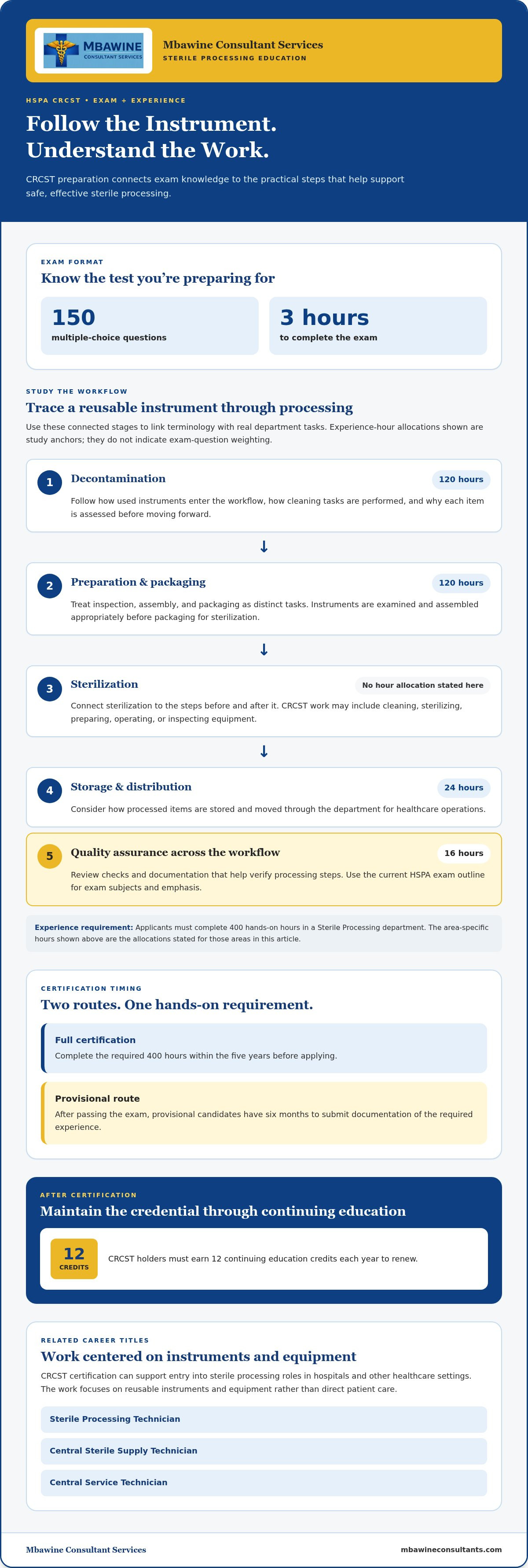
The HSPA CRCST exam contains 150 multiple-choice questions, and candidates have three hours to complete it. Earning the credential also requires hands-on experience, so preparation involves more than learning exam terminology: it means understanding the work and processes that support safe, effective sterile processing.
If you’re considering HSPA CRCST certification, start by understanding what the exam covers and how the experience requirement fits your timeline. This article explains the practical skills covered in CRCST preparation, the exam format and timing, and the difference between provisional and full certification.
You’ll also learn how continuing education helps maintain the credential and what career paths CRCST certification may support. With the requirements and options clear, you can make a more informed decision about your next step in sterile processing.
The HSPA CRCST credential can support entry into sterile processing roles in hospitals and other healthcare settings. Common job titles include Sterile Processing Technician, Central Sterile Supply Technician, and Central Service Technician. The work centers on processing reusable instruments and equipment, rather than providing direct patient care. HSPA serves more than 61,000 members and certification holders worldwide, reflecting the credential’s place in a broad professional community.
CRCST certification depends on both an exam and documented hands-on experience. Applicants must complete 400 hours in a Sterile Processing department. For full certification, those hours must be completed during the five years before applying. Provisional candidates who pass the exam have six months to submit documentation of the required experience. That structure can help candidates plan an initial technician role while meeting the practical requirement.
These titles describe related work, but employers define duties according to each department’s structure. A technician may develop deeper expertise in areas such as instrument assembly or quality assurance. With experience, some professionals take on workflow coordination or staff oversight. These opportunities depend on the facility’s duties and structure, not on CRCST certification alone.
The range applies to each listed title, not to every credential holder. Job setting, responsibilities, experience, and local employment conditions can affect compensation. When assessing a position, compare its duties and requirements as well as its salary.
The credential also requires ongoing professional development. CRCST holders must earn 12 continuing education credits each year to renew. This continuing requirement connects certification to sustained learning after the exam, as sterile processing professionals maintain and develop their knowledge. For candidates assessing the pathway, the practical sequence is clear: pursue a relevant department role, complete the required hands-on hours, document them within the applicable timeframe, and maintain the credential through annual education.
HSPA began formal certification of Sterile Processing technicians in 1971, when the organization was known as IAHCSMM. Candidates comparing training and certification preparation can review the CRCST program information as they map their next steps toward a sterile processing role.
Prepare with HSPA’s current candidate materials and exam content outline, using each topic to guide focused review. Connect terminology to practical examples, such as tracing an instrument from decontamination through inspection, packaging, sterilization, and storage.
A useful study plan follows the main stages of sterile processing. The experience requirement identifies key areas: decontamination, preparation and packaging, storage and distribution, and quality assurance. These areas also provide a practical framework for understanding how department tasks connect.
These experience-hour allocations are useful study anchors, but they do not indicate how exam questions are weighted. Use them to identify practical areas to review, then consult the HSPA exam outline for its subjects and emphasis. For example, when studying packaging, connect it to inspection and assembly instead of memorizing packaging terms in isolation.
Certified Registered Central Service Technicians may clean, sterilize, install, or prepare laboratory and healthcare equipment. They may also operate or inspect equipment and perform routine tasks. Test your understanding with examples: identify the task, the equipment involved, and where it fits in the processing sequence. This links factual recall to technicians’ responsibilities.
Divide study sessions into topic groups and note which areas need another review. A practice question about a processed instrument, for instance, can prompt you to consider its cleaning and inspection, packaging, and related quality checks. When an answer reveals a gap, return to the relevant HSPA material. Organize notes by domain to separate unfamiliar terminology from uncertainty about the work sequence.
For guided review alongside independent study, consider enrolling in Sterile Processing classes to build knowledge around the tasks and processes represented in the exam content.
CRCST training connects equipment handling with the sequence of sterile processing work. Certified Registered Central Service Technicians may clean, sterilize, install, or inspect healthcare and laboratory equipment. They may also perform routine tasks and operate equipment. For example, an instrument must be cleaned and prepared before it can move through later processing stages.
Cleaning requires attention to the item and the task being performed. In decontamination, technicians handle used instruments as they enter the processing workflow. Training helps learners understand where this work fits and why a step cannot be treated as interchangeable with inspection or packaging. The hands-on experience requirement includes 120 hours in decontamination, making this a substantial area of practical preparation.
Equipment operation and inspection add another practical dimension. A technician may operate equipment as part of routine work, then inspect it or the processed items involved. Training should connect those actions to the work sequence instead of treating equipment names as isolated vocabulary. For example, identify which task comes before packaging and which comes after it.
Process awareness matters because sterile processing depends on connected tasks. An instrument that reaches packaging has already passed through earlier work; later storage and distribution depend on the processing sequence being maintained. HSPA states that 80% of Sterile Processing work is hands-on experience in a hospital setting. That figure highlights why practical familiarity complements classroom study.
Assess readiness by explaining each task in sequence. Trace an instrument through decontamination, preparation, packaging, quality assurance, and storage or distribution. At each stage, identify the technician’s action, the equipment involved, and the next step. This shows whether a learner understands how department responsibilities connect, rather than simply recalling terms.
Training also helps learners distinguish between tasks. Cleaning is different from inspecting; assembling is different from packaging; operating equipment is different from reviewing its output. Use examples from each stage to explain these differences accurately. When reviewing a missed question, identify the process step and revisit how it relates to the steps before and after it.
Start by reviewing HSPA’s CRCST application requirements and identifying the certification route that applies to you. Candidates seeking full certification must complete the required hands-on experience before applying. Provisional candidates take the exam first, then document their experience within the permitted timeframe. Your chosen route determines what evidence to prepare.
HSPA advises applicants to finish studying before submitting an exam application because the 90-day testing eligibility period begins when the application is received. Application processing takes three to four weeks. After HSPA approves an exam application, applicants have a 120-day eligibility window to schedule the exam with Prometric. Because the listed timing rules differ, follow the eligibility dates in your application and approval notices.
Most Prometric test centers are open at least six days a week for HSPA certification exams. This may give you several scheduling options, but appointments depend on each center’s availability. Plan around your eligibility window instead of waiting until its final days to schedule. The exam is computer-based, so review your appointment information and be ready to follow the test center’s procedures.
Keep copies of your application, approval, and any experience records you submit. If HSPA requests verification, use those records to answer the request accurately and within the 120-day response period. Applicants may appeal an eligibility decision by sending written notice within 30 days of the decision’s timestamp. Record that timestamp so the appeal deadline can be calculated correctly.
For provisional candidates, passing the exam does not complete the experience requirement. They must submit documentation of 400 hands-on hours within six months of passing. Candidates who miss that deadline have their provisional certification revoked and must retake the exam. Treat the experience submission as a separate application milestone, with records prepared before the six-month period expires.
HSPA accepts paper CRCST applications through August 15, 2025, except for applications paid by check or money order. CRCST application processing takes 3-4 weeks, so plan accordingly.
That fee covers the exam attempt, not preparation classes or other personal expenses. Use the same exam-fee amount when budgeting for an initial sitting or a retake, and account for training expenses separately.
Application timing matters because missing the testing window can mean paying again. After HSPA approves an application, candidates have a 120-day eligibility window to schedule the exam with Prometric. Applicants who miss that window forfeit the exam fee and must submit a new application with full payment to test again. Scheduling promptly helps protect the original fee.
HSPA recommends scheduling within the first 45 days of eligibility to improve the chance of finding a suitable appointment. Most Prometric test centers are open at least six days a week for HSPA certification exams. Appointment times still depend on the center’s schedule, so candidates should treat booking as an early administrative task, not a final step.
Before submitting an application, finish studying and prepare the required application information. HSPA advises applicants to complete studying first because the 90-day testing eligibility period begins when the application is received. Application processing takes three to four weeks. Since the guidance also describes a 120-day window after approval, follow the eligibility period attached to your application and approval.
These amounts apply to the exam, not to the broader process of becoming certified. Candidates should separately plan their study time, exam scheduling, and hands-on experience documentation. Provisional candidates, for example, must submit documentation of their 400 hands-on experience hours within six months of passing. That requirement involves planning and recordkeeping, distinct from paying for the exam.
To plan your budget, first decide whether you’re preparing for an initial attempt or a retake. Submit your application when you’re ready to use the resulting eligibility period. Schedule early, record your appointment details, and keep track of the eligibility deadline. If you need a retake, include its separate exam fee and application process in your plans before selecting another test date.
Applicants who qualify under the Americans with Disabilities Act can receive testing accommodations at a designated testing center at no additional cost. CRCST applicants with provisional certification who fail to complete the hands-on requirement within 6 months will have their certification revoked and must retake the exam.
Mbawine Consultant Services offers Sterile Processing classes for professionals building their knowledge of department workflows and certification topics. The classes provide structured instruction alongside independent study, helping learners connect exam concepts with practical processes such as instrument preparation, packaging, and quality assurance.
Healthcare facilities can turn to Mbawine Consultant Services for Healthcare Temp staffing, Interim Management, and Healthcare Sterile Processing Consulting. These services address staffing and operational needs, while the classes focus on professional learning. Choose the support that fits your goal, whether you’re strengthening your own preparation or building department capability.
To discuss Sterile Processing classes or related support, contact Mbawine Consultant Services or visit mbawineconsultants.com.
Choosing the HSPA CRCST pathway means committing to disciplined work, practical competence, and continued learning. Turn that commitment into a preparation plan suited to your experience and the responsibilities you want to pursue. Identify where you need structured learning, then set aside regular time to build your understanding of sterile processing practice.
For learners seeking instruction alongside independent preparation, Mbawine Consultant Services offers Sterile Processing classes. A focused learning plan can give your certification preparation direction and help connect study topics to work performed in a sterile processing department.
Explore enrollment for Sterile Processing classes and take a deliberate step toward your professional goals. Consistent preparation and attention to the standards of the field can help you move forward with purpose.
HSPA stands for the Healthcare Sterile Processing Association, and CRCST stands for Certified Registered Central Service Technician. The HSPA CRCST credential identifies professionals working in central service and sterile processing. For example, a CRCST may clean, inspect, prepare, or sterilize healthcare equipment. The association was formerly known as IAHCSMM, the name used when formal technician certification began. These terms distinguish the certifying organization from the professional credential.
Applicants pursue either full certification after completing the required experience or provisional certification after passing the exam. Full certification requires 400 hands-on hours completed during the five years before applying. Provisional candidates must submit documentation of their 400 hours within six months of passing. Before applying, identify which route matches your experience and organize records that show your work in a Sterile Processing department.
The exam covers knowledge related to sterile processing workflows, including decontamination, instrument preparation and packaging, storage and distribution, and quality assurance. These topics connect to practical responsibilities such as cleaning used instruments, inspecting and assembling items, and tracking processed supplies. For focused review, follow HSPA’s current exam outline and connect each topic to a workflow example instead of relying only on memorized terminology.
The computer-based exam contains 150 multiple-choice questions, with three hours to complete them. A 15-minute tutorial comes before the exam. The passing score should be taken from HSPA’s current candidate guidance; don’t assume a percentage based solely on the question count. During preparation, practise reading each question carefully and allocating time so you can consider every answer before submitting the exam.
Applicants need 400 hands-on hours in a Sterile Processing department. The experience includes 120 hours in decontamination, 120 hours preparing and packaging instruments, 24 hours in storage and distribution, and 16 hours in quality assurance processes. Keep an organized record of completed work and submit documentation through HSPA’s required process. Provisional candidates must submit their hours within six months of passing the exam.
CRCST certification can support applications for roles such as Sterile Processing Technician, Central Sterile Supply Technician, and Central Service Technician. These figures are not individual salary guarantees. Responsibilities, experience, facility setting, and employment conditions can affect compensation. When evaluating opportunities, compare the actual duties attached to a position, not just its title.

Article by
Mba Akuribila
Mba‑Akuribila is a healthcare leader, educator, and founder of Mbawine Consultants, a Bronx‑based institution recognized nationwide for advancing excellence in sterile processing and allied health workforce development. Born in Bongo in Ghana’s Upper East Region, his journey from rural beginnings to national impact reflects a lifelong commitment to service, empowerment, and community advancement.
For over two decades, he has trained sterile processing employees, mentored, and placed thousands of healthcare professionals across the United States. Through Mbawine Consultants, he established one of the country’s most trusted Sterile Processing Certification Test Prep Programs, preparing new Americans and career‑changers for successful entry into the field. The organization, as at 2026, has graduated more than 15,000 sterile processing technicians who now serve in hospitals, ambulatory centers, dental practices, and reprocessing facilities nationwide.
Under his leadership, Mbawine Consultants has expanded into a full Healthcare Staffing Agency, connecting nurses and allied health professionals to meaningful employment opportunities. His team also provides Interim Management Services, supporting hospitals and surgical centers with experienced leaders who stabilize operations, strengthen compliance, and improve workflow efficiency.
As a former surgical technician, sterile processing manager, educator, and system‑wide director, Mba‑Akuribila brings deep expertise to Sterile Processing Consulting, helping healthcare facilities elevate quality, safety, and regulatory readiness.
His work in the United States and Ghana continues to reflect his core philosophy: service above self, opportunity for all, and excellence without compromise.


