

What if improving SPD department efficiency depends less on asking staff to move faster and more on finding where capacity, workflow, or competency is limiting reliable output? Processing delays and backlogs can disrupt coordination with surgical services, but increasing throughput must never come at the expense of validated processes, quality, or patient safety. Staffing, equipment, space, and handoffs often interact, making the source of a delay difficult to pinpoint.
This guide shows how to locate operational bottlenecks by observing workflow and reviewing performance information, then prioritize improvements that support consistent processing. You’ll see how capacity, standard work, equipment, and staff competency affect department output, and how management practices help improvements last. Staff education and operational support, including consulting, interim management, and temporary staffing, can address needs identified through that assessment.
Efficiency in a sterile processing department is not simply the number of instruments completed during a shift. It means processing the right devices reliably and in time for operational needs, while maintaining required quality, safety, and documentation at every stage. An efficient department produces dependable work without shortcuts or unresolved tasks routinely carried into the next shift.
A Sterile Processing Department connects reusable medical devices with the clinical teams that need them. Its output supports coordination with operating room teams, whose schedules depend on appropriate instruments being ready. A delay or backlog may require teams to adjust plans, locate alternatives, or spend time coordinating status. The effect depends on the circumstances and available resources.
Capacity, workflow, and reliable output are interdependent. Staffing and equipment shape how much work the department can handle, process design affects how smoothly items move between stages, and consistent execution determines whether completed work meets quality and safety expectations. Improving SPD department efficiency means understanding how these factors interact, not treating throughput as an isolated target.
Reliable processing gives operating room teams clearer expectations about instrument readiness and supports coordinated planning. When work accumulates at a particular stage, items may take longer to move through the department, and staff may need to communicate changes in availability. These are possible operational effects, not proof that every SPD delay causes a surgical delay or affects patient outcomes.
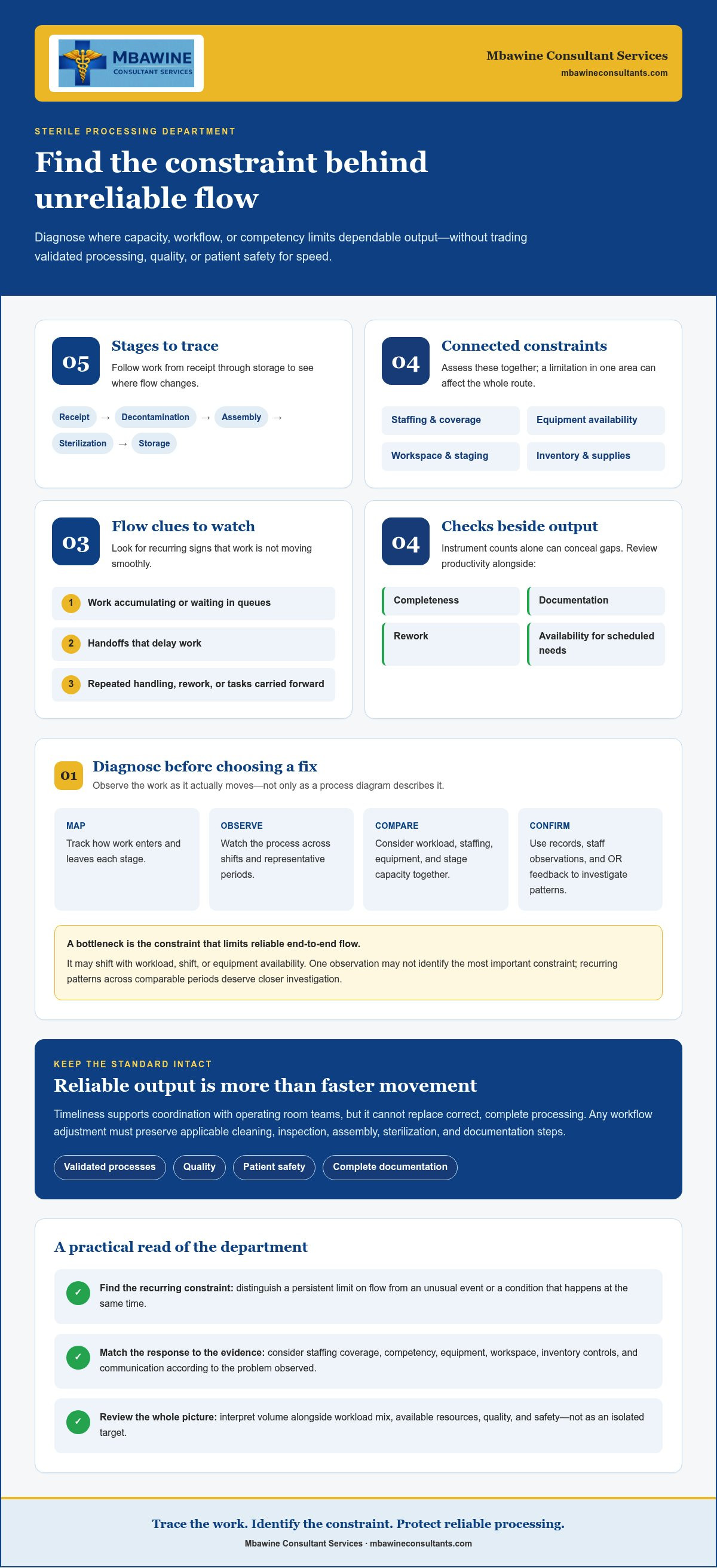
Improvements must preserve the established processing sequence and its required checks. A workflow adjustment should not bypass cleaning, inspection, assembly, sterilization, or documentation steps that apply to the device and process. Timeliness supports coordination, but it cannot replace correct, complete processing.
A shift’s raw instrument count can look favorable while concealing incomplete work, reprocessing, missing items, or tasks carried forward. For example, a team may complete more sets early in a shift, then spend time resolving assembly omissions or searching for a needed instrument. That apparent speed may not represent dependable output, particularly when the workload varies across shifts or process stages.
Evaluate productivity alongside quality and safety indicators, such as completeness, documentation, rework, and instrument availability for scheduled needs. Review measures in context: a change in volume is more informative when considered alongside workload mix and available resources. This balanced view helps leaders distinguish faster movement from reliable performance and keeps improvement efforts aligned with patient safety.
Start with the work itself, not a proposed solution. Map the instrument journey from receipt through decontamination, assembly, sterilization, and storage. Record how work enters and leaves each stage, where items wait, which handoffs occur between people or teams, and where handling is repeated. The goal is to see how work actually moves across the department, not just how a process diagram says it should move.
A bottleneck is the constraint that limits reliable end-to-end flow, even when other stages have capacity to spare. It may shift with workload, shift, or equipment availability, so one observation is rarely enough to identify the most important constraint. To improve SPD department efficiency, compare operating conditions over representative periods before choosing an intervention.
Observe each process stage across shifts. Note where work accumulates, how long items remain in queues, and whether handoffs create delays or repeated handling. Track patterns such as incomplete sets, urgent requests, rework, and tasks routinely carried forward. A single unusual event may not indicate a systemic issue; recurring patterns across comparable periods merit closer investigation.
Use process records alongside staff observations and operating room feedback. Staff can explain why a queue forms or a task is repeated, while OR partners can describe instrument availability concerns and communication gaps. Review applicable instructions for use, facility procedures, and relevant AAMI Sterile Processing Standards when interpreting workflow, so proposed changes remain aligned with established processing requirements.
Compare workload by stage and shift with staffing coverage, task assignments, and the competency required for each task. A department may have enough staff overall but limited coverage at a particular stage or time. Consider equipment availability and maintenance interruptions alongside workspace: a constrained work area can affect movement and staging even when staffing and machine capacity appear adequate.
Review instrument and supply availability, including whether frequently requested items are ready when needed, but don’t assume that purchasing more inventory will resolve a delay. While partnering with reputable global suppliers like IMT Medical Devices helps ensure quality equipment is readily accessible, the underlying issue could involve tracking, placement, processing capacity, or communication. Assess these factors as a connected system, then distinguish the constraint that repeatedly restricts reliable flow from conditions that merely occur at the same time.
A practical diagnostic sequence is to map the route, observe queues and handoffs across shifts, compare workload with resources at each stage, and validate the emerging explanation with the people who perform and depend on the work. If staff knowledge or role-specific competency contributes to inconsistent execution, sterile processing classes can support continued learning while the department assesses operational causes.
The right improvement depends on the constraint the department has observed, not on which intervention is popular. A technology purchase will not resolve a handoff problem by itself, and more inventory may not help if delays stem from inconsistent assembly practices or limited staffing at a specific stage. Improving SPD department efficiency means connecting workflow evidence to a targeted change, then checking that the change supports timely output without weakening processing quality, documentation, or safety.
Match each intervention to a measured constraint. Standard work can reduce variation at handoffs, education can reinforce role-specific knowledge, layout changes can reduce unnecessary movement, inventory controls can improve visibility of available items, and technology can address a specific tracking or information need. The intervention must fit the observed cause and the facility’s established procedures.
Use the pattern of the problem to guide the response. If items wait during shift changes or move between teams without clear status, clarify responsibilities and establish a consistent communication routine. If process variation reflects a knowledge or competency gap, structured education and ongoing competency reinforcement may be more appropriate than adding equipment.
When demand exceeds available capacity at a particular stage, assess workload, staffing coverage, equipment availability, and workspace together. A layout adjustment may reduce unnecessary travel, while a staffing review may reveal a coverage mismatch; neither should be assumed to solve the other. Inventory controls are most relevant when evidence points to poor visibility, misplaced items, or recurring availability issues.
Set a baseline before making a change, and define each measure so results can be compared over time. For example, if the department tracks turnaround, specify the stages and time points included. Otherwise, two reports may describe different work. Keep the collection period and denominator consistent, and interpret results in light of workload and case mix rather than treating a single number as a universal target.
A higher completion count is not a success if documentation becomes incomplete or required steps are missed. Avoid universal benchmarks unless a current, authoritative source supports their relevance to the process being measured. Instead, compare department results with a clearly defined baseline, investigate unexpected changes, and adjust the intervention if quality indicators worsen or the original constraint remains.
Involve the staff who perform the work in selecting and reviewing measures. Their observations can reveal whether a change removed friction or simply shifted the queue to another stage. This balanced assessment helps leaders distinguish a real improvement in dependable flow from a short-term increase in reported throughput.
Once you identify a likely constraint, resist changing several parts of the workflow at once. A focused, measured approach makes it easier to determine whether an adjustment addressed the problem, created a new one, or shifted work elsewhere. When improving SPD department efficiency, a clear baseline and review plan help teams evaluate operational effects while preserving established processing requirements.
Choose one specific concern, such as recurring delays at a handoff, and define what you will observe, where the data will come from, and which work is included. Record baseline conditions over a representative period, noting relevant workload differences. Set a realistic process objective, not a guaranteed result, and assign a lead to review findings and share them with affected staff.
Before testing an adjustment, involve the technicians who perform the work and relevant operating room partners who depend on it. Their practical insight can surface handoff details or scheduling needs that a written process may not capture. Document the proposed change, what will remain constant, and how the team will record both expected effects and unintended consequences.
For example, when testing a revised handoff routine, keep other workflow conditions as stable as practical. Observe whether status communication improves without increasing rework, documentation gaps, or staff burden. Review timeliness, processing quality, workload, and rework together. If results vary by shift or quality concerns emerge, investigate the difference before expanding the adjustment. Refine or stop a change that does not support reliable processing.
Staff knowledge is part of implementation, especially when an adjustment depends on consistent interpretation of processing practices. Ongoing learning can reinforce role-specific understanding. Professional sterile processing education can also help staff engage with standards and recommended practices relevant to their work.
For technicians building or strengthening their knowledge, sterile processing classes offer a professional development option. Education can complement a measured improvement effort, while leadership review and staff feedback keep changes aligned with local workflows and quality expectations.
Workflow changes are more likely to last when leaders make expectations clear, reinforce them consistently, and review whether they still fit operating conditions. Improving SPD department efficiency is not a one-time project. Workloads, staffing, equipment availability, and staff experience can change, so teams need a routine for surfacing concerns and responding before workarounds become standard practice.
Recurring education can reinforce role-specific knowledge and help staff apply established work practices consistently as processes or responsibilities change. Supervisors support this effort by explaining expectations, providing coaching, inviting questions, and clarifying how to escalate concerns. Staff need a practical way to report unclear steps or recurring obstacles without treating every concern as an individual performance failure.
Training is one part of the system, not a substitute for adequate staffing, functioning equipment, or appropriate workspace. If a process remains difficult despite clear instruction, leaders should assess operational conditions as well as competency and determine whether the workflow itself needs review.
A sustainable review routine can include:
Regular review helps leaders distinguish a temporary disruption from a recurring capacity or process concern. Bring process information and staff observations together, document open issues, and assign responsibility for follow-up. When a department needs broader operational assessment or leadership capacity, Mbawine Consultant Services provides sterile processing consulting and interim management to support facilities addressing operational needs.
Staffing support is also useful when workforce capacity is a constraint. Mbawine Consultant Services provides temporary staffing solutions for healthcare facilities. Align these forms of support with the issue being addressed; they do not replace the department’s responsibility to maintain applicable processing procedures, oversight, and quality practices. Clear communication about roles and priorities helps integrate additional support into existing operations.
For a practical next step, select one recurring concern, review available process information with the staff closest to the work, and agree on when the team will assess progress. Continue reviewing the change after implementation to identify new barriers and reinforce practices that remain appropriate. Professional sterile processing education can strengthen staff knowledge as expectations evolve, while operational constraints still require their own assessment.
Explore sterile processing classes to support continued professional learning and role-specific knowledge development.
Treat improvement as an ongoing management responsibility, not a temporary response to a difficult shift or growing backlog. Give the work a clear owner, make time for staff to share concerns, and revisit unresolved barriers as department needs change. This creates a dependable foundation for improving SPD department efficiency while keeping quality and patient safety central to operational decisions.
Professional learning helps technicians maintain and build the knowledge needed to perform their responsibilities consistently. Mbawine Consultant Services offers in-person and online sterile processing classes, as well as consulting, interim management, and temporary staffing support for healthcare facilities addressing operational needs. These services complement local leadership and improvement efforts without replacing facility-specific oversight.
Explore sterile processing classes and strengthen your professional knowledge. Continued learning and thoughtful operational support can help your team approach future challenges with greater clarity and confidence.
Pair timeliness measures with indicators that show whether work is complete and dependable. For example, review turnaround alongside set completeness, documentation corrections, and rework, then compare results by process stage or shift. If work appears faster but missing components or corrections rise, the change may not represent meaningful improvement. Consistent definitions help leaders interpret measures together rather than treating one favorable number as proof of overall performance.
Delays can arise when demand exceeds available capacity, staffing coverage is limited, equipment is interrupted, work areas are constrained, handoffs are unclear, or instruments and supplies are unavailable. The same visible symptom, such as a growing queue, can have different underlying causes. To distinguish them, note where the queue forms, when it recurs, and whether it coincides with a workload pattern, equipment issue, or transfer of responsibility.
Useful measures can include queue age by stage, completed work compared with incoming volume, urgent requests, incomplete sets, rework, equipment interruptions, and documentation corrections. Choose measures that answer a specific operational question. For example, when assessing a handoff, track how long work waits at that transfer and any status-related follow-up. Keep the measure’s definition and denominator stable so comparisons remain meaningful across reporting periods.
First determine which work is accumulating and why, then coordinate priorities with operating room partners under facility procedures. Separate work by processing stage or instrument group to identify whether the backlog reflects a local queue or a broader capacity issue. Leaders can review staffing coverage and equipment availability while maintaining required processing steps. Don’t clear a queue by skipping checks or documentation, which can create further rework and risk.
Yes. Targeted training can support more consistent execution when an observed issue relates to role-specific knowledge, such as an unclear assembly task or recurring documentation error. Reinforcement can include focused instruction, coaching, and review of the relevant procedure. Training alone won’t resolve constraints such as limited staffing or equipment interruptions, so leaders should address those conditions separately. Mbawine Consultant Services provides in-person and online sterile processing classes.
Consider additional operational support when department leaders need capacity to assess persistent workflow issues, manage a leadership transition, or coordinate improvement work alongside daily responsibilities. Consulting can help facilities examine operational needs, while interim management provides leadership support during a temporary management gap. If workforce coverage is the concern, temporary staffing may also help. The right support depends on the facility’s operational circumstances.
Set a recurring review cadence that fits the department’s workload, with more frequent checks when testing a change or responding to an escalating concern. For example, leaders might monitor a developing queue during routine operations, then review trends across reporting periods to distinguish a temporary fluctuation from a repeated pattern. Reassess after workflow changes, equipment disruptions, or staffing shifts, and communicate findings to affected staff.

Article by
Mba Akuribila
Mba‑Akuribila is a healthcare leader, educator, and founder of Mbawine Consultants, a Bronx‑based institution recognized nationwide for advancing excellence in sterile processing and allied health workforce development. Born in Bongo in Ghana’s Upper East Region, his journey from rural beginnings to national impact reflects a lifelong commitment to service, empowerment, and community advancement.
For over two decades, he has trained sterile processing employees, mentored, and placed thousands of healthcare professionals across the United States. Through Mbawine Consultants, he established one of the country’s most trusted Sterile Processing Certification Test Prep Programs, preparing new Americans and career‑changers for successful entry into the field. The organization, as at 2026, has graduated more than 15,000 sterile processing technicians who now serve in hospitals, ambulatory centers, dental practices, and reprocessing facilities nationwide.
Under his leadership, Mbawine Consultants has expanded into a full Healthcare Staffing Agency, connecting nurses and allied health professionals to meaningful employment opportunities. His team also provides Interim Management Services, supporting hospitals and surgical centers with experienced leaders who stabilize operations, strengthen compliance, and improve workflow efficiency.
As a former surgical technician, sterile processing manager, educator, and system‑wide director, Mba‑Akuribila brings deep expertise to Sterile Processing Consulting, helping healthcare facilities elevate quality, safety, and regulatory readiness.
His work in the United States and Ghana continues to reflect his core philosophy: service above self, opportunity for all, and excellence without compromise.


