

A credible instrument tracking system ROI calculation starts with the facility’s baseline data, not projected savings. To make the business case useful, compare measurable operational benefits with the full cost of implementation and ongoing use, rather than relying on broad claims about efficiency or accountability.
Instrument visibility can affect daily workflows, from locating items to managing inventory and documenting processing activity. The challenge is assigning credible value to those outcomes when departments record delays, losses, labor, and reprocessing inconsistently, while software, hardware, integration, training, and maintenance costs may sit in separate budgets.
This guide explains how to build a transparent, assumption-based ROI model that decision-makers can review and compare. You’ll identify baseline measures, translate operational changes into financial and nonfinancial value, account for initial and recurring costs, and test assumptions across system options. The goal is not to promise a particular return, but to make the investment case traceable, consistent, and grounded in facility-specific evidence.
Choosing a tracking system before defining the operational problem can turn the evaluation into a feature comparison that misses facility needs. A defensible instrument tracking system ROI calculation compares benefits reasonably attributable to the investment with its total costs over a stated period. The familiar Return on Investment (ROI) measure can structure that comparison, but its usefulness depends on the quality of the inputs and the boundaries of the analysis.
Start by documenting the workflow problem. A department may spend time searching for instruments, lack consistent records of set status, or repeatedly reconcile information by hand. These are different issues. A system’s functions matter only when they address a defined need within the facility’s actual workflow. A list of capabilities does not, by itself, show that an improvement will occur or that the system caused it.
An instrument tracking system generally uses identification methods and software records to associate instruments or sets with events and workflow stages. ROI analysis estimates whether measurable benefits, such as less labor spent on specific tasks, compare favorably with implementation and ongoing costs over the same period. It is a business-case estimate, not a guarantee of savings or performance.
Keep financial effects separate from operational and risk-management outcomes. Better visibility or more consistent records may support accountability and process control, but do not assign a monetary value unless the facility has a defensible way to calculate it. Report nonfinancial measures separately, such as record completeness or whether staff can determine a set’s workflow status.
Examine the work before estimating benefits. Observe how staff locate and count instruments, document processing steps, and reconcile set contents. Identify where delays or repeated effort occur, then check how reliably teams can determine an instrument set or tray’s workflow stage. These observations establish a local baseline instead of relying on assumed industry averages.
Before projecting a return, define the workflow boundary: which locations, instrument groups, tasks, and staff activities are included? Decide how observations will be collected and check whether current records are consistent across shifts or departments. The expected effect depends on the baseline, implementation scope, staff adoption, and local assumptions. If workflow practices or training vary, note those conditions instead of attributing every change to the system. This gives operations and finance a shared basis for evaluating the investment.
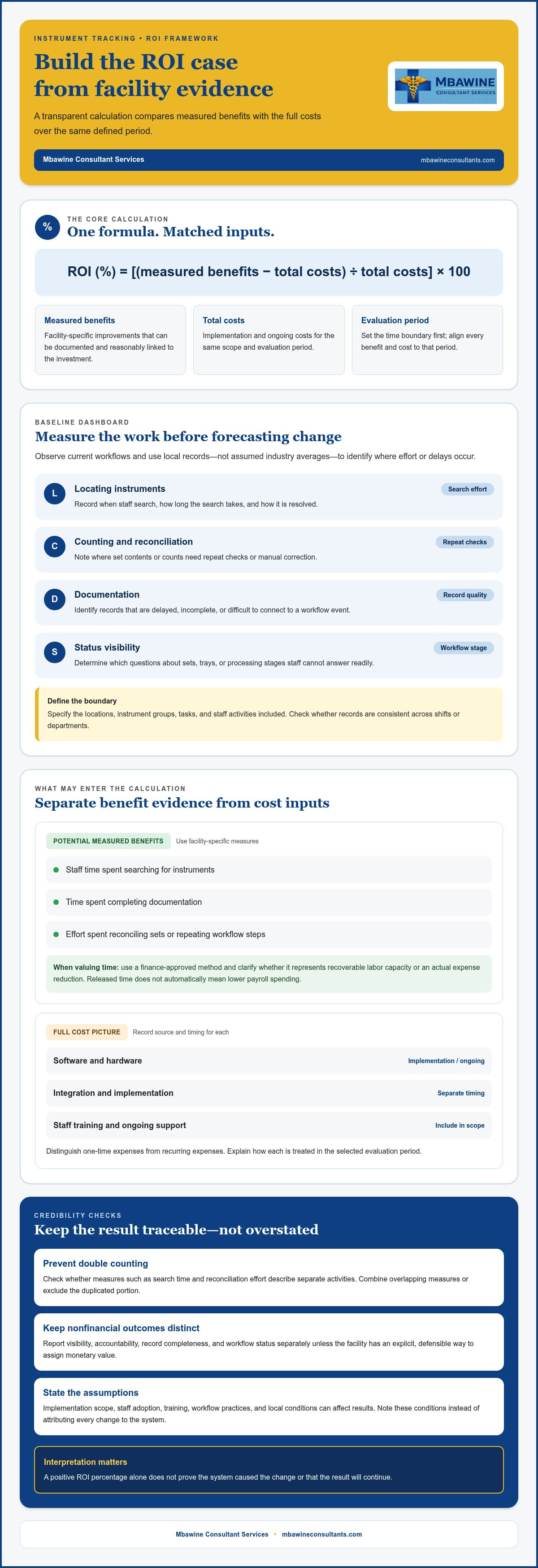
Once the facility has defined the workflow under review, translate its evidence into a calculation that others can reproduce. Use this formula:
ROI (%) = [(measured benefits − total costs) ÷ total costs] × 100
Define the evaluation period before entering values. If the analysis covers one year, compare benefits and costs attributable to that same year. Identify one-time implementation expenses separately from recurring expenses, and explain how each is treated. Do not combine a one-time benefit with annual recurring costs without adjusting the time basis. A positive percentage alone does not prove that the system caused the change or that the result will continue.
Use facility-specific measures for benefits, such as staff time spent searching for instruments, completing documentation, reconciling sets, or repeating workflow steps. Convert time into a financial value only with a finance-approved method, and state whether the estimate reflects recoverable labor capacity or an actual expense reduction. These are not interchangeable: time released for other duties may increase capacity without reducing payroll spending.
Compile the full cost picture for the same scope and period. Depending on the proposed implementation, relevant categories may include software, hardware, integration, implementation, staff training, and ongoing support. For each input, record its source, timing, and whether it is a one-time or recurring cost.
Guard against double counting. If improved set visibility reduces both search time and reconciliation effort, confirm that the measures represent separate activities. If they overlap, combine them or exclude the duplicated portion. Keep operational gains, such as improved workflow visibility, separate from monetized benefits unless the valuation method is explicit and defensible.
Build the baseline from observations and records that represent the workflows in the proposed scope. Review relevant shifts and instrument processes rather than relying on a single department’s best-documented period. Use time studies, workflow logs, and operational records where available, and note gaps or inconsistent definitions that could affect the comparison. Finance should review assumptions used to value staff time or other measured changes.
Show how adoption affects expected benefits instead of presenting one projection as certain. Prepare conservative, expected, and higher-adoption scenarios, stating the assumptions behind each. For example, distinguish a projection based on partial staff use from one assuming consistent use across the included workflow. Label every forecast as an estimate, then compare it with measured results after implementation.
A clear model depends on consistent processes as well as sound arithmetic. Sterile processing education can help staff build readiness and apply workflow practices consistently. Mbawine Consultant Services offers sterile processing classes in person and online.
A single ROI percentage can hide differences in workflow fit, implementation effort, and the assumptions behind projected benefits. Compare each option using the same criteria and evaluation period, then assess how its capabilities align with the facility’s documented needs. This makes the instrument tracking system ROI calculation a more useful decision tool than a ranking based on a headline figure alone.
Build a consistent comparison matrix, with a row for each criterion and a column for each system option. Record what each option supports, what the facility must provide, and what remains uncertain. The goal is not to assume that systems perform alike, but to make differences visible using common questions.
Assess standards alignment and regulatory statements separately. Record the exact claim and the source used to verify it, including the source’s publication or revision date. Requirements can change, and a general compliance statement should not be treated as proof that a particular system or facility workflow satisfies a current obligation.
Apply the same facility baseline, calculation period, and valuation assumptions to every option. Keep measured benefits distinct from potential benefits that lack local evidence. For example, a reporting function may be available, but any projected reduction in documentation effort remains an estimate until facility observations or operational records support it.
Test whether the comparison changes under different assumptions. Sensitivity checks can vary staff adoption, the amount of workflow time affected, or the implementation scope. If one option appears preferable only under a high-adoption scenario, make that dependency explicit. If the ranking remains similar under more conservative assumptions, decision-makers can see that the result depends less on a single projection.
Document each option’s limitations alongside its strengths. A clear comparison helps operations, finance, IT, and sterile processing leaders distinguish technical capabilities from outcomes that depend on workflow design, training, and sustained staff use.
A forecast becomes a credible investment case when the people responsible for the workflow can verify its assumptions and later compare them with observed results. Before implementation, assign responsibility for data collection, calculation review, and decisions about whether results support broader adoption. This governance strengthens the instrument tracking system ROI calculation by clarifying who owns each input and how changes will be interpreted.
Agree on measures before work begins. Define which instrument groups, departments, shifts, and process stages are included, and specify how each measure will be recorded. A shared definition of a search event or documentation delay prevents teams from comparing unlike observations. Also log training, workflow redesign, staffing changes, and technical interruptions, since these factors can influence results independently of the tracking system.
Select workflows that represent the intended use, then record the baseline using the same definitions planned for post-implementation measurement. During the evaluation, track training completion, process adjustments, technical issues, and interruptions that may affect adoption or measured time. Review observations with frontline staff and operational leaders before drawing conclusions, so data anomalies and workflow context are not mistaken for system effects.
After implementation, compare observed results with the forecast using the original measures and period wherever possible. Explain deviations directly. For instance, if a projected change in documentation effort did not appear, determine whether staff adoption, process changes, or the measurement method differed from the original assumptions. Preserve both the original estimate and the actual result. Revising the forecast without documenting why weakens the decision record.
Reliable adoption depends on staff understanding the workflow expectations attached to their roles, including accurate identification, timely record entry, and consistent completion of defined steps. Orientation should explain how the system fits existing procedures, where staff should document exceptions, and how supervisors will identify incomplete or inconsistent use. Treat these practices as part of implementation, not as incidental tasks.
Professional development can reinforce the sterile processing knowledge needed for consistent practice. Staff building foundational knowledge can explore CRCST certification preparation as part of a broader learning pathway. Mbawine Consultant Services also offers sterile processing classes to support staff readiness and informed workflow adoption.
An ROI result should inform a facility’s decision, not replace operational judgment. The final business case needs to show what was measured, which costs were included, where evidence is limited, and how sensitive the result is to changes in adoption or implementation scope. A defensible instrument tracking system ROI calculation gives decision-makers a traceable basis for discussion rather than presenting a projection as a guaranteed outcome.
Summarize the calculation in a concise, reviewable format. Include the formula, evaluation period, workflow boundary, baseline definitions, data sources, assumptions, exclusions, and the people responsible for each input. State how projected or observed changes were attributed to the investment, and identify changes in staffing, training, or procedures that could also have influenced results.
Present financial measures separately from operational outcomes, and label the strength of evidence for each. For example, distinguish a benefit supported by facility time-study observations from a potential benefit inferred from a system capability but not yet measured locally. Include implementation dependencies, such as staff orientation, process consistency, and technical integration, so leaders can see what must be in place for projected value to materialize.
Facility stakeholders should set decision thresholds in light of local priorities, budget processes, and operational requirements. Avoid importing a generic ROI target that may not reflect the facility’s needs. Leaders may weigh a financial result alongside operational visibility or process-control objectives, provided those nonfinancial considerations are clearly identified rather than presented as monetized savings.
Approval is not the end of the work. Sustained value depends on training, workflow governance, consistent use, and ongoing measurement. A system cannot independently resolve gaps in role understanding or process execution. Professional education can help staff strengthen the sterile processing foundation that supports reliable workflows, alongside a facility’s technology evaluation and implementation plan.
For professionals seeking to build that foundation, explore sterile processing classes that support continued learning and operational readiness.
A tracking investment is also an opportunity to reinforce the professional practices that sustain instrument accountability over time. As workflows evolve, teams benefit from continued attention to role-specific knowledge, consistent documentation, and disciplined use of operational data. That foundation helps facilities interpret future results in context and make adjustments based on observed practice rather than assumption.
A sound instrument tracking system ROI calculation is one part of a longer commitment to operational readiness. Specialized sterile processing education and certification preparation can help professionals deepen their understanding. In-person and online classes provide learning formats suited to different needs. Ongoing development supports informed participation in technology decisions and helps teams translate defined processes into consistent daily work.
Build the knowledge that supports responsible sterile processing practice. Explore Mbawine Consultant Services’ sterile processing classes to take a purposeful next step in your professional development.
Subtract total costs from measured benefits, divide the result by total costs, then multiply by 100 to express the return as a percentage. For an instrument tracking system ROI calculation, define the evaluation period first and use values that belong to that period. Keep the supporting worksheet with the result so reviewers can trace each input to its source and distinguish observations from projections.
Include costs required to put the system into use and maintain the evaluated scope. Depending on the implementation, these may include software, hardware, integration, implementation work, staff training, and ongoing support. Clarify which expenses occur once and which recur. For example, a training expense may be concentrated during rollout, while support may continue through the evaluation period. Treating both as the same cost type can distort comparisons.
Facilities can measure workflow changes with observable records, such as staff time spent searching for a specific set, time spent completing documentation, or repeat effort required to reconcile contents. Define the start and end points for each measure so observations are comparable. Track nonfinancial outcomes, such as whether staff can retrieve a set’s recorded status, separately unless the facility has a defensible method to value them financially.
There is no reliable universal payback period. It depends on local costs, the workflows included, measured benefits, and staff adoption. Estimate payback only after defining which benefits count and when they are expected to occur. Present the result as a forecast, not a promise, and update it with actual post-implementation data. A projected payback date can shift if rollout timing or adoption differs from the original assumptions.
Yes, but label the result preliminary and make its data limitations explicit. A hospital may begin with available operational records, structured observations, or a limited measurement period while identifying missing shifts, workflows, or inconsistent definitions. Do not present data gaps as measured savings. Strengthen the baseline before using the estimate for a final investment decision, and preserve the assumptions so later analysis can be revised transparently.
No. A system can support identification and workflow records, but it cannot guarantee that instruments will not be misplaced or that expenses will decline. Outcomes also depend on process design, accurate data entry, staff use, and how exceptions are handled. Define how the facility will identify and document missing instruments and related costs, then compare those observations over time rather than treating a system capability as a guaranteed result.
Compare each option against the same representative workflows and evaluation period, using a shared matrix for identification, data capture, reporting, integration, training, support, and total ownership costs. Note which functions are available and which outcomes depend on local adoption. A practical test is whether staff can capture the required event within their actual workflow, not simply whether a feature appears in a system description.

Article by
Mba Akuribila
Mba‑Akuribila is a healthcare leader, educator, and founder of Mbawine Consultants, a Bronx‑based institution recognized nationwide for advancing excellence in sterile processing and allied health workforce development. Born in Bongo in Ghana’s Upper East Region, his journey from rural beginnings to national impact reflects a lifelong commitment to service, empowerment, and community advancement.
For over two decades, he has trained sterile processing employees, mentored, and placed thousands of healthcare professionals across the United States. Through Mbawine Consultants, he established one of the country’s most trusted Sterile Processing Certification Test Prep Programs, preparing new Americans and career‑changers for successful entry into the field. The organization, as at 2026, has graduated more than 15,000 sterile processing technicians who now serve in hospitals, ambulatory centers, dental practices, and reprocessing facilities nationwide.
Under his leadership, Mbawine Consultants has expanded into a full Healthcare Staffing Agency, connecting nurses and allied health professionals to meaningful employment opportunities. His team also provides Interim Management Services, supporting hospitals and surgical centers with experienced leaders who stabilize operations, strengthen compliance, and improve workflow efficiency.
As a former surgical technician, sterile processing manager, educator, and system‑wide director, Mba‑Akuribila brings deep expertise to Sterile Processing Consulting, helping healthcare facilities elevate quality, safety, and regulatory readiness.
His work in the United States and Ghana continues to reflect his core philosophy: service above self, opportunity for all, and excellence without compromise.


