

A leadership gap in sterile processing needs a qualified interim manager, not simply someone to keep the schedule moving. An interim SPD manager for hospital leave coverage can provide department oversight while the hospital conducts a permanent search; candidates may be expected to start within 2 to 3 weeks of acceptance and have sterile processing certification and Joint Commission compliance experience.
Consistent oversight matters because sterilization workflows, regulatory compliance, and quality control remain essential during a leave. This article explains how hospitals can arrange interim leadership, assess qualifications and responsibilities, structure the engagement, and evaluate its cost. It also shows how to identify immediate department needs so a temporary manager can support continuity and prepare for the next leadership transition.
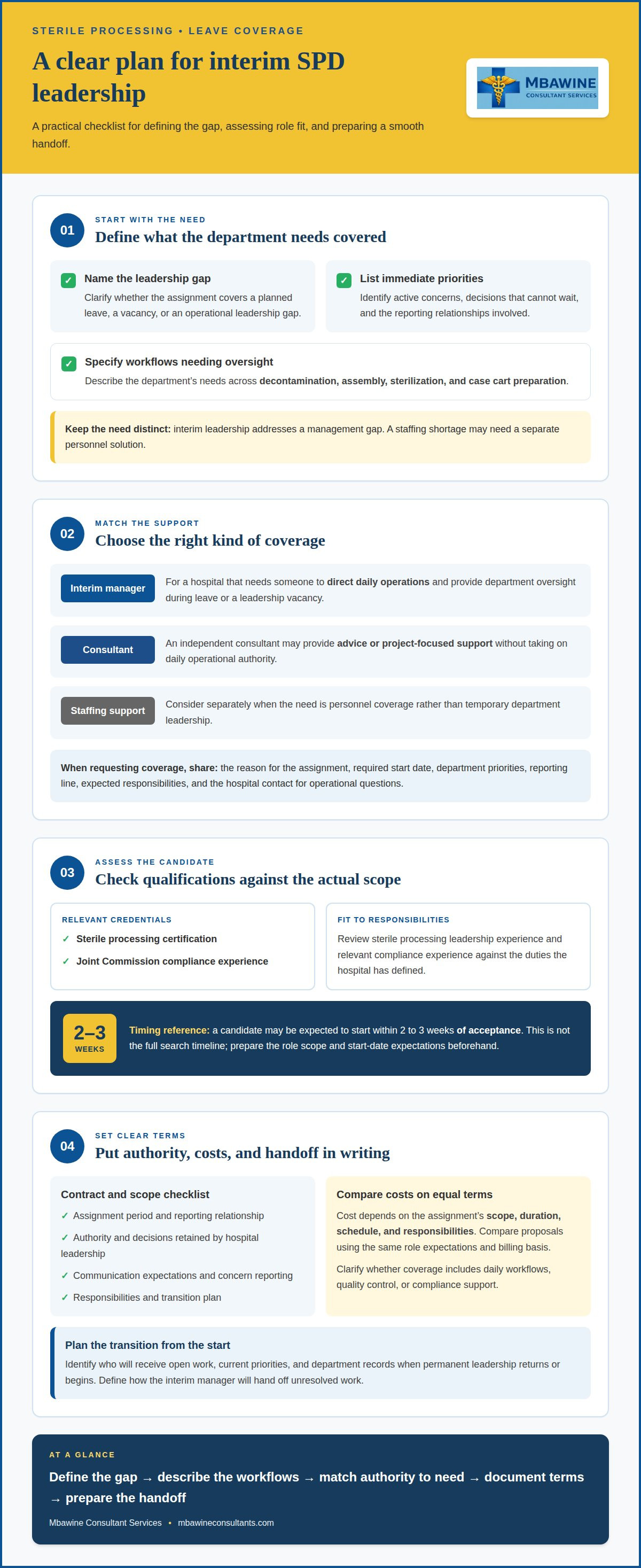
An interim SPD manager for hospital leave coverage can lead the department while a hospital searches for a permanent manager. Start by defining the leadership gap, immediate priorities, and decisions that need temporary oversight.
Interim leadership can cover a planned leave or vacancy while the hospital seeks permanent leadership. A staffing shortage may need a separate solution, so distinguish management duties from personnel coverage. Identify which workflows need oversight, including decontamination, assembly, sterilization, and case cart preparation.
List active concerns, reporting relationships, and decisions that cannot wait. For example, specify who will coordinate workflow questions while the leadership role is vacant. This gives candidates a practical picture of the department and helps define the temporary role before placement begins.
An interim staffing agency can coordinate candidates for a leadership assignment, while an independent consultant may provide advice or project-focused support. For leave coverage, determine whether the hospital needs someone to direct daily operations or advise leaders without taking on that authority.
When requesting coverage, explain the reason for the assignment, required start date, department priorities, reporting line, and expected responsibilities. Identify the workflows requiring oversight and the hospital contact for operational questions. These details help candidates understand the role and let the hospital assess whether their experience fits its needs.
An interim Sterile Processing Department Director candidate may be expected to start within 2 to 3 weeks of acceptance. This timing begins after acceptance, so hospitals should prepare the role scope and start-date expectations beforehand. Candidate availability and assignment terms also shape the placement process.
Cost depends on the assignment’s scope, duration, schedule, and responsibilities. Clarify whether the manager will oversee daily workflows, quality control, or compliance support. Compare proposals on the same role expectations and billing basis. Distinguish operational leadership from consulting or additional staffing, since each addresses a different need.
Document the assignment period, reporting relationship, authority, communication expectations, and transition plan in the agreement. Specify which duties belong to the interim manager and which decisions remain with hospital leadership. A clear scope helps prevent confusion about responsibility during leave coverage.
Hospitals seeking an interim SPD manager for hospital leave coverage should define relevant qualifications, such as sterile processing certification and Joint Commission compliance experience. Specify how the manager will report concerns and hand off open work to returning or permanent leadership. This gives the assignment a clear framework for oversight and transition.
For a U.S. hospital, the available timing reference is the candidate’s start after acceptance, not the full search process. An interim Sterile Processing Department Director candidate may be expected to start within 2 to 3 weeks of acceptance. Hospitals should therefore distinguish candidate acceptance from the earlier work of defining the role, reviewing qualifications, and arranging the transition.
Start by setting the required start date and explaining the reason for coverage. A planned leave gives the hospital time to prepare responsibilities and department information before the manager arrives. A vacancy or staffing shortage may require faster coordination, but the basic steps remain the same: define the role, assess candidates, agree on terms, and prepare onboarding.
Use these steps to reduce avoidable delays:
Each step affects the path to placement, although the cited 2 to 3 weeks begins only after acceptance. A hospital that finalizes the scope early can present candidates with a clearer assignment. A late change, such as adding responsibility for quality oversight, may require renewed discussion before the candidate accepts.
For example, a hospital arranging leave coverage can prepare a role summary before the departing manager’s last day. Identify who approves operational decisions, which workflows need oversight, and how the interim leader will report progress. This gives the candidate a clear picture of the assignment and supports an orderly start.
Hospitals should also coordinate the end of the interim period while planning the start. Define who will receive open work, current priorities, and department records when permanent leadership returns or begins. For broader workforce planning beyond an immediate management gap, hospitals can review sterile processing enrollment information as a separate step.
Compare proposed interim management costs using the same scope and billing basis. An hourly rate and a daily rate are not directly comparable unless the covered hours and responsibilities are clear. Request a proposal that states the billing basis, assignment period, and included duties so finance and SPD leaders are assessing the same service.
The cost depends on the assignment. Key factors include scope, duration, coverage schedule, leadership responsibilities, and placement arrangements. A role focused on daily workflow oversight differs from one that also covers broader quality-control or compliance responsibilities. A clearly defined scope helps the hospital understand what the quoted terms include.
Before comparing costs, define the manager’s expected work. Specify whether the role includes oversight of decontamination, assembly, sterilization, case cart preparation, staff coordination, or department reporting. These details distinguish focused leave coverage from a broader operational leadership role and give decision-makers a consistent basis for comparing proposals.
Ask the proposal to identify the following terms:
For an hourly proposal, clarify how partial days and schedule changes are handled. For a daily proposal, confirm the hours and responsibilities included in each day. This prevents the hospital from comparing a defined daily assignment with an hourly arrangement covering a different schedule.
Assess cost alongside operational fit, not in isolation. The candidate’s sterile processing leadership background, Joint Commission compliance experience, and ability to oversee the defined workflows should match the assignment. Also check that the proposal clearly describes reporting relationships and the manager’s authority. A stated rate is difficult to assess without these terms.
Before approval, have SPD leadership and finance review the scope, schedule, billing basis, and any separate charges together. For example, if the hospital adds quality-control oversight after receiving a proposal, request revised terms that include that responsibility. Documenting the change keeps the agreement aligned with the manager’s expected work.
Cost is specific to the assignment. The hourly or daily rate depends on its scope, duration, coverage schedule, responsibilities, and placement arrangements.
A clear agreement connects the interim SPD manager’s authority to the department’s needs. For leave coverage, define the assignment period, reporting relationship, operational duties, and transition plan. A specific scope gives hospital leaders and the manager shared expectations from the first workday.
Describe the role in practical terms. For example, state whether the manager will oversee daily workflows, coordinate staff activities, support quality control, or report compliance concerns through the hospital’s established process. Separate assigned responsibilities from decisions reserved for hospital leadership. This prevents unclear or conflicting authority in a temporary role.
Include these elements in the written scope:
Make broad terms practical with specific examples. If the scope includes “workflow oversight,” name the processes involved, such as decontamination, assembly, sterilization, or case cart preparation. If the manager supports quality control, describe the reporting path for concerns. The agreement should clarify responsibilities while leaving established hospital procedures in place.
Define qualifications alongside duties. If the role requires sterile processing certification and Joint Commission compliance experience, state those expectations clearly and align them with the work. A manager leading the department needs a different scope from an advisor engaged for a specific project.
Finally, specify how changes will be handled. If hospital leaders add responsibilities during the assignment, document the revised scope, reporting expectations, schedule, and related terms before the manager takes them on. At the end of coverage, use the transition plan to hand unresolved matters to the designated leader. A well-defined agreement gives the interim manager a practical framework while preserving the hospital’s established decision-making structure.
Structured onboarding helps the interim manager understand the department before taking on daily oversight. Coordinate access, workflow orientation, reporting relationships, and handoff priorities with the manager’s first day in mind.
Keep onboarding focused on the actual assignment. A role centered on workflow oversight needs access to relevant procedures and operational contacts. If the manager also handles quality control, clarify the reporting pathways. Distinguish orientation from authority: explaining a process does not, by itself, expand the agreed scope.
If onboarding identifies a separate need for staff education, review sterile processing class enrollment as a distinct development step.
Mbawine Consultant Services provides Sterile Processing classes for professionals seeking education in the field. When a leadership gap also highlights a need for staff development, classes can complement interim management by building the department team’s knowledge.
Hospitals can also use Healthcare Temp staffing when they need workforce coverage, or Healthcare Sterile Processing Consulting for specialized department guidance. These services address different needs: interim leadership covers management responsibilities, while staffing and consulting support other operational priorities.
Consider the department’s next need once interim coverage is arranged. If education is a priority, explore Sterile Processing classes; if leadership support is still needed, consider Interim Management. Contact Mbawine Consultant Services or visit mbawineconsultants.com to learn more.
An interim SPD manager for hospital leave coverage should support continuity while the hospital retains clear ownership of department priorities. Treat the assignment as a planned transition, not simply a temporary name on the schedule. A defined handoff helps returning or permanent leadership understand current work, decisions, and unresolved concerns.
Before coverage begins, identify what the department needs from its next leader and what knowledge should stay within the team. This can guide workforce development alongside interim leadership and help prepare the department for future changes. Mbawine Consultant Services offers Sterile Processing classes for professionals seeking further education in the field.
Hospitals and professionals can take a practical next step by exploring relevant learning opportunities and aligning them with department needs. Explore Sterile Processing class enrollment and continue building a capable, prepared sterile processing team.
Define the department’s leadership duties, then match candidates’ experience to those responsibilities. Assess sterile processing certification, leadership background, and experience with Joint Commission compliance. During interviews, use practical scenarios, such as coordinating workflow concerns across decontamination, assembly, and case cart preparation. Ask how candidates approach communication and escalation to assess how they would work within established processes.
An interim SPD manager provides temporary leadership for sterile processing department operations. Depending on the agreed scope, the manager may coordinate daily workflows, support quality control, communicate operational concerns, and work with hospital leaders on department priorities. For example, the manager could coordinate a handoff between teams responsible for instrument assembly and sterilization. The written assignment should distinguish operational authority from decisions retained by hospital leadership.
Prepare a concise role brief before seeking coverage. Include the reason for the temporary assignment, required responsibilities, reporting relationship, start-date needs, and current department priorities. Use these details to assess interim management candidates or staffing support against the actual gap. For example, a leave assignment focused on department leadership differs from a request for additional personnel to meet staffing needs.
Match qualifications to the manager’s responsibilities. For an interim director role, require sterile processing certification and relevant experience with Joint Commission compliance. Also assess whether the candidate has led sterile processing operations and can explain their approach to team communication, workflow oversight, and escalation. Connect each qualification to the specific decisions the manager will make.
The interim manager should follow the hospital’s established policies and compliance processes, not replace institutional guidance with personal interpretation. Clarify which hospital leaders or compliance personnel handle questions related to AAMI, AORN, OSHA, and Joint Commission requirements. For example, define how the manager documents a concern and routes it to the appropriate internal contact. The scope should specify the manager’s support role and escalation pathway.
An uncovered leadership role can leave staff without a clear point of contact for workflow questions, quality concerns, and operational decisions. Reduce confusion by assigning an accountable leader during the gap and communicating the reporting path to SPD personnel. For example, staff should know whom to notify about a delayed case cart or unresolved workflow issue. Recording open concerns also supports continuity when permanent leadership returns.
Mbawine Consultant Services serves healthcare facilities nationally through Interim Management and Healthcare Temp staffing. Hospitals can choose interim management when they need temporary department leadership, or staffing support when personnel coverage is the gap. The right service depends on the uncovered responsibility, such as management decisions or additional workforce capacity. Define that need clearly so the service matches the department’s operational requirements.

Article by
Mba Akuribila
Mba‑Akuribila is a healthcare leader, educator, and founder of Mbawine Consultants, a Bronx‑based institution recognized nationwide for advancing excellence in sterile processing and allied health workforce development. Born in Bongo in Ghana’s Upper East Region, his journey from rural beginnings to national impact reflects a lifelong commitment to service, empowerment, and community advancement.
For over two decades, he has trained sterile processing employees, mentored, and placed thousands of healthcare professionals across the United States. Through Mbawine Consultants, he established one of the country’s most trusted Sterile Processing Certification Test Prep Programs, preparing new Americans and career‑changers for successful entry into the field. The organization, as at 2026, has graduated more than 15,000 sterile processing technicians who now serve in hospitals, ambulatory centers, dental practices, and reprocessing facilities nationwide.
Under his leadership, Mbawine Consultants has expanded into a full Healthcare Staffing Agency, connecting nurses and allied health professionals to meaningful employment opportunities. His team also provides Interim Management Services, supporting hospitals and surgical centers with experienced leaders who stabilize operations, strengthen compliance, and improve workflow efficiency.
As a former surgical technician, sterile processing manager, educator, and system‑wide director, Mba‑Akuribila brings deep expertise to Sterile Processing Consulting, helping healthcare facilities elevate quality, safety, and regulatory readiness.
His work in the United States and Ghana continues to reflect his core philosophy: service above self, opportunity for all, and excellence without compromise.


