

Institutional excellence in the perioperative environment isn't merely a byproduct of clinical skill; it's the direct result of rigorous adherence to the highest regulatory benchmarks. Maintaining consistent Joint Commission sterile processing standards remains one of the most daunting challenges for healthcare leadership, especially as the intersection of CMS requirements and AAMI technical updates creates a complex web of overlapping expectations. You likely feel the mounting pressure of unannounced surveys and the persistent difficulty of maintaining staff competency amidst high turnover rates.
This guide provides a comprehensive roadmap to navigate these complexities, ensuring your department achieves successful, citation-free outcomes while fostering a highly competent workforce. We'll examine the critical 2026 updates to AAMI ST79 regarding steam sterilization validation, strategies for professional certification, and the systematic processes required to bridge technical gaps in departmental workflows. By aligning your operational protocols with these evolving institutional requirements, you can significantly reduce the risk of surgical site infections and solidify your facility's reputation for patient safety and technical mastery.
Regulatory compliance within the Central Sterile Services Department (CSSD) represents a complex synthesis of federal mandates and professional technical standards. It's a foundational requirement for institutional operation, ensuring that every surgical instrument processed meets a baseline of safety. While the Centers for Medicare & Medicaid Services (CMS) establishes the legal framework through Conditions of Participation, accrediting bodies like The Joint Commission interpret these requirements through the lens of established clinical practices. State Departments of Health add another layer of oversight, focusing on specific environmental and safety protocols that must be maintained to retain licensure.
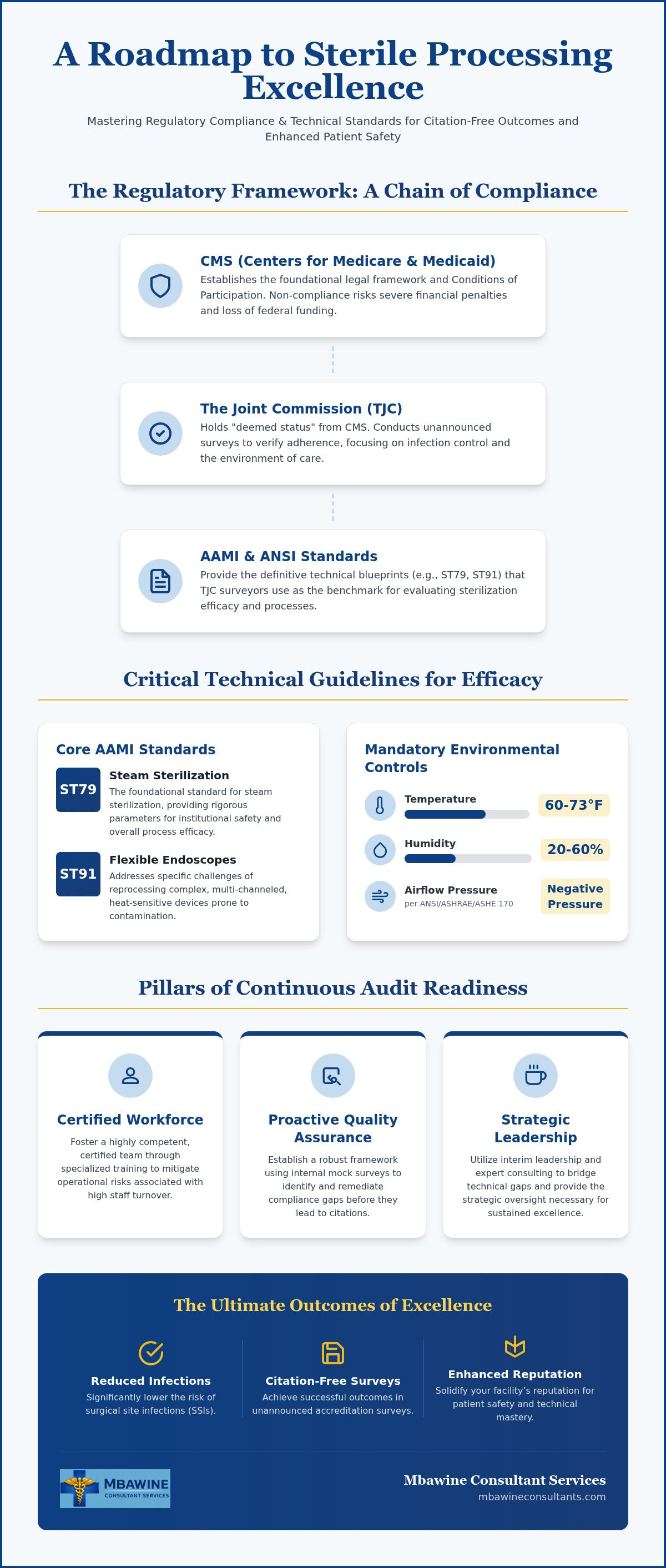
CMS dictates the fundamental requirements for healthcare reimbursement, meaning that non-compliance can lead to severe financial penalties or the loss of federal funding. The Joint Commission functions as a critical intermediary, holding "deemed status" from CMS to conduct surveys that verify an institution's adherence to these federal laws. Their methodology emphasizes the environment of care and infection control, placing Joint Commission sterile processing standards at the center of the evaluation.
Unannounced surveys represent a significant administrative risk. They demand that departments maintain a constant state of audit readiness, as any deficiency identified during these inspections can result in immediate citations or follow-up surveys that strain institutional resources. It's essential for leadership to recognize that these surveys aren't merely periodic hurdles but are rigorous assessments of a facility's commitment to patient safety and operational excellence.
Professional standards, while technically voluntary, serve as the definitive technical blueprint for sterilization efficacy. The Association for the Advancement of Medical Instrumentation (AAMI) publishes guidelines, such as AAMI ST79 for steam sterilization, that The Joint Commission adopts as the benchmark for technical evaluation. These standards provide the specific, measurable criteria that surveyors use to determine if a department's processes are safe and effective. ANSI standards further refine these technical requirements, offering a rigorous framework for validating equipment performance.
By 2026, the adoption of these updated professional standards has become a non-negotiable aspect of regulatory compliance. Facilities that fail to integrate these technical advancements into their daily operations risk falling behind the evolving expectations of accreditors. Engaging in healthcare sterile processing consulting provides an objective assessment of current protocols against these high-register technical demands, ensuring that the department remains aligned with the latest industry benchmarks.
Technical execution within the sterile processing environment requires an unwavering commitment to the Association for the Advancement of Medical Instrumentation (AAMI) guidelines. AAMI ST79 remains the foundational standard for steam sterilization. It provides the rigorous parameters necessary for ensuring institutional safety and efficacy. Simultaneously, the increasing complexity of flexible endoscopes has elevated the importance of AAMI ST91. This standard addresses the specific challenges of reprocessing multi-channeled, heat-sensitive devices that are prone to contamination. Adherence to these specialized guidelines is a core component of maintaining Joint Commission sterile processing standards during technical evaluations.
Environmental controls are equally critical to the integrity of the sterilization process. The department must maintain precise temperature ranges, typically between 60°F and 73°F, and humidity levels between 20% and 60% to prevent microbial proliferation and ensure the stability of sterile packaging. Airflow must be strictly regulated according to ANSI/ASHRAE/ASHE Standard 170. Decontamination areas must maintain negative pressure relative to the preparation and packaging areas to prevent the migration of airborne contaminants. Meticulous documentation of these environmental variables, alongside sterilization cycle parameters and biological monitoring results, is essential for demonstrating continuous compliance. To maintain this accuracy, facilities can utilize specialists like Zenith Sales & Calibrations Pty Ltd for professional instrument calibration.
Effective reprocessing begins at the point of use. Surgical teams must initiate treatment immediately following a procedure to prevent the formation of resilient biofilms. These organic structures can shield pathogens from subsequent cleaning and sterilization efforts. In 2026, regulatory bodies emphasize the validation of mechanical cleaning equipment through daily testing of ultrasonic cleaners and washer-disinfectors. High-level disinfection (HLD) protocols also require rigorous attention to soak times and minimum effective concentration (MEC) testing to ensure the total elimination of vegetative microorganisms.
The validation of a sterilization cycle is not complete without comprehensive monitoring. This includes the mandatory use of chemical indicators and biological monitors in every load. Biological indicators provide the only direct measure of lethality by challenging the process with resistant spores. Documentation must be exhaustive, capturing the sterilizer number, cycle parameters, and the specific results of all monitoring devices. 2026 updates highlight the necessity of enhanced validation for complex instrumentation with intricate geometries or long lumens. Maintaining this level of technical precision is often best supported by advanced sterile processing education that prepares staff for these rigorous demands. If a failure occurs, the facility must have clearly defined and executable emergency recall procedures to protect patient safety.
A certified workforce serves as the most robust defense against regulatory infractions and the severe consequences of patient harm. As surgical technologies advance, the margin for error in instrument reprocessing narrows significantly. This technical reality has fueled a national trend toward mandatory certification for sterile processing technicians across multiple states. Professional education doesn't just impart knowledge; it fundamentally reduces the frequency of human error within the sterilization loop by standardizing workflows. Utilizing structured sterile processing classes allows healthcare facilities to build a reliable talent pipeline that supports long-term compliance goals.
Technicians typically pursue recognition through either the Healthcare Sterile Processing Association (HSPA) or the Certification Board for Sterile Processing and Distribution (CBSPD). Both pathways require a comprehensive understanding of microbiology, decontamination, and sterilization science, yet they offer different approaches to professional validation. The CRCST certification is particularly valued by many institutions because it mandates 400 hours of hands-on experience before full credentialing is granted. This practical requirement provides accreditors with tangible evidence of technical mastery. To sustain these credentials, technicians must complete annual continuing education units (CEUs). This ongoing requirement ensures that staff members stay informed about the latest Joint Commission sterile processing standards and evolving AAMI technical recommendations.
The Joint Commission requires that healthcare organizations go beyond initial certification to provide ongoing, competency-based assessments for all staff. These assessments must be specific to the tasks performed and the equipment utilized within the department. A comprehensive education program includes written examinations and direct observation of technical skills to verify that every technician can consistently execute complex protocols. By prioritizing Sterile Processing Education, leadership can ensure that the workforce remains audit-ready at all times. This systematic approach to training identifies performance gaps early, allowing for corrective action before a surveyor enters the facility. In an environment characterized by high staff turnover, these rigorous educational frameworks are essential for maintaining the institutional memory required for citation-free surveys and consistent adherence to Joint Commission sterile processing standards.
Achieving institutional excellence requires moving beyond reactive compliance toward a culture of perpetual audit readiness. This proactive stance is anchored in a systematic protocol for internal "mock surveys" designed to mirror the rigor of an actual accreditation visit. By identifying compliance gaps before they're observed by external surveyors, leadership can implement corrective actions that solidify adherence to Joint Commission sterile processing standards. A robust Quality Assurance (QA) program must focus on key performance indicators (KPIs), such as biological indicator pass rates, tray error frequencies, and environmental control stability, to provide a data-driven assessment of departmental health.
Instrument traceability represents a critical pillar of patient safety and regulatory defense. Every surgical device must be tracked with precision from the moment it enters the decontamination suite until it's utilized in the operating room. This closed-loop system ensures that any sterilization failure can be immediately linked to specific patients, facilitating rapid recall and remediation. The SPD Manager serves as the primary guardian of these processes, ensuring that staff members don't just follow protocols but understand the gravity of their role in the broader clinical ecosystem. This leadership is vital for maintaining the high-register technical environment required by modern healthcare mandates.
In the eyes of regulatory bodies, a lack of documentation is synonymous with a failure to perform the task. This principle mandates that every sterilization cycle, biological test, and high-level disinfection process be recorded with absolute accuracy. Many facilities are transitioning to digital tracking systems to enhance data retrieval speeds and reduce the human error inherent in manual logs. A comprehensive compliance framework requires daily verification of sterilizer printouts, weekly reviews of biological monitoring trends, and monthly audits of staff competency records to ensure no detail is overlooked.
When a sterilization failure or a positive biological indicator occurs, the department must initiate a formal root cause analysis (RCA). This systematic investigation identifies the underlying technical or behavioral factors that contributed to the incident, preventing future recurrences. Managing immediate-use steam sterilization (IUSS) is another area of high regulatory scrutiny; it must be reserved for urgent clinical needs and documented with the same level of detail as standard cycles. Similarly, protocols for managing bioburden incidents must be swift and transparent, prioritizing patient safety above operational speed. To ensure your leadership team possesses the technical depth required for these high-stakes responsibilities, you should consider enrolling in specialized sterile processing leadership training.
Maintaining Joint Commission sterile processing standards isn't a static achievement but a continuous administrative effort that demands sophisticated oversight. When departments face leadership gaps or systemic failures, the risk of regulatory non-compliance increases exponentially, threatening both accreditation status and patient safety. Institutional excellence depends on the ability of executive leadership to bridge technical and operational divides through targeted, expert intervention. This strategic approach ensures that the department remains resilient in the face of evolving standards and workforce challenges.
The introduction of sterile processing interim leadership provides a stabilizing force during periods of organizational transition. These experienced professionals offer an objective perspective that's often difficult for internal staff to maintain during high-stakes regulatory environments. They specialize in overhauling failing compliance systems, ensuring that every protocol aligns with the most recent 2026 mandates. By moving from a state of crisis management to sustainable operational excellence, interim leaders prepare the department for the rigors of unannounced surveys. They implement the structure necessary for a highly competent workforce to thrive, effectively mitigating the risks associated with staff turnover and competency gaps.
While internal audits are necessary, sterile processing consultant services offer the high-level, objective assessment required for comprehensive institutional optimization. These consultants conduct rigorous evaluations of departmental workflows, identifying subtle technical gaps that might escape routine internal observation. A critical outcome of this specialized engagement is the development of customized policies and procedures (P&Ps) that perfectly harmonize AAMI technical guidelines with the specific accreditation requirements of The Joint Commission. This alignment is vital for creating a defensible compliance posture that stands up to the most intense scrutiny.
Professional education remains the primary tool for securing the long-term regulatory health of the department. It's the foundation upon which all other safety protocols are built. To ensure your facility remains at the forefront of industry standards, it's essential to enroll in professional training programs that validate technical mastery. This commitment to ongoing development ensures that your department doesn't just meet the minimum requirements but sets a benchmark for excellence in infection prevention and patient care.
Achieving sustained compliance within the modern perioperative environment requires a proactive synthesis of technical precision and strategic leadership. Excellence is the goal. By integrating the latest AAMI technical guidelines with a culture of perpetual audit readiness, healthcare facilities can effectively mitigate the risks associated with unannounced surveys and complex instrument reprocessing. Maintaining Joint Commission sterile processing standards isn't merely an administrative requirement; it's a fundamental commitment to the highest levels of patient safety and infection prevention. Precision is non-negotiable.
The path toward a citation-free future is anchored in the professionalization of the workforce and the implementation of expert-led stabilization strategies. Our team provides expert-led certification preparation for HSPA and CBSPD alongside national interim management solutions designed for regulatory stabilization. We ensure deep alignment with the most rigorous 2026 professional sterilization standards to protect your facility's reputation and operational integrity. Specialized support provides the necessary framework for institutional success.
Secure your facility’s regulatory future: Enroll in Mbawine’s Professional Education and Consulting Services. Investing in these foundational pillars ensures that your department remains a guardian of industry excellence for years to come.
The most frequent citations during surveys typically involve failures in environmental monitoring, such as maintaining precise humidity levels, and inconsistencies in documentation regarding sterilization cycles. Surveyors also focus heavily on point-of-use treatment and the presence of bioburden on ready-to-use instruments. These deficiencies often stem from a lack of standardized training or departmental oversight. Addressing these gaps proactively is essential for maintaining Joint Commission sterile processing standards and ensuring institutional audit readiness throughout the accreditation cycle.
While certification isn't federally mandated in every state by 2026, there's a significant national movement toward making it a legal requirement for all technicians. Several states have already enacted legislation requiring HSPA or CBSPD credentials to ensure a baseline of technical competency. Even in states without formal mandates, most healthcare facilities now require certification as a condition of employment to mitigate the risks of regulatory citations and improve patient safety outcomes in the perioperative environment.
Professional standards suggest that departments should conduct internal mock audits at least quarterly to identify and remediate compliance gaps before an actual survey occurs. These self-assessments should mirror the rigor of an accreditation visit, focusing on documentation accuracy, technical proficiency, and environmental controls. Regular audits foster a culture of perpetual readiness among staff members. This systematic approach allows leadership to address performance issues in real-time, ensuring the facility remains aligned with evolving Joint Commission sterile processing standards.
AAMI standards provide the technical and clinical how-to for sterilization processes, while The Joint Commission establishes the broad accreditation requirements that facilities must meet to operate. TJC doesn't usually write its own technical sterilization protocols; instead, it adopts AAMI guidelines as the primary benchmark for evaluating departmental efficacy. Consequently, a facility that fails to follow AAMI technical standards is effectively failing to meet the accreditation expectations set by The Joint Commission during an unannounced survey.
The 2026 updates to AAMI ST79 place a heightened emphasis on the validation of steam sterilization cycles for complex surgical instrumentation. These changes require more frequent biological monitoring and the use of advanced chemical indicators to verify that steam has penetrated every part of the load. Daily operations must now include more rigorous documentation of these validation steps. Facilities must ensure their staff understands these technical nuances to prevent sterilization failures that could lead to surgical site infections.
Interim management is a highly effective solution for departments struggling to recover from a failed survey or significant regulatory citations. These experienced leaders provide the objective oversight and technical expertise necessary to overhaul failing systems and implement corrective action plans. By stabilizing the workforce and standardizing workflows, interim managers bridge the gap between current deficiencies and institutional excellence. They serve as a catalyst for cultural change, preparing the department for successful follow-up surveys and sustained compliance.
Digital documentation has become the primary tool for ensuring traceability and data integrity in the modern sterile processing environment. These systems allow for the instantaneous retrieval of sterilization records and biological results during unannounced surveys, which is a critical requirement for accreditors. By reducing the human error inherent in manual logbooks, digital tracking enhances the accuracy of the sterilization loop. It provides leadership with the real-time analytics needed to monitor key performance indicators and maintain departmental health.
Mbawine Consultant Services provides specialized sterile processing classes designed to prepare technicians for HSPA and CBSPD certification exams. These programs are delivered through both in-person and online formats, offering the flexibility required for busy healthcare professionals. The curriculum is tailored to the latest 2026 standards, ensuring that staff members possess the technical mastery needed for institutional success. By focusing on employee education, Mbawine helps facilities build a highly competent workforce capable of maintaining rigorous regulatory standing.

Article by
Mba Akuribila
Mba‑Akuribila is a healthcare leader, educator, and founder of Mbawine Consultants, a Bronx‑based institution recognized nationwide for advancing excellence in sterile processing and allied health workforce development. Born in Bongo in Ghana’s Upper East Region, his journey from rural beginnings to national impact reflects a lifelong commitment to service, empowerment, and community advancement.
For over two decades, he has trained sterile processing employees, mentored, and placed thousands of healthcare professionals across the United States. Through Mbawine Consultants, he established one of the country’s most trusted Sterile Processing Certification Test Prep Programs, preparing new Americans and career‑changers for successful entry into the field. The organization, as at 2026, has graduated more than 15,000 sterile processing technicians who now serve in hospitals, ambulatory centers, dental practices, and reprocessing facilities nationwide.
Under his leadership, Mbawine Consultants has expanded into a full Healthcare Staffing Agency, connecting nurses and allied health professionals to meaningful employment opportunities. His team also provides Interim Management Services, supporting hospitals and surgical centers with experienced leaders who stabilize operations, strengthen compliance, and improve workflow efficiency.
As a former surgical technician, sterile processing manager, educator, and system‑wide director, Mba‑Akuribila brings deep expertise to Sterile Processing Consulting, helping healthcare facilities elevate quality, safety, and regulatory readiness.
His work in the United States and Ghana continues to reflect his core philosophy: service above self, opportunity for all, and excellence without compromise.


